Joe Skibinski/Penske Entertainment
Rollout timeline for Dallara IR-28 coming into focus
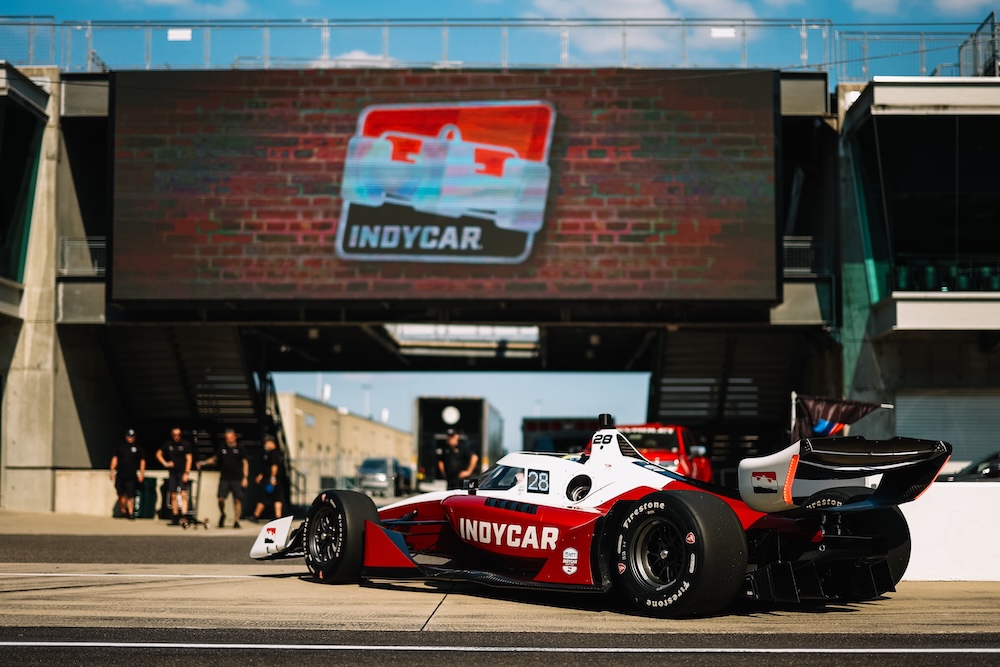
The IndyCar Series is more than a year away from going racing with its new Dallara IR-28 chassis powered by equally new hybrid engines from Chevrolet and Honda, but behind the scenes, the process of getting to 2028 is starting to accelerate.
Following multiple outings with the first IR-28 prototype from August through October, Dallara and IndyCar signed off on the car’s validation track tests, which triggered the start of widescale chassis manufacturing.
The next 12 months will be incredibly busy for the Italian racecar constructor and all of the vendors involved in making the IR-28. Mike O’Gara, IndyCar’s VP of Competition and Race Engineering, sat down with RACER to detail the major calendar moments that are in place.
MANUFACTURER CARS
Having moved into November, the next phase is about to start moving, as Chevrolet and Honda were due to receive their first IR-28s before Thanksgiving.
“That’s absolutely correct,” O’Gara said. “There are still some things that will lag behind like hybrid stuff and things like that, but as far as stuff coming from Dallara, they'll get everything that Dallara is supplying for the car. They will be complete cars in crates with hopefully little or zero missing from their bill of materials.”
HYBRIDS
All of the track testing done to date with the IR-28 has been without the new energy recovery system (ERS). A changeover in vendors to Helix for the motor generator unit (MGU) and BOLD Technology for the battery-based energy storage system (ESS) has come with a longer lead time to devise and test the brand-new ERS.
“It'll be just after the first of the year where they'll get raceable pieces,” O’Gara said of the initial deliveries to Chevy and Honda that will head into dyno testing. “I'm sure they'll want to start with dyno stuff, and there it's basically free reign to do that.”
MANUFACTURER TESTING
Validation testing with the IR-28 took place with ballast installed in the bellhousing where the ERS will eventually be located. The test mule also used a 2022-spec 2.4-liter twin-turbo V6 motor supplied by Ilmor Engineering, which meant test drivers Alex Palou and Alexander Rossi did not have the new 2.4L TTV6s with their added power and torque or the estimated 100hp of ERS boost to propel the IR-28.
The exact date for the first manufacturer test isn’t written in stone, but something in the second quarter of 2027 is most likely for the truest version of the 2028-spec IR-28 to turn laps with the respective Chevy and Honda test teams and the full hybrid powertrains. April is the expectation.
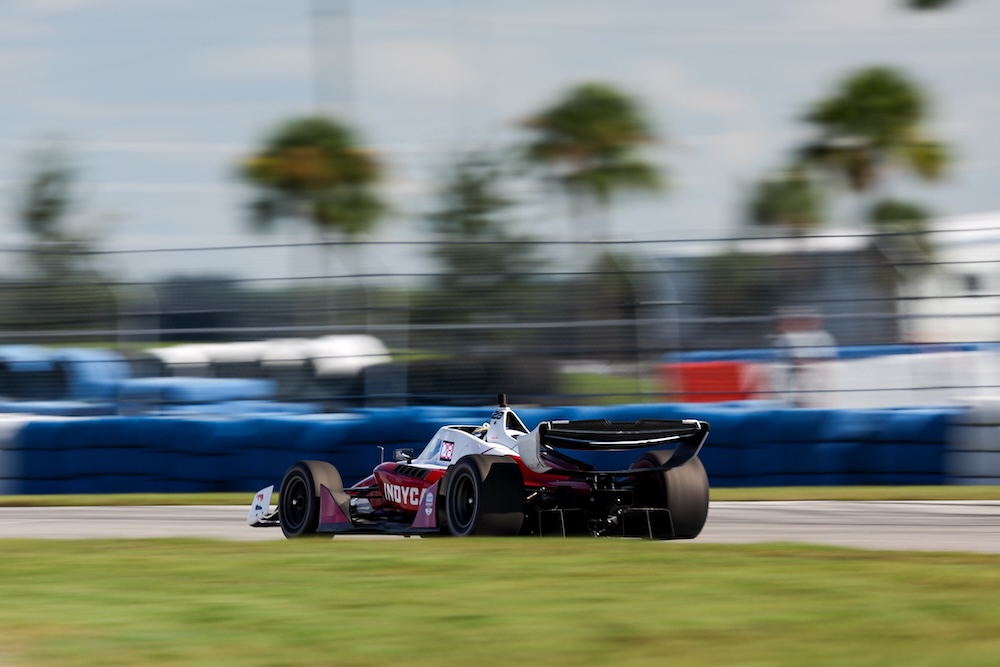
Honda and Chevrolet are scheduled to track-test their new engines for the first time next spring. Chris Owens/Penske Entertainment
“They won't hit the track until next spring,” O’Gara said. “Once they get to a point where they're comfortable enough on the dyno with them to take them to a track, then we will regulate that testing, and mainly that's because of support, being able being able to provide support to them. We don't want one car going off to Laguna and the other one going to Milwaukee, and us trying to figure out how we support it with Helix and Dallara.
"So there'll be coordinated tests. When and where, that's going to be determined by when they have engines ready, and when they have the hybrid ready. So I think early quarter two of 2027, you'll see both cars on track at the same time.”
TEAM CARS
“Late June, early July,” O’Gara says for IndyCar’s 11 full-time teams to start receiving their first IR-28s.
The distribution plan will be controlled by the series, where all teams will be scheduled to pick up the first cars they’ve purchased on the same day. It’s the same process that was used in 2011 when the new-for-2012 Dallara DW12s were readied for retrieval at the end of the year in Indianapolis.
With the IR-28s, IndyCar teams will have a rare in-season delivery schedule as the 2027 championship moves into its final summer months.
“So the plan would be to have a batch built so all teams get a chassis that they can start crawling around and building and asking questions on what they can change and modify and rub on and all that stuff,” O’Gara said. “So all teams will have a car, June, July timing, with scheduled other rounds of additional cars coming after that in the months following.
“Some teams will order far more cars than they're going to use at the track. Just planning ahead. Unfortunately, these initial cars are going to have to be multi-purpose cars. They’ll be test cars. There are going to be multiple drivers from each team driving them. They could be seven-post test cars. They could be wind tunnel cars. Where with the DW12, teams have so many of them, you can have a dedicated wind tunnel car, and a dedicated seven-post car, and eventually we'll get there. But to start, they're going to be true test mule cars that get run through the ringer, not just on rigs, but on at the racetrack, too.”
IN-SEASON TESTING
O’Gara does not envision in-season testing for IndyCar teams in 2027.
“We want teams to be able to focus on the 2027 championship,” he said. “So I don't think we're going to go down that road. Teams will be able to have cars that they can start rubbing on, but as far as testing goes, I anticipate it being after the end of the '27 season. Then, then we start hitting it.”
But Chevy and Honda might be welcome to make use of some race weekends to stay over and run their IR-28s immediately following select events.
“For the manufacturer cars, something like that could be a possibility,” he added. “Logistics of running the Monday after a race event are pretty nice. You just stay an extra couple of days. Everyone's there. All your suppliers are there. So for the their cars, I could see something like that happening at a few venues just because it'll be convenient and makes financial sense.”
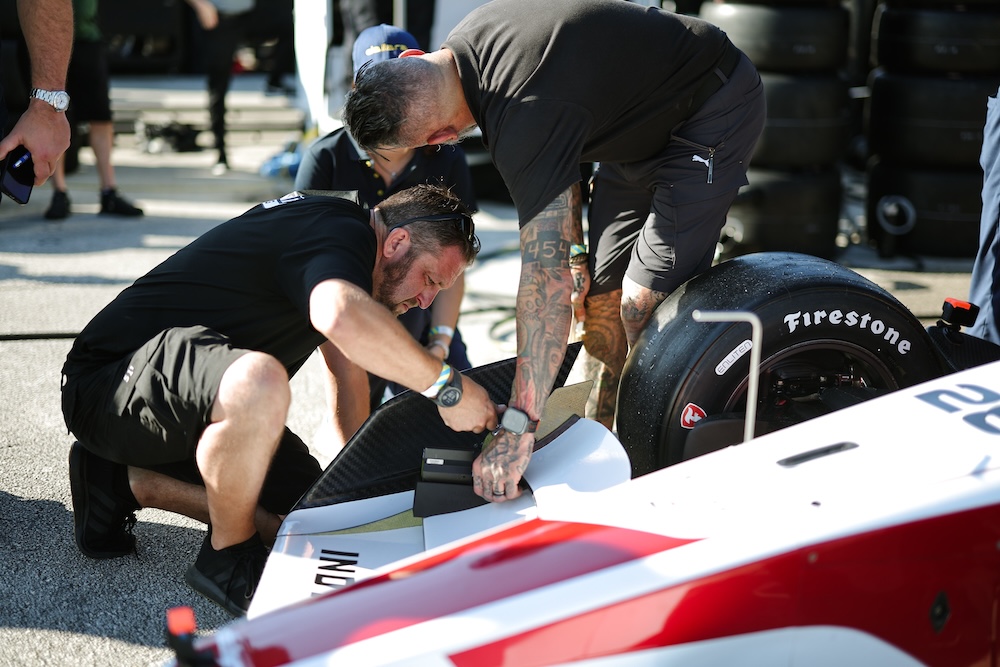
In-season testing probably won't be a thing for the teams in 2027, but the manufacturers might opt to bolt test days onto the end of race weekends. Chris Owens/Penske Entertainment
DEMO RUNS
Although he isn’t in charge of the promotions involving the IR-28, O’Gara does like the idea of letting IndyCar fans see the 2028 car on display or even in motion next year at the races.
“To some demo laps, I think it would be cool,” he said. “And this is just my thinking; no talks have gone on yet with any of this stuff, but I think it'd be cool to have it pace the field somewhere. I think [IndyCar president] Doug Boles is up for creative stuff like that. So at the minimum, I think it'd be great to have it on display.
“One thing that I would love to have is some coordinated tests leading up to St. Pete 2028, the first race, but before we get to St. Pete, and I've been pitching this to Doug, we need a big blowout Spring Training media extravaganza. Teams roll out their cars with their new liveries. It'd be a big deal, like we used to do at Homestead in the Champ Car days. FOX could help with stuff like this too, right? Hyping it up at the Super Bowl and wherever else they're present. Do something big and awesome.”
TEAM TESTING
The last significant planning for the IR-28’s preparations to race is where the most work is left to be done by O’Gara and the series’ competition department.
After years of paring down and heavily restricting the number of test days with the outgoing DW12 chassis, how many test days will teams be given to get to know the IR-28s during the next offseason? Which tracks will be made available for use? Will IndyCar coordinate those tests as group outings, or will teams be left to run on their own?
At the moment, there’s more questions than answers to offer, but O’Gara has a solid view of where he wants to take the process.
“It's going to depend a lot on the engine manufacturers,” he said. “Do they build a small batch of engines just to prove out some stuff, and then go into larger production, or will they have a lot of engines ready to go testing? It's going to be on the engine manufacturers as to how many miles they can put on them, so I'd like to see some coordinated testing, several open tests, because that's going to be the best way to support it.
“If all 11 teams want to go to 11 different places on the same day, we can't support that. The best way to accelerate the development cycle and create more the durability with the car is to have everyone at the same place at the same time, running in the same conditions. I think for the overall budget, it's going to be cheaper if all the teams are splitting the cost of a track rental compared to one team bearing the cost of the rental of the track. It's massive swing.
“So, I think I'm a big fan of coordinated testing from the support aspect, but I don't want teams to feel like they’re locked down and can't go do anything on their own. But I think the more coordinated we are, the more chance of this being successful. And we know the testing rules are going to have to change a bit when you get a brand new car.
“What do we have now? Teams have three days of (private) testing. We're going to have to revisit some of that. Doing more open tests will help that. and we're gonna have to have a lot of those because teams are gonna want to turn a lot of miles on their new cars.”
Presented by:
Marshall Pruett
The 2026 season marks Marshall Pruett's 40th year working in the sport. In his role today for RACER, Pruett covers open-wheel and sports car racing as a writer, reporter, photographer, and filmmaker. In his previous career, he served as a mechanic, engineer, and team manager in a variety of series, including IndyCar, IMSA, and World Challenge.
Read Marshall Pruett's articles
Latest News
Comments
Comments are disabled until you accept Social Networking Cookies. Update cookie preferences
If the dialog doesn't appear, ad-blockers are often the cause; try disabling yours or see our Social Features Support.