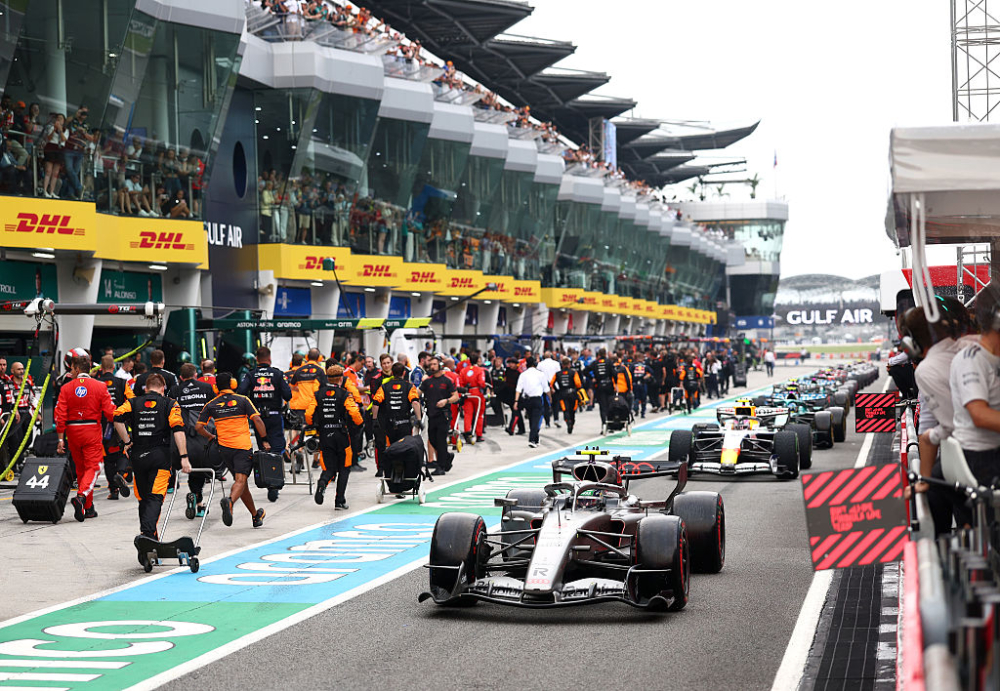
Andy Hone/Getty Images
F1’s got a bug in its system
An enormous pre-race crack of thunder in Sepang was ominous.
Just before the national anthem was played ahead of the Bahrain Grand Prix in Malaysia, it was the “in Malaysia” part that had been hammered home quite literally as the rain poured down on the grid and a thunderstorm delayed the start.
The thunder was matched with a lightning strike nearby, but the delay – which was due to the amount of standing water – actually drew little in the way of complaints from fans. The conditions were clearly not suitable for racing, but within 40 minutes there had been multiple track inspections and water clearing attempts to ensure a restart as soon as the visibility allowed.
Finally, finally, there looked like being a wet race in 2026.
And then came some of the most farcical scenes that have been seen in some time, in a sport that does have a bit of a history of shooting itself in the foot.
First, Max Verstappen slowed behind the safety car, on the opening formation lap of what was due to be two before a standing start. Then Lewis Hamilton behind him suffered the same fate, and soon, cars were everywhere.
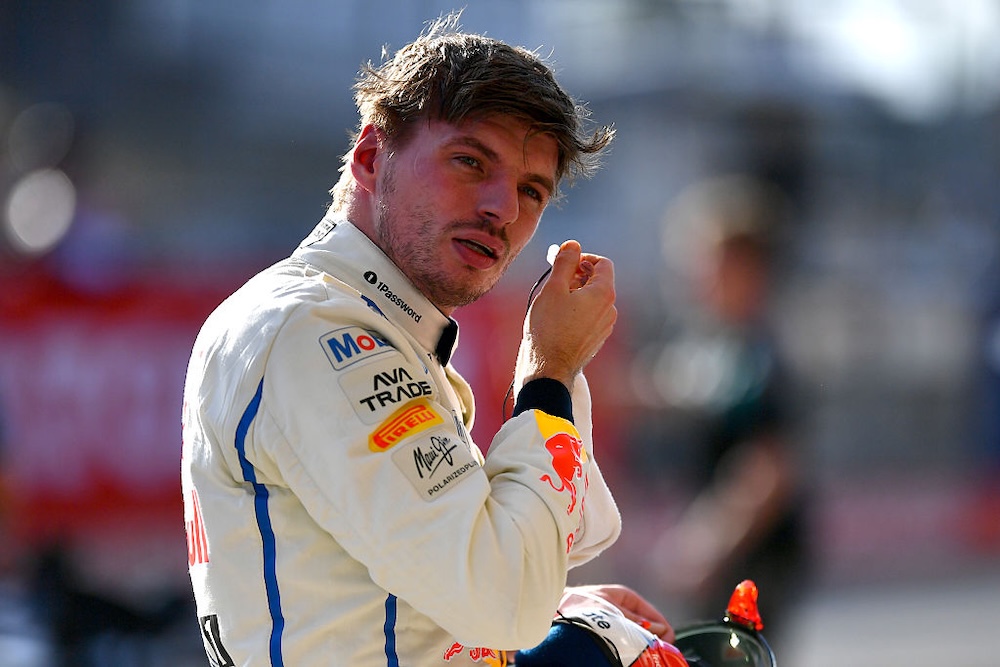
“That’s the problem that we have, these engines are so complicated and a lot of software is implemented,” Verstappen said. “When there is some kind of error or glitch, or whatever you want to call it, that’s the problem. I triggered it first, then I look in my mirror, and I just see everyone… I was like wait, are they waiting for me or…?”
Hamilton: “It was like the Lego race!”
MV: “Yeah, we had the same speed.”
LH: “Same speed!”
Kimi Antonelli: “It was insane. Like at some point we were five-wide in the straight, because we couldn’t understand what was going on.”
MV: “Then we do a lap and I see eight other cars crawling still, and I saw you [Hamilton] by yourself crawling.”
LH: “I had to stop on-track, stop the car, the engine, and restart it. I’ve never done that before.”
MV: “Yeah, what can you say? It’s not what you want, right, for the sport. I hope there is a lesson learned.”
It led to a suspension of 48 minutes, that at first appeared to be to get the cars off the track and back in order. But it turned out something more problematic than car positioning needed addressing.
“There’s some special software settings for the cars to ensure that in wet conditions the cars can run safely,” FIA single seater director Nikolas Tombazis said.
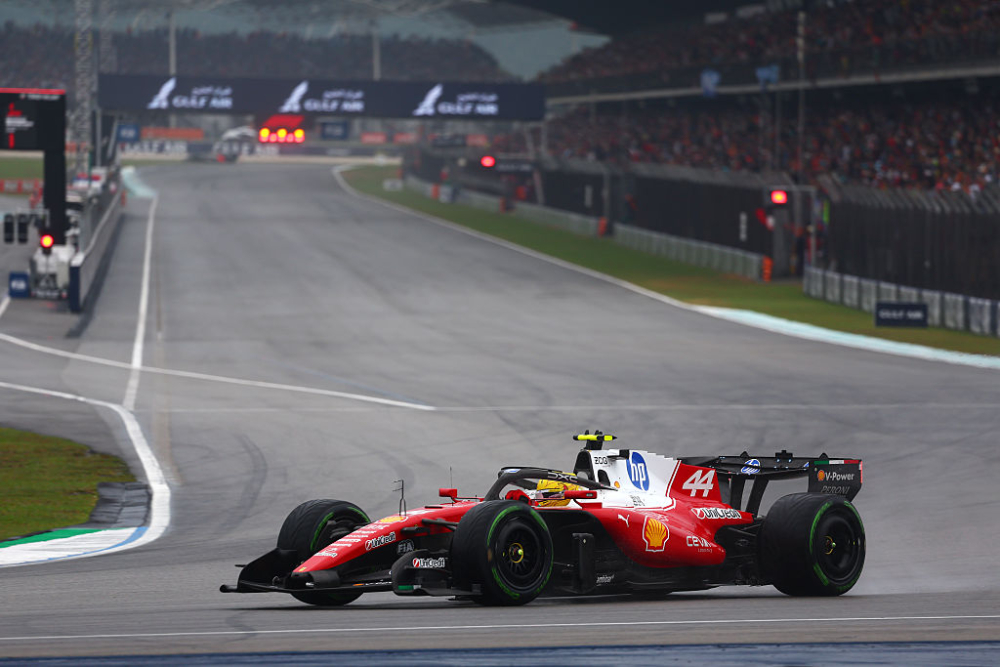
Hamilton was notably struggling during the formation laps, but he wasn't the only one. Joe Portlock/Getty Images
“This year, we've had very, very little running in the wet so far, and while we have tested the software – and the software is developed by the FIA in collaboration with the teams and the PU manufacturers, and with the supplier of the standard ECU, so a lot of people have put their eyes on it – it didn't contemplate a particular combination of events which also related to the fact that some cars in the formation lap went incredibly slowly.
“The leader slowed down, and then there was a bit of a concertina effect, and some cars almost came to a standstill. There was a bug in the software that triggered those cars that slowed very much to not be able to accelerate again.”
It must be said, the FIA response was rapid. Within 25 minutes the issue had been diagnosed, analyzed, and a fix implemented – all while discussing with the teams and answering their questions – before it was then distributed and installed. When you properly think about it, it’s a hugely impressive reaction.
But it’s a response that shouldn’t have been needed, because the immense complexity of this year’s power units continues to threaten to trip the sport up. There were changes made after three races at the start of the season, and further more significant adaptations to the balance of power are due over the next two years. They’re a set of regulations that have constantly needed addressing for problems they have created, and on this occasion it stopped a race from starting for the best part of an hour.
“The whole day felt like a bit of a faff,” George Russell said. “With the delay and then the red flag and endless laps under the safety car and then suddenly doing extra laps to allow Checo [Perez] to overtake – it didn’t feel very F1 today. I’d have a been a bit disappointed if I was in the stands watching that unfold, so that wasn’t good.
“It’s all just so complicated. The power units are exceptionally complicated, the more complicated you make things, the more there is to go wrong. So that is something we need to bear in mind for the future.”
Russell retired with a power unit issue late in the race, in a display of what is a far more acceptable reliability challenge as teams push performance. But for the cars slowing on the opening lap due to software glitches that had gone unidentified previously, stronger words were used.
“It felt like you were in the rental karting and you ran out of time, that’s basically how it felt,” Sergio Perez said. “It’s obviously not great what happened today. I’m sure we will learn from it as a sport, but what happened today is totally unacceptable.”
Charles Leclerc did not appear to suffer the same fate as his teammate, but had a similar sentiment to Perez after all the drivers were left kicking their tires when they should have been out on track racing.
“I don't want to be so extreme with my words, but surely it’s not good enough,” Leclerc said. “We’ve been raising those issues, and I hope that we fix them. But unfortunately I don’t think there's any short-term solutions to these problems. These problems are unfortunately the result of decisions made quite a long time ago, and now to revert or to change that is going to take time.”
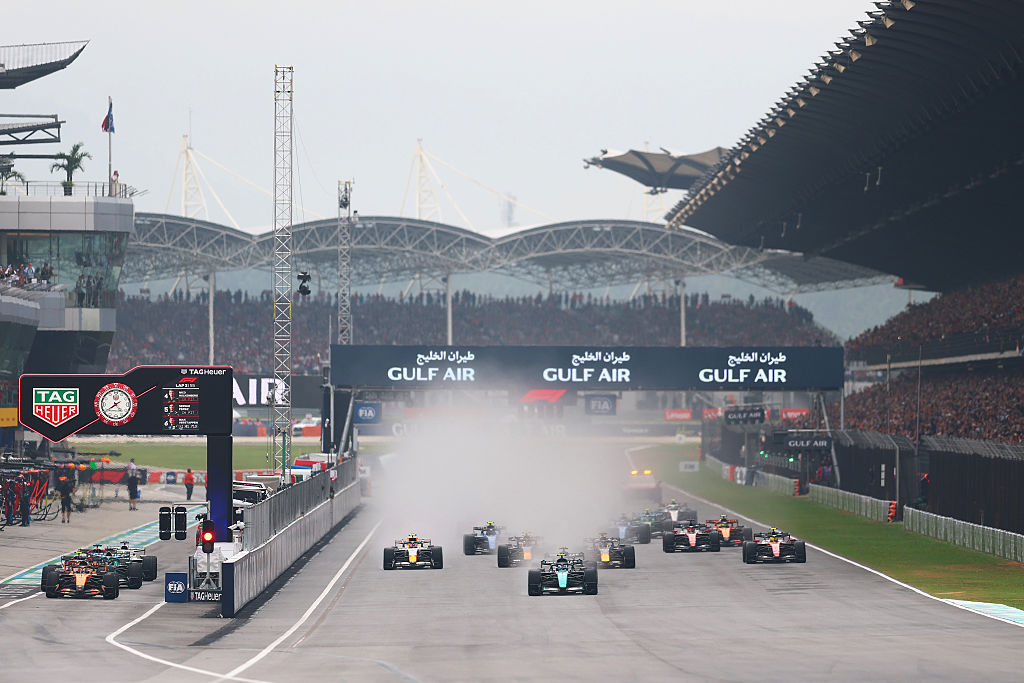
Odd elements added some excitement, but familiar issues still cropped up. Bryn Lennon/Formula 1 via Getty Images
The FIA committed to “a full review of the issue” but it’s not just the issue in isolation that upset so many fans, despite the excitement that followed when proper racing finally broke out. It’s the fact that this ruleset has caused so many problems that require concessions to be made, with the dilution of Sepang’s middle sector – the latest set of high-speed corners where cars are far from the limits of grip while harvesting energy – another example.
Verstappen won for the first time this season but was in no mood to let that temper his previously stated opinion on the power units, being quoted as telling Viaplay: “With a V8 you don’t have these problems.”
The remarkable scenes of having to update the software of an entire F1 grid after it had failed to start a race might just well prove to be the straw that breaks the camel’s back when it comes to these regulations. Some of the manufacturers that pushed so hard for them will surely be learning that there is a serious risk the value of having the technology they want gets outweighed by the negativity that comes with it.
It’s as a collective that F1 as a sport ended up with these regulations, and it’s as a collective that they have been trying to harness the positive aspects while improving on the weaknesses. That is something the sport often does well, and perhaps the improvements can come quickly enough to further enhance the driving challenge and avoid similar embarrassing delays in front of tens of millions of fans in future.
If that strength of F1 does not shine through, however, then the ongoing talks about the next ruleset might well take on increased urgency.
Presented by:

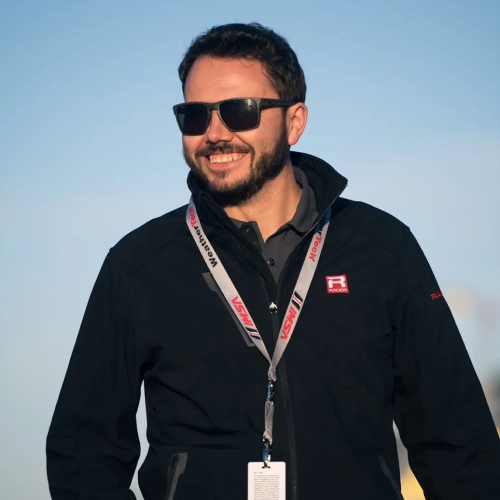
Chris Medland
While studying Sports Journalism at the University of Central Lancashire, Chris managed to talk his way into working at the British Grand Prix in 2008 and was retained for three years before joining ESPN F1 as Assistant Editor. After three further years at ESPN, a spell as F1 Editor at Crash Media Group was followed by the major task of launching F1i.com’s English-language website and running it as Editor. Present at every race since the start of 2014, he has continued building his freelance portfolio, working with international titles. As well as writing for RACER, his broadcast work includes television appearances on F1 TV and as a presenter and reporter on North America's live radio coverage on SiriusXM.
Read Chris Medland's articles
Latest News
Comments
Comments are disabled until you accept Social Networking Cookies. Update cookie preferences
If the dialog doesn't appear, ad-blockers are often the cause; try disabling yours or see our Social Features Support.