Clive Rose/Getty Images
Lewis Hamilton’s barn find feels pulled from a fairy tale
Lewis Hamilton has driven some of the most extraordinary cars in existence. Such is the life of a legendary Formula 1 star. Despite his access to automotive creme, his latest Ferrari might be not only one of the most expensive, excluding his work car, of course, but it might be his most beloved.
The seven-time F1 world champion recently took delivery of a Ferrari F40, and while there is nothing particularly unusual about a F1 driver owning an F40, this one comes with a story. Hamilton had been searching for the right car for years. He didn't simply want a low-mileage example. He wanted one with a history, something that felt like a time capsule rather than another highly polished collector car from a garage with better lighting than a doctor’s office.
There are low-mileage collector cars, then there is this Ferrari F40 “barn-find.” The F40 had been driven just 69 kilometers from Maranello to its owner's home before being parked and apparently never started again. For decades, it sat untouched, building a protective layer of dust and dirt. According to Hamilton, the passenger door had never even been opened. It’s hard to believe that a F40 could have sat this long so untouched, and I think we all can understand that Lewis Hamilton wasn’t searching back roads for old barns and garages to pick. No matter what the real story of this acquisition is and what team of auto archaeologists actually discovered the Ferrari, we are damn sure glad they did, and so is Hamilton.
Lewis Hamilton did what car lovers do
“I wanted to drive it,” Hamilton explained.
That decision turned a spectacular barn find from a priceless collectible (boring) into something considerably more entertaining, a real car. Rather than hide the car away in a collection, Hamilton brought it back to Maranello, where he knows a guy who works on Ferraris. The folks at Ferrari went through the car and made sure it was ready to return to the road. And that's where the story gets weird.
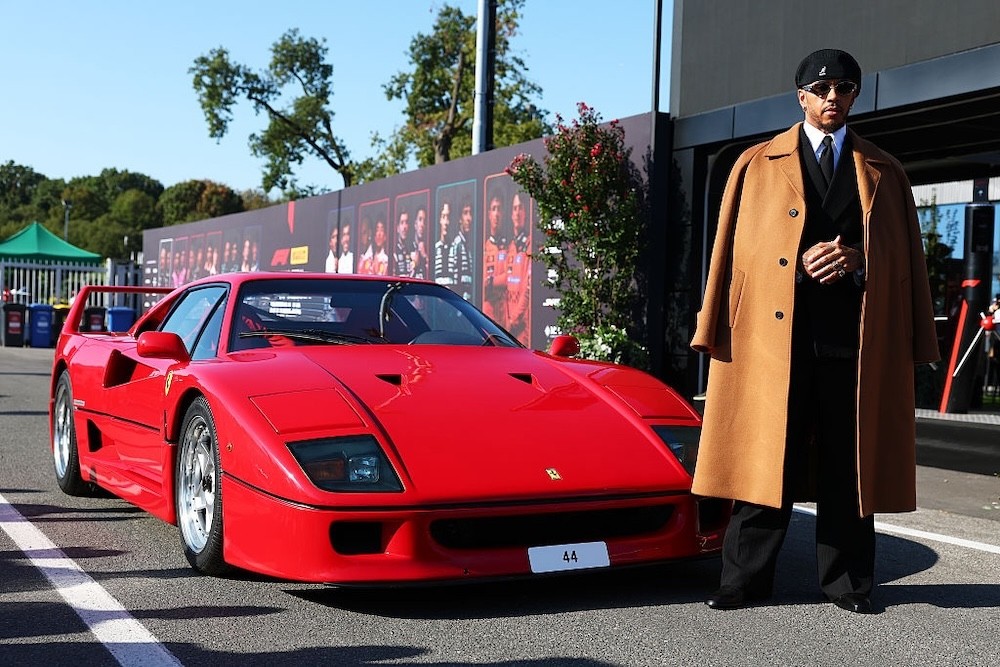
When Ferrari removed the F40's engine during its inspection, the technicians discovered that the engine was stamped with the number 44, which happens to be Lewis’ race number.
That number has been with him since his karting days. It came from the license plate of the Vauxhall Cavalier his father, Anthony, drove him to karting events in when he was a kid. Hamilton eventually adopted 44 as his permanent racing number in Formula 1. Now it was sitting etched on the engine of his dream Ferrari.
“I couldn't believe it,” Hamilton said. “I was like, ‘Did you know? You've got to be lying.’”
It's the sort of providence that would feel a little too cheesy if somebody wrote it into a movie. Hamilton had spent years looking for an F40 with the right story, found one that had barely been driven since leaving Maranello, and then discovered that its engine carried the number that has followed him throughout his career.
Hamilton clearly isn't treating it as merely a nice coincidence, either. His arrival at Monza with the F40 was carefully conceived as a celebration of Ferrari itself.
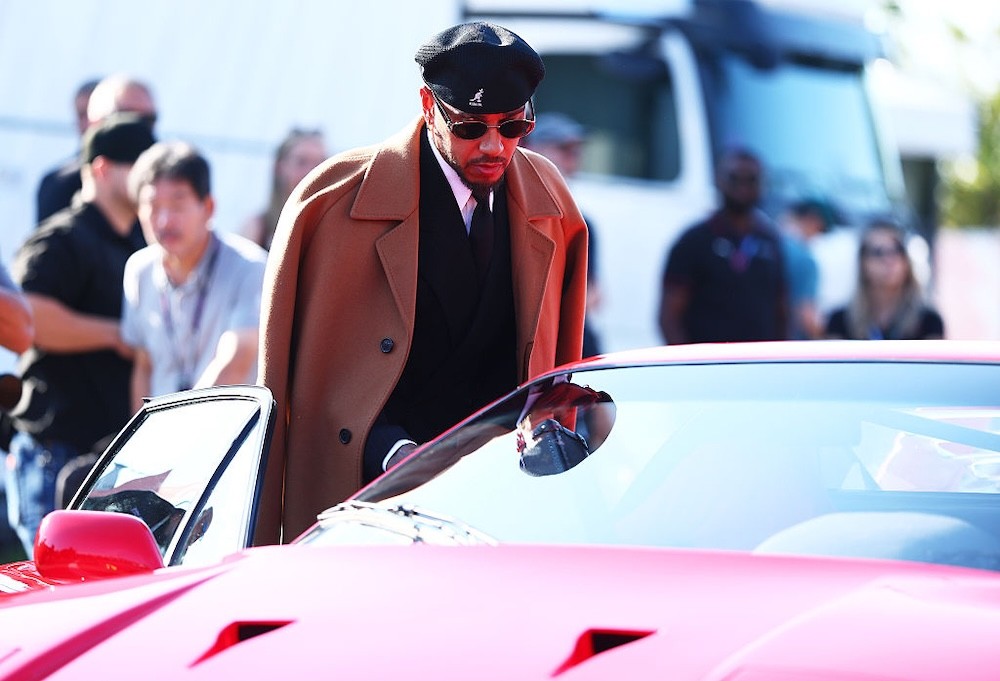
Last Thursday, Hamilton drove the refreshed car to the Italian Grand Prix, then posed with it behind the Ferrari paddock wearing a sharp suit, tie, hat and coat. It was perhaps a bit of an audacious and extravagant entrance, but how else should a Ferrari driver show up to a home game at Monza, the Temple of Speed? Hamilton said he wanted to highlight Ferrari's history in its home country and create a moment that could never be repeated.
There's also something wonderfully fitting about Hamilton being the person to finally wake this particular F40 up from its dusty slumber.
Why the F40 is so special
The F40 has always occupied a strange place in Ferrari history. It was the last road car developed under Enzo Ferrari's watch and became one of the defining supercars of not only the 1980s but maybe of the genre itself. For a kid growing up obsessed with cars, it was an almost impossibly exotic, over-the-top, and opulent thing on four wheels. Hamilton, like many of us, remembers having model cars lined up as a child, with the red F40 standing out from the rest.
“I just remember as a kid I had all these cars lined up and the red car, the F40, was the one,” he said.
Now he owns one.
Clive Rose/Getty Images
More importantly, Hamilton seems to understand that owning a Ferrari as a Ferrari Formula 1 driver carries a little more weight than it would for most people. He's increasingly embracing the brand's history and lore, both on and off the track. The Monza appearance wasn't just a trip to the circuit in an old Ferrari. It was a carefully constructed meeting between one of the world's most famous drivers, Ferrari's most famous road cars, and the company's most important race weekend. It was Ferrari all the way down.
Modern cars can’t do what the F40 did
Hamilton has said that arriving at races in red is one thing, but that there is another world of Ferrari history, fashion and culture outside the sport. The F40 fits perfectly into that world. Its shape, its reputation and its connection to Ferrari's past are almost impossible to replicate with a modern supercar. And perhaps that's why Hamilton wanted this particular car so badly. It’s why we all do.
He could have bought practically any Ferrari. Instead, he found one that had spent three decades waiting. It was essentially unused and nearly perfectly preserved. Then Ferrari took it apart, found the number 44 stamped into its heart, put it back together, and sent it out into the world again to be debuted at Monza. Hamilton may call that fate, and if we can put our skepticism aside for a moment, for once, it's hard to argue with him.

Peter Corn
Peter Corn is an automotive writer and storyteller. Peter has spent nearly a decade writing about cars, trucks, and motorcycles for some of the best publications in the business. He believes the best automotive stories aren't really about the machines at all, but instead, the people who love them.
Read Peter Corn's articles
Latest News
Comments
Comments are disabled until you accept Social Networking Cookies. Update cookie preferences
If the dialog doesn't appear, ad-blockers are often the cause; try disabling yours or see our Social Features Support.