Jakob Ebrey/Getty Images
Will this be the year that Toyota rediscovers its Le Mans mojo?
Earlier this week, RACER.com’s Stephen Kilbey and Kazuki Nakajima took time to reflect on the 10-year anniversary of Toyota’s greatest defeat at Le Mans.
In the decade since, Toyota Racing eventually broke its multi-generational Le Mans curse with its first overall win in 2018. As it turned out, the first of five consecutive wins, a streak that broke through the end of the LMP1 era into the inauguration of the new Hypercar regulations.
But since its last win in 2022 the Japanese factory squad has become uncomfortably well-acquainted with a different brand of disappointment in the last three years: Where no matter how good or how poorly they’ve executed their race, it’s just never been enough to win the biggest race of the year.
This year, Toyota Racing feels rejuvenated after the most frustrating WEC season it languished through in over a decade. Instead of the anxiety and pessimism which seemed to linger over the Toyota camp at Le Mans last year, the feeling from drivers like four-time Le Mans winner Sébastien Buemi is significantly more optimistic. And in the case of Buemi, he’s excited for the race to come.
“I mean, to some extent, a little more excited than last year,” Buemi said to RACER before the start of the race week. “We have this new aero package, we won Imola, made a big mistake on strategy in Spa, otherwise, another P2 would have been possible.
“So coming back on a couple of strong races, and (we’re) hopefully going to have a good shot at fighting for the win.”
Buemi is one of five drivers who’ve won Le Mans in the past for Toyota. The lone exception is Nyck de Vries, who was a bit more reserved in his assessment of where the team stood before a wheel was turned in Test Day.
“We feel like we’re heading in well-prepared. And we will do the best we can to build our week and to execute a good race,” said the Dutchman. “And then it’s up to Le Mans to decide who gets to win it.”
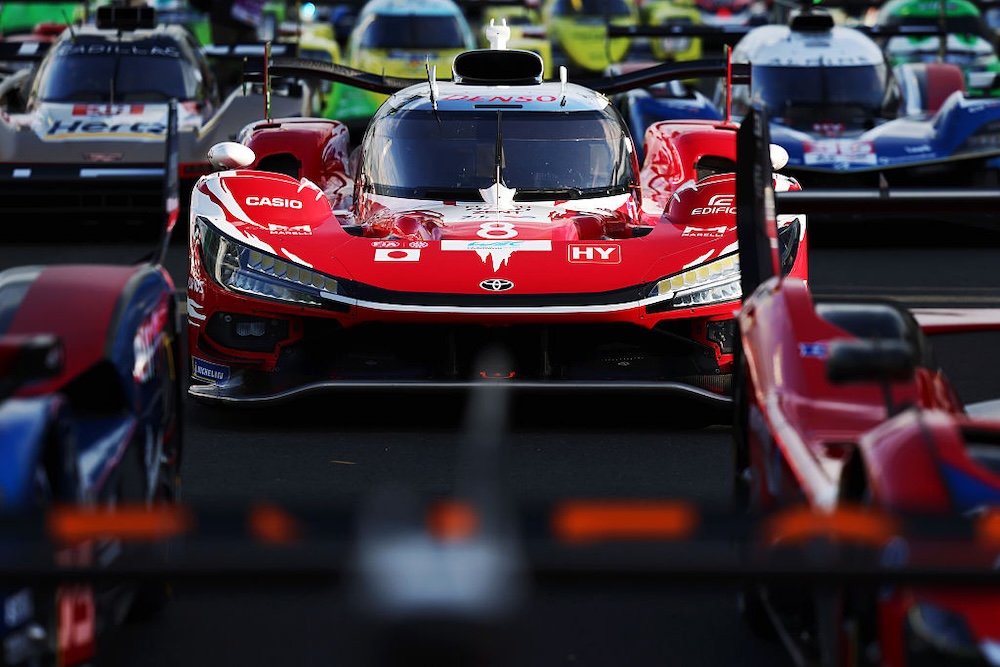
Toyota’s wholesale updates to its LMH prototype, now known as the TR010 Hybrid, have solved critical pain points on the aging GR010 – with the added benefit of it being a more stylish design that doesn’t feel like a hold-over from the LMP1 days. This revamped car, complete with its Toyota GT-One inspired livery, won on debut at the 6 Hours of Imola in front of a partisan crowd of Ferrari supporters and staff.
“We’ve tried, obviously, to make it look like a road car on the front – which is also one of the main factors on why we changed it,” Buemi explained. “But we also tried to make it easier to drive and just better all-around, and it seems to be better.”
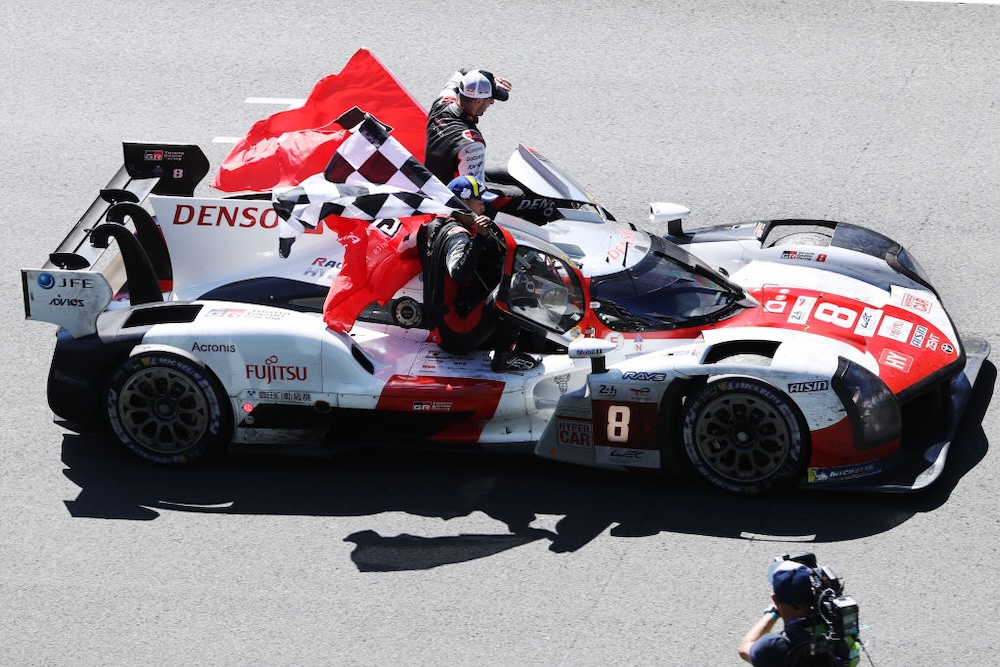
Toyota's last Le Mans win came in 2022. JEP/Getty Images
“Aesthetically, it’s different,” De Vries said. “It has addressed some of our areas we feel needed some improvement, but we’re yet to find out whether it really made all the difference (at Le Mans).”
The importance of that Imola win, in a narrative sense, can’t be understated, as Ferrari has become the new great rival for Toyota in this Hypercar era. It was in 2023 when the Ferrari 499P won Le Mans on its first attempt, while Toyota suffered a couple of unfortunate incidents during the race which felt reminiscent of the many fits of the old Toyota ‘curse’. When the season ended, Le Mans was the only blemish on what would have been a perfect season for Toyota.
In 2024 and 2025, the story was the same: Ferrari got the glory at Le Mans both times. But while Toyota finished a close second again in ’24, it fell further away in ’25, with its operational prowess waning, and yes, its Balance of Performance parameters may not have helped.
Critics began to repeatedly point out that Toyota hadn’t won Le Mans until after LMP1 rivals Audi and Porsche left, and haven’t won since the massive influx of new Hypercar manufacturers, including Ferrari, first turned up in 2023. This does, however, assume to some degree that the task of finishing the 24 Hours of Le Mans is easy; if it was, Toyota may never have had to wait 33 years to win Le Mans for the first time.
It’s not something that Toyota has completely ignored, for what it’s worth. Nakajima called 2023 a missed opportunity to bring closure to that day in 2016. Buemi was Nakajima’s co-driver in that fateful race, then for three of his four Le Mans wins, and then after Nakajima hung up the helmet, Buemi finished a painfully close second in ’23.
This year, Buemi could become only the sixth driver to win the 24 Hours of Le Mans outright for a fifth time. Yet, his motivation, as it is for everyone at Toyota Racing, is just to get back to the top step. “It would be amazing,” Buemi said about building his Le Mans legend. “But to be honest, the last time we won was a long time ago.
“At the end, I just want to win. Just to prove to everyone that we work hard and we have a good car, and we are capable of fighting at the front. Winning is just the consequence of the hard work. So we only thing about how we can be faster the whole week.”
The morale is up at Toyota Racing for the first time in a long time. The vibes are good again. The Japanese manufacturer has become a fashionable pre-race pick to win Le Mans for the first time since 2022.
It helped that driver/team principal Kamui Kobayashi set the fastest time aboard the No. 7 Toyota in Free Practice 2 on Wednesday night, after both team cars advanced to the Hyperpole phase of Qualifying. The No. 8 Toyota that Buemi drives seemingly carries no ill remnants of its Test Day accident either.
But for all of Buemi’s excitement, he is keen to remind anyone that nothing at Le Mans is guaranteed. “At the end of the day, we will see on Sunday night if it did work out,” he said.

RJ O’Connell
Read RJ O’Connell's articles
Latest News
Comments
Comments are disabled until you accept Social Networking Cookies. Update cookie preferences
If the dialog doesn't appear, ad-blockers are often the cause; try disabling yours or see our Social Features Support.