The RACER Mailbag, June 3
Q: In the last Mailbag, Marshall lamented top drivers not being able to truly show how good they are because the spec era compresses the differences between best and worst.
Isn't that the high-downforce/low-power nature of the spec chosen, rather than something that's inherent to spec racing?
I think of all the times that we wonder what certain drivers could've accomplished with decent machinery, or even now when we wonder how a talented driver like Rinus Veekay would fare at Ganassi or Penske. It doesn't make me want to return to an era of massive differences between cars, but instead makes me want to enhance the differences between the drivers by giving them a different spec car.
Start the 1994 Indy 500 with a field of 33 Beasts, and it doesn't become a race between just Emerson and Little Al. Which of the great drivers in that era could've been competitive in that car?
I thought this was the most appealing part of JR Hildebrand's Blackbird 66 concept. With a field of identical Blackbirds, we find out who's the bravest and most skilled driver by the one who's brave enough and skilled enough to get on the throttle earlier, as opposed to our current field where nearly the whole field stays flat through the corners.
Mike, California
MP: No, it’s inherent to spec racing. CART cars had plenty of downforce and solid power in the early 1990s. The big power, plus differences in chassis and/or tire, or simply the ability for teams to modify the most popular chassis of that period, allowed virtuoso performances. Today’s car has set track records everywhere it has raced, except for the Indy 500 in qualifying, and it’s not too far off of Arie Luyendyk’s lap record. And the drivers who will never be remembered for having extreme talent are capable of lapping far too close to those who’ll be inducted into Halls of Fame. That’s unique to the spec era.
All of the mid-1990s greats would have been insane in the Penske PC23-Ilmor/Mercedes 500 car.
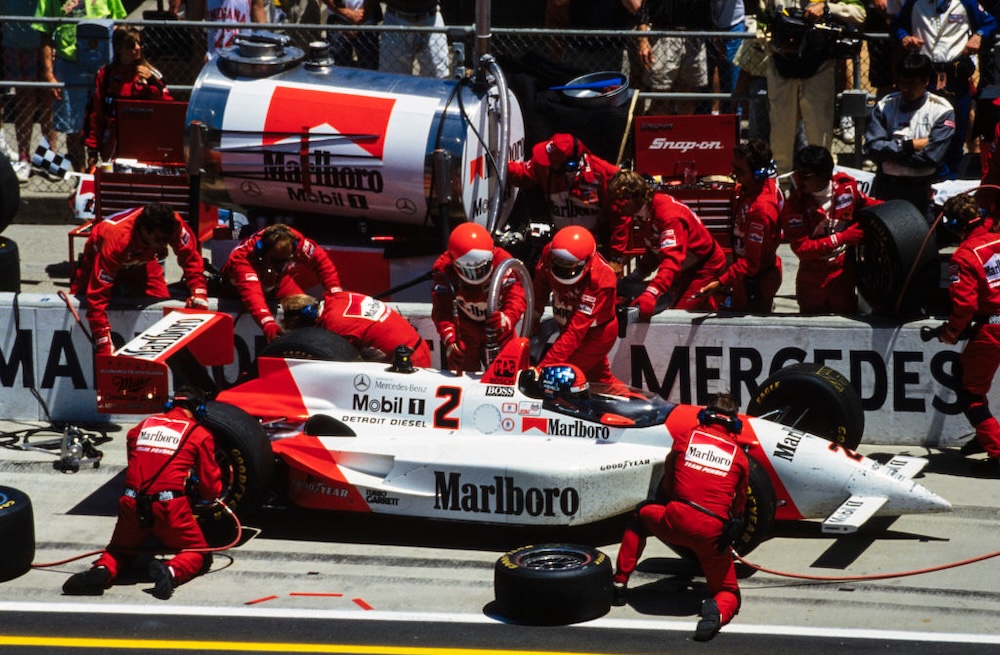
Imagine 33 of these things in one race. William Murenbeeld/Getty Images
Q: How do they pick the 16 entries for pit stop competition out of all the Indy 500 entries?
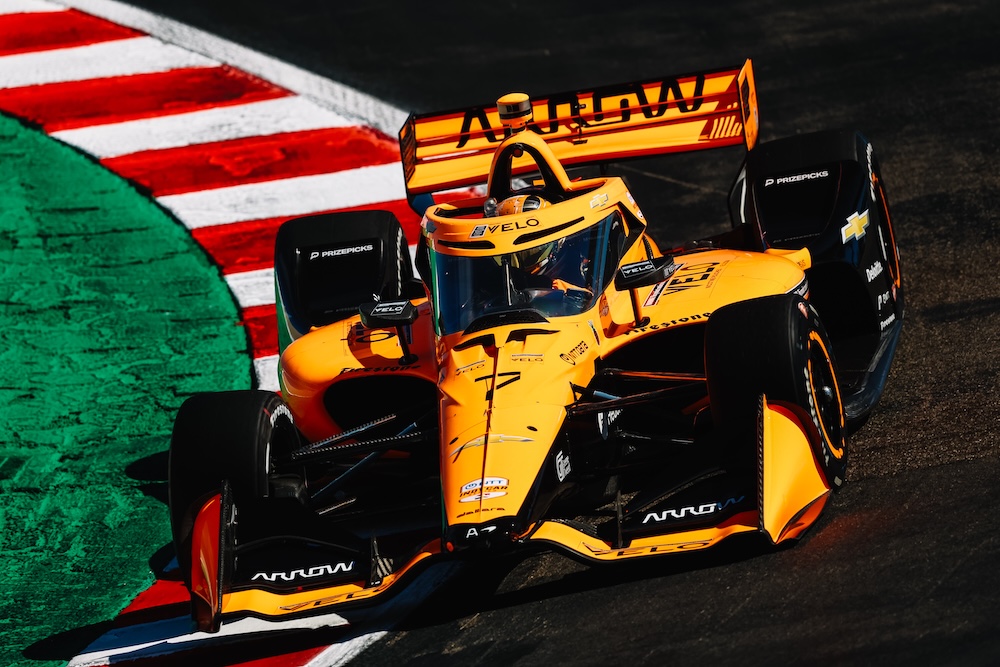
I noticed with the painted names and sponsors on the pit stalls at Indy, only one had an engine manufacturer: Pato O'Ward's box labeled as "Arrow McLaren Chevrolet." Is Arrow McLaren any more of a Chevy-sponsored team than the others?
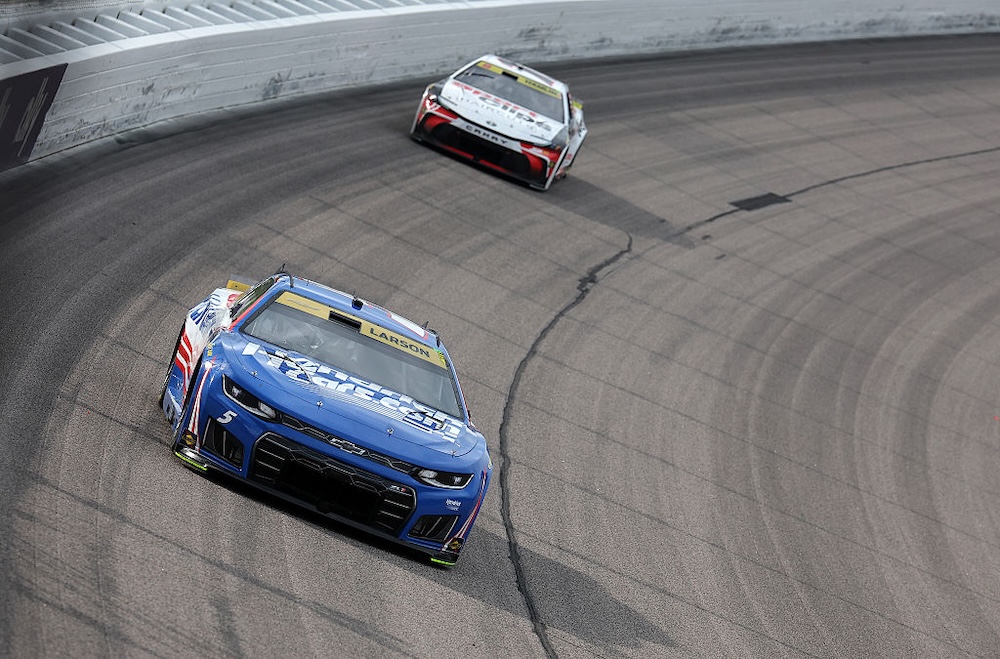
Hypothetically, if the winner of the Indy 500 was doing the NASCAR double, how would all the post-race media obligations be handled? I imagine this had to be seriously considered when Larson was running in ‘24 and ‘25.
Also, an article request: I think it would be really interesting to do an article, with pictures, showing what tech inspection at an IndyCar event looks like. How many parts do they check? How many are checked on every car vs random spot checks? How many employees do they have performing these checks, and how much time do they have to do their job? With that, how about getting an interview with Rocket [Kevin Blanch]? I feel like he has been thrown under the bus in several tech-related articles over the last few years, so I think it would be interesting to get his perspective on P2P-gate, attenuator-gate, the new IOB, etc.
David
MP: Rocket has the ability to speak whenever he wants to, be it through IndyCar’s communications team, or his own chosen methods via social media or self-publishing sites. He’s never lacking in opinions, but opts to keep them out of print. If that changes, everyone will know. He occasionally threatens to write an autobiography, which would be the first of its kind done in crayon…
A deep dive on tech would be interesting. I did a video with Rocket on some of the tools and methods used a few years back with the approval of former IndyCar President Jay Frye, and by the time I went to put it together, Jay had been fired, and then the May ordeal happened, and then the IOI/IOB/MDO happened. I’ll see if they’re game to do something new.
Since doing the double involves leaving immediately after the Indy 500 is over if the driver completes the race, the answer is fairly obvious, I’d think, since the driver is flying to Charlotte and taking fluids and whatever else to try and recover and prepare for more racing. Depending on how late the 500 runs, I’m guessing the victory lane ceremony and kissing the bricks and lapping the track while waving to fans would be cut short. Getting the driver back on Monday after the Charlotte 600 is the most realistic scenario.
Pato’s car was listed on the entry as Arrow McLaren, so I don’t know why the painter added Chevrolet. His teammates had VELO, Prize Picks, and NTT DATA listed on their entries, but Pato’s was simply the team name. Team Penske is considered to be the most Chevy team in the series.
Pit stop eligibility:
- Best average finish of the top five in each event’s Pit stop Challenge (previous year’s Indianapolis 500 through the event prior to the current Indianapolis 500).
- Each full-season team will be permitted to enter their highest-ranked entrant.
- Indianapolis 500-only teams.
- Teams may be invited to enter their next highest-ranked entrant, and such entrants will be ranked behind teams that have chosen to compete with their highest-ranked entrant.
Q: Watching Felix Rosenqvist’s onboard at Indy, you hear the spotter instructing “regen and deploy” right at the finish line. Curious to know if David Malukas fully used his hybrid availability to the line?
Also, thanks for your explanation of the Alex Palou post-race infraction. If this was a supplier default, why was there any penalty to Palou/Ganassi? Seems like the supplier should be fined, not the customer.
Matt, Niles, MI
MP: I’d need to ring David and ask, and he’s coming off of a bad weekend in Detroit so I’ll leave him alone. To state the obvious, if he had ERS power to deploy, I’m sure he would/did deploy. But the aero benefit Felix had was not going to be negated by hybrid boost from Davey’s car.
On the Palou front wing mounting issue, there was a disagreement as to the root cause. IndyCar Officiating felt it was an assembly error – likely the cause of a human doing something incorrectly. The Ganassi team felt it was a part failure. The one thing both agreed on was the tilting wing was not something positive that helped Palou, which is why the matter was treated in a relatively light manner by the referees.
Legal or illegal is black and white. The car was illegal. The illegal thing wasn’t a performance gain; if anything, it was hindering ever so slightly, which is where some shading was applied by the refs with the penalty.
Marshall Pruett
The 2026 season marks Marshall Pruett's 40th year working in the sport. In his role today for RACER, Pruett covers open-wheel and sports car racing as a writer, reporter, photographer, and filmmaker. In his previous career, he served as a mechanic, engineer, and team manager in a variety of series, including IndyCar, IMSA, and World Challenge.
Read Marshall Pruett's articles
Latest News
Comments
Comments are disabled until you accept Social Networking Cookies. Update cookie preferences
If the dialog doesn't appear, ad-blockers are often the cause; try disabling yours or see our Social Features Support.