James Gilbert/Getty Images
Understanding Palou’s Indy 500 wing penalty
Two cars, 12 months apart, ran afoul of the same the minimum height regulation during post-race technical inspection at the Indianapolis 500.
With confusion over what was found to be illegal on Alex Palou’s car and how its illegal state differed from the illegal state of PREMA Racing’s car that led to severe penalties for Callum Ilott and his team after the Indy 500 in 2025, it’s worth taking a look at both situations to understand what took place in each scenario.
2026 INDY 500
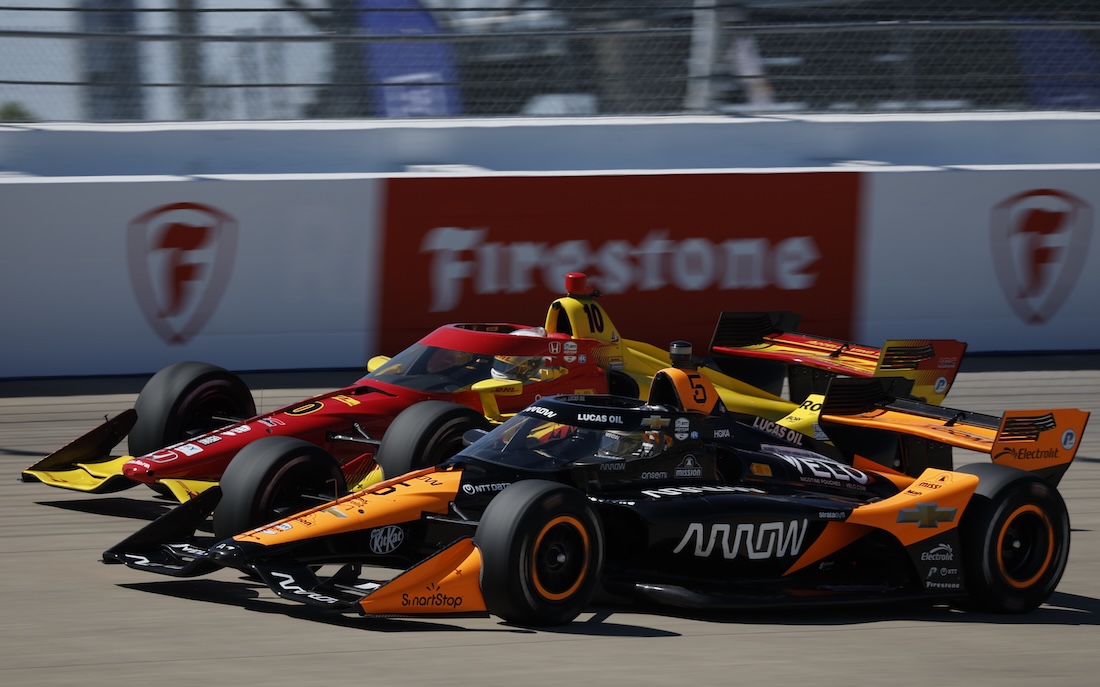
The IndyCar Series championship leader’s No. 10 Chip Ganassi Racing Honda failed post-race tech at Sunday’s Indianapolis 500 for a front-wing endplate height violation.
The right side of the wing element was measured and found by the IndyCar Officiating Incorporated technical inspection team to be below the minimum of 8.3 inches. In response, IndyCar Officiating issued a $10,000 fine to the Ganassi team and the loss of five drivers’ and five entrants’ championship points.
Palou’s lead was reduced from 47 points over Team Penske’s David Malukas to 42, and the same margin of 42 points now exists between Ganassi’s No. 10 and Penske’s No. 12 Chevrolet in the entrants’ standings.
Palou’s finishing position of seventh place was left intact by the governing body that includes IndyCar Officiating led by Scot Elkins, its new Managing Director of Officiating, and its three-person oversight panel at the Independent Officiating Board (IOB), which is led by chairman Raj Nair, Ray Evernham, and Ronan Morgan of the FIA.
In the penalty announcement, two technical rules were cited for the No. 10’s violation:
- Rule 14.7.6.8. Front wing must adhere to the following Technical Inspection dimensions
- Rule 14.7.6.7.1. For the purposes of technical inspection, the front wing must not measure less than 8.300 inches when set at any angle, while installed on the IndyCar technical inspection fixture.
The violation was limited to one of the three Ganassi entries; uniform illegality across the Nos. 8, 9 and 10 cars were not found. On race day, all three of Ganassi’s entries passed pre-race tech, and later in post-race tech, Kyffin Simpson’s No. 8 Honda and Scott Dixon’s No. 9 Honda passed while Palou’s No. 10 was judged to be illegal.
WHAT FAILED ON PALOU’S CAR?
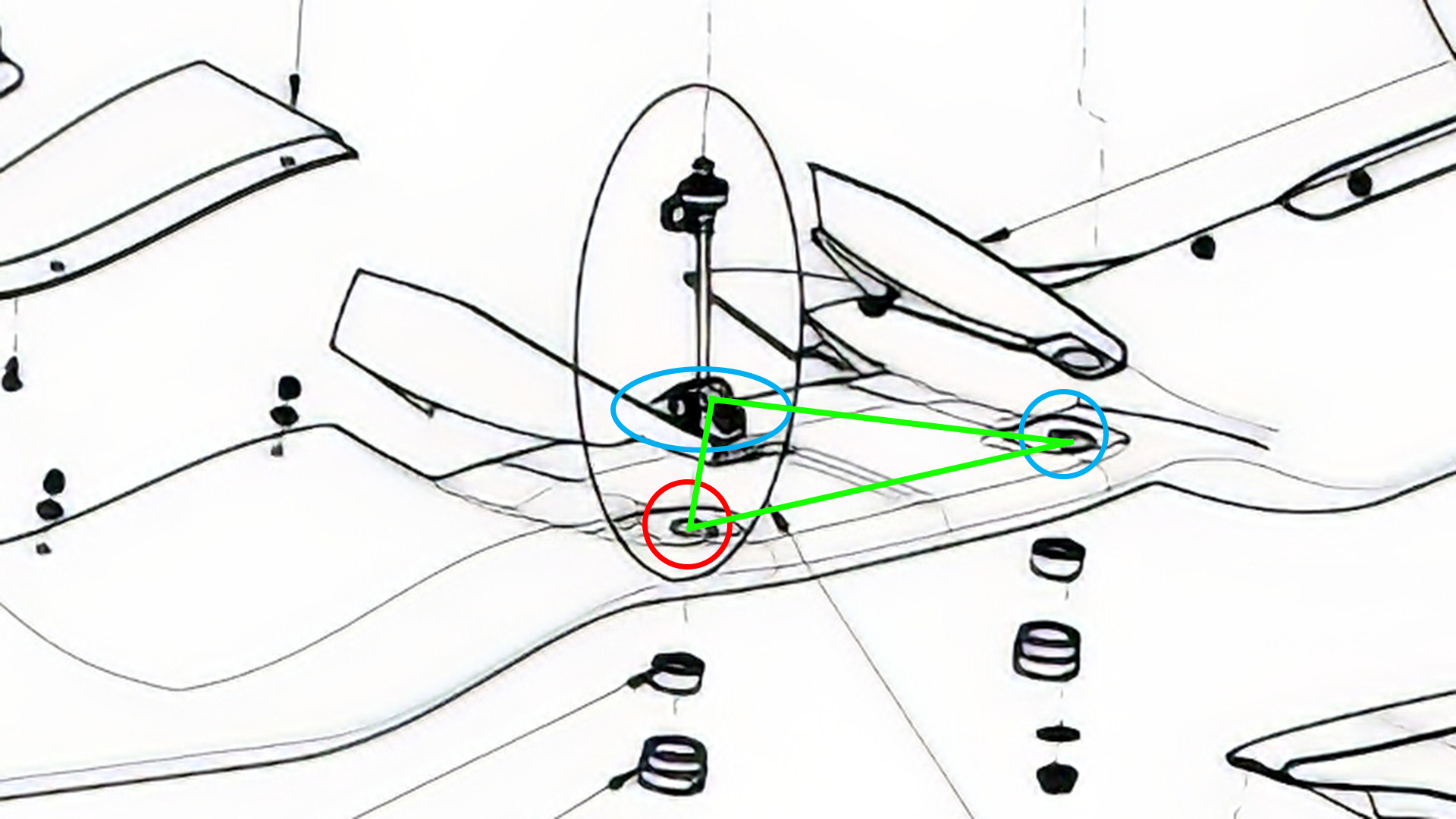
The speedway front wing used by all teams at the Indianapolis 500 is mounted beneath the nose using three points of connection. The positioning of those points forms a triangle with the two wide points toward the front of the wing element and the top of the triangle is found in the center towards the back.
At the front of the car toward the leading edge of the wing, there are two recessed holes on the underside where bolts are inserted upward and threaded into the bottom of the nose.
The third attachment point is on the topside rear of the wing where a clevis is bolted in place and connects to the threaded wing angle adjustment rod that protrudes from the nose. Mechanics twist the adjuster to increase or decrease the wing angle and add or remove downforce and drag.
The ability to make angle adjustments come from how the wing is bolted to the nose with the two front bolts.
Spherical bearings known as "monoballs" are used in the front wing assembly mountings in the same way they’re used in suspension A-arms; bolts run through a monoball inside a clevis attached to the chassis hold the suspension to the car while allowing the suspension to pivot up and down as the driver races around the track.
With the single speedway front wing main plane, the use of monoballs allow the front of the wing to be firmly bolted to the nose while allowing the angle adjuster at the rear to tilt the wing up or down to increase or decrease downforce.
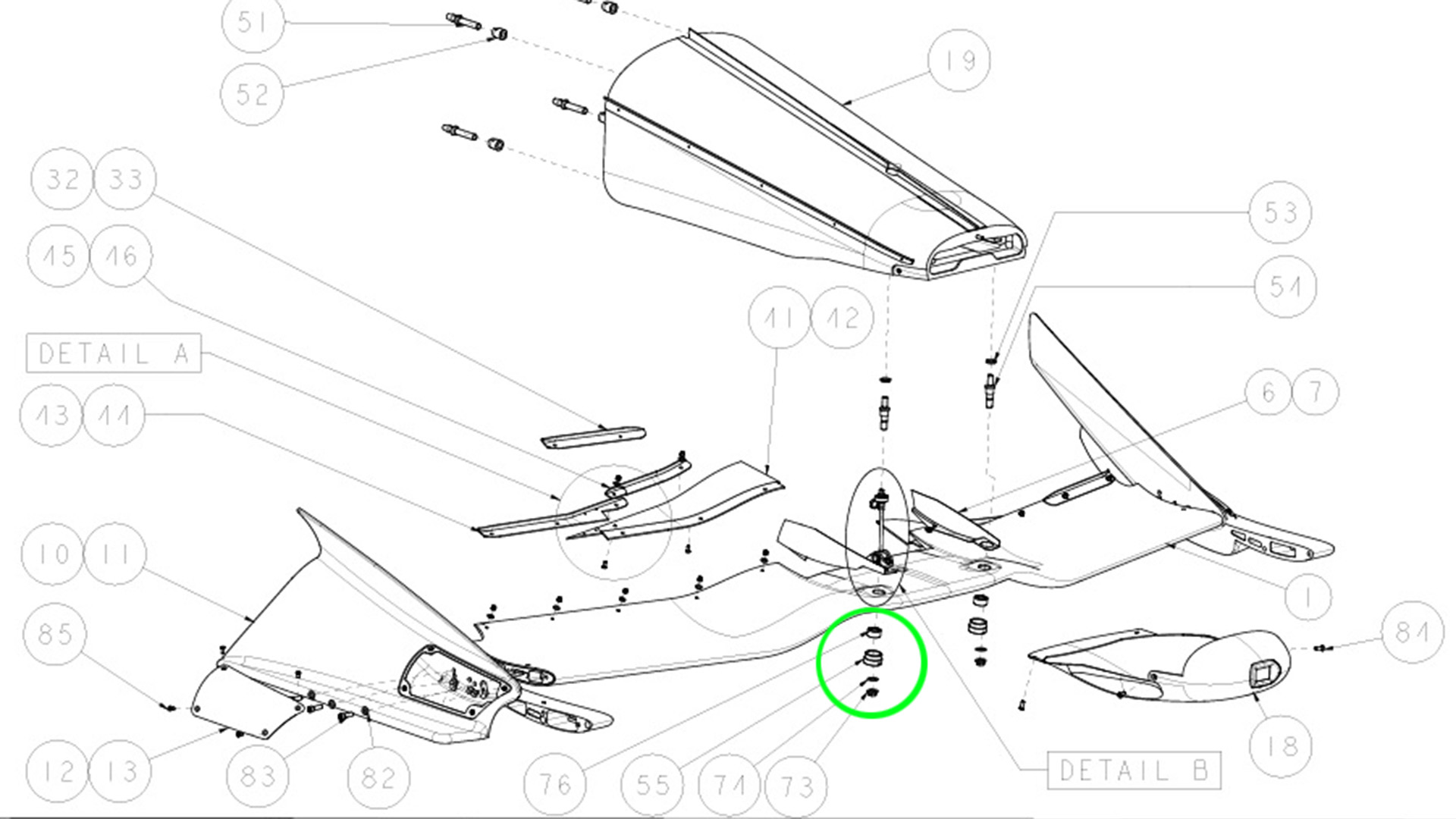
With the three mounting points known, something came loose within the right-front mounting assembly that includes the bolt, monoball and sleeve that threads into the wing that holds the monoball. RACER understands it was Part 55 (below, circled in green) which started to loosen at some point later in the race.
_copy.jpg)
As a result, the right-front leg of the mounting triangle (circled below in red) was compromised and the slack allowed the wing to tilt downward on the right by a slight amount. The left-side mounting at the front (circled in blue) and the rear mounting clevis for the angle adjuster (also in blue) were appropriately tight. In post-race tech, the right-side endplate was found to be below the 8.3-inch minimum and the left side was high by an unspecified amount.
With all three mounting points completely tight, the top center of the front wing sits flush against the bottom of the nose, which is the expectation within the rules. The front wing is meant to be flat and level at all times, and with the loosening right-front mounting assembly, the wing was no longer held rigid against the nose on the right side and was allowed to separate from the nose and dip down on the right while having the opposite effect on the left side of the wing, which was tilted upward by an unknown sum.
One person with knowledge of the situation believed the right-front mounting was at risk of coming completely undone and would have eventually started to drag on the ground if more laps at speed had been run.
The cause of the loosening is unknown. RACER has confirmed the Ganassi team does not use a thread-locking solution or silicone sealant while affixing the two front bolts or the threaded monoball assemblies depicted in the assembly drawing.
The fact that only one side on one of its cars loosened while the other side on the No. 10, and all bolts/assemblies on the Nos. 8 and 9 front wings were tight and compliant to the wing height rule, makes it hard to identify the root of the issue.
And if the right-front mounting was left loose from the outset, Palou’s race would have been hindered from the start with aerodynamic instability. His somewhat sudden and surprising inability to fight for the win in the closing stage of the race suggests the loosening either occurred suddenly in the latter stage of the race or progressively worsened and reached the point of being a competitive liability in the sprint to the checkered flag.

Marshall Pruett
The 2026 season marks Marshall Pruett's 40th year working in the sport. In his role today for RACER, Pruett covers open-wheel and sports car racing as a writer, reporter, photographer, and filmmaker. In his previous career, he served as a mechanic, engineer, and team manager in a variety of series, including IndyCar, IMSA, and World Challenge.
Read Marshall Pruett's articles
Latest News
Comments
Comments are disabled until you accept Social Networking Cookies. Update cookie preferences
If the dialog doesn't appear, ad-blockers are often the cause; try disabling yours or see our Social Features Support.