The scariest car in America
The topic of what makes something quintessentially American is usually where conversations go to die. Everyone gets weird. Everyone gets loud. Everyone starts treating it like some kind of moral judgment — absolute and unbending. That's not only unproductive, but it's also deeply unfun. So let's agree to set that aside, for just a little while.
Every once in a while, something becomes so deeply fused to the American experience that it bypasses all that fuss, and we sort of accept it in its place. The Ford Crown Victoria is one of those things. And yet, that ubiquity isn't shared in the same way across America, which makes the Crown Vic one of the more genuinely interesting cars to think about in a cultural context.
It's because of where the Crown Vic sits in American culture that it holds the title of scariest car in America. Its place in car culture is different from every other car on this list. Not because it was especially fast — it isn’t. Not because it was especially dangerous in the conventional sense. Again, it isn’t. Plenty of cars were more dangerous. Infamous widowmakers like the Porsche Carrera GT, the Dodge Viper, and the Shelby Cobra would happily throw themselves into a guardrail because you sneezed at the wrong time. The Crown Victoria is different. The fear it inspired was psychological. Civic. Institutional. The Crown Victoria weaponized headlight recognition. That's what made it uniquely American and uniquely terrifying.
A name that started with a tiara
The Crown Victoria name didn't start with the ol’ Cherries and Berries. It started in 1955, as the top trim level of the Ford Fairlane — one of the most stylish and fashion-forward cars of an era that took automotive style very, very seriously. The top Fairlane trim wasn't like the top trims of most cars today, which mostly means leather seats and a bigger screen. The Crown Victoria trim was damn near a different car altogether.
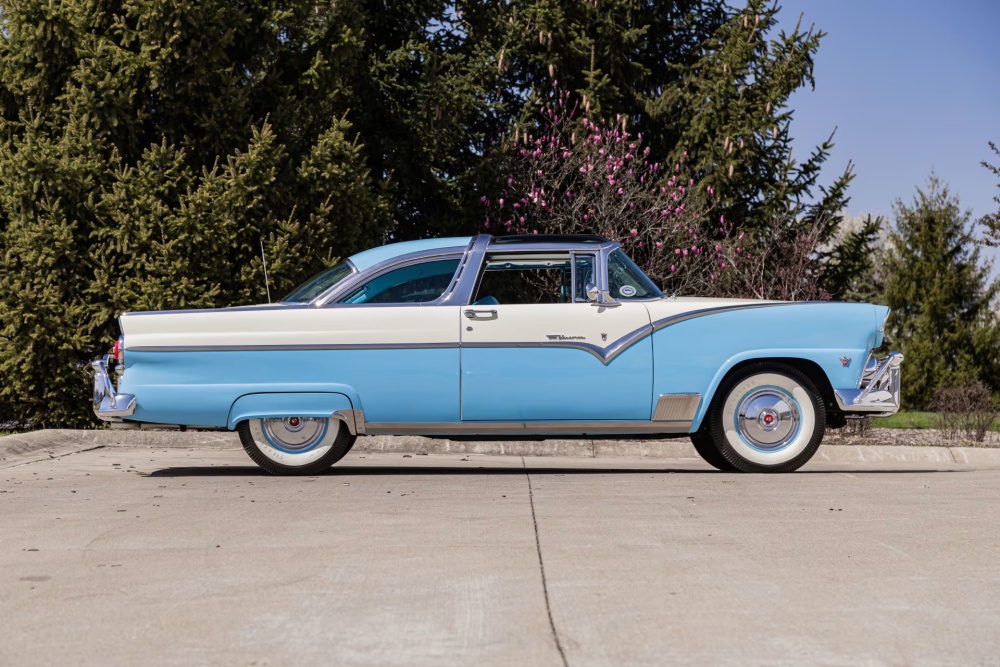
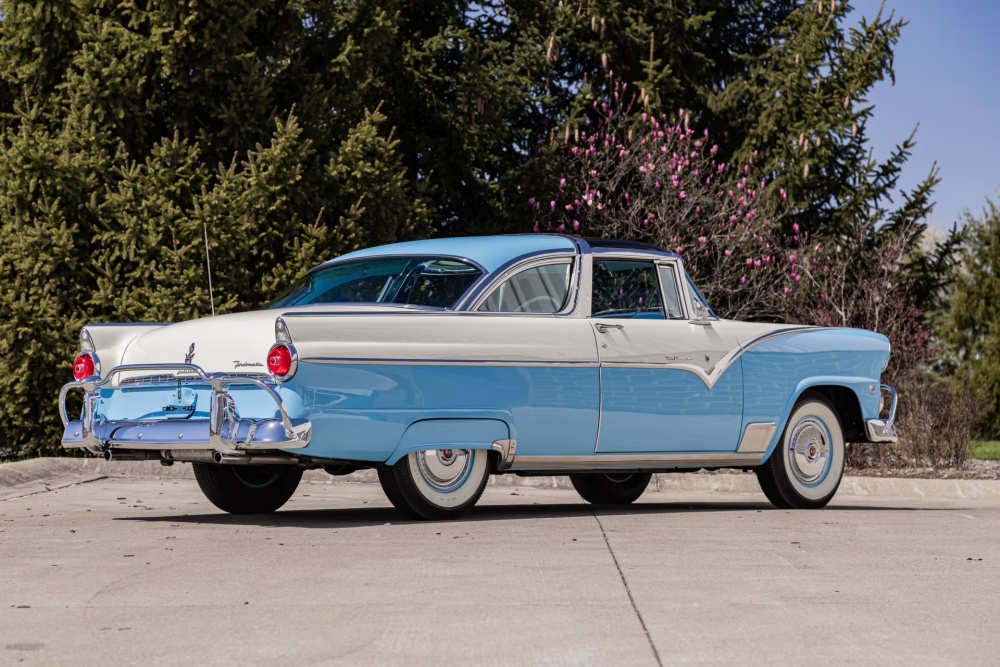
Compared to the standard Fairlane hardtop, the Crown Victoria's roofline was lower, flatter, and longer-looking, with rear pillars swept back an extra three inches. The windshield was lower too, shared with the Sunliner convertible, giving the car a silhouette that looked set apart from the rest of the Farilane line. Despite looking longer than the standard hardtop, it measured exactly the same — both cars came in at 198.5 inches overall, riding the same 115.5-inch wheelbase. But boy, did Ford load it with enough visual drama to trick the eye completely. Double-wide chromed windshield molding. Candy-colored vinyl interiors. Custom door panels and a rear-seat center armrest. Enough polished stainless steel trim that passing one on a sunny day was genuinely perilous to oncoming traffic.
Courtesy of Mecum Auctions
The defining feature was a literal crown — or tiara — a broad band of chrome trim that arched up one B-pillar, swept across the roofline. It came down the other side, separating the standard steel roof from an optional transparent front roof section made of a blue-green-tinted, quarter-inch-thick acrylic plastic. Only 1,999 were built with the transparent top option, and Ford was careful to note that it was not glass, not Plexiglas — just a beautifully peculiar moonroof. It was pure jet-age American design. The original Crown Victorias are rare and wonderful cars.
Courtesy of Mecum Auctions
The Fairlane Crown Victoria disappeared after only slightly over a year in 1956. The name sat quietly on the shelf for nearly twenty-four years before Ford brought it back in 1980 as the top trim level for the Ford LTD — the big-body Detroit dreadnaught of the 1980s. Vinyl roofs. Bench seats. Floaty suspension. Entire generations grew up in the back seats of these things, getting thrown from side to side. It was the backbone of American domestic motoring, and it was about to become something else entirely.
The car that instantly makes you nervous
It was during the LTD Crown Victoria era of the 1980s that the Crown Victoria's shadow started stretching across American culture in a new direction. The LTD was employed extensively as fleet vehicles for many different purposes; Taxis (a whole different kind of scary), corporate fleets, and of course, as police cars across the country. For the first time in the name's history, seeing a Crown Victoria in your rearview mirror no longer triggered admiration. It triggered arithmetic. How fast am I going? Did I signal? Is that a push bar? Why is he still behind me?
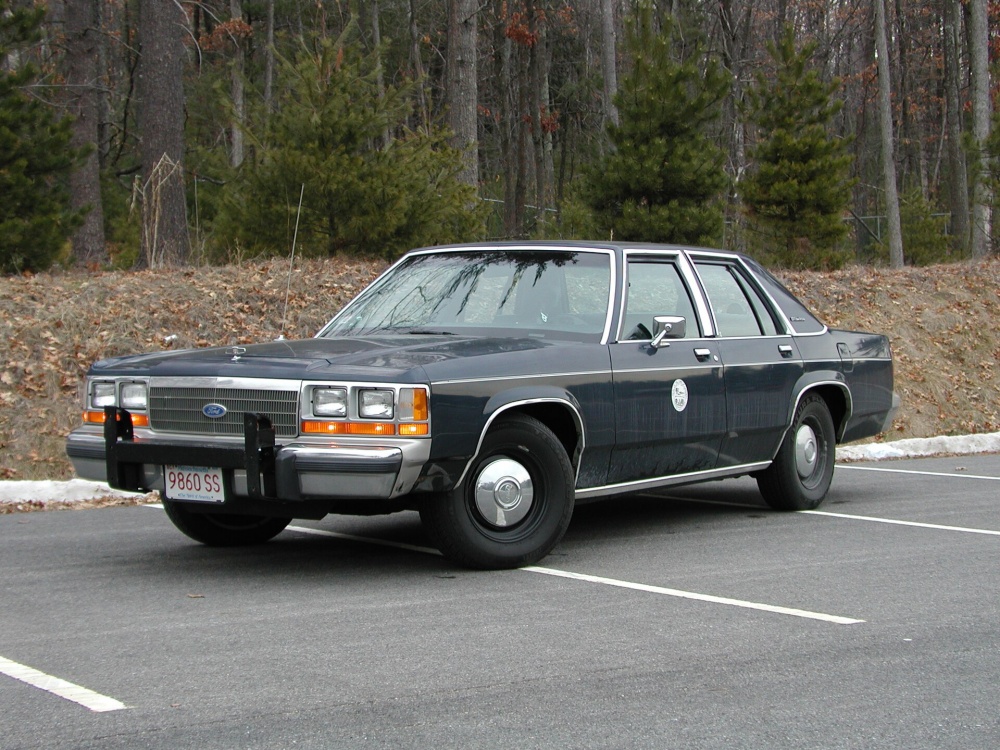
Wikimedia Commons
It’s in this mental shift that the Crown Vic stopped being just another car
Americans have an extraordinarily complicated relationship with police — one so deeply embedded in the country's cultural DNA that it's impossible to separate from the broader American story. Music, film, race, economics, entire neighborhoods, politics, television, legislation, and car culture itself are all shaped by the relationship between civilians and law enforcement. Entire genres of American art are essentially conversations about the American relationship to authority.
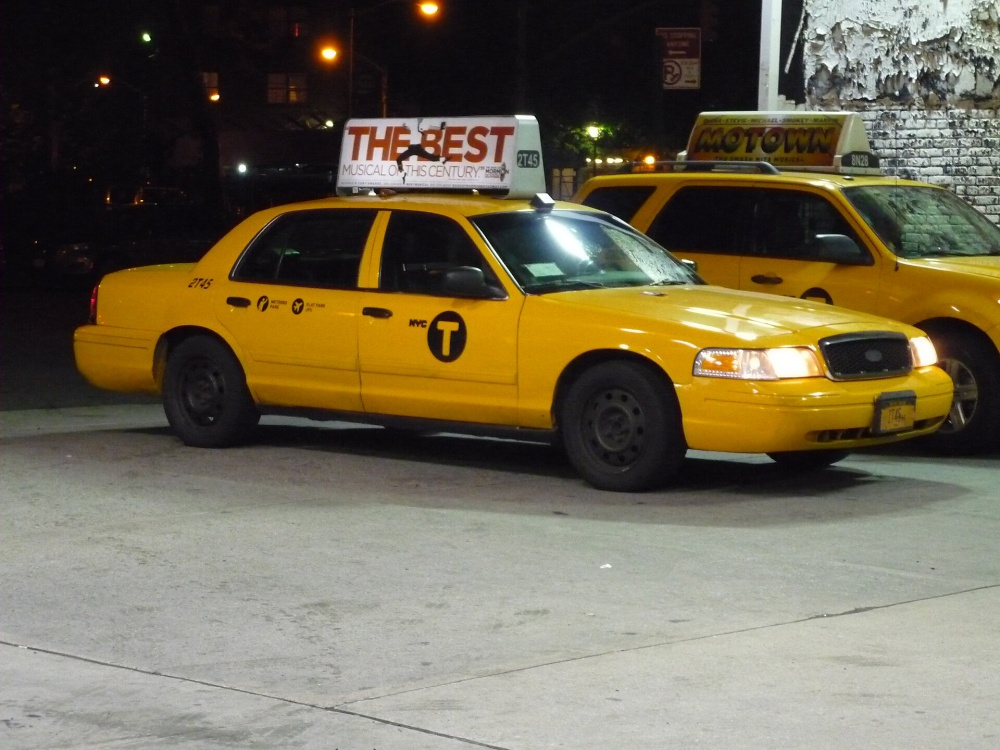
Wikimedia Commons
For some Americans, a Crown Victoria in the rearview represented safety and order. For others — particularly in communities that experienced over-policing — it represented surveillance, harassment, or things considerably darker. The same headlights triggered radically different responses depending on which side of town they appeared on. And yet even in those communities, the reality was more complicated still: many of the same people who feared that silhouette also depended on the police. The Crown Victoria ended up carrying all of those contradictions in one iconic silhouette — a V8-powered symbol of American ambivalence toward authority.
Of course, this isn’t the first time the Americans associated a certain sedan with the police. Ford was using the “police Interceptor” nomenclature since at least 1954. And Ford, in particular, has been a go-to for police since as early as 1915. The point is, the Crown Vic isn’t the first, and won’t be the last. But I would argue that it's as representative of authority as any car around today. Maybe the Humvee? But that’s a different conversation.
Whoop Whoop, that’s the sound of the police
Then, in 1992, Ford introduced the redesigned Crown Victoria Police Interceptor, dropping the LTD prefix and letting the Crown Victoria nameplate stand alone. The new car brought more “aerodynamic” styling and Ford's new 4.6-liter Modular V8, making as much as 250 hp, but underneath it remained stubbornly traditional – if it were a truck. The LTD used Ford's Panther platform, meaning body-on-frame construction, rear-wheel drive, and a live rear axle. It was simple, durable, cheap to repair, and capable of surviving years of curb-hopping, endless idling, and coffee-fueled midnight shifts without complaint. A 1998 refresh brought updated exterior styling and revised suspension and steering. The Mercury Grand Marquis, almost kinda the same thing as what was selling in piles to regular people. However, by May 2003, the Crown Victoria Police Interceptor accounted for approximately 85% of the police cars in use in the United States. Not just a majority. Eighty-five percent. That is not another police car. That is the police car.

Wikimedia Commons
What made the Crown Vic uniquely intimidating was how completely it haunted our rearview mirrors, road shoulders, and wooded interstate cut-throughs. Few objects in modern life produce such an immediate and involuntary physical response. The second someone spots that profile — the squared-off roofline, the steel wheels, the particular geometry of those headlights in the dark, the spotlight — the body changes before the brain catches up. Feet lift off the throttle. Eyes dart to the speedometer. Back muscles tense. The music volume comes down instinctively. Shoulders tighten. A nation collectively trained itself to recognize one shape, and Ford built that shape for nearly two decades without changing it, so we would know it when we saw it.
It was just G-men who loved the Crown Vic
In classic American car-culture fashion, we reclaimed it. Ford announced the Crown Victoria's discontinuation in 2007, and production ended in 2011. Departments began retiring them in large numbers, and ex-police Crown Victorias flooded auction lots and Craigslist listings at prices that bordered on the absurd. Suddenly, the scariest car in America was also the cheapest V8 rear-wheel-drive sedan in America. Kids bought retired interceptors for two thousand dollars and discovered they were weirdly good — the heavy-duty cooling systems, reinforced frames, and torquey V8s making them ideal for track days, Gambler 500 builds, drift cars, and long-haul road trip beaters. If it's cheap and has a V8, car people are going to buy them by the thousands, and paint them in every color, jammed full of all the superchargers, turbos, and even bigger V8s. These instruments of institutional authority became objects of genuine affection that served the people in a completely new way.
That reversal and full character arc feels deeply American, too. The Crown Victoria started as a luxury trim with a chrome tiara on its roof, became the most psychologically effective police car in the history of American law enforcement, and ended its life as a beloved, cheap project car in millions of American garages. It was never the fastest car in America. It was never the most beautiful, though once upon a time it tried very hard to be. What it became instead was something considerably rarer — a car capable of making an entire country feel something, all at once, instantly. The Ford Crown Victoria is a cultural landmark that also happens to be one of the most American cars ever made.

Peter Corn
Peter Corn is an automotive writer and storyteller. Peter has spent nearly a decade writing about cars, trucks, and motorcycles for some of the best publications in the business. He believes the best automotive stories aren't really about the machines at all, but instead, the people who love them.
Read Peter Corn's articles
Latest News
Comments
Comments are disabled until you accept Social Networking Cookies. Update cookie preferences
If the dialog doesn't appear, ad-blockers are often the cause; try disabling yours or see our Social Features Support.