The Ghost in the Wall: America's most mysterious motorcycle
America's most mysterious motorcycle was built by an equally enigmatic character in Chicago in 1916, stolen (maybe), bricked into a secret compartment behind a basement wall for fifty years, until an unwitting hero stumbled across it at work.
Aging is tough. The deeper into our lives we dive, the faster hope flies past our faces, barely able to even recognize it before it's more of a question than a feeling. Even more cruelly, there are things that, over time, speed up our plunge, like reason, logic, carpool, power bills, office lunches, groceries, embarrassment, buzzing phones, pride… overhandling and creasing the delicate flutter of hope of dreaming of finding the magical sword, or a secret history, proving your royal lineage, or finding clues leading to a lost buried treasure. This isn’t a hope that says that you’ll be the next king, or that you’ll pull the ancient sword from the Ancient Glade, but instead that wonderful and unexpected things can and do happen, here, in this life – even to a plumber. Sadly, eventually, that hope can feel less like hope and more like an escape from real life into a fantasy.
That is, until you read stories like this one. Real fantasy living alongside, even bolstered by, logic and reason and statistics and bills. The story of the most mysterious and marvelous motorcycle ever discovered might not involve magic rings or dark lords, but damn if it ain’t a little spark of hope that there are still fantastic treasures out there to be found by the most unlikely people in the most peculiar places. Hell, perhaps the next great treasure is within arm's reach, even as you read this.
Treasure buried, treasure found
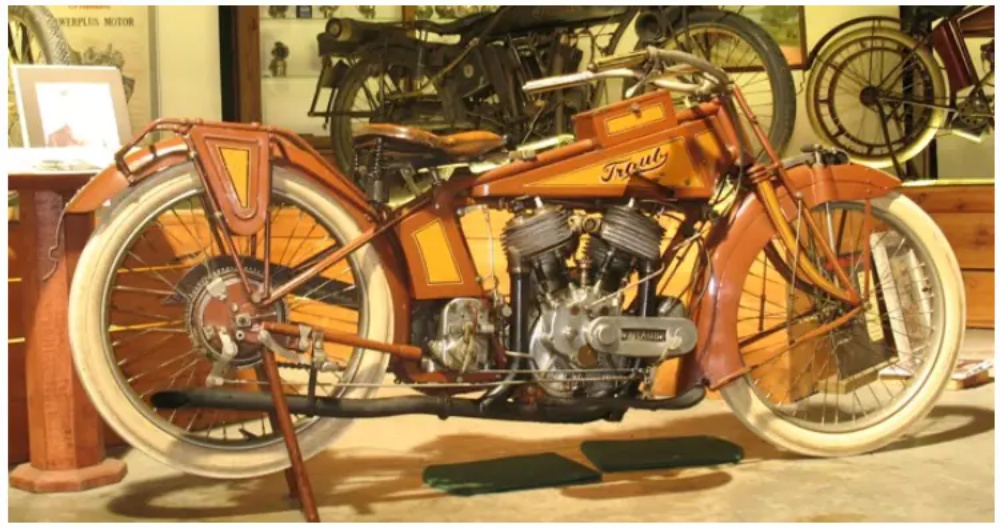
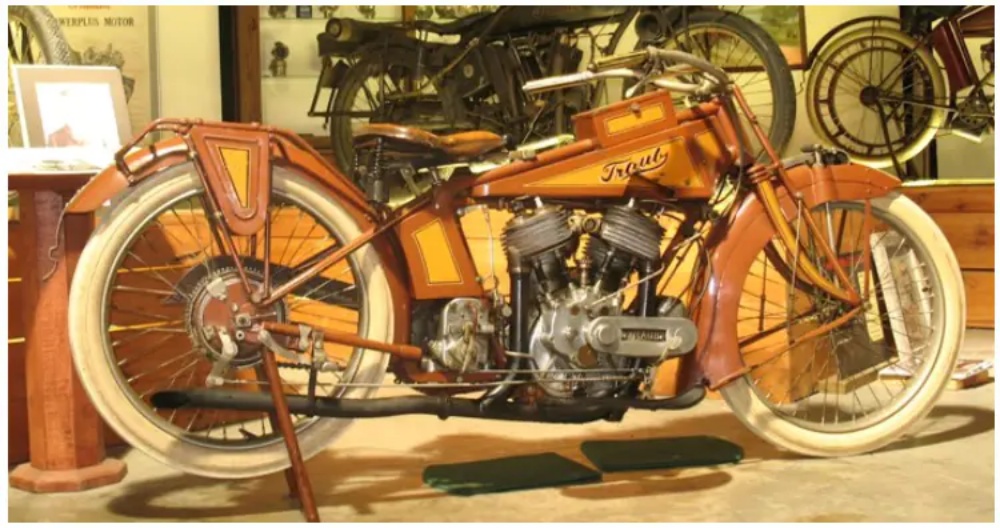
In 1967, an unnamed plumber was working in a regular, middle-class suburban home in Chicago. While we don’t know exactly what problem our gallant plumber came to fix, the problem must have been pretty serious because he started tearing out a dingy section of wall in the basement, when an unexpected chord of soft white and silver flashed from a tiny secret room between the walls. The false wall was cleared, opening the tiny, secret room holding a very old two-tone, brown and mustard motorcycle with the name “Traub” written across its tank.
Wheels Through Time
Despite it being 1967, the bike was noticeably old in its day. It had features that weren’t relevant in motorcycling for at least 40 years. The name was meaningless, and its style enigmatic. I can only imagine the plumber and homeowner had questions flying through their heads like cars down the interstate: “Who built this thing? How old is it? What’s it worth? Does it run… Wait, how did it get walled into the basement?!?!?”
According to the history of the building, the machine had apparently been there since 1916 without any of the subsequent property owners knowing about it. So, not only was a mysterious motorcycle hidden in the walls, it’s not like it was Pawpaw’s whooped old bike from his youth; this thing was pristine. Not an artifact; buried treasure.
And, so as not to let a good story swim by without a swat, as researchers and historians tried to learn more about the Traub, the story blossomed from mystery to folklore, and everything that comes with it. As you might suspect, one story of how the Traub came to be Jimmy Hoffa’d, of course, involves some felonious capers ending in a world war.
The mysterious Traub
The story is that the man who owned the home at the time of discovery, or someone he knew, tracked down the previous owners of the home, who claimed that, while they didn’t know the bike was in the walls all this time, they knew who hid it and why.
The former owners are said to have admitted that their son was the person likely responsible for the strange treasure. They mentioned that their son had stolen the motorcycle, possibly from the man who built it, since this wasn’t a production motorcycle. Once the parents found out about the hot bike, they forced him to enlist in the army as punishment. Timing can be a real bitch. The son was shipped off to Europe to learn his lesson. He never made it back to Chicago. As tragic an ending as this is, he made one final, secret play for the boys; he hid his booty behind a fake wall in his parents’ basement, kept safe until after his time in Europe.
The war ended. Europe rebuilt. Entire countries reborn into a post-WWI world. The world moved on. People came and went from the Chicago home, and the Traub waited, cold and dry.
What actually happened?
As cinematic as this part of the tale is, and for as long as this stood as the official explanation, nearly every thread exposed by modern research has proven this story to be nothing more than a yarn. It didn’t happen. So what did?
The Traub would be passed around and live a long second life before much more information would come to light. The homeowner, who found it with his plumber’s help, traded the mystery machine to a Chicago motorcycle shop owner named Torillo Tacchi in exchange for a $700 Suzuki. Tacchi restored it and kept the bike for some 10 years. Then, in one of those only-in-America chains of custody, Bud Ekins – Steve McQueen's famed stuntman – purchased the Traub while on the set of the Blues Brothers movie in the late 1970s. Ekins later sold it to California collector Richard Morris, who sold it to historian and curator Dale Walksler in the 1990s. The Traub is now one of the "crown jewels" in the collection. Dale passed away in February 2021 after a four-year battle with cancer. His son Matt now carries the torch as curator and owner.
The machine
At risk of getting too in the weeds here, we need to talk about why this bike is significant in the first place. Rarity in and of itself is fun, but not always the most significant detail about a thing. Hell, the Bubonic plague is rare, and no one wants that.
What came out of this long chain of custody is a handful of experts spending serious one-on-one time with the ghost bike and discovering some pretty strange features. In fact, these engineering discoveries would prove to be the biggest mystery surrounding the bike.
The Traub’s engine is a beautifully crafted 78ci V-twin engine with a 4-inch stroke and a 3 7/16-inch bore, yielding an engine capacity of 1,278cc, which was absolutely huge for 1916. What passed as big displacement motorcycle engines from the Traub's era were around 1,000cc. The bike is thought to have been capable of reaching 85 mph – territory that most American motorcycles of the era couldn't touch. The lever gate for the shifter is unique, operating what could have been the first three-speed gearbox on an American motorcycle, with two separate neutral positions marked on the shift mechanism, with a zero found between first and second gear, and between second and third. If this means nothing to you, just know, these are very unique and super-advanced features for any bike of the time, much less one that was built by hand by a guy no one had ever heard of and hidden inside a wall for 50 years.
Then there's the braking system. No one had ever used a single-cam/twin-brake system on any other American motorcycle – brake shoes clamping not only the inside of the drum but the outside simultaneously. Simply put, in 1916, this was extraordinary. The tolerances throughout the engine were machined so precisely that during reassembly, the only parts that needed fabricating were the base gaskets. The bike doesn't use any other gasket anywhere in the engine. One gasket. On a century-old hand-built motor.
This was not a tinkerer's weekend project. Entire factories of builders and engineers across the globe were building bikes this precisely, with this much power and innovation. Whoever built this machine had world-class skills and, apparently, a very specific vision for what a motorcycle could be.
Who built the 1916 Traub motorcycle?
The trail gets more interesting and more plausible when you follow the census records. The 1910 Chicago census shows that a 27-year-old Gottlieb Richard Traub lived at 1520 North Paulina Street and listed himself as a toolmaker in a factory. His WWI Army draft registration card stated that he was a self-employed experimental machinist. The address turned out to be an attached garage located at the back of his residence, not far from where the bike sat behind its secret room.
According to the folks at Wheels Through Time, there is also documentary evidence that predates the bike by nearly a decade. In 1907, Traub wrote a letter to the editor of Motorcycle Illustrated, published in the July edition, describing his homemade four-horsepower motorcycle and giving his address as North Paulina Street, Chicago. The specifications in that letter – bore, stroke, gearing, tank capacity – are strikingly similar to the machine that would later be found in the wall. Notably, displayed with the Traub in the museum is a custom wrench with the Traub name on it, exactly the kind of detail a proud craftsman would include on a one-off creation.
What this paper trail suggests – and it is a suggestion, not a verdict – is that Gottlieb Richard Traub built this motorcycle himself, possibly iterating on an earlier version from 1907, and that the machine never left his world. Whether it was stolen, abandoned, or deliberately hidden remains open. Granted, it’s hard to imagine building such an exquisite thing and burying it like this, but like it or not, humans have a long history of doing exactly this. The archaeological record shows hundreds of massive stone works, colossal earthen mounds, and wonderfully intricate mosaics that ancient people initially buried for one reason or another. No matter the truth, Gottlieb Richard Traub was born on March 23, 1883, and died on December 16, 1952. Whatever he knew about why that bike was immured, he took with him.
What we're left with
The Traub is genuinely difficult to categorize. It's not a prototype in any corporate sense – there was no Traub Motor Company, no investors, no production run. It appears to be one man's decade-long battle with the limits of what a motorcycle could be.
The Traub isn't just a curiosity. It's evidence that American motorcycle culture, even in its earliest days, never entirely belonged to capitalism and big business. There were people out there in garages and home workshops building things once they got off work that nobody asked for. These folks causally advanced the form because they thought they could.
What’s truly a treat in our modern world is that the bike’s caretaker, Matt Walksler, still fires it up for crowds at the museum. People have worked on it over the years, some minor improvements made here or there, but the bike is overwhelmingly original.
Hearing this ghost machine fire elicits the same response, every time: the same wild-eyed wonder a kid might feel the first time he sees Indiana Jones uppercut a Nazi. It’s twin-cylinder lope fires the heart like when we watch the great light saber duels in a galaxy far, far away. The smell of burnt fuel and oil wafts like we might imagine the horrible workshops of Mordor. This bike is Tolkien, Christie, King, and any other tale we love to speculate and fantasize about. But unlike all of those tales, this fantastic mystery happened, and to a couple of normal people, no less, as great stories often do. Not world-traveling aristocrats or great titans of industry with every resource available. It happened to a plumber and a guy who just needed his toilets to work.
See it if you can. Wheels Through Time is in Maggie Valley, North Carolina, and the Traub – along with some 370 other machines — is waiting.
The Traub motorcycle is on permanent display at Wheels Through Time, 62 Vintage Lane, Maggie Valley, NC. wheelsthroughtime.com
Sources: Wheels Through Time, Bart, Chicago census records

Peter Corn
Peter Corn is an automotive writer and storyteller. Peter has spent nearly a decade writing about cars, trucks, and motorcycles for some of the best publications in the business. He believes the best automotive stories aren't really about the machines at all, but instead, the people who love them.
Read Peter Corn's articles
Latest News


Comments
Comments are disabled until you accept Social Networking Cookies. Update cookie preferences
If the dialog doesn't appear, ad-blockers are often the cause; try disabling yours or see our Social Features Support.