Chris Jones/IMS
Pit stop turnaround a key element to Ganassi team’s brilliance in 2025
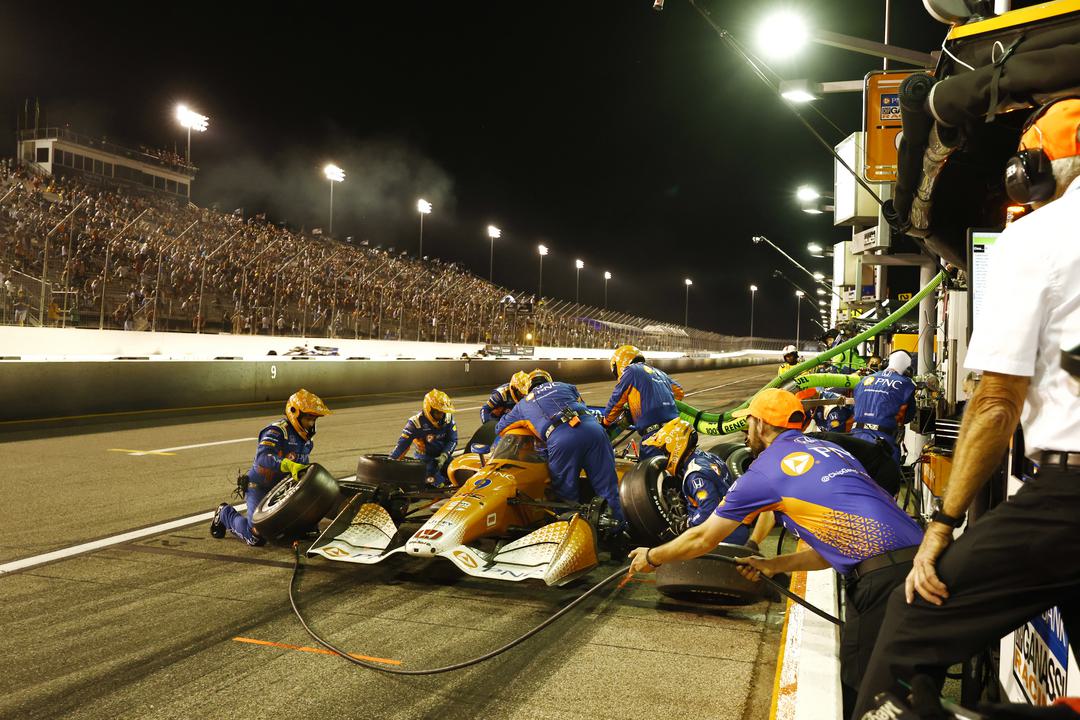
Of the many components that propelled Chip Ganassi Racing to a 1-3 finish in the NTT IndyCar Series drivers’ standings with Alex Palou and Scott Dixon, a significant contribution came from their respective pit crews who delivered a wildly impressive year-to-year improvement for the organization.
In 2024, Team Penske ruled pit lane, winning the season-long contest among over-the-wall crews by placing first in the Firestone Pit Stop Performance Award rankings. It was the closest thing to dominance as Penske went 1-2-4 with Will Power’s No. 12 Chevy crew leading the charge, Scott McLaughlin’s No. 3 Chevy crew in second, and Josef Newgarden’s No. 2 Penske Chevy squad a close fourth in the standings. The best Ganassi could muster was fifth with Palou’s No. 10 Honda.
Fast forward to 2025 and Ganassi turned the tables on Penske as Dixon’s No. 9 Honda crew led by Tyler Rees jumped from eighth to first; shadowing them in second was Palou’s No. 10 Honda crew headed by Ricky Davis to seal a Ganassi 1-2 as the season’s best performers on pit lane.
“I had this conversation with the group after Nashville about how their work together on pit lane was phenomenal,” Davis told RACER. “What they were able to achieve as team is really something to be proud of. We always have the in-house competition where we want to be the best in our class among our own cars, which helps a lot, which helps the motivation to work out harder and practice smarter.
“To improve what you do, not to try to do it as fast as you can, but improve what you with your technique. Find little things here and there that will make your pit stops smoother. And I think for the most part, especially if you look from the beginning of the year, that's exactly what the guys did. They learned from the first couple races, and just practiced and tried to be smoother and better, and that's where we got it to being the best this year.”
Relegated to 22nd in the pit stop rankings, Ganassi’s No. 8 Honda entry for Kyffin Simpson stands out as the key car area of improvement for the team to make during the offseason. As Davis notes, winning the year-long race to be the fastest in and out of the pits isn’t strictly the domain of the seven over-the-wall crew members assigned to each entry. A huge factor in their shared success or failure is the person piloting the car.
“Along with that, there's a lot of help from the drivers too, for getting in the box and leaving the box the way they need to,” he said. “It helps that overall time because it's from pit in to pit out, so with our car, Alex has also worked on that. He's done a few things to improve his ability to get in the box faster and reaction time to leave a lot faster, too.”
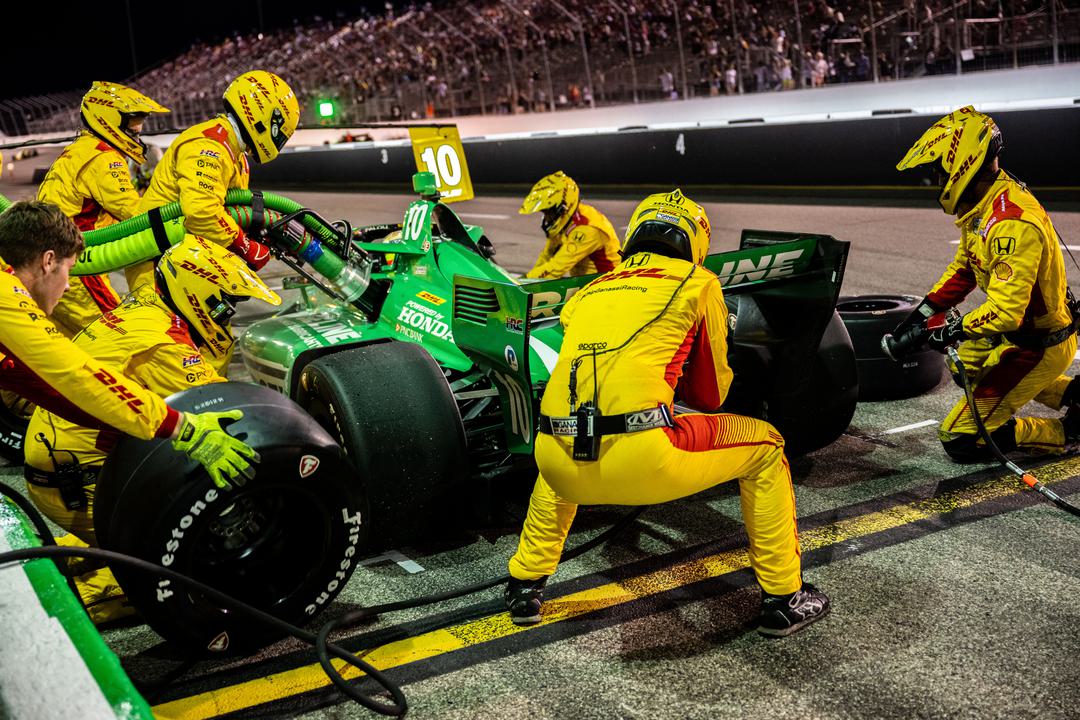
The driver is an integral part of the performance equation too. Karl Zemlin/IMS
Davis spent decades racing into position and changing tires before stepping back and managing his crew from the pit wall. Having been one of the fastest people on pit lane, Palou’s crew chief enjoys watching Ganassi’s next-generation of talent compete with the best and most consistent tire swaps and refueling times as the men and women who service the cars star in races of their own.
“Even back when I did it, one of the greatest things was when, say, you pit and they’re all coming in with a bunch of cars and you’re nose to tail, or you're behind somebody, and you know, as a crew, you can gain one spot, two spots,” Davis said.
“Or if you're behind by a few seconds, you can decrease that time you're behind. It is a feeling that I don't know if I can describe to you, what it feels like inside, but it is a miniature race win for the guys to go over the wall to gain a spot here and there, or jump your teammate, right?”
With one or more cameras trained on the pit box and GoPro cameras attached to their helmets, a wealth of visual and time data is available after each race, and like every team in IndyCar, Ganassi parses through all of it to use as confirmation of what’s working best for each member and which areas require improvement. The goal is to be named “Top Gun” after the season finale.
“Our guys, their times are broken down for each pit stop,” Davis continued. “And our pit stop coach, he breaks down the times and consistency time. And we have an award, it's called ‘Top Gun Performance,’ for the person that stays the most consistent, not necessarily the fastest, but the deviation time from pit stop to pit stop throughout the whole year is the smallest. It all gets calculated, and that person comes the Top Gun. It's pretty awesome.
“That’s what we're trying to express to them: be more consistent. If you have a four second stop and then you have a seven second stop, it doesn't help, right? And it goes with the fuelers, too, and the time that it takes them to plug in the car, and the less deviation time they get, the quicker they can get in the car, the quicker we can get fuel in, and quicker the pit stop goes.
“There's a lot that goes into it. It's not just easy as coming in, changing tires and dumping fuel in the car. It's all calculated, and it's all within your mind to try to be as quick as you can, but also be as consistent as you can.”
Marshall Pruett
The 2026 season marks Marshall Pruett's 40th year working in the sport. In his role today for RACER, Pruett covers open-wheel and sports car racing as a writer, reporter, photographer, and filmmaker. In his previous career, he served as a mechanic, engineer, and team manager in a variety of series, including IndyCar, IMSA, and World Challenge.
Read Marshall Pruett's articles
Latest News
Comments
Comments are disabled until you accept Social Networking Cookies. Update cookie preferences
If the dialog doesn't appear, ad-blockers are often the cause; try disabling yours or see our Social Features Support.