Steve Swope photo
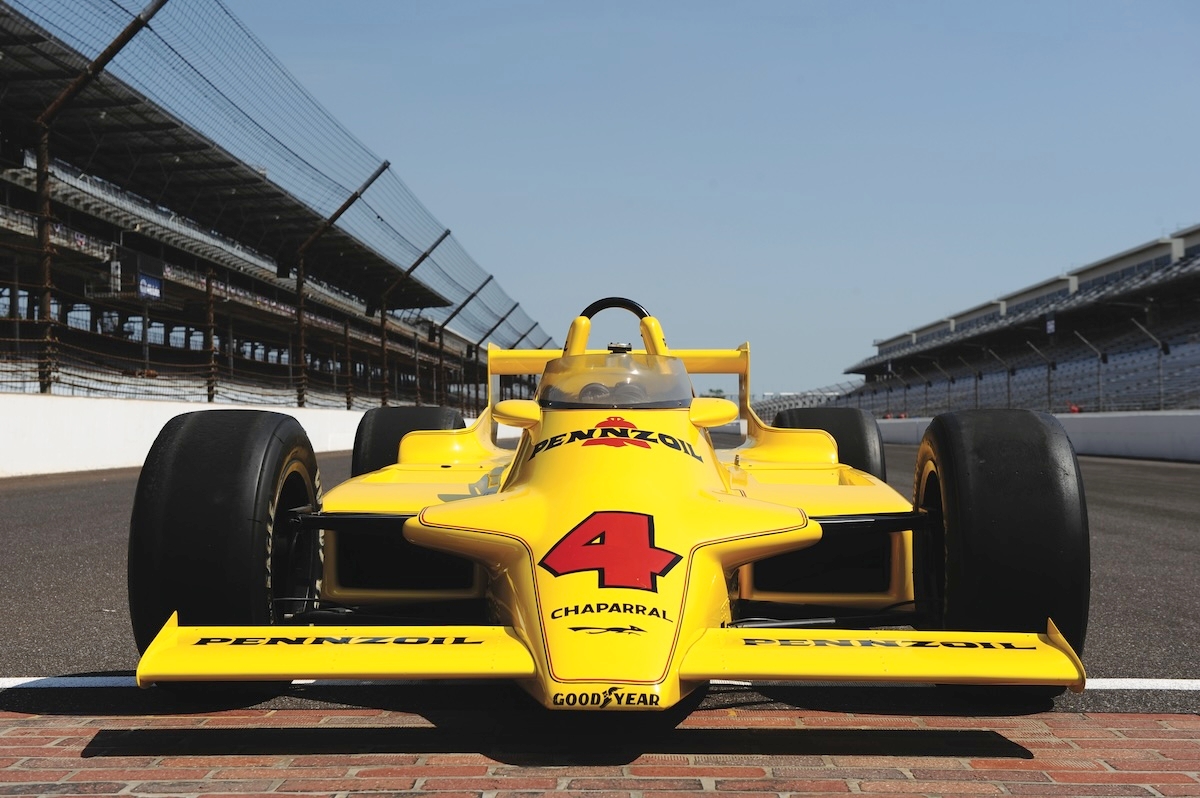
The low Chaparral
One of the most spectacular designs in IndyCar history came from a British drawing board for a team from Texas. Forty-five years ago, on Sunday, May 25, 1980, it conquered the Indianapolis 500.
“What that car would let me do was amazing. The only time I had to lift the throttle at Phoenix was crack it just a little to transfer weight to the front for Turns 1 and 2. The rest was flat all the way and, at the time, that was unheard of at Phoenix. The lateral G-force in Turns 3 and 4 was so great it would make you grunt. We had to do things to the cockpit to prop me up and give me a shoulder rest.”
The words are Johnny Rutherford’s and he was speaking about his first test of the Chaparral 2K already dubbed “The Yellow Submarine,” in the fall of 1979. Sure, Rutherford had always been a wonderfully brave driver. But to push so hard on his first acquaintance with the car that the air was squeezed out of his lungs? That’s not just a courageous racer trying to find the limits of his car; that’s a car redefining the limits of its driver, and the whole series. Chaparral Cars had taken a leap and forced its rivals to follow.
Innovation was not unusual from the Midland, Texas-based company founded by Jim Hall and Hap Sharp. The tweaks and mods and experiments on their sports cars, from 2 to 2J, were relentless. But those machines hadn’t started trends. The 2K was different.
Perhaps surprisingly, it wasn’t until 1978 that Chaparral entered IndyCar racing, using a Lola T500. Hall's driver, Al Unser, was unimpressed. “I couldn’t get that car to do anything,” said the legend who died in 2021. “Any track we went, how the car was when we rolled it out was how it was going to stay. You’d make pretty big changes and it just wouldn’t respond.”
It’s worth reminding ourselves that Unser is talking about a car in which he became the only driver ever to win all three 500-mile races in one year – Indy, Pocono and Ontario – and eventually claimed second in points despite missing two races… But we’ll take his word for it that the 1978 T500 was a clumsy lump on anything but superspeedways. What Hall gave him to drive next, from Round 4 of 1979, was rather different.
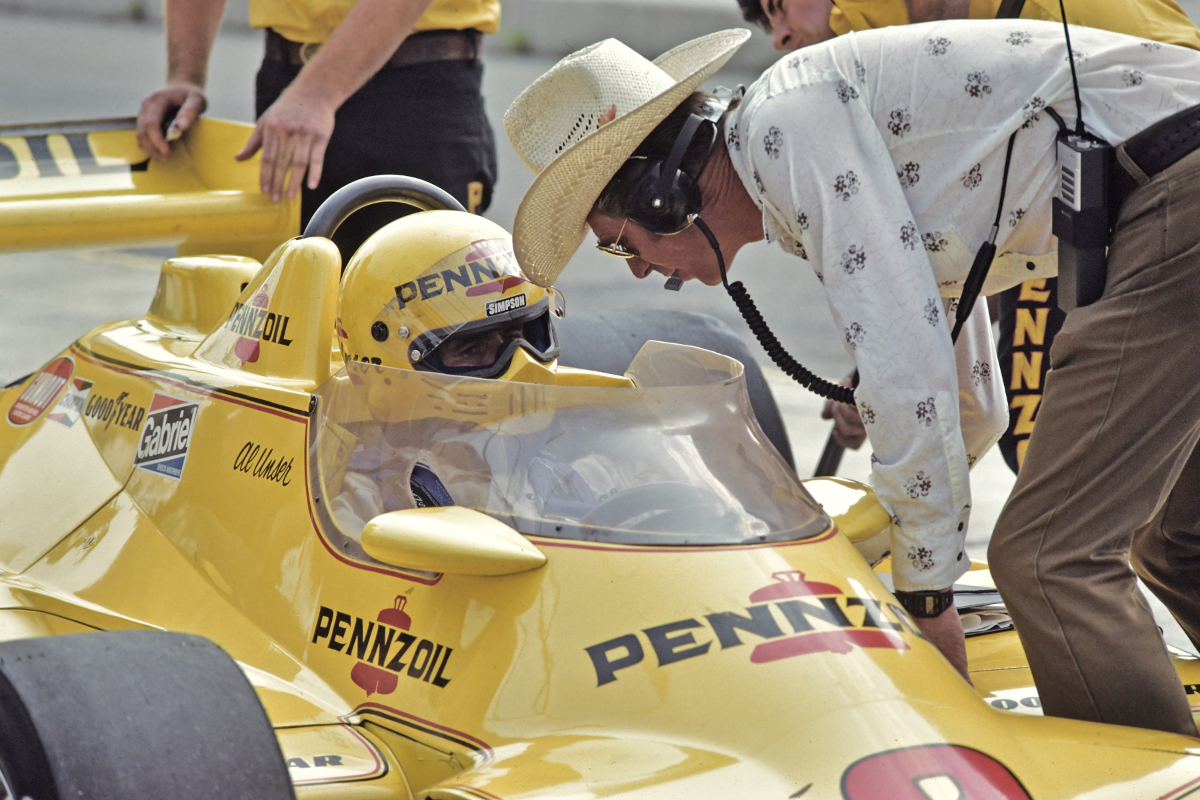
Al Unser and Hall were an ideal combo to develop the 2K in 1979.
“When I first got involved in Indy cars, I was lucky to get Al Unser,” said Hall. “He wanted to move on to another team [from Vel’s Parnelli Jones Racing] and knew our capabilities. Then John Barnard [also from VPJ] came to see me later that year and said he was looking for a different deal. He wanted to go back to England. So he and I talked and he said something that had been in the back of my mind – that ground effects would be great for Indy cars because they’re running at high speed all the time. It didn’t take long to put together a deal.”
Barnard, a rising star of race car design, had already done superb work for McLaren on the M23 F1 car and M16D IndyCar, before tackling VPJ’s short-lived F1 project and once-great but now dwindling IndyCar team.
Said Barnard: “There were quite a few English guys at VPJ at the time – Jim Chapman was running it, Hughie Absalom was chief mechanic, myself, Bill Eaton and so on. Then Al Unser left for Chaparral and Hughie went with him.
“So I went out to Midland, told Jim I had one or two ideas for an Indy car, and the deal was pretty much done on a handshake. I went to England and started drawing the car in my dad’s front room. Then I called Gordon Kimball who’d been helping me at Vel’s and he came over and started drawing some bits for me,
“On the VPJ6, I’d been playing around with plastic skirts underneath the car and the drivers could feel the difference. By then, Lotus had made the 78, which had a wing shape underneath and brushes down the side, which got us all thinking. Patrick Head [of Williams F1 team] also told me, ‘You can’t believe what you get from the underside of the car, it’s incredible.’ So I think we all felt we had to go that way. But the Chaparral never saw a wind tunnel. BS Fabrications [owned by Bob Sparshott] made the bits for me – chassis, suspension, and so on – and I think Hughie organized a mock-up Cosworth engine.”
Considering Barnard didn’t put pencil to drawing board until September of ’78, it’s no wonder the new car wasn’t ready for the start of the ’79 season in the newly founded CART IndyCar series. Unser drove the one-year-old Lola – now in the team’s startling new Pennzoil livery – to top six finishes in the opening three rounds. Then, two weeks before practice began at Indy, Unser sampled the new 2K at Ontario Motor Speedway.
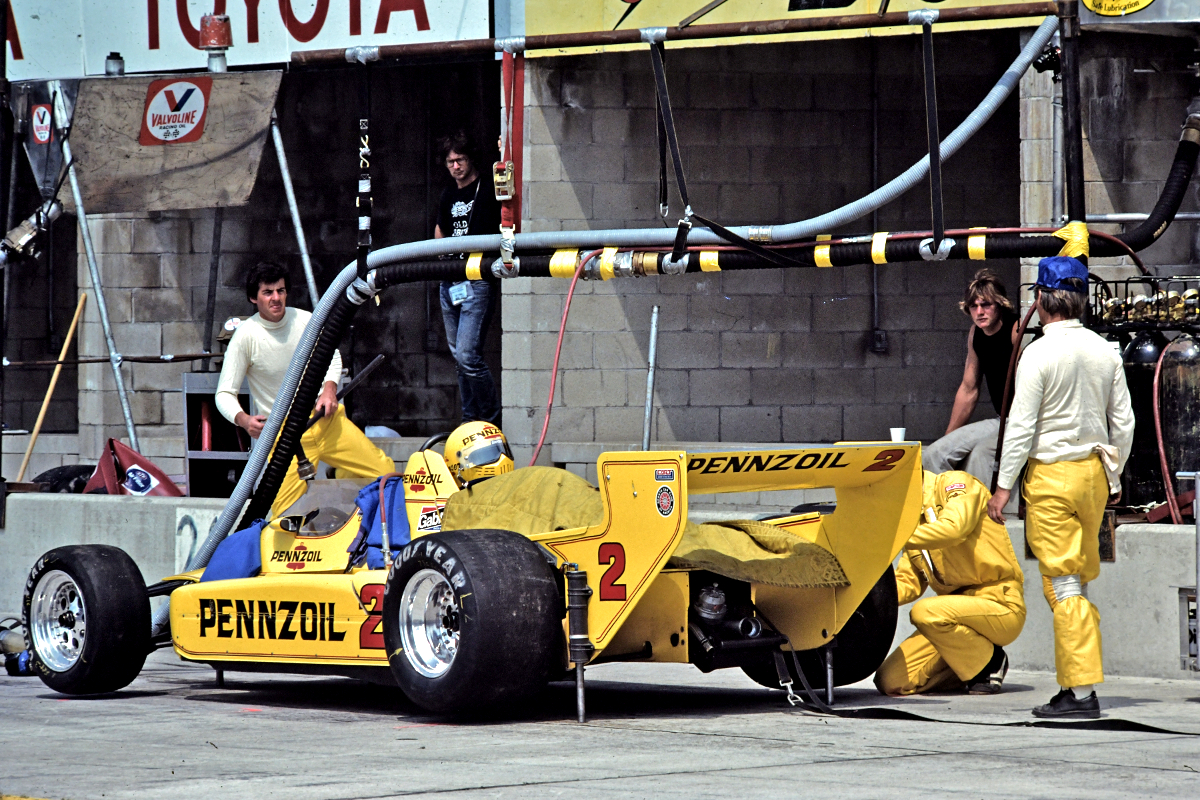
From front to back, the Chaparral 2K was a completely new animal.
“The Chaparral was day and night better than the Lola,” he said. “What John created was superior to any other car of the time. The downforce was leaps and bounds ahead of the competition. It did exactly what I wanted it to do.”
Hall agreed, observing: “We were amazed how good it was. It didn’t have the center of pressure in quite the right place, so we needed to trim it a bit, but we had adequate wings to do a lot of trimming. We also had to reduce downforce a little, as I recall. But it was obvious that it was a tremendous change from the car we’d been running the year before.”
The huge venturi tunnels on the 2K’s underside did a great job of pulling the car down to the surface of Indianapolis Motor Speedway, while its top surfaces were so much lower than those of its rivals. Even Unser, who rarely laid it all on the line in qualifying, couldn’t help but nab a front-row slot for the Indy 500 alongside Rick Mears and Tom Sneva. Race day was when he flexed.
“When they took the green flag, Al didn’t back off for Turn 1 and everyone else did!” recalled Hall with a chuckle. “It was the most amazing thing you ever saw. He stretched 100 yards in the first turn, 100 yards in the second turn. By the time he came past us again, he had a lead of about 400 yards. But then…”
After leading 85 of the first 100 laps, Unser was forced to retire when a melted transmission seal let the gearbox oil leak away. Itty-bitty irritations and new-car niggles such as this would become a theme in ’79, despite the car’s tremendous pace that ensured Unser repeatedly qualified in the top three. At Watkins Glen, for instance, Unser took pole and was leading with 16 laps to go, when his car gearbox jammed in third, and he nursed the car home a frustrated fifth.
Then at Phoenix, the final round, everything went smoothly, Unser led 138 of 150 laps and delivered the Chaparral team a well deserved victory. Yet the celebrations were more muted than they should have been, because some principal players were departing. Barnard, offended at the lack of credit he received for a revolutionary design, was heading to McLaren’s Formula 1 team. Unser, a big fan of Barnard, was offended on his behalf and “wasn’t seeing eye-to-eye” with Hall, so he quit; engine maestro Franz Weis was leaving, Absalom had already gone.
But they had left a legacy; the groundwork had been covered. For 1980, the 2K was now pretty much bug-free. And Rutherford, who had been pondering his future following McLaren’s departure from IndyCar, was suddenly handed the keys to the best car.
“For half a day, I couldn’t get comfortable with it [at Phoenix],” he said. “Al liked to run it fairly soft, and I prefer a car that holds a constant attitude, so it won’t roll and upset the center of pressure. Fortunately, I had asked Jim to hire Steve Robey, my crew chief at McLaren. Steve started banging stiff springs on the car and before the day was over, we were nearly two seconds under the track record!”
“Lone Star J.R.” opened the season with pole and victory at Ontario, and more significantly, did the same at Indy in May, for his third victory at the Brickyard. It had looked fairly easy but it was, in fact, daunting.
“What I had driven there before, McLarens, only let you go so far,” he said. “The Chaparral let you go so much further, it really put you in a nervous situation. The edge of the universe was a lot shallower in the 2K than in an M24…”
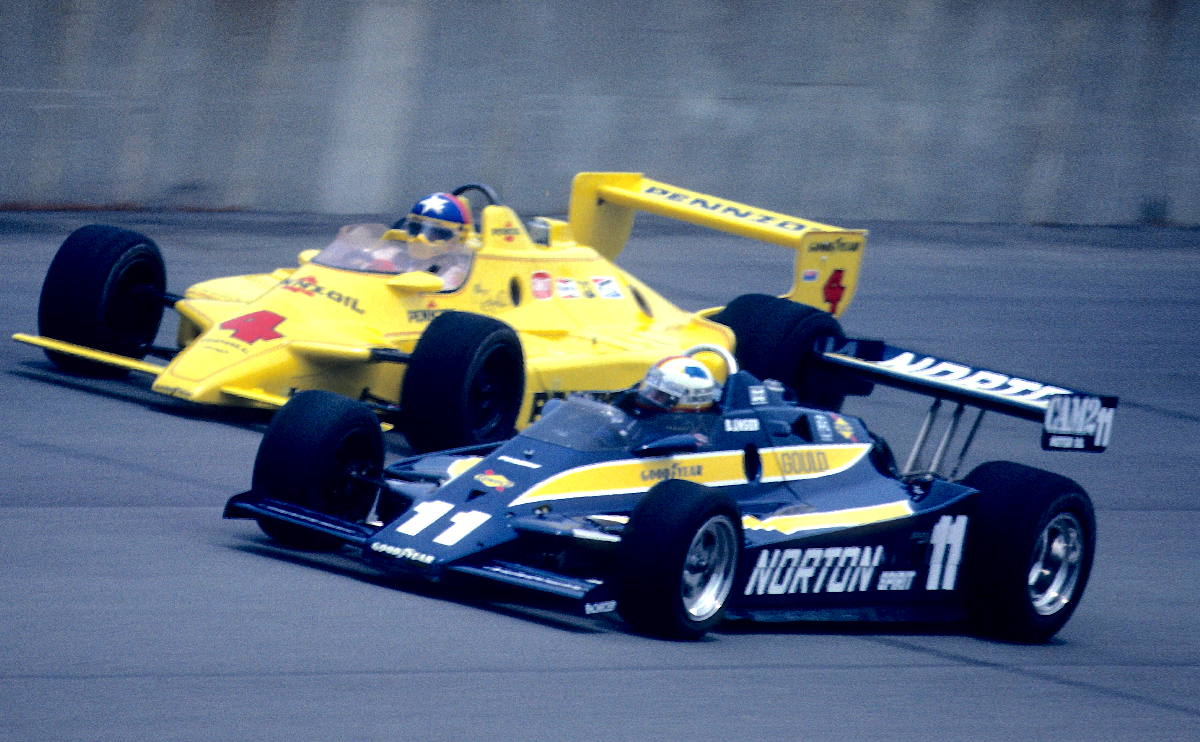
The Chaparral led the way in 1980 but rivals were catching on as the season progressed. Here, Rutherford duels Bobby Unser and his Penske PC-9 at Michigan.
With three more wins and smart top-fives elsewhere, Rutherford was comfortably IndyCar champion, for the only time in his career. Yet Chaparral’s advantage dissipated rapidly, as others – particularly Team Penske – learned the car’s aero tricks. The 2K would win just once more, in the 1981 season opener.
“The fact that the 2K won the title in 1980 is testimony to the fact that it was fundamentally right,” says Barnard. “And once I realized the forces we were dealing with, there were so many ways I could have improved the car. For example, between ’79 and ’80, I’d “found” carbon composites and I ended up applying that to the McLaren MP4/1 Formula 1 car. But if I’d stayed at Chaparral, the minimum I’d have done would have been designing proper carbon underfloors that didn’t warp at high speed. That would have improved the car immensely.
“So I know that we could have kept going with enormous success.”
Chaparral ran the 2K into 1982, but it now looked like it had suffered botched surgery and its results matched its appearance. In every sense, the magic had gone. After four outings, the team switched to running a customer March 82C. At year’s end, ground effect was banned and the team pulled out. When Hall returned in ’91, it was with a Lola.
But mention Chaparral to any IndyCar fan and their first thought will be of the glorious 2K that enjoyed a brief period of dominance that compelled others to imitate in a manner that not even its charismatic sports car forbears achieved.
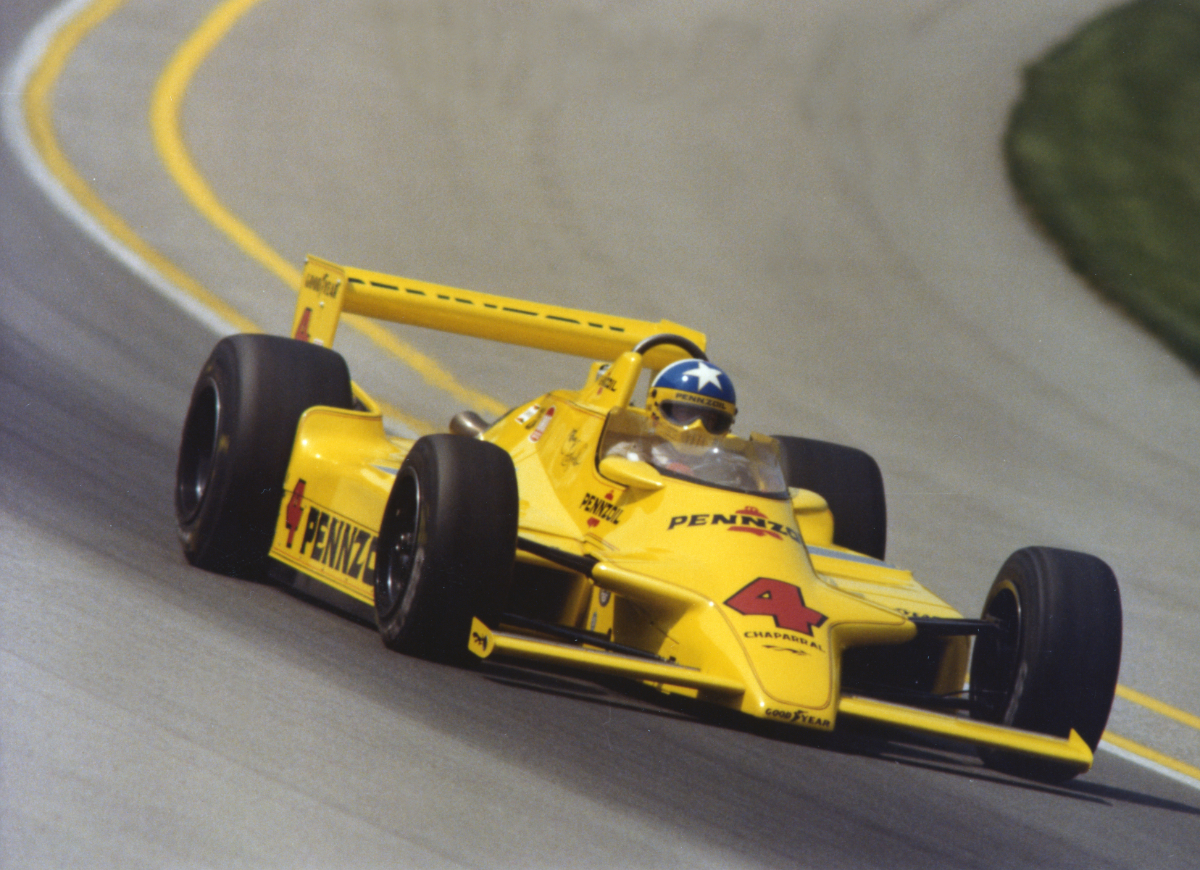
Rutherford and the Chaparral en route to victory in the 1980 Indy 500.

David Malsher-Lopez
David Malsher-Lopez is editor-at-large for RACER magazine and RACER.com. He has worked for a variety of titles in his 30 years of motorsport coverage, including for Racer Media & Marketing from 2008 through 2015, to which he returned in May 2023. David wrote Will Power’s biography, The Sheer Force of Will Power, in 2015. He doesn’t do Facebook and is incompetent on Instagram, but he does do Twitter – @DavidMalsher – and occasionally regrets it.
Read David Malsher-Lopez's articles
Latest News

Comments
Comments are disabled until you accept Social Networking Cookies. Update cookie preferences
If the dialog doesn't appear, ad-blockers are often the cause; try disabling yours or see our Social Features Support.