Michael Levitt/IMSA
Doonan discusses BoP process ahead of Detroit GTP adjustments
IMSA President John Doonan took some time to speak with the media regarding a recent "manual adjustment" in the WeatherTech SportsCar Championship's GTP Balance of Performance, which will take effect at the upcoming Chevrolet Sports Car Classic in Detroit.
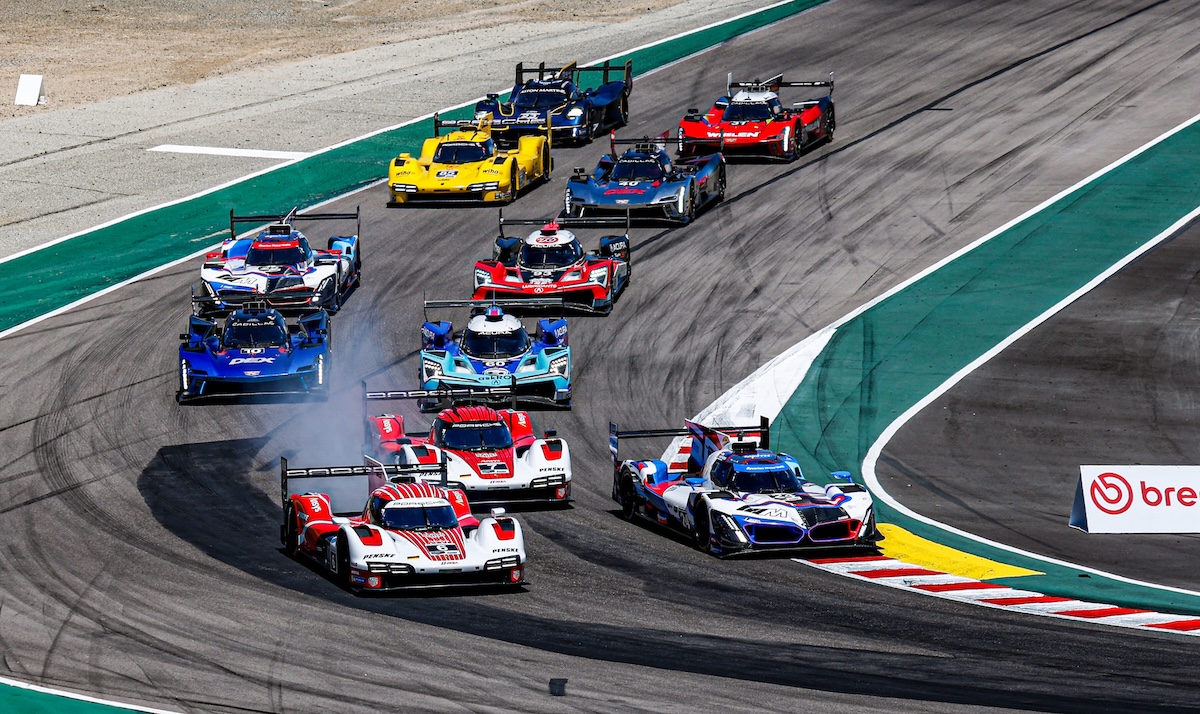
The adjustment amounts to significant horsepower increases and minimum weight decreases for the Acura ARX-06 and Cadillac V-Series.R, and the opposite adjustments for the BMW M Hybrid V8 and Porsche 963, which have had power reductions and weight increases for the Detroit street race. The Aston Martin Valkyrie has had no significant changes to its power, weight, or maximum stint energy.
The IMSA Technical Committee (ITC), in collaboration with the manufacturers, traditionally sets the parameters of horsepower, weight and maximum stint energy based on a five-race rolling average.
"The goal each and every time is to have a transparent process with our manufacturers to make sure that everybody understands that IMSA has a responsibility to have equal and fair competition, and also to take all of the factors that play into performance on-track, and make adjustments," Doonan said. "All of these changes are based on a data-driven process. I think in the end, we've had a rolling average process year-to-date, and we've realized that that rolling process hasn't reacted fast enough in equal and fair competition.
"You want to do the right thing and make adjustments that are based on a process. But also, when things are somewhat diverging in terms of competition, when you've got a couple of cars outside the performance band, and a couple of cars on the low side, you want to bring everybody together."
More IMSA

Among the four OEMs that have participated in GTP since the 2023 season, Porsche Penske Motorsport has won every IMSA WeatherTech SportsCar Championship race this year and has finished 1–2 in each of the last three races, while BMW M Team RLL has won the pole position for all four events. Meanwhile, Acura and Cadillac sit a distant third and fourth in the GTP manufacturers' championship, and none of the three factory Cadillacs have scored a podium finish between them this year.
"What we'll do going into Detroit is still look at the rolling average, no doubt. We don't want to pull the rug out from anybody else," Doonan emphasized. "But we're also doing, call it a manual adjustment, such that we take into the percentage of advantage we've seen on cars in both categories – prototype and GT – going forward, and we've addressed this with the manufacturers this morning.
"We'll let them know what the process looks like going forward. In general, the overall process is really no different than it was in 2024, in terms of correcting lap time. But when we see an instability in the BoP, we want to make adjustments such that the competition is as tight as possible."
Doonan stopped short of saying if there will be significant changes to the long-term processes of setting the BoP parameters – such as altering the number of races calculated in the rolling average, or putting a greater emphasis on tire performance and drop-off as the FIA World Endurance Championship has done this season. But he was very candid about the amount of data that has gone into setting the BoP parameters in all applicable classes of IMSA competition, and the desire to make consistent decisions based on the data that the ITC has at its disposal.
"We've got an awesome group of engineers that are combing through reams and reams of data from these races. And thanks to our partnership with Bosch and all the data that comes off the scrutineering loggers, we've got so much to look at and decide," he noted. "Going forward, we went to make sure that it continues to be converged. It's almost like a sandwich – because that's what the performance window is, it's a plus or minus that we want everyone to be in. We want to create fair competition. We'll look at every factor there is. We'll look at tires and tire performance – I think Michelin has continued to bring a consistent product for us, a high-quality, consistent product. So every one of the factors plays in, which makes it all the more difficult to get it right.
"I think the goal among our committee is to have some consistency. To be frank, it's a lot of work. Our folks are around the clock, going through data."
While acknowledging BoP is a never-ending process, Doonan stressed its importance to the overall IMSA product.
"Every time our ITC group gets together – honestly, as difficult as BoP is, it's one of my most favorite meetings of the week, and some would say, 'Boy, you need your head examined, John!' But to be candid, this is our product, and so it's a fun, exciting debate with my teammates about what we think we can do in transparency, but also in consistency," Doonan said. "To keep very tight competition, but also not have these major swings.
"We know the circuits, we know the cars, for the most part. Obviously, we're going to the wind tunnel. We're doing things in initial homologation to give us a baseline. But people are there to race – that's why it's called racing, not winning. People are going to evolve. And we just want to continue to provide a platform where everybody shows up, every weekend, knowing that they have a chance at a podium, at a win, and then ultimately the championship."

R.J. O'Connell
Read R.J. O'Connell's articles
Latest News
Comments
Comments are disabled until you accept Social Networking Cookies. Update cookie preferences
If the dialog doesn't appear, ad-blockers are often the cause; try disabling yours or see our Social Features Support.