The RACER Mailbag, November 16
Welcome to the RACER Mailbag. Questions for any of RACER’s writers can be sent to mailbag@racer.com. Due to the high volume of questions received, we can’t guarantee that every letter will be published, but we’ll answer as many as we can. Published questions may be edited for length and clarity. Questions received after 3pm ET each Monday will appear the following week.
NOTE: The Mailbag will take a break during the week of Thanksgiving, but please continue sending questions to the regular address and we'll run them the following week.
Q: It wouldn’t be a Wednesday with the Mailbag if I wasn’t reading pleas to market IndyCar better. I’m hopeful that the Drive to Survive clone and other stuff will work. I do think we should also remember that there are all kinds of fun ways to get the word out. The 2012 Red Bull F1 video for the soon-to-opened COTA track was great and viral fun, and got 6.3 million views.
Ads like Michael Andretti locking Alex Zanardi in a port-a-potty or the tour van driver in Long Beach being bored with the normal tour and talking about the amazing Champ Cars and having to weld the manhole covers down to avoid them being sucked up are also great examples. If you want to get people excited, yes you need drivers to have celebrity recognition (as you remind us frequently) but you also need either fun or controversy.
I’m not saying we need to see Chastain-like rim shots on Indy oval races, but let’s bring back fun and/or controversy to the promotion. Put drift tires on Josef’s car and have him lay smoke all around Long Beach. Launch a Dallara on a SpaceX test. Surely the marketing teams can come up with some fun stuff.
Peter
MARSHALL PRUETT: Amen, Peter. Somehow NASCAR, once the super-strict and stodgy and boring sanctioning body that was afraid to try anything fun or interesting, has become the more open and creative of the two series. We’re living in bizarre times.
Of all the things I hope to see happen with IndyCar, somewhere near the top of the list is Marketing VP SJ Luedtke waking up to find an email from the series’ owners that reads:
“Good morning, SJ. We’ve decided to give this marketing thing a real try next season. We also wanted to compliment you for what you’ve been able to do so far using the pocket change you’ve had to dig out from the couch in the lobby. We’ve heard that Formula 1 commits $20 million a year to its social media efforts. Just social media. We don’t know what they spend on the rest of their marketing programs, but we’re told it’s a much bigger number.
“So, while we don’t have that kind of cash sitting around, we are going to roll the dice and commit $2 million to a social media budget for you. And since your department is really small, we’re dropping another $6 million into your 2023 budget. That way, you can go and hire a few agencies to put their best people on creating marketing initiatives that move the needle for us.
“P.S., the $8 million disappears if ‘DEFY EVERYTHING’ makes a return.”
Q: Don’t know if you saw this online, but here is a starting grid of the 1966 Mexico GP autographed by the participating drivers. I am not a big autograph seeker but this is impressive.
David
MP: I live for things like this, David. Not sure I have anything as cool, but I was fortunate back in early 2017 to buy a pristine program from the 1967 24 Hours of Le Mans and then have my hero Dan Gurney and A.J. Foyt sign the cover at the 50th anniversary gathering Ford put together in Long Beach. I’m still trying to decide whether to frame it or store it inside Fort Knox.
Q: I'm always interested in reading stories from the inside sources about the health and future of IndyCar. The drivers, teams and team owners are at the top of that list. Certainly, increased awareness of the series is needed and many have spoken up about how that promotional network is being built up and how it needs to go further.
Before we bash the current ownership too hard though, have we all read up on our history and studied the failures and triumphs of the past? We're really focused on getting back to the '90s era of a near-convergence with F1 and dominance over NASCAR, however, the arc of history is much longer and convergence and divergence has happened a few times over that history.
Many of us have read John Oreovicz's book about the split and recent history of the sport. Gordon Kirby's book about Chris Pook and the history of the Toyota GP of Long Beach is also a good read and takes us back in time a little further. I would also recommend a third book by John M. Burns called Thunder at Sunrise: A history of the Vanderbilt cup, the Grand Prize and the Indianapolis 500, 1904-1916. It weaves historical context into the birth of American open-wheel racing. It also illustrates things that were wildly popular and successful as well as the challenges the sport contended with in its infancy. Marshall, can you recommend any other good books similar to the three listed for reading in the off-season?
Eric Gackenbach, Dearborn, MI
MP: Most of my racing books remain in storage, Eric, but we’re hoping to buy a home and move later next year, so if you want to circle back on a deeper list, I’d be happy to share some deeper cuts when they all go back on the bookshelves.
So, that makes it hard to suggest books which fit that exact criteria into a response, but of those that come to mind that shed deep insights on fascinating periods of the sport, For Gold and Glory by Todd Gould is incredible. Brick By Brick by Patrick Sullivan is another. I’ve bought multiple copies in the past and given them as gifts.
Black Noon: The Year They Stopped The Indy 500
by Art Garner.As always, if you can, please buy directly from authors and racing memorabilia stores when possible.
Q: I'm curious to hear your opinion about the status of the Road to Indy system. We are seeing with the current Linus Lundqvist situation with the prize funding being cut significantly from $1.3 million to $500K and the lack of guaranteed races for next year that he is struggling to find a spot in the IndyCar grid.
Does what we are seeing make it more likely that drivers who are trying to get into IndyCar will skip the Road to Indy pathway in favor of racing in the Formula Regionals championships in order to get the Honda-backed Super Formula seat, race in Super Formula for a year or two and then come back and race in IndyCar? It seems like a better option at the moment unless something changes.
Srinjoy
MP: It’s among the least impressive things Penske Entertainment has done since it bought IndyCar. Truly embarrassing.
In almost every instance, Indy NXT drivers pay for the privilege of racing in the series. Only in the rarest of scenarios do we have teams that have sponsors who cover most or all of the bill for the season.
That means the big grid coming in 2023 is loaded with parents who are using their own money – or the money contributed by a business they or friends own – to compete in Indy NXT. Prior to Penske Entertainment’s takeover in 2022, the big carrot the series dangled in front of those parents was the possibility for their children to earn a scholarship if they place at the top of their class.
I’d never say cutting the scholarship from $1.2 million to $500,000 leaves a champion like Linus Lundqvist with nothing, but in terms of what it takes to get to IndyCar, Penske Entertainment may as well go the rest of the way and trim it to zero.
When the average full-season IndyCar budget ranges from a low of $6 million to a high of $11 million, $500,000 won’t get you anywhere. Buying a ride for just the Indy 500 comes with a $1 million price tag, at minimum. What’s Lundqvist going to do, pay the $500,00 and pull in and park after 250 miles?
At least with the $1.2 million, which came with a guaranteed Indy 500 seat and two other races, teams were happy to speak with the new champions. Now, under Penske Entertainment’s big cost-cutting focus the racing series it owns, the offering of a real advancement scholarship has been a casualty. So, the good news is Indy NXT will have a monster grid next year because most of the seats were paid for before the scholarship was gutted.
My fear is not for 2023, but for 2024 when a new round of parents have to ask themselves if spending more than $1 million for their kids to race in Indy NXT is worth it due to what Penske Entertainment’s taken away as an enticement. I really hope it doesn’t happen, but if car counts fall in 2024, we’ll know why it happened and who to blame.
Q: I know this happened before Roger took ownership of the IndyCar series and the best real estate on earth (minus former White Castle), but Tim Cindric put his son in a NASCAR ride. Even though Joey Logano won the championship again for Penske, was this a move for Cindric to make more money racing? Does he have the skill to compete in IndyCar, or is daddy looking to make him rich? Does Tim Cindric see IndyCar as too dangerous or not profitable enough for the kid? Makes you wonder why Penske’s second in charge put his son in a tin-top while the team's strongpoint is in open-wheel.
Dave
MP: Are we talking about the same Roger whose Cup team won NASCAR’s two biggest crowns in 2022, starting with Austin Cindric taking the Daytona 500? Same Austin Cindric who won the 2020 NASCAR Xfinity championship for Penske? If so, I’m thinking Penske’s strongpoint is NASCAR along with IndyCar, where Roger also won the championship.
Austin spent two early years from 2013-2014 at the bottom of the Road To Indy ladder system and wasn’t spectacular. From thereon, it was all touring cars, GTs, and stock cars, where he found his groove and set him on a path to where he is today.
I’m not entirely sure where the attitude towards Tim is coming from in relation to his son or positioning his place in the team as some sort of money grab. Penske wouldn’t endorse Austin being in one of his cars if he lacked the talent to be there, and so far, he’s proven to be worthy of the opportunity.
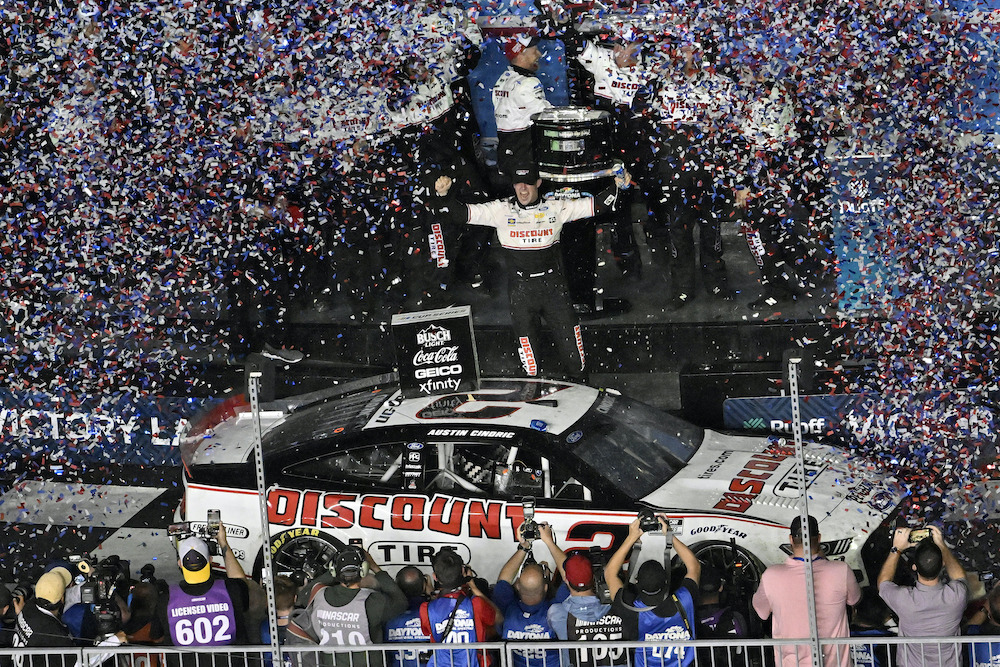
Cindric seems to be doing OK for a guy who's 'only there because of Dad.' Nigel Kinrade/Motorsport Images
Q: When could we start getting races (IndyCar, F1, NASCAR) broadcast in 4K? NASCAR on FOX will do one or two but regularly.
Shawn, MD
MP: From the intel I received, it won’t happen until NBC as a whole goes 4K.
Q: How about reaching out to Donald Davidson for some stories about the Rathmann brothers Dick and Jim? There seems to be some interesting facts about their racing careers that deserve to be remembered.
Doug Mayer
MP: Thanks, Doug. I’ll add it to the list.
Q: I was quite surprised to see how poor the IndyCar TV ratings are. On some race weekends the TV ratings were below NASCAR’s Xfinity SERIES and even NHRA. NBC reported that year-to-year 2022 was an improvement, but didn’t mention poor overall ratings. Other series offer more cameras such as helmet, shoulder, rear spoiler and foot cams for free! Those same series provide practice and qualifying at no charge. None of them charge to watch a race.
Like many, I have a nice-sized 4K TV and am not interested in watching a race on my phone screen and paying for such. Frankly, I don’t understand why Peacock is involved in IndyCar. I feel it alienates many fans at a time when the focus should be on growing the fan base. Toronto is one of IndyCar’s best venues and instead of attracting new fans it’s only available on pay per view.
Undeniably, the IndyCar fan base needs to grow. Dumping Peacock should be done immediately. I would suggest a fan feedback committee like other series have adopted. I invited some friends and neighbors to watch Iowa race. A couple of them asked about there being four types of tires: red, black, primary and alternate. I explained there are only two types. Commentators may want to use red/black or primary/alternate but not mix both names back and forth.
Kirk
MP: Hi, Kirk. Yes, IndyCar should do a lot of things, and if it were more popular, it would have better options. As for TV, 16 of the 17 races will be on TV channels, with the aforementioned Toronto event as the only one fully reserved for streaming. If you have a nice and new TV, is there a reason you don’t use it to watch IndyCar? Whether it’s paying for cable or one of the streaming services that offer live TV, why limit yourself to your phone? I’m confused. Peacock is there as the secondary solution for watching every race.
As for TV numbers, were you thinking NBC would announce an increase in ratings and then say its ratings were poor? Granted, that would be an epic press release. The ratings, compared to NASCAR, and F1 on an increasing basis, are poor because IndyCar is less popular than NASCAR and F1. Seems fairly self-explanatory.
And since IndyCar isn’t a ratings winner, it doesn’t get to have its practice and qualifying sessions aired live on NBC or the USA Network. The same goes for IMSA. Anything that happens before the race goes to Peacock because there are better ratings to be found with other shows and sports.
On the not-charging-for-races part, I’m fairly confident they all cost money to watch via cable or streaming platforms. If not, please tell me where to get all the major networks and cable outlets that air racing for free so I can save a lot of money.
Firestone refers to their tires as primaries and alternates, so there’s that, and since there’s a visual differentiator they use with colors so fans can tell the difference, calling out the color makes sense. I’m sure you explained that to your friends because without attaching the color of the primaries and the color of the alternates, only using primary/alternate or black/red won’t do the job.
Q: Peter Carey's comment/questions about F1 got me thinking. I get that DTS has contributed to F1 being more popular. But what demographics are buying these tickets at Miami, COTA, and Vegas at the prices they are looking for? I listened to a scribe discuss concerns about the age of F1 fans at races being 45 and older, and it makes sense. So the ticket prices are ridiculous. Even if I had the money, I would rather put it in my kids’ or future grandkids’ education fund. Or, fund an addition to my house.
So the question is, does F1 expect these prices to hold indefinitely? Where are the future ticket buyers coming from?
Steve Selasky, Rockford, MI
CHRIS MEDLAND: To be honest Steve, I’m pretty sure F1 doesn’t expect prices to hold indefinitely. They’re cashing in at the moment in certain areas. You have to look at the calendar as a whole, and only a few weeks ago the Mexico City promoter said the U.S. events are good because fans do both, and those who can’t afford tickets to Miami or Vegas see the value of Mexico.
Vegas is a three-year contract and is really F1 testing to see if it can have a race that is exclusively good for TV and with huge ticket prices in such a location – there’s none of the support events or other action that a racing fan will really want. That already exists with Austin, which is why that race has such big demand (also driving up prices) but I think COTA is more likely to fluctuate based on interest and be long-term, rather than a Vegas or Miami that might be shorter-term and then another city will want to host a race and people will also pay as a one-off.
What COTA does really well (and Miami did too, to be fair) is the same as any other U.S. sport and that’s ensure a whole event that is fun, regardless of the race itself. When you look at it as a three-day festival rather than just a Sunday grand prix, then tickets for Austin are around the ballpark I think you’d expect. The other two push the limits because of demand as new additions.
Future ticket buyers are going to be different for each race. I’m generalizing of course: Vegas is a demographic I can’t claim to be part of, but Austin is going to be more your general fan who already watches on TV and want to go to a great track, and Miami attracted a crowd through FOMO, creating a very shareable event that marketed itself through fans posting on social media and downtown parties. There will be some crossover, but unless first-time F1 goers in Miami get hooked on the racing, they’re less likely to go to Austin, but might seek out Vegas.
Having those differences keeps each race viable, and while it’s understandably frustrating for hardcore F1 fans in the States who love racing and want to go to as many as possible, they haven’t lost anything – those two new races didn’t replace Austin, only added to it. Hopefully if the growth continues then if there’s a fourth race in the States it would also be more in the COTA mould and provide a better value-for-money option for invested fans, but sustained demand would need to be high enough for that to work.
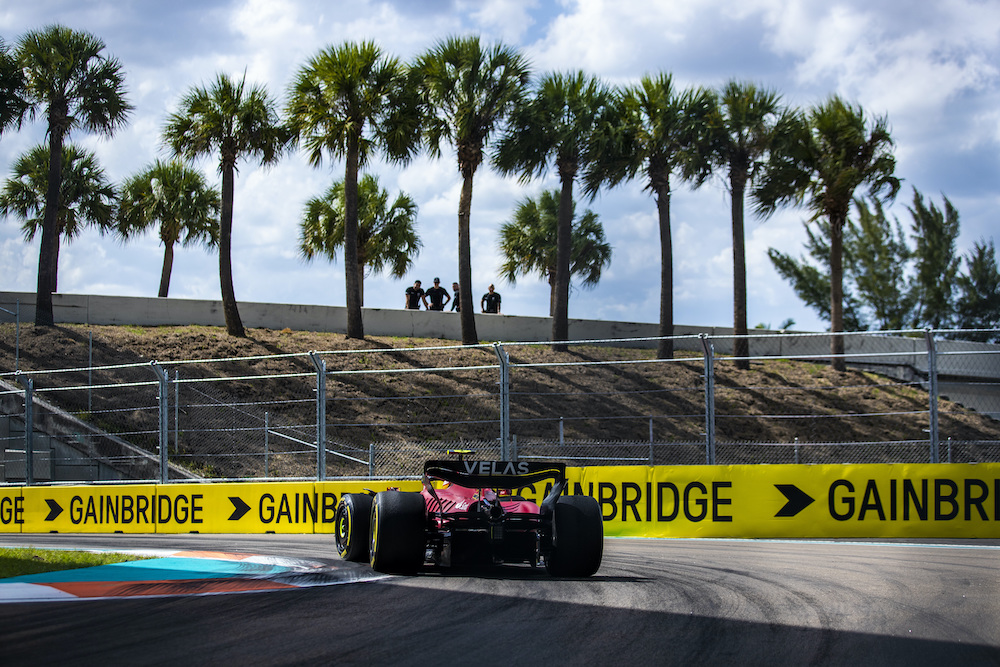
If Miami ticket prices are too steep you could always try disguising yourself as a palm tree. Sam Bloxham/Motorsport Images
Q: Chris, I have a problem. I have been watching F1 since live broadcasts began in the U.S. and have been following since the early ‘70s. My favorite F1 drivers are Daniel Ricciardo, Fernando Alonso and Sebastian Vettel. My favorite teams have been McLaren and Ferrari. Now Danny has been ousted and I can no longer support McLaren, Seb is retiring and Fernando has made another bone-head career move to join a lesser team. And of course Ferrari, season after season, have let me down since Michael Schumacher left. I'm no fan of Hamilton, Verstappen, Russell, Ocon or Norris.
I have watched all seasons of Drive to Survive, but I don't know why. It has made celebrities of the team principals but has made me dislike Wolff, Horner and Brown and I think Steiner is more showman than a competent leader.
I am also angry that Red Bull pushed aside Porsche, Andretti is being shut out and Herta didn't get a Super License. (And I consider Sargent as much of an American representative as I did Cheever, not much of one.) I think the Sprints are stupid, making the race a two-day, two-heat event and that the stewards and race director(s) look like amateurs, instead of the sport pinnacle. And Pirelli is backing down to the "world's best" drivers, who are afraid to drive on cold tires, like drivers in other series do. And don't get me started on the inability to race on wet tires.
I'm struggling, so can you give me any reasons to keep watching or should I just give up on F1?
Bruce K in Philadelphia
CM: A nice easy one for me here Bruce – it only feels like my job is on the line!
I’d start off with the racing. The stewarding still needs improving (as I mentioned in my answer to Eric), but the on-track action is improving and this was year one of the new rules – teams should be getting even closer over time. Plus, can I ask if you were entertained by last year’s title fight? That had many people hooked all year long, and those protagonists look set for another battle next year but with added contenders.
I genuinely think we could be on for a three-way fight for the title next year. Ferrari should have given Red Bull a harder time this season and while I know that failure has hurt you, remember how far off the pace the team was a year ago, and even in 2020. The gains have been big and quick, so now it needs to make a much smaller step to properly fight for the title across a whole season.
And Mercedes’ gains are a good sign too, because it shows it is understanding its weaknesses and should start next year closer to the top two at the very least. All three teams have drivers capable of winning the title, and Hamilton v Russell could be some power play in 2023 if regular wins are on offer.
Aside from that, your favorite three drivers all emerged long after you started watching, and who knows who will grab you attention moving forward as the one you want to support? It could be one of the current crop, or Logan might surprise you, or maybe a rookie such as Piastri comes in and keeps you interested. I’d have loved to see Colton get his shot too and it’s a shame that won’t happen for a few years now at least, but I’m pretty hopeful the FIA will adjust the Super License weighting for IndyCar moving forward to open that door a little bit more.
For Pirelli, it’s still going with the cold tires plan, it just changed the step it’s making next year before a whole new tire comes into play and tire blankets are banned in 2024 (I don’t think they’ll fix the wet tire issue though – it’s not the tires, it’s the spray, and if you want cars this incredible in the dry, they’ll always throw up loads of spray and make it impossible to see in the wet).
I’m almost asking everyone to reply again this week, but did you not enjoy the Sprint in Brazil? I can see when races are dull it’s just amplified, but when it works, it’s really good – at Interlagos we had a shock pole position on Friday, then two races full of drama, hard racing and controversy. And the fastest and most deserving guy that weekend still won.
Q: Medland, what in the wide world of sports was that stewards’ decision baloney from Brazil? Are the stewards really saying that Max should have 1) observed that Lewis wasn’t going to leave him enough room 2) oriented himself to see if he should bail out 3) decided to bail out of the corner 4) and slammed on the brakes in the hope that Lewis doesn’t pancake him and the driver behind doesn’t Ricciardo him? In the span of about a second, while Max’s front axle was never behind Lewis’s rear axle from the entrance to Turn 1 through the accident scene?
I mean, you know Lewis knew he didn’t leave him room if Lewis is quoted as radioing the team that it was a racing incident instead of describing it as the most dangerous driving since the 1995 Hungarian Grand Prix.
I know F1 doesn’t care about the product as much as it cares about the ticket prices, hospitality suites, and staging racing in places that high dollar investors want to go, but they can’t seriously talk about fixing the lack of overtaking while keeping rules that seriously potentially penalize overtaking drivers. Unless a driver is fully ahead of another driver, the leading driver can run the overtaking driver off the track all day long. There are two outcomes: the leading driver always remains ahead, or the overtaking driver is penalized for any contact, even if the leading driver creates it. This leaves no motivation for an overtaking driver to try anything but an ironclad pass.
A simple solution exists here. Obligate the leading driver to leave a car’s width to any overtaking car whose front axle is equal to their own rear axle. This would remove disincentives to passing and make steward decisions on contact much more straightforward. The overtaking or leading driver would receive a penalty almost always based on front/rear axle location at the time of impact, and like baseball, a tie (axle to axle contact) would go to the leading driver, putting the onus on them to leave room.
Keep up the good work.
Eric
CM: I don’t think I made many friends among Max fans with my column about his team orders row this week, but I do side with them (and you) on the Hamilton incident. Lewis actually said “that was not a racing incident” to his team, pushing for a penalty for Max, but to me it was one. Both put their cars in a position where contact was likely, which is why they each blame the other pretty firmly.
Max knew Lewis would close the door, and Lewis knew Max wouldn’t back out. They haven’t quite worked out how to race each other cleanly yet because Max is so aggressive and Lewis started pushing back just as hard a year ago. In Brazil he wasn’t allowing him to have the apex after not completing the move at Turn 1, but really, only half a car’s width more probably would have allowed him to keep the Red Bull behind on the exit. If Max had then hit Lewis after the apex it’s a different story, but he’d have had to adjust his exit speed to ensure he didn’t understeer wide into him from that angle.
The racing rules actually say Max was entitled to room there, so I agree with you that the stewards got it wrong. I don’t think it was a penalty for Lewis either, just a racing incident where they share the blame for the contact and in the end Hamilton was penalized by running wide and losing places, and Verstappen was by breaking his front wing.
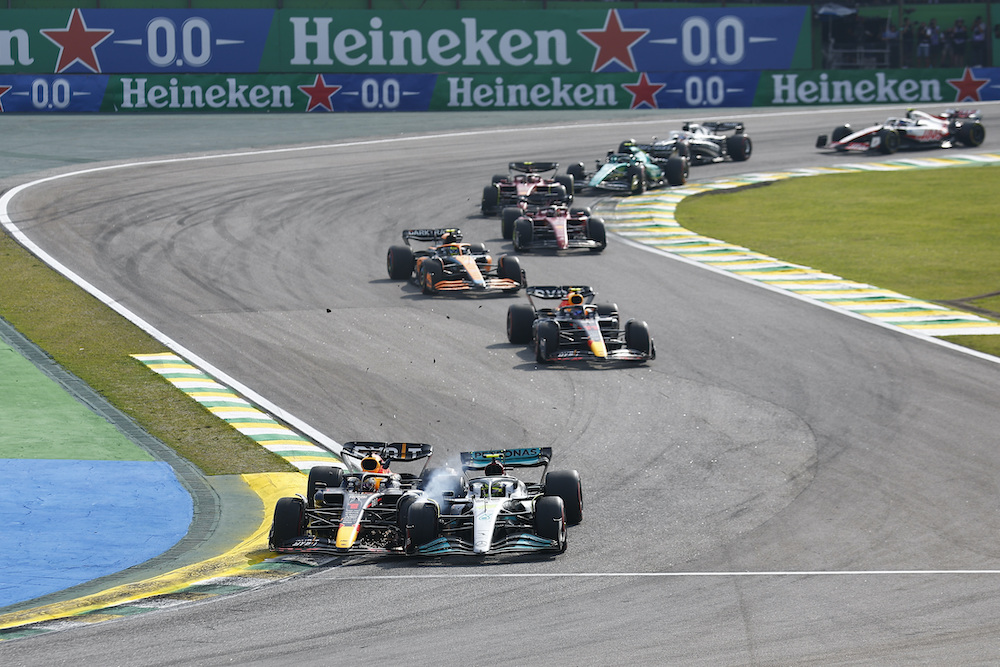
Fun and games. Sam Bloxham/Motorsport Images
Q: In response to Brian Gabriel’s comment on the Sky F1 announcing team and his defense of Crofty and Brundle (who are indeed knowledgeable), I’m drawn back to about 10 to 15 years or more, when in Canada, two different F1 broadcasts were shown. Both obviously used the F1-supplied feed; however, one was anchored by the ITV team of James Allen and Martin Brundle (with a smattering of Ted Kravitz, as I recall) and the other was a Speed TV product hosted by Bob Varsha with David Hobbes and Steve Matchett.
It was clear that the ITV team was much better versed in the nuances of F1, but I gravitated towards the Speed product. Varsha was a good presenter and I enjoyed Hobbes’ insights and he gave us the term ‘clag’, for which we should be forever grateful. Plus, I enjoyed Matchett’s stories about Berger passing gas when Steve tightened his belts. But the main reason I watched these guys is because the ITV team was too openly pro-British. They went insane over everything Button did (remember, until the Brawn year, Jenson had only one win in a rain-affected race), and the ITV team refused to refer to Eddie Irvine as being even remotely Irish, only grudgingly acknowledging he was an ‘Ulsterman’.
I started watching F1 in ‘95 and unless I’m very much mistaken, don’t remember Murray Walker and Jonathon Palmer lacking this objectivity… I mean Murray did refer to Schumi as ‘ze German’, but I seemed to recall they were as happy when Villeneuve won a race as they were when Hill did. Maybe time has altered my memory? Anyway, when faced with a choice, ITV had me reaching for the inferior Speed product, because the US based announcing team didn’t go nuts for Scott Speed, (also an inferior Speed product). The same is occurring now. The Sky Sports F1 team, (with perhaps a slight exception for Brundle) has very little objectivity when it comes to Lewis and now George, culminating in Kravitz’s inability to let last year go and Red Bull’s petulant ban.
Sky’s solution to better appeal to North American viewers? Showcase Danica Patrick’s woeful lack of F1 knowledge. The only time Danica seemed engaged during the Mexican broadcast was when she was talking to Ricciardo about NFL football. My friends and I all wish ESPN would go it alone and produce their own play-by-play from a booth and just cut to Sky for the pre and post-race. Not feasible, I know. I do believe in national pride and as a Canadian, I know our broadcast of international hockey tournaments is likely similarly cringe-worthy for anyone else, but I wish the Sky Sports F1 crew could tame the nationalism down just a little bit. (Or maybe I just wish current Canadian F1 drivers were not so bad, and I’m secretly jealous).
Trevor Bohay, Kamloops, Canada
CM: I feel like this topic could run and run so keep those opinions coming in, but I actually think it’s a bit too lazy of Sky to just use Danica and say that ticks the box. It’s not a broadcast designed around her, and she’s excellent on IndyCar coverage and has great racing insight, but needs to be part of a U.S.-specific set-up and not the more heavily British one you point out, Trevor.
Actually, commentary from Bristol would be feasible and then cut to the pre- and post-race shows from Sky, but ESPN is testing the water the other way with a bit more original programming and then taking the Sky feed for the race itself each time. We do similar on SiriusXM with a live pre- and post-race show that’s U.S.-specific and produced, but then cut to BBC 5 Live for the commentary as it stands.
The main reason I wanted to respond to your point though is that I think options are good, and F1 TV means there’s already a neutral option there for U.S.-based fans who would rather have something a bit more nuanced. Perhaps ESPN could offer its own coverage alongside a feed that is from F1 TV.
None of it is easy or cheap to do, I’ll admit, and F1’s on a good trajectory that has been helped by ESPN, but it’s just some of the ways I feel the sport can better engage with the audience here.
THE FINAL WORD
From Robin Miller's Mailbag, 19 November, 2014
Q: Today I went on YouTube to watch the greatest race of all time, the 1982 Indy 500, and something about this race always bothered me and nobody seemed to talk about it. No, it has nothing to do with the 'Coogin' crash, or ABC’s obsession with showing Rick Mears’ wife, but it has to do with Bobby Unser. I’m wondering how in the heck did Uncle Bobby go from defending winner to managing a small team like Garza Racing? Seemed like a very odd pairing to me. Can you give us the story behind that?
Derrick, Lancaster, PA
ROBIN MILLER: A quick phone call to Robert Unser for his story. “It was all because of my youngest son, Robby, and trying to help get his racing career going. I’d neglected my other boy, Bobby Jr., for the most part and he was a stranger to me so I wanted to make it right with Robby. And believe me, it was tough to walk away from that PC10 of Roger’s [Penske] because I developed it and I knew how fast it was. It ranked right there with Dan Gurney’s 1972 Eagle. I’d broken every track record testing it and I promised Roger I would run five races for him in 1982, but I just couldn’t get along with Derrick Walker [team manager] so I quit. Flew home to Albuquerque and called Roger and told him I wasn’t going to drive anymore. That was a tough day.”
Unser then agreed to help develop Pat Patrick’s Wildcat in the spring of 1982 but the bodywork flew off during a test at Phoenix and damn near decapitated the three-time Indy winner.
“That was it,” says Unser. “Damn near put out my eye, and I drove myself to the hospital and decided, ‘No more.’ I wasn’t broke and I was healthy so I put away my helmet – at least, for Indy cars.”
Uncle Bobby got paid a pretty penny to help Garza, who reportedly needed a shrink after two years ;-)
Marshall Pruett
The 2026 season marks Marshall Pruett's 40th year working in the sport. In his role today for RACER, Pruett covers open-wheel and sports car racing as a writer, reporter, photographer, and filmmaker. In his previous career, he served as a mechanic, engineer, and team manager in a variety of series, including IndyCar, IMSA, and World Challenge.
Read Marshall Pruett's articles
Latest News
Comments
Comments are disabled until you accept Social Networking Cookies. Update cookie preferences
If the dialog doesn't appear, ad-blockers are often the cause; try disabling yours or see our Social Features Support.