The RACER Mailbag, July 13
Welcome to the RACER Mailbag. Questions for any of RACER’s writers can be sent to mailbag@racer.com. Due to the high volume of questions received, we can’t guarantee that every letter will be published, but we’ll answer as many as we can. Published questions may be edited for length and clarity. Questions received after 3pm ET each Monday will appear the following week.
Q: Formula E at the Indy road course? Seems perfect. Andretti involvement and all. Is it too political?
Gene Markiewicz
MARSHALL PRUETT: Not sure about the political angle, but I’d say not holding a Formula E event at the Speedway would fall under the category of "practical" since it would be the most boring damn race in 100-plus years of competition at IMS. This would be a race nobody asked for, run in front of empty grandstands.
I can tell you, however, that if you’re a fan of sports car racing, be prepared to buy tickets for a 2h40m IMSA WeatherTech SportsCar Championship race on the IMS road course in September of 2023. It’s set to replace Mid-Ohio.
Q: After reading your article about Foyt parking the No. 11, I wondered if there was a reason they didn’t park one of the other cars in order to preserve No. 11’s superior position in points and potential for Leaders Circle money? Neither No. 14 nor No. 4 appear to be on a trajectory to finish 22nd or better in points. Couldn’t they switch drivers and sponsors around? I know No. 14 is probably sacred for Foyt. Why not put Kellett in No. 14 along with his K-Line sponsorship and put Kirkwood in No. 11? Is there a rule against mid-season switches like this?
Tom Hinshaw, Santa Barbara, CA
MP: If the drivers and sponsors are open to it, teams can move pieces around as desired, but in relation to the Leaders Circle, that’s a slippery slope. The LC is a merit-based competition to earn guaranteed prize money, so if you strip the merit part out of it, teams would spend each season moving at-risk drivers and sponsors to different entry numbers, because that’s exactly what would happen if such insanity were allowed.
Q: In the June 29 Mailbag, Josh Laycoch asks about 500 winners who never hit the wall at IMS, and specially mentions Ray Harroun, since he won the only 500 he participated in. After recently reading Mark Dill's book I can say the Harroun did have an unfortunate tire failure at IMS during a race meet in May 1910, where the Marmon Wasp took a solid beating from the Turn 3 wall.
Gabe in Northwest Indiana
MP: Thanks, Gabe. Dill’s book is a delight.
Q: Menards always had colorful cars have been in both NASCAR and IndyCar for a long time. I don’t see any Menards sponsorship in IndyCar this year. Why the change? Do you think he will come back to IndyCar?
Jim, Eau Claire, WI
MP: Pagenaud’s No. 22 entry that made use of it is no longer being fielded, and it appears the three surviving entries are all booked with sponsorship. If there was a need, I’d hope John Menard would step back in on the IndyCar side.
Q: Why not run race trim (no HP boost ) for Indy 500 qualifying?
Gary, Auburn, CA
MP: Because it’s the one time of the year where going for maximum speed has been something to celebrate, so the idea of betraying that excitement -- as we experienced this year -- to go slower for no particular reason is probably why race boost isn’t used.
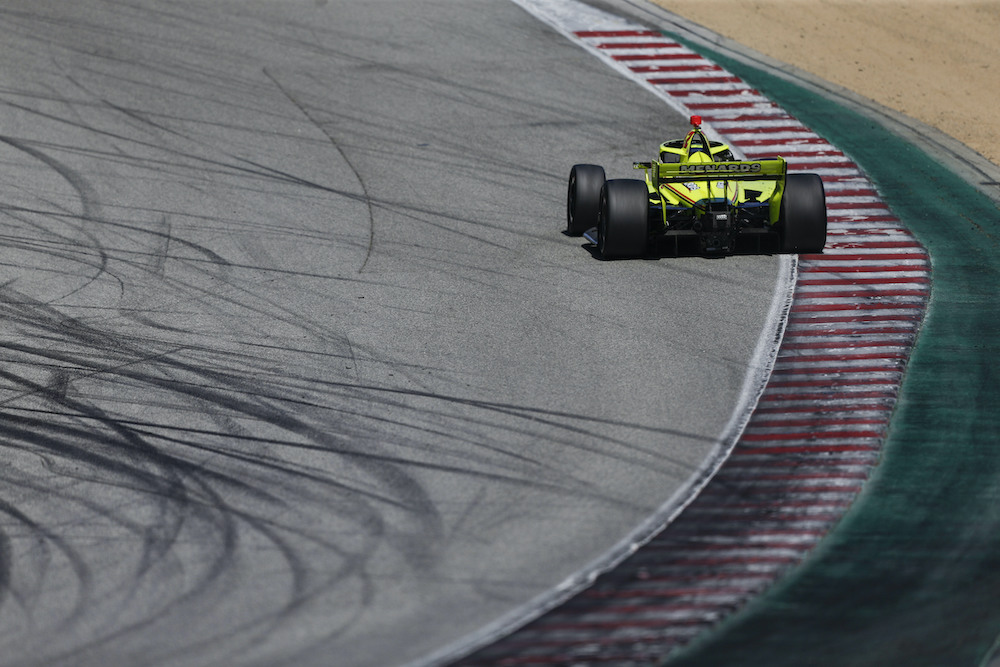
Have we seen the last of Menards liveries in IndyCar? Jake Galstad/Motorsport Images
Q: At one time, IndyCar said that with increasing car counts, it may change the first round of road course qualifying from two sets of 12 cars to three sets of nine cars. With all the recent driver complaints regarding traffic issues during the qualifying sessions, is it time to do just that?
Mike, Holland, MI
MP: Yes indeed, that was from a story we did a little while back with Jay Frye, and so far, it hasn’t been needed this year but could stand revisiting next year if more full-time entries appear.
But here’s the problem: We could change road/street course knockout qualifying to having only two cars on track at the same time and I swear to God, we’d still have complaints about blocking or turbulence or dirt being kicked onto the track or some other grievance aired. I’m tired of the bitching and moaning, tired of the constant cries of "I WAS BLOCKED" over the radio and the non-stop messaging from pit lane to race control for those instances to be reviewed.
Kill the blocking penalties, make the #FrontNose and wing assemblies stronger, and let the nerfing and paybacks begin as drivers police each other on the spot.
Q: I see that Chase Elliot won the pole at the recent NASCAR Road America event with a 1m34s-plus time, which was shockingly 10 seconds faster than Alexander Rossi's pole time at the Road America IndyCar event just two weeks ago.
Does RA have a shorter circuit for the stock cars, or I am I dreaming that they are suddenly so much better than the IndyCars on road circuits?
William "Colonel" Sanders, Overland Park, KS
MP: Well, my chicken-loving friend, it might be time to lay off the special sauce. The recent NASCAR pole was a 2m14.427s lap. Never hurts to consult Mr. Google.
Q: Not sure if you know who to send this to, but when watching in-car cameras on the IndyCar app, so many times they default to showing the nose camera for long periods of time. While this is a cool cam, the overhead cam where you can see the driver is the one we viewers want to see. It gives the best view possible. The nose cam misses so much and is not a great perspective.
Please, please change to the forward overhead cam for default!
Craig
MP: The people (OK, person) has spoken, IndyCar!
Q: Watching practice, qualifying, and the great race at Mid-Ohio, I noticed some markings on the track that seemed to have nothing to do with the racing. One was a mark that was somewhere between a V and a right angle. Others were just lines on the track that seemed to have nothing to do with any track markings. They were all white. Any idea what they were? I enjoy the Peacock broadcast, although I do wonder how some of the accidents are timed to be in the commercial breaks. They do a pretty good job of covering them after the fact.
Mike
MP: Without photos to go by, it’s hard to say, but most tracks like Mid-Ohio which stay extremely busy with driving schools will add colors or markers throughout the circuit that are used by those schools for whatever purposes or exercises they’ve devised.
Q: The key to not having yellow flag lotteries is to equalize with open pits, which IndyCar seems to be so against, with safety being the excuse. Another thing it could easily implement is a yellow mode on cars like a pit speed limiter, so as soon as a yellow is thrown the drivers would have to go to a yellow mode (with a speed restriction) which will enable race control to keep the pits open, or at least go the Virtual Safety Car route. They don’t seem to want to change any of these things to bring parity to racing, which just upsets me so much.
Another thing that annoys me is that the back of the field is scrambling so much during the rolling start that they are not even in position before it goes green, forcing backmarkers to fall back right at the start. Why they can’t go to standing starts with road and street courses is beyond me.
This also necessitates drivers needing diverse skills to do standing and rolling starts (on ovals), and for a series that touts drivers needing diverse skills to deal with diverse set of tracks, they are very shy about changing things to make racing exciting.
Shyam Cherupalla
MP: Yes, the idea of VSCs has been floated many times; with a new electronic light panel and its software in play now, new options exist. Rolling starts work just fine; if the tailenders don’t want to pack up, they can suffer the consequences. The idea that only standing starts are capable of producing exciting racing is silly.
Q: I watched both the Mid-Ohio IndyCar race and the Road America NASCAR race last weekend, and was struck by a fundamental difference between the two classic road courses. Road America has generous paved runoff areas outside the racing line in many of the turns, while Mid-Ohio does not. In the race at Mid-Ohio the cars often put a tire or two off the track, kicking up plumes of dirt and in some cases sending the cars off course. At the Road America race, especially in Turns 1 and 5, there were expanded paved areas outside the turns to allow cars a second chance to gather themselves up and get back on course, even if it cost them a position or two.
I felt this made the Road America race much better from a fan's perspective, as cars spent fewer laps under yellow flags because they didn't get stuck in the gravel traps as much.
Why wouldn't Mid-Ohio have extra, paved runoff areas outside the turns like Road America? Circuit of The Americas has a huge runoff area outside Turn 1 and it makes for great passing opportunities as cars funnel back onto the track. I think Mid-Ohio would benefit from more runoff areas outside their tight turns to keep the action moving, reduce the lack of visibility when plumes of dirt are kicked up and help reduce yellow flag laps. What is your opinion?
Kevin P., Los Angeles, CA
MP: I’m sure it would help, as you’ve outlined, but it would require vast sums of money because all of the roads and camping areas that surround Mid-Ohio would been to be moved back as well. The major issue is the entire facility is like a time capsule back to what it was like to go racing in the 1970s and '80s. I’ve long referred to Mid-Ohio as the most period-correct track on the IndyCar (and IMSA, and NASCAR) calendar.
So before money is spent to push the corner runoffs back, the whole place needs a facelift. Don’t get me and tens of thousands of local fans who love the place wrong; been going there forever and it’s made awesome by the super friendly fans and campers, but compared to almost every other venue we go to, it’s starting to give sanctioning bodies a reason to ask if it’s up to par with the rest of the regular stops where modern looks and modern conveniences are the norm.
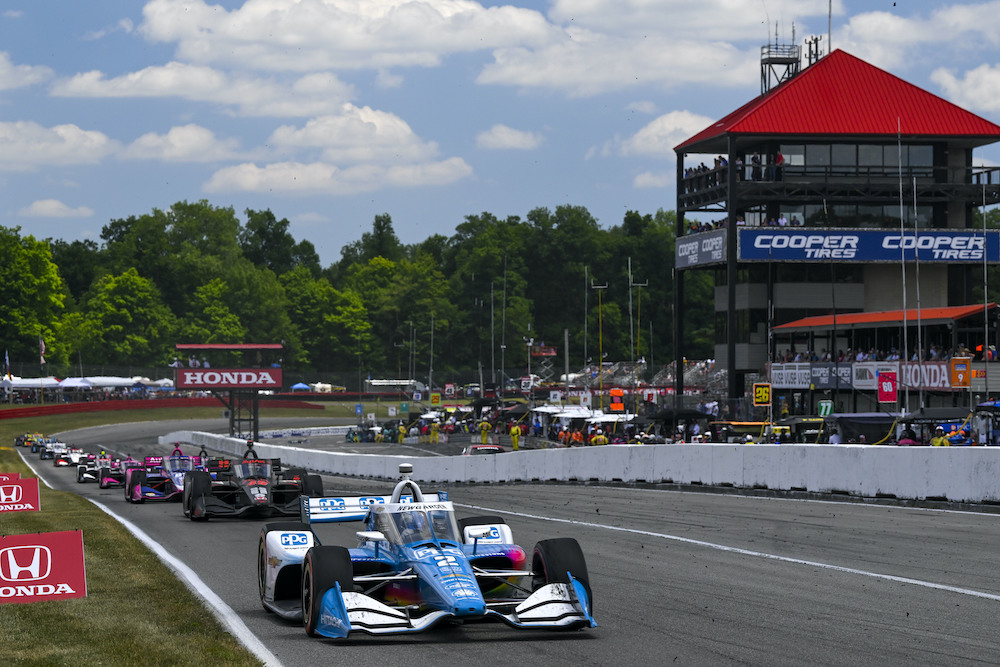
Think of it as the racetrack version of a classic rock station. Gavin Baker/Motorsport Images
Q: Every so often I enjoy watching old IndyCar races on YouTube. I've noticed that when watching races from the '80s that they often refer to the series champ as the "national champion." What's the story here? That phrasing is never used today.
Although the races were all CART at this time, was there still some sort of USAC involvement? Was it a sponsorship thing? Or, were the television presenters just trying to use phrasing that the general public would understand?
Matthew
MP: Just a change in phrasing (I can’t help but giggle and think of the FX series "Archer"). It’s a legacy from when regional and national championships were very much a thing in motor racing. Not to date myself, but when I worked on USF200 and Formula Atlantic teams in the late 1980s and early '90s, we had just that -- East and West championships -- where separate title winners were crowned. You’d also have a cool annual coming together on the Atlantic side where the best from both series came together for a race weekend to see who was best, but the winner was not named as the national champ.
After CART was formed and USAC was dropped as the sanctioning body, yes, there was a brief period where USAC continued to hold IndyCar events in the (unsuccessful) hope of maintaining control, giving us a late '70s forerunner to "The Split" that led to the formation of the IRL that competed against CART starting in 1996.
Q: My question is about IndyCar’s internet presence. When I type "F1" into a Google search, Google brings up a box showing the upcoming races, the results, recent news, and recent Twitter posts. This is similar to what happens when you Google everything from NASCAR to the NFL to even the Australian Football League.
For whatever reason, when I search "IndyCar" I don't get the handy-dandy little box with the schedule and results. Do you suppose it would be possible for the powers that be to ask Google to add that feature, or figure out why it isn't implemented? Everyone who Googles F1 instantly knows where and when the next race is. I, as a fan of IndyCar, have a difficult time sometimes keeping up with the schedule and trying to find it on IndyCar's site.
James Roney
MP: Yet another great note and call to action from a fan, IndyCar. I’m positive someone from the series could reach out and do as you suggest, James.
Q: Watching Scott Dixon in the lead of the Indy 500 this year, two names were going through my head: Mario Andretti and Dale Earnhardt. Thinking of those two names, I had a feeling something was going to go wrong for Dixon just like Mario at Indy or Dale at Daytona, and then it happened. With all the championships and races they have won, Mario went one for 29 at Indy, Dale went one for 23 at the Daytona 500 and now Dixon is one for 20 at Indy. It seems to me that with Dixon, more people hold it against him that he has only won one 500 compared to Mario at Indy and Dale at Daytona. Do you get the same feeling?
Ryan
MP: The "Why doesn’t Dixon have more Indy 500 wins" thing popped up rather heavily last year and was compounded this year when he was so clearly the class of the field. Beforehand, it wasn’t a regular topic of conversation.
It reminds me of all the insane criticism Steph Curry got after winning three NBA championships without being named the Final MVP. Like the three titles weren’t incredible enough on their own. Then he and my Warriors won their fourth championship, Steph was named MVP, and the critics have gone silent.
Not sure what one could find to criticize with Dixie after six titles and an Indy 500 victory to his credit (not to mention some stellar sports cars wins). If he retires with one and only one at Indy, it will be a shame in the same way it was for Mario and Dale, but those two are revered as two of the all-time greats. I can only hope the same reverie is given to Dixie.
Q: We always camp near the Keyhole for Mid-Ohio and this year's race was really good. The race itself was entertaining but I was gutted for AMSP as we met with some of the team camping on Saturday night. There were several people there and it was great to hear the stories, but what surprised us most was that the teams are still experiencing part shortages. They said it was across the board, but companies like Dallara, Cosworth and Xtrac are still short on parts, which is stunning given we are in July!
They said one of the best people in the paddock had left Xtrac due to the continued parts issues. Cosworth, they said, apparently have always had long lead times and bad service, and they were not too kind to Dallara, either. They also said it was not a supply issue, just a lack of planning for parts that have been in use for years.
So the question is, how does the series look at sole suppliers when the suppliers can't provide parts? You would think they would allow others to supply parts that the suppliers can't keep up with. Are there plans for the series to allow others to make parts to ensure the teams have what they need?
Todd
MP: I think they’d look at them with compassion and understanding as supply chain issues continue to be a very real pain in the ass for every major series here. In a limited number of instances I’m aware of, the issue has been with limited machinery or staff to mass produce an item. Also in limited instances, I’ve heard of a supplier being overwhelmed with other contracts to satisfy, which have pushed some IndyCar items back on the to-do list.
Most of the issues I know about involve a lack of raw materials, so if Sole Supplier A is short on a metal it needs to machine, I can’t see how someone else would have an abundance of the material to solve to production problem. But if teams are unable to run because of a shortage and an outside vendor can somehow step in and resolve the issue, I can’t see IndyCar saying no.
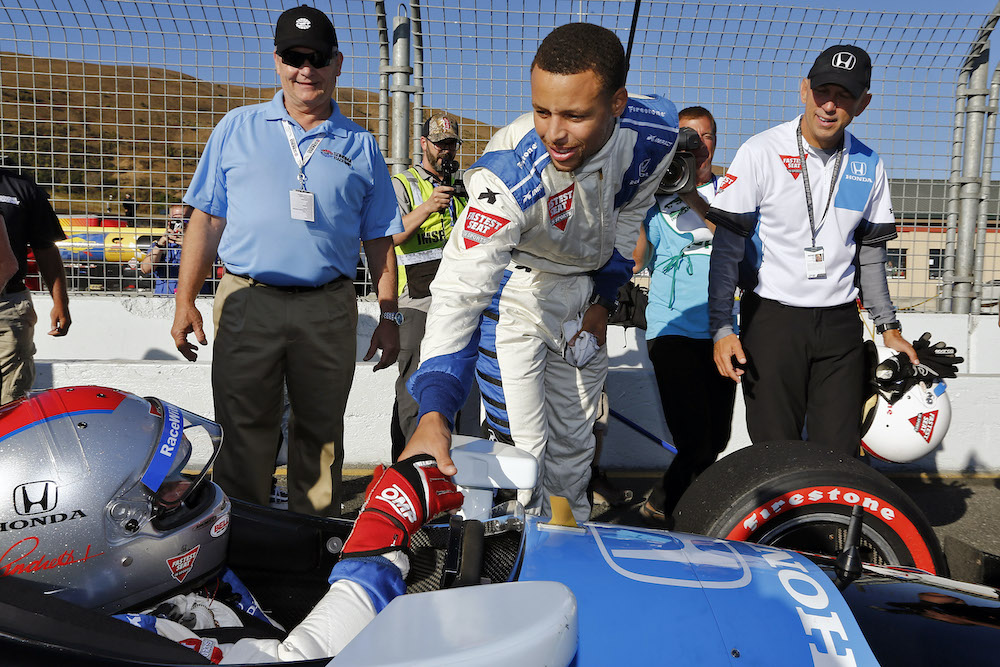
Yeah, but what has Steph Curry ever done in an IndyCar? Phillip Abbott/Motorsport Images
Q: With a current 17-race schedule and the likelihood of losing Texas, will drop it to 16? I have come up with venues, some have been used before and some not. Permanent road courses: CMTP, Watkins Glen, Road Atlanta, NOLA Motosports Park, Sebring. Ovals: Richmond, Kentucky, Milwaukee, Fontana, Michigan. The oval venues have a lot of potential if IndyCar can find a way to piggy-back with ARCA -- they are racing at Michigan and Richmond to small crowds at standalone races. If IndyCar was included, it would help both series. I know IndyCar had a three-year deal with Rich-mond just before the COVID outbreak -- I don’t understand why R.P. has not reached out to them. Or maybe he has.
A.E., Danville, IN
MP: I’d put my money on next year’s schedule looking an awful lot like this year’s calendar. R.P. said he wanted to keep Texas, so given his track record on getting what he wants, I’ll plan on covering the race next year. The interest shown by Richmond waned during COVID, so despite having a wedding planned, it never went beyond an engagement party.
Q: I went to Mid-Ohio for my first-ever Trans Am race and it was awesome. I went to the TA race and watched the TA2 race on the live stream. While watching the TA2 race there was a stack-up of cars on one of the restarts which wrecked a couple of cars. Two drivers were interviewed after getting out of their cars and they both seemed to blame the guy in front of them for not going on the green flag. My question is, what level of gamesmanship are officials generally able to tolerate on restarts?
Brandon Karsten
MP: I’ve never seen racing series take such things more seriously than they do today. In a general sense, the days of lagging back and then taking off to build a lead on the trailing driver(s) has been rooted out with start/restart zones and intense scrutiny on the leading drivers to ensure they aren’t cruising around to either gain an advantage or risk having the drivers behind stack up and run into each other.
Q: I may get roasted in the comments section, but I have to ask this question. Given that IndyCar is planning for a new chassis, is it possible it could use, for example, the 2022 Haas F1 design, and adapt it with simpler, cheaper suspension components and aerodynamic pieces?
It is a fairly safe design, as Mick Schumacher has demonstrated, and could be reinforced for oval use if tests show any deficiencies. Dallara already builds for Haas, so intellectual property could be protected. It is designed to accommodate a hybrid power train. I would think economies of scale would make the price reasonable. Are there any rules in F1 that would prevent Haas, or another constructor, from selling the design from a previous year? Obviously, Haas will be designing a new car for next year.
Bary Berger
MP: If anyone’s going to do the roasting around here it’s me, but you’re safe, because it’s a great question. If a team/company like Haas and its chassis builder were allowed to do so, a significant redesign would be required since F1 cars aren’t conceived or built to handle monster superspeedway crashes at 230mph or above.
We know an F1 team would bring great knowledge to chassis design/construction on the road racing side, but it’s the oval ignorance that would be the major concern -- with Dallara as the obvious exception. The one thing F1 teams don’t know how to do is to mass produce a car at a comparatively low price point, so that, combined with the absence of oval safety knowledge, would have me feeling rather leery of such things.
Q: During the Indy Lights race at Road America when the car went into the catch fencing, it looked like the AMR guys did most of the repairs. Seems to me that other tracks have employees to do this job. I doubt the AMR crews are trained to do repairs.
Jim Davis, Tucson, AZ
MP: I was in the area when the repairs were going on and didn’t count who was from where, but with an IndyCar race to run and a fixed TV window, getting the fixes done ASAP was needed. As for training, we’re talking the same type of poles and fencing you might install in your backyard, so I’m confident anyone could have helped by following instructions from those in charge at the track. If anything, I’d think the track would have thanked the AMR team for the quick turnaround.
Q: I’ve watched IndyCar at least since Nigel Mansell came in, and have successfully converted my daughter and sister into fans, but I’m still having trouble explaining why the pits are closed sometimes and other times not during a yellow flag. I’m not the only one, having heard Bell, Hinch, and Diffey talk about it on the broadcasts. At the risk of this becoming as common as wanting Cleveland and Milwaukee back on the schedule (which I do), can you please explain again, once and for all again, race control’s logic behind when the pits are open or closed during cautions?
I’ve read 7.1.3.2 and 7.2.2 in the rulebook, but they don’t address specifics, so I have to wonder if they decide by rock paper scissors, a coin flip, or odds and evens.
Also: how is a driver’s place determined during a yellow pit stop? If the pits are open, Driver A pits. Does he keep his same position as before he pitted (P13, then pits, can he go back to P13, or does he go to the back of the field)? I get that the rules say overtaking isn’t permitted, but that implies he can’t advance his position (from P13 to P3). Where does a driver in P13 end up and why there?
A suggestion for NBC/IndyCar: Add the team name to the driver’s info onscreen. The way it is now, you see the car number, driver’s name, and major sponsor (“12 Will Power Verizon” with a picture of the car). That’s fine, but it’s very confusing keeping teams and drivers straight when drivers change teams at the end of each season, rookies come into the series, and when one driver subs for another. Change it to: “12 Will Power Verizon Team Penske,” or “51 Takuma Sato Nurtec Dale Coyne Racing w/RWR” or “30 Christan Lundgaard Shield Cleansers Rahal Letterman Lanigan”.
Yeah, commentators might give that information during the broadcast, and sure, it’s on the IndyCar website’s driver’s page, and it might crowd a small graphic, but c’mon, when they show an in-car shot, it’d make things easier for the more casual fan to keep track of who’s where. Plus, it’s even more exposure for the smaller teams (Paretta, D&R, Dragonspeed, etc.).
Rich McGuigan, KY
MP: The only place where competition is allowed during a yellow is on pit lane, just as you’ll find in pretty much every series I can think of. If you’ve watched an IndyCar race where the pits were closed under a yellow, then opened for the field to pit as desired, I have to believe you’ve seen exactly what takes place.
As for why IndyCar closes the pits, I’ll see if race director Kyle Novak will share his thoughts the next time we speak.
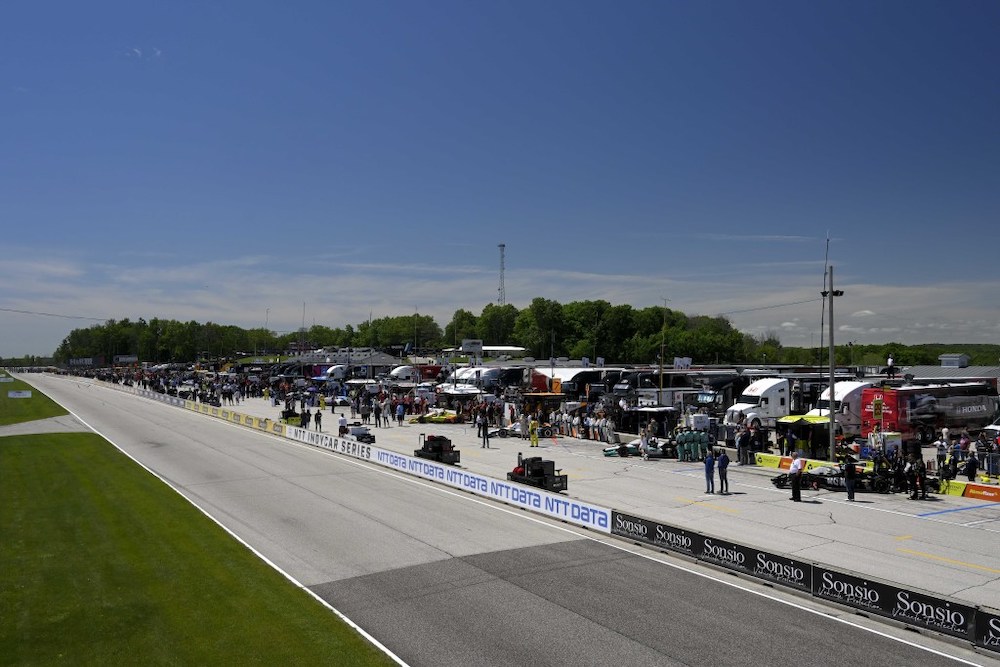
Pitlane's a pretty straightforward place – until you start adding yellows into the mix. Gavin Baker/Motorsport Images
Q: I'm interested to get your thoughts on a slight variation of IndyCar's caution and pit open/closed procedures. I realize that this comparison is going to be apples and oranges, but on road and street courses, why doesn't IndyCar look at implementing a Virtual Safety Car procedure like F1 uses? You had a great point around local yellows which F1 also throws, so wouldn't the logic be to utilize a similar system?
Chris in Alexandria
MP: We won’t see it this year, but I’d expect IndyCar to use its EM Marshaling System to bring VSCs to bear in the near future.
Q: In IndyCar, drivers control the use of Push to Pass. Each car given so many seconds of PTP depending on the track and number of laps in the race, correct? In F1, who controls the use of DRS? It seems to me the driver is not in control of when DRS is activated. Can you clarify for me?
Fred in Oregon
CHRIS MEDLAND: DRS can only be used in certain zones (marked out by the FIA ahead of each race weekend). They're usually on the track's main straights, so in Austria there were three zones -- one on the pit straight, one on the run from Turn 1 up to Turn 3, and one from the run from Turn 3 down to Turn 4. Each zone has a detection point that is usually one corner before, and if a car is less than one second behind the car in front, it will be able to use DRS in the next zone. If a car is more than a second behind at the detection point, it can't use DRS in the next zone (even if it closes up through the corner).
So the FIA controls when DRS is available to a driver through the automated detection points, and then the drivers activate it themselves inside the car when it is available. Theoretically, a driver could choose not to activate it if they didn't want to.
Q: I’d like to know how "American" America’s F1 team is. What, if anything, does Haas do in the North Carolina facility, and are there any key American personal within the team?
IndyCar (and Buffalo Bills) fan in western NY
CM: Kannapolis only houses a Haas machine shop and some HR/finance departments, with the rest of the team based either in Banbury in the UK or at Maranello and Dallara in Italy for logistical reasons. There is a very good American in a senior engineering position, though, with the voice you hear on Mick Schumacher's radio being Gary Gannon. Gannon is Mick's race engineer, and was born in Nebraska. As a Cornell graduate he worked at HPD before moving to the UK, eventually joining Marussia and then Haas.
The team’s head of reliability, Scott Vizniowski, is also from the U.S. and now works at Maranello, while the team has hired from IndyCar too as Trevor Green-Smith – who was Alexander Rossi‘s assistant engineer at Andretti – joined as a performance engineer this season. But don’t forget that regardless of where it’s based, the money behind it all is very much American — the team wouldn’t exist if it wasn’t for Gene Haas.
THE FINAL WORD
From Robin Miller's Mailbag, 15 July, 2015
Q: I read that back in 1986 in CART’s heyday, Ferrari had a car all put together and ready to race and then changed their mind. Is this true, and if so, what happened? That would have been interesting.
Doug Ferguson
ROBIN MILLER: Yes sir, there was a Ferrari IndyCar designed, built and tested but never raced, and many figured it was just a ploy by Enzo Ferrari to get his way with Formula 1. Ferrari was mad at F1’s engine regulations so he commissioned an IndyCar. Ferrari talked to Goodyear about a CART program and it suggested Truesports. Bobby Rahal gave a demonstration run in his ’85 March at Fiorano along with Michele Alboreto (who would ironically end up in the IRL one day) and Gustav Brunner – who would designed the ’87-’88 Ferrari F1 cars – first penned the Ferrari IndyCar, which was unveiled to the media in ’86. Alboreto tested it but never raced it and it was handed down to the Alfa-Romeo boys who came to Indy in 1990 (with disastrous results).
Presented by:
Marshall Pruett
The 2026 season marks Marshall Pruett's 40th year working in the sport. In his role today for RACER, Pruett covers open-wheel and sports car racing as a writer, reporter, photographer, and filmmaker. In his previous career, he served as a mechanic, engineer, and team manager in a variety of series, including IndyCar, IMSA, and World Challenge.
Read Marshall Pruett's articles
Latest News
Comments
Comments are disabled until you accept Social Networking Cookies. Update cookie preferences
If the dialog doesn't appear, ad-blockers are often the cause; try disabling yours or see our Social Features Support.