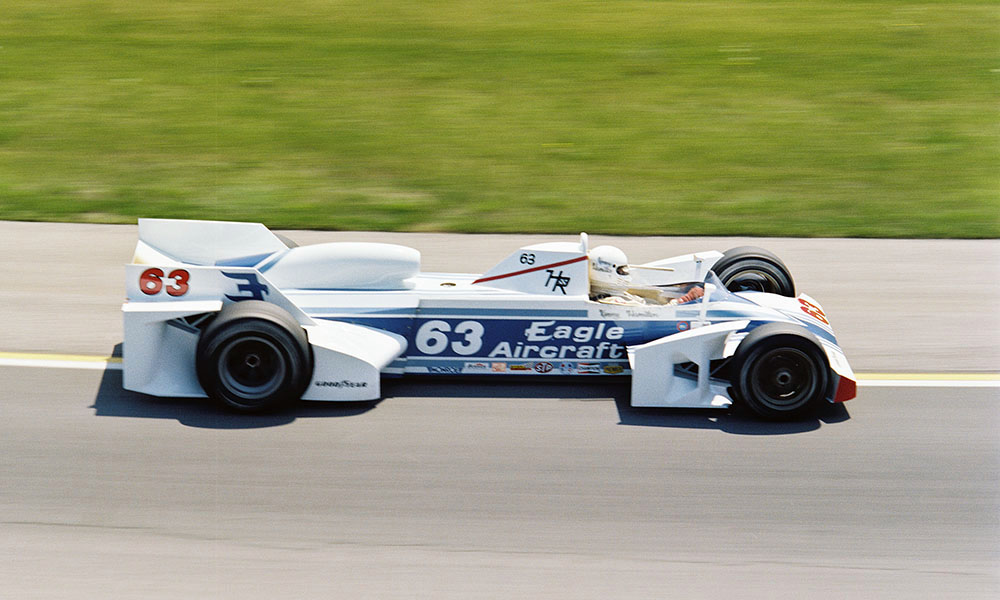
IMS Photo
RETRO: The wild tale of 1982’s Eagle Aviation Flyer IndyCar
Where in the world do we start the conversation on Ken Hamilton, the Eagle Aviation Flyer DW2-Chevy V8, Hamilton’s son Davey, the 1982 Indy 500, and the legacy of one of the craziest machines to turn laps the Indianapolis Motor Speedway?
Before we get to the main story, let’s start with where the inspiration behind the exceptionally weird open-wheeler emerged.
Ken Hamilton’s first attempt to take part in the Indy 500 came in 1981 with an old Chevy-powered Riley chassis from the mid-’70s sourced through veteran driver Roger McCluskey. Despite the car’s age, the short-track oval racer from Idaho dreamt big about taking on the big 2.5-mile Speedway and was able to pass the Rookie Orientation Program. Days later, his Indy debut would be curtailed.
“In 1981, they had the largest field, not only of cars, but like 80-some potential drivers and 115 entries,” Hamilton said. “I lost an engine and by the time I got the other engine back, I missed qualifying. So I didn't make it that year, but my car was fast enough.”
Despite the setback, Hamilton’s spirited attempt to race in the Indy 500 garnered considerable attention back home in Boise.
“Nobody from Idaho even thought about doing it,” said future IndyCar star Davey Hamilton, who was 18 at the time. “And he was doing it more as a hobby; he still had a business and work, trying to make it happen. It created a lot of energy around Idaho, and so that the gentleman that owned Eagle Aviation reached out to him and said, ‘Hey, I'd like to help you out. What's it going to take?’”
Enter Joe and Dean.
“A multimillionaire, Joe Turtling, owned a bunch of Caterpillar dealerships and stuff around the country and he had a designer and engineer build him a crop duster airplane,” Ken Hamilton said. “It was called an Eagle Biplane. And in talking with Joe, he said that Dean Wilson could design a race car for Indianapolis, and he would get involved and pay to have one built if Dean could design it and build it.”
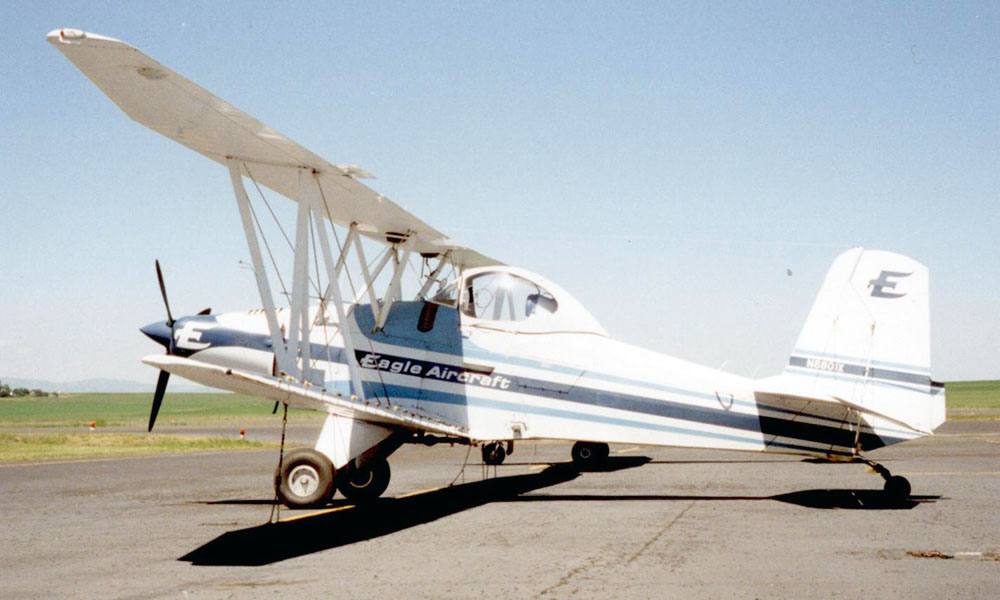
Dean Walker’s crowning achievement: The DW1 crop duster bi-plane. RuthAS/Wikipedia
With his recent acquisition of Eagle Aviation, Turtling saw a chance to promote his new business via The Greatest Spectacle In Racing. The car would eventually carry the same corporate colors as its marquee biplane. A trip to the 1981 CART IndyCar Series season finale at the one-mile Phoenix oval in November got the 1982 Eagle Aviation Indy 500 program moving.
“They were talking about buying a car at that point, like a [Penske] PC-7,” Davey Hamilton said. “So they went to Phoenix that year and [Walker] started looking at cars, and he was a pretty intelligent guy, obviously, built one of the best crop dusters. I can't remember what made it so special, but it was really good for a crop duster.”
Despite being a few years old by 1981, copying the championship-winning Penske PC-7 would have been a smart choice by Wilson.
“I remember them taking pictures of [a PC-7] with his hand by the race car to get the scale of what everything was,” Hamilton continued. “He actually whittled a 1/8th scale car out of wood. It looked just like a [Penske] PC-7. And then the problem is he kept whittling…he kept whittling and kept whittling. And then pretty soon, he came up with that [DW2] design.”
Wilson wasn’t the first person with aviation or aerospace experience to get involved with an Indy 500 design. He might, however, be the first to apply expertise in spraying crops with various chemicals from a low-flying aircraft to create an open-wheel racer meant to tackle the world’s most famous Speedway.
And where Wilson used his highly specific crop duster know-how to create the DW2, Hamilton did the same by contributing what he knew best to the project. Strip all the bodywork off the car, and you’ll find plenty of borrowed items from one of his non-winged sprint cars.
“That's how I ended up with that [DW2],” Ken Hamilton continued. “[Wilson] was a very good airplane designer, but not much of a race car designer. So he designed it, Joe paid the money, I furnished all the suspension and stuff on the thing, and the engine, transaxles...”
Fabricated and assembled in Idaho, the DW2 was birthed in the same building where Wilson's esteemed crop duster, the DW1, sprang to life.
“About 20 minutes outside of Boise, it was built in his hangar where he designed the aircraft, and I'd go out there with my dad and work on the car. As he built it, it was pretty wild, pretty crazy,” Davey Hamilton recalled.
As Kevlar, honeycomb and carbon fiber were taking greater holds in IndyCar as cutting-edge construction materials, the DW2 chassis was made from the same kind of supplies found in any good short track machine. What emerged from the hangar was a vessel that was unquestionably long and strange.
“It was a frame structure like half-inch and three-quarter square tube, chromoly frame with aluminum skin,” Ken Hamilton said. “Back then, they were using a lot of the honeycomb materials in [Dan Gurney’s All American Racers] Eagles, Marchs, Penskes, and so forth in that era. But [the DW2] was a complete nightmare. Unfortunately, being a poor boy and having no money, I had to go along with whatever they wanted to do to make it try to make it happen.”
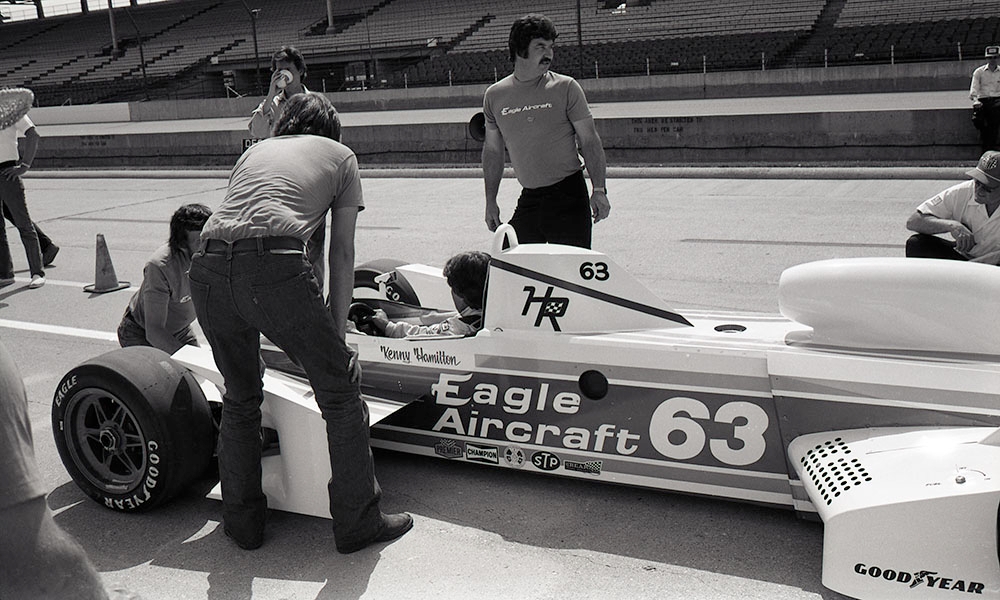
The impossibly long DW2 might have been the inspiration for the two-seater Indy car. IMS Photo
It also utilized materials found in Wilson's crop duster.
“That thing had some plywood in it, too.” Hamilton continued. “He did use some plywood in the back vertical fins. He used woods that they would use in an airplane like balsawood. I think he just put some sort of primer on and painted over that.”
Hamilton handled the motor for the DW2.
“I had Rex Hutchison build me an engine out of Sacramento; it was a Chevrolet 355,” he said. “At that time, Roger Rager made it in [the Indy 500] with a Chevrolet out of a school bus, and my engine was good enough. Just my chassis was not.”
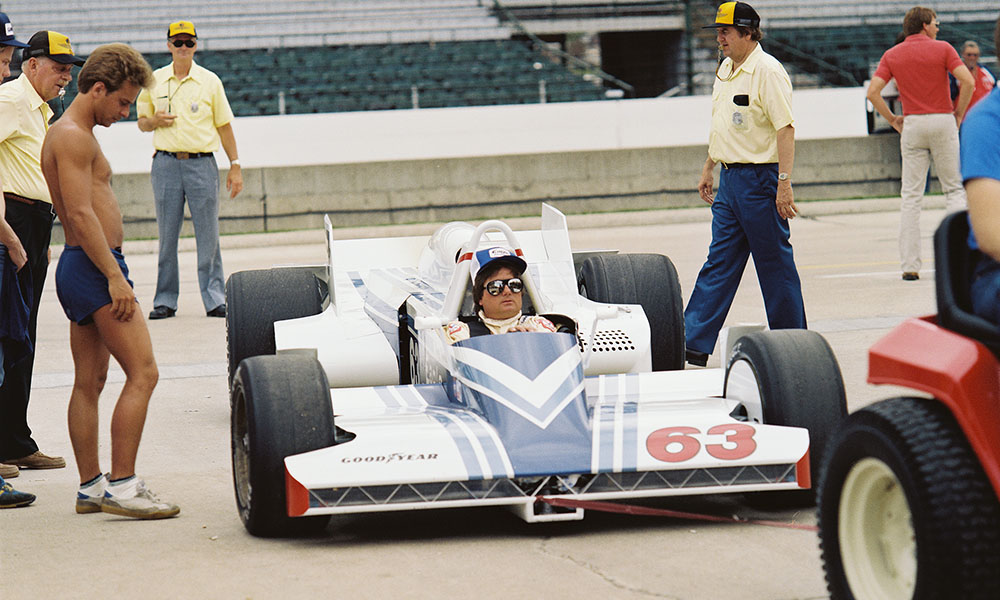
What’s more remarkable -- the guy in tight shorts or the front of the DW2? IMS Photo
The DW2 was a machine of extremes. Its 118-inch wheelbase was cartoonishly long among its contemporaries and the forward cockpit placement within its vast rectangular expanse was nothing less than shocking. Wilson's design choice meant Hamilton’s feet and legs were precariously close to the leading edge of DW2’s nose where, oddly enough, its radiators also happened to be located.
Positioned so far forward that his lower extremities would double as impact structures, the DW2’s dash and steering wheel were nearly level with the rearward face of the front tires. It’s not an exaggeration to say that if he wanted to, Hamilton could have loosened his seat belts and leaned forward to touch the front wheels.
“Literally, my feet were six inches from the wall if I had gone straight into the wall...” he noted.
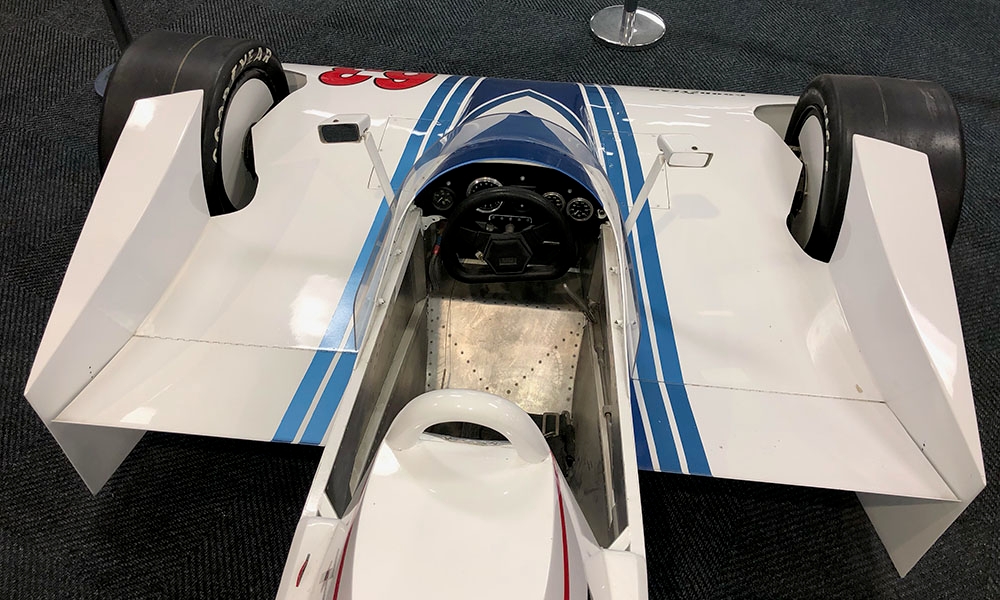
It’s frightening to see how far forward Hamilton was placed in the DW2. Amy Mauder photo
If the DW2’s chassis looked like the IndyCar version of a stretched limousine, the aerodynamics attached to the frame were from outer space. Although Ken Hamilton says Wilson told him his concepts for the bodywork were vetted in a wind tunnel, Hamilton’s son doesn’t believe it.
“Here we are from Idaho, know nothing, but pretty excited to have an opportunity to come to Indy…no wind tunnel testing, no track testing,” he said.
Ken Hamilton remembers the fateful call where he learned the original Penske-inspired car would be benched in favor of Wilson's otherworldly ideas. Regrets were forming as the DW2 reached the end of its build.
“He calls me up and says, ‘Oh, hey, I've changed my mind; aerodynamically, it's going to be better if we build it like this.’” he said. “I looked at it and I said, 'Golly, Dean, I just don't think that's going to work.' He said, ‘Well, this is gonna be ground effects.’ Ground effects was the thing to have.
“And I said, ‘Golly, you know more about it than I do. I have to take your word for it.’ But I tell you, when it was all done and painted, yeah, OK, this is a definitely a different animal than what I'm used to looking at and seeing. But it's my only opportunity. I didn't like it. But hey, if it'll work like he thinks it's going to work, that'll be great.”
Ground effects -- the use of large, upwardly curved tunnels contained within the sidepods that flank the chassis to generate massive amounts of downforce -- made waves in 1978 when Mario Andretti won the Formula 1 world championship in a ground effects creation pioneered by Lotus that allowed the car to corner at mind-bending speeds. By 1980, the same aerodynamic technology was put to devastating use by Indy 500 winner Johnny Rutherford in the Chaparral 2K as ground effects became the must-have item in order to succeed at the Speedway.
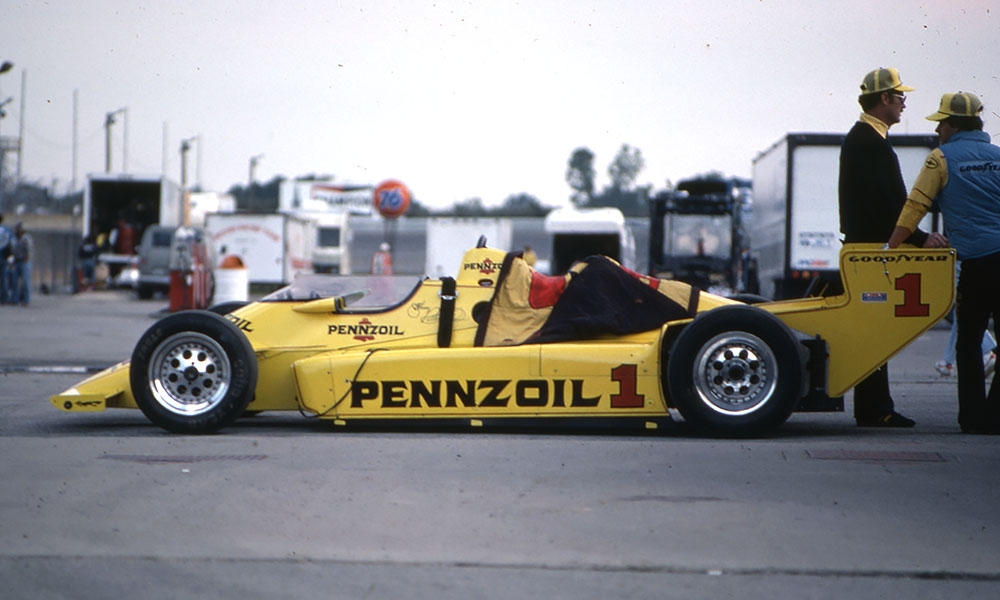
The Chaparral 2K set the standard for IndyCar ground effects with big wing profiles contained between the wheels in the sidepods. Marshall Pruett archive
Widely known at the time of the Eagle Aviation DW2’s creation, it was in the use of sidepods where downforce from ground effects was made, but that didn’t stop Walker from abandoning the well-proven aerodynamic solution for concepts of his own. The Eagle Aviation Indy car would ditch the sidepods in favor of fully independent ground effects systems placed at the front of the DW2 and at the rear of the car.
Where sidepods made downforce at the center of a car and pulled the front and rear tires into the track surface in unison, the DW2 used small tunnels built into fairings surrounding the front tires to try and achieve its downforce needs, and completely separate ground effects fairings to handle downforce generation at the back. To Wilson's credit, great thought went into the DW2’s aerodynamics, with the rear fuselage treatment featuring beautiful tunnels and tapered underbody fairings that evoke images of a streamliner.
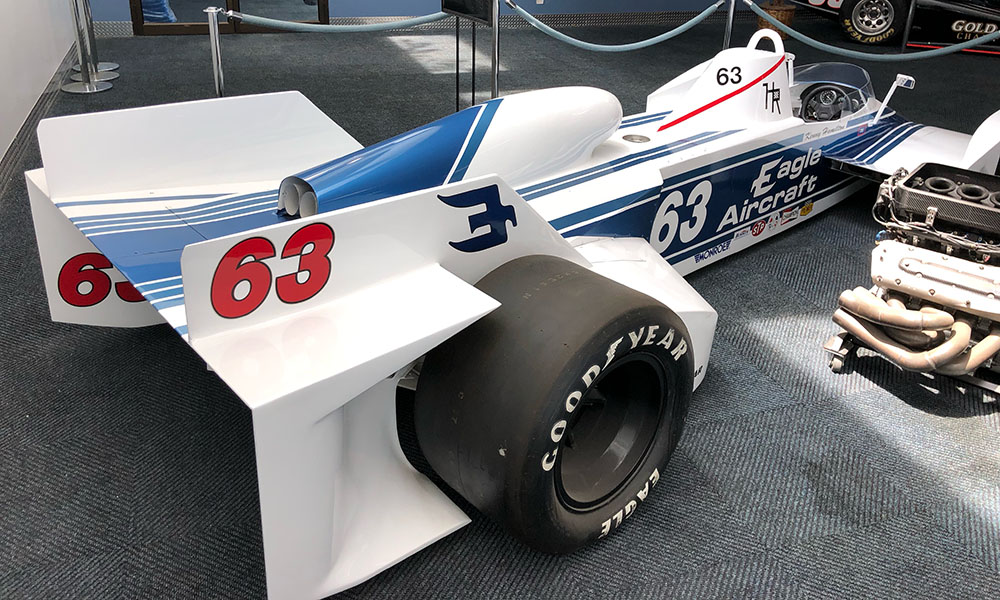
The DW2 took a unique approach to ground effects. Amy Mauder photo
To work, the disconnected front and rear ground effects would need to generate downforce in harmony to give Hamilton a car that was fast, balanced, and safe to drive. To the surprise of no one, the DW2 was the only entry at the 1982 Indy 500 to deploy bisected ground effects.
“[Wilson] said, ‘This thing, I’ve designed it to go 250 miles an hour and it won’t turn over.’” Hamilton declared. “And I said, ‘Dean, I'm not worried about it turning over. I'm worrying about it spinning out, hitting the wall.’ He said, ‘Well, it won't turn over.’ I said, ‘You’re not understanding. I'm sure it won't turn over. But it won't go around the corner. I'm afraid we need more down pressure. I don't think you're going to have enough down pressure with the way you have your air effects. We need a wing.’ He said, ‘No, it don't need a wing.’”
Minus the wing, but featuring all of Wilson's extravagant concepts, the DW2 was strapped in and sent from Iowa to Indianapolis. Amid the gasps when the car was rolled out of the trailer for the first time, a valid question was raised by one of Indy’s best drivers.
“I remember [IndyCar champion Tom] Sneva, because he and my dad were friends, goes up to him and a group of the guys with the car, ‘You guys put this in the wind tunnel or anything?’” Davey Hamilton said. “Because obviously when the car got unloaded, it got a lot of attention. And the guy that built the car, he looks up and down the straightaway at Indy and goes, ‘That looks like a good place, we're gonna do right here!’”
It was time to learn about the DW2’s ability -- or inability -- to perform as expected on the straights and corner with speed and safety by venturing out onto the 2.5-mile oval and turning the Eagle Aviation Flyer’s first-ever laps.
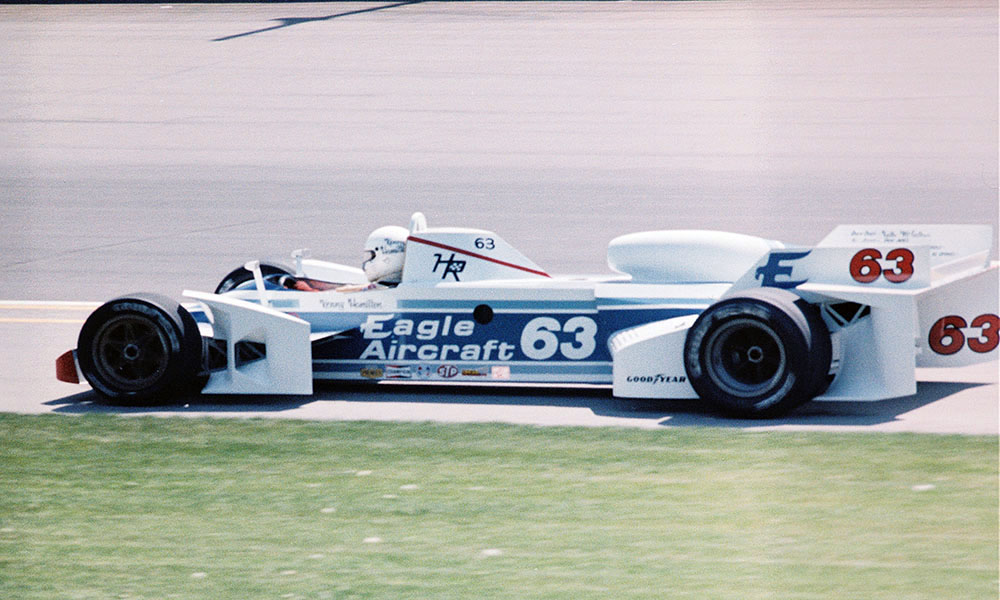
The DW2’s bisected ground effects were only part of the car’s problems. IMS Photo
Gobsmacked by the realization that Wilson intended for Hamilton to embrace the role of a test pilot, one who might not return with his life and limbs fully intact, he summoned the kind of courage that few humans possess and strapped into the mystery machine. It was time for another non-surprise.
“You still don't know what you have until it gets on track,” Davey Hamilton added. “Bottom line was the front ground effects just took all the air away from the back of the car. The front was overly stuck and the back just had no grip because the air was going over the top of the back of the car, not underneath of it, for the ground effects to work.”
“You can see the front ground effects and rear ground effects, instead of one solid, went through the center, and he had all these ideas like the air intake that’s like you’d see on an airplane engine. Things like that were maybe a little bit ahead of their time…”
Although he got through Indy’s rookie orientation sessions with ease in 1981, the Speedway wasn’t about to let Hamilton and the curious Eagle Aviation Flyer saunter into the event without a few restrictions in place. Hamilton’s first outing came on the opening day of Indy 500 practice on Saturday, May 8.
“We had to go through my rookie deal again because I finished it the year before in my old car, and then they made me do it again because it was an unknown car, which I understand,” he said. “But I lost the thing twice.”
Coming up in part 2: Ken Hamilton, the world’s bravest man, prepares to drive the DW2-Chevy for the first time.
Marshall Pruett
The 2026 season marks Marshall Pruett's 40th year working in the sport. In his role today for RACER, Pruett covers open-wheel and sports car racing as a writer, reporter, photographer, and filmmaker. In his previous career, he served as a mechanic, engineer, and team manager in a variety of series, including IndyCar, IMSA, and World Challenge.
Read Marshall Pruett's articles
Latest News
Comments
Comments are disabled until you accept Social Networking Cookies. Update cookie preferences
If the dialog doesn't appear, ad-blockers are often the cause; try disabling yours or see our Social Features Support.