Mike Levitt/Motorsport Images
INSIGHT: Dan Wheldon's accident, 10 years on, Part 1
The events of October 16, 2011, stalked Townsend Bell on a daily basis. They walked in front of him, staring back, inciting confrontation.
Ten years on, those events have moved. The memories surrounding Dan Wheldon’s death are packed away, like a small suitcase overstuffed and bursting at the seams, trailing far behind, out of sight. That’s where Bell needs the emotional remnants of the IZOD IndyCar World Championship at Las Vegas Motor Speedway to stay. It’s for the sake of his mental wellbeing.
“It took me a few years to not think about that every day,” Bell acknowledges. “I'm not sure I know the clinical definition of post-traumatic stress disorder, but I would imagine that's what I was experiencing for a few years. It was a really unpleasant event for a lot of people. A really vivid and deeply disturbing kind of moment, etched in my mind, that I didn't really know how to deal with.”
Driving the No. 22 Dreyer & Reinbold Racing entry, Bell was one of 15 IndyCar racers involved in the absurd accident that killed two-time Indy 500 winner.
“You had to make a decision: You either you go into that race to protect yourself the whole time, or you go all-in,” he says. “I was all-in.”
Footage of the accident, with drivers ricocheting off walls and each other as the carnage and mayhem built, was nothing compared to the firsthand experience inside the cars.
“I went high at the start as cars were going four-wide, and all of a sudden it was like I was riding the draft of the biggest tornado ever,” Bell continues. “Down the back straightaway, maybe three-wide, and then back up to maybe five-wide in the corners, and I'm like, ‘Holy ****, we're going to the front.’ I mean, it was nuts.
“You’re watching guys bounce off each other. Sparks flying and dust everywhere, and we're hauling ass and it's just one giant pack. I started P24 and got to, like, P14 in 11 laps. It was wild. And then the crash happened.”
By nothing other than chance, Bell’s broken Dallara chassis came to a stop near Wheldon’s crumpled car. His instincts said to get as far away as possible from the scene that looked more like a plane crash than anything one might associate with a motor race. But with his friend in close proximity, Bell ignored the urge to flee and ran over to check on Wheldon.
From the moment the crash was triggered Bell’s eyes and senses were battered with images of flying cars, fires, his own meeting with the wall, and lastly, the damage caused by the fence pole that struck Wheldon’s helmet. Bell looked inside the cockpit of the No. 77 Sam Schmidt Motorsports car and saw movement; the Briton was still alive. But there’s no need to say more about the visuals he experienced in that private encounter.
“I was on a flight, probably four years later, and I happened to sit next to a therapist,” Bell says. “Long flight, LA to Florida, and 90 percent of the time, it’s just a quick hello, take your seat, and then everybody throws on their headphones and off we go into our own worlds. This is one of those rare occasions where it was probably a three-hour conversation.
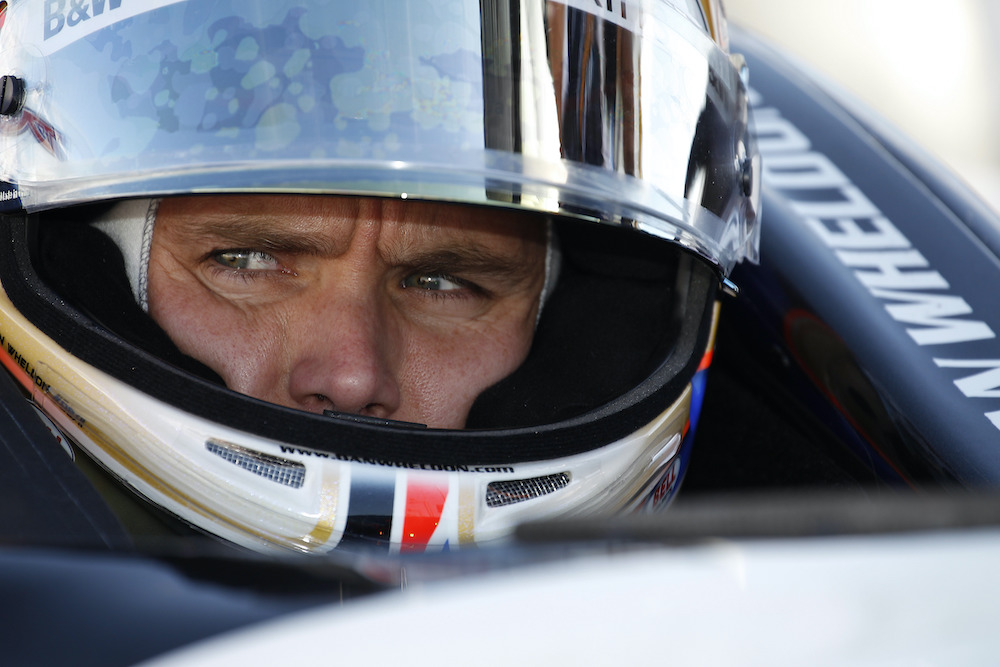
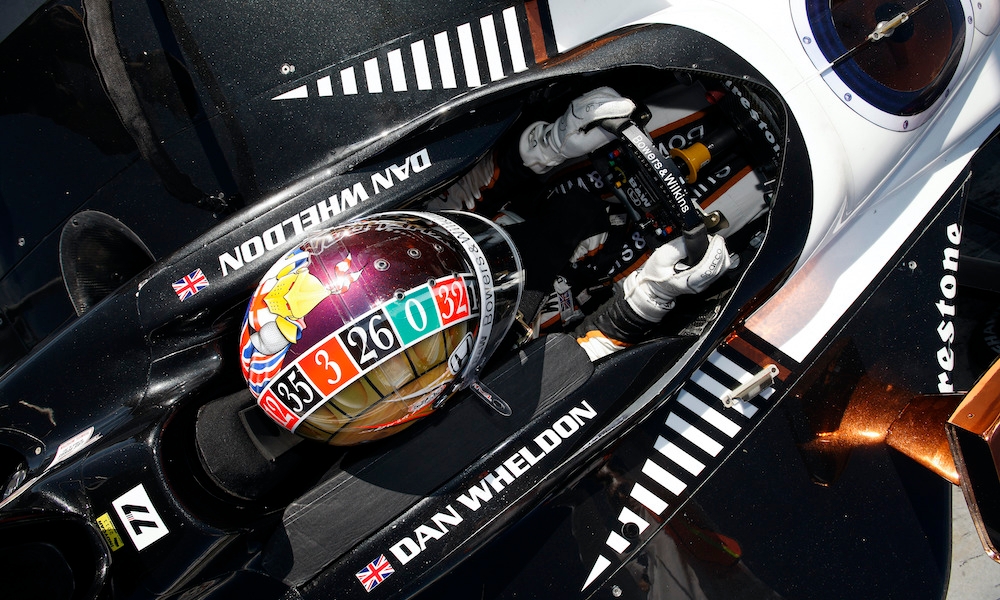
Wheldon won the 2011 Indianapolis 500 as an Indy-only entrant, and had no races on his schedule for the rest of the season before securing a chance to chase a massive cash prize at the Las Vegas season-finale (above). Michael Levitt/Motorsport Images
“And over the course of those three hours, she had asked if I’d ever been in really bad accidents and how drivers deal with them. I was able to share Las Vegas with her, and she helped with ways to manage that moment in my ongoing life. Because it really haunted me for a long time. The strategy that I came up with was to see my life as a spectrum of time, and to understand that the moment in time with Dan was deeply disturbing, graphic, horrific on a number of levels.”
The events of October 16 were so severe, even someone as attuned to the risks of the sport as Bell needed to acquire tools to cope with the aftermath.
“Now it lives on a timeline in the past where I can dive deep and go back and open that up like I am right now, open it up in an exploded view, if you will, go back into that moment, and then I put it away,” he says.
“That is where it lives, in that moment of time, no longer in my present. I’ve had to learn how to do that so it wouldn’t completely overwhelm or dominate my conscious thoughts, at the risk of missing other important moments in my life going forward.”
HOLLOW
Having covered 2011’s IndyCar season finale in Las Vegas, Bell’s accounts of lingering shock and sorrow have a familiar feel. Witnessing tragedy at the racetrack is nothing new. It’s often dealt with as a peripheral matter – grieving for the fallen and the family of the departed – without internalizing the event. With Wheldon, it was different, personal. Like something precious had been ripped from inside us.
The sight of drivers, crew members, and even a few reporters openly weeping after the news began to circulate revealed the magnitude of how heavily his loss was received.
Most who met the man – even in a brief encounter – came away feeling like they’d found a new best friend. To those who held longer relationships with Wheldon, his death was like turning off the sun. Outside of his immediate family, enough time has passed for Wheldon’s absence to become normalized. The same assertion cannot be made for October 16, 2011.
Knowing how some of my views on all that happened surrounding Las Vegas have evolved over time, I wanted to check in with others who were there; those I interviewed in the days and months that followed, to see if or how their thoughts have changed with 10 years of hindsight and introspection. I also wanted to gain a stronger understanding of the Las Vegas event and how it was administered. At the time, IndyCar was forthcoming on some matters and silent on others.
And in realizing that many IndyCar fans discovered the series since that fateful event, it’s also worth going back in time and revisiting the event for their sake.
Along with Townsend Bell, Dario Franchitti, the 2011 IndyCar Series champion and one of Wheldon’s closest friends, stepped forward. Sam Schmidt, Wheldon’s team owner for the final two events of the year at Kentucky and Las Vegas, weighs in on the hardest day of his career as an IndyCar entrant. Graham Rahal, one of IndyCar’s young stars at the time, speaks on the lessons and legacy of the race. And former IndyCar president Randy Bernard, who came up with the IZOD IndyCar World Championship, goes deep inside the event while also responding to his critics.
THE CONCEPT
Wheldon’s Indy 500 win with Bryan Herta Autosport, the smallest team in IndyCar, was an inconceivable thing. Out of work after leaving Panther Racing, Wheldon went into 2011 with no ride and no real prospects of landing a front-running opportunity to advance his career.
A call from former Andretti Autosport teammate Bryan Herta opened the door for the 2005 Indy winner, and despite being told he was a fool to sign with Herta’s tiny and unproven outfit, Wheldon’s faith and optimism quieted the dissenting voices. Riding the longest odds that month of May, Wheldon and the Herta team were victorious as the 32-year-old married father of two delivered the upset of the century.
It's here, with no additional races on Wheldon’s calendar after the 500, where Bernard, the former CEO of the Professional Bull Riding organization and a celebrated master of promotions, had an idea that had just might bring him back to the grid while generating serious attention for the series.
Randy Bernard: We wanted to create a big event for our year-end IndyCar event, and we knew we needed to do it in a resort destination. Whether you live in Kansas or New York City or London, everyone loves to go to Las Vegas. And that was one of our goals: How do we grow our fan base with a world class championship event somewhere that could help bring in an audience from all over the world, (and) make it a signature IndyCar event? And so that's what we did.
I looked at the track down in New Orleans; they have a road course. It wasn't that nice, so we looked at resort destination cities in the United States and the one that was the zinger was Vegas. And I don't believe there was anyone that had as good of relationships in Las Vegas as I did with CEOs at 80 percent of the hotels and the LVC – Las Vegas Convention authority – from our world finals with the PBR we held there. So I was able to do a lot of things that nobody had ever been able to do in the past.
The original IZOD IndyCar World Championship concept was a bit open-ended. IndyCar’s leader looked to sporting stars outside of open-wheel racing as possible options to take part in the 500 kilometer contest, `but found no takers. Specific to Wheldon, Bernard hatched a modified plan that made headlines throughout the sport.
Randy Bernard: You know, Dan was a friend. So when I came up with the idea of having GoDaddy and Verizon sponsor the $5 million prize if Dan could win that race, after he already won the Indy 500, everybody loved it. And if he won the prize, it was gonna be split with a fan, so that was another thing that just brought excitement. And ABC was going to cover it. I probably had 15 voice messages on my phone from him, begging me to be in that race. And then when it came together, Dan was like, ‘Thank you, thank you, thank you for giving me this opportunity. This is amazing.’
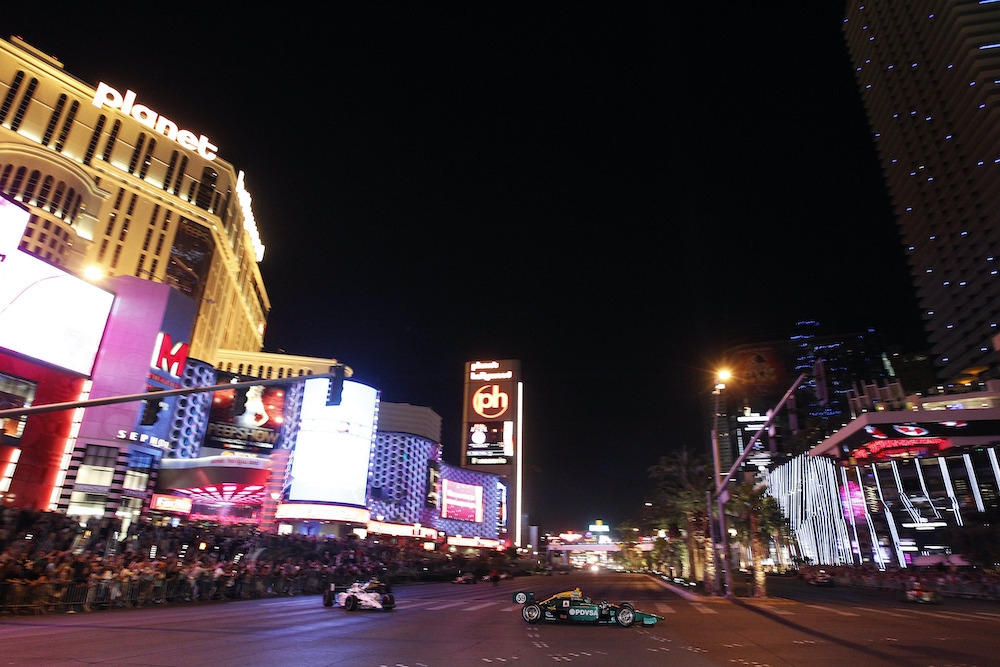
Then-series CEO Randy Bernard wanted to go large for the 2011 finale, and settled on a Las Vegas race. His connections within the city paid promotional dividends with stunts such as a night-time IndyCar demonstration on the famous Strip. Michael Levitt/Motorsport Images
The only thing Wheldon needed was a team and a car. Having bought the assets of the defunct FAZZT Race Team, Sam Schmidt retained driver Alex Tagliani for the 17-round calendar in 2011. The French-Canadian’s pole at the Indy 500 let it be known that the No. 77 SSM entry was quick at the Speedway, but with a season filled with more downs than ups, Schmidt saw Bernard’s $5 million challenge as a risk worth taking.
To his great displeasure, Tagliani was pulled from the No. 77 in favor of Wheldon, and to prepare for Las Vegas, Schmidt made the switch starting at the penultimate round in Kentucky to give Wheldon and the team a chance to build chemistry prior to the big show.
THE CARS
Las Vegas 2011 was the farewell for IndyCar’s fully spec formula. All 34 cars entered were Dallara IR07s using identical Honda V8 engines and Firestone tires.
As described in IndyCar’s 49-page crash investigation that was made public in December of 2011, two teams conducted a feasibility test at Las Vegas on behalf of the series nearly one year before the race was held:
“The compatibility and performance testing occurred on November 15, 2010. The test included 2 race car/driver combinations selected by IndyCar and Firestone. One race car was driven by Ryan Briscoe of Team Penske, and the second race car was driven by Scott Dixon of Target Chip Ganassi Racing. Over the course of the 2-day test, the 2 race cars completed a total of 400 laps, and the top lap speed was 214.456 mph. This test was followed by private testing at Las Vegas Motor Speedway as individual teams prepared for the race.”
With positive feedback received from the two-car test, Las Vegas would return to the IndyCar schedule.
In single-car qualifying, the field was separated by less than a half-second as polesitter Tony Kanaan’s best of 25.0242s was bookended by Simona De Silvestro’s 25.4943s at the bottom of the field. In average speeds, Kanaan achieved 219.345mph to De Silvestro’s 215.447mph, which spoke to how little separation was found between the fastest and slowest cars on the banked 1.5-mile oval.
Echoed by many before and after the race, the Las Vegas track offered a high degree of grip. The technical specification chosen by the series ensured ample aerodynamic downforce was utilized, and with Firestone’s high-quality rubber outfitted to each car, the phenomenon shown in qualifying did not come as a surprise. Even the slowest cars were fast, which would make for a crowded experience for the 34 drivers once the race began.
Townsend Bell: We went and tested there. I was filling in for Justin Wilson for two races at Kentucky and Vegas and the Dreyer & Reinbold team was not performing particularly well at that time. Larry Curry was the team manager and was gung-ho on Vegas. So they hired the legendary Dust Brothers to do their body fit on the car and get us in the aero game with the big teams. We had run well at Kentucky, but we were still a way off of the Penske guys and the Ganassis. So Curry was like, ‘We are going to do everything in our power to figure out how to generate a big result there, so we're going to go all the way to Vegas and test.’
And from my first moment there, I knew this was gonna be gnarly. I left the pits; I’d never driven the oval in Vegas, and I was flat straight out of the pits, first lap. Like, this was just ridiculous. A no-brainer. You could put anybody in there and they could hold it wide open, because there was so much grip. But we weren’t really super-fast. So we go home, the Dust Brothers come in again and it’s non-stop body fit and sanding, and we show back up for the Vegas race with these totally perfect aerodynamic beauties.
And I'll never forget first practice session. I go out, and we literally did the same lap time to like 100th of a second of our best from the test. I don't know how money much they spent, but it was a ton on body fit. Didn't yield 1/100th of a mile an hour in lap time. And so we're all standing there on pit wall after the first practice session, I'm with Matt Curry who's the race engineer, and we're all scratching our heads like, ‘Son of a bitch! What are we going to do?’
And I remember Matt looks at the Newman/Haas cars that are pitted right next to us. And he's like, ‘Man, they sure are running a lot of camber on the right side.’ And we get to looking at it, and I think he snapped a few photos, and they were running so much camber that the tire’s contact patch was super-small. It was really smart. So we go out the next session and try something close to whatever degrees of camber they were running, and all of a sudden, we pick up like a mile an hour! It was like the magic bullet.
You start pulling the tire off the ground and the thing just starts going faster because it doesn't need all that lateral grip. It's so easy-flat that it's just all friction. Less contact patch, less friction. So we just keep adding camber and adding camber, and going faster, faster, faster. So much so that the in order to go really extreme, we had to go find a fabricator that night and machine new uprights that would allow the clearances to get even more camber the next day.
You’re basically trying to pull as much tire off the racetrack as possible; we went as far as we could go, and it helps paint the picture of just how ridiculously flat this whole racing situation was still going to be. That's when I knew the race was gonna be just insanity.
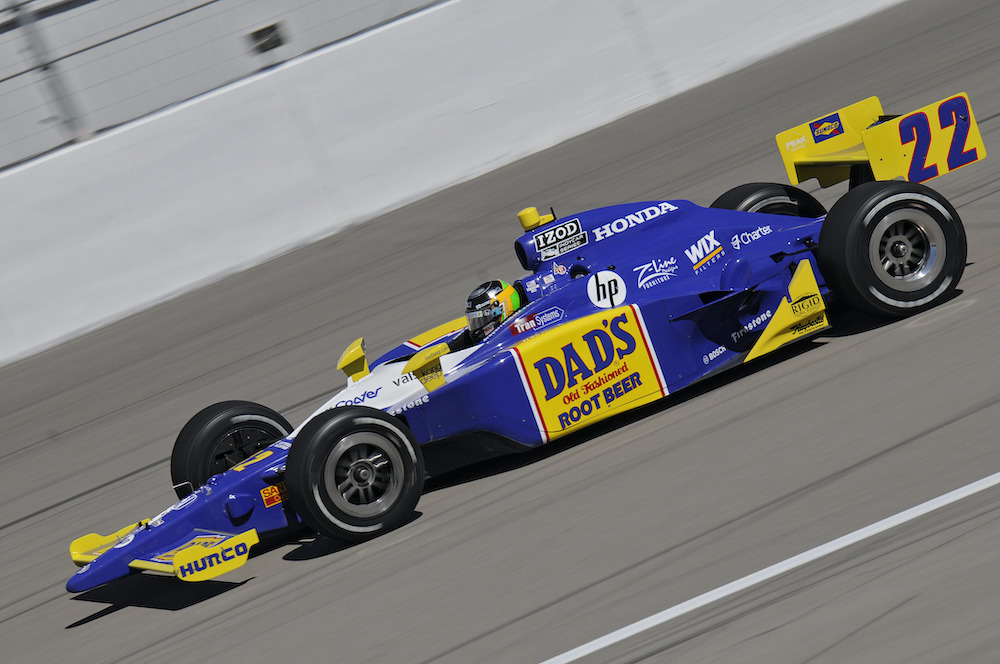
The more Townsend Bell learned about what the car needed to go fast at Vegas, the more convinced he became that the race would be – in his words – "insanity". Michael Levitt/Motorsport Images
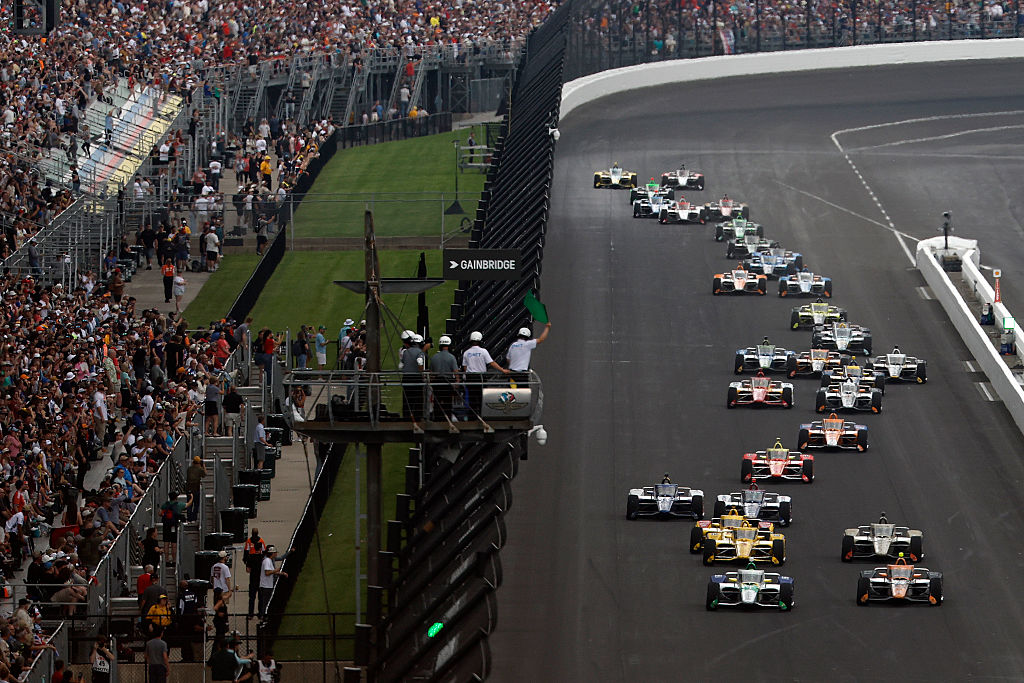
Kanaan took the green flag and led from pole as drivers traded positions in close proximity behind his No. 82 KV Racing Technology Honda. It was a hornet’s nest of activity as drivers jockeyed for position, made gains, fell back, juked left and right. They were unable to break free from each other as excessive mechanical and aero grip kept the open-wheel cars in a tight cluster. The roving pack circulated around the oval at speeds surpassing 220mph in a brief and deadly exhibition of pack racing.
The 200-lap race lasted 12 before it was halted.
Graham Rahal, No. 38 Chip Ganassi Racing Honda: Unfortunately, it was an accident waiting to happen. And all of us knew it. If you were at the driver intros that day… The tension was just so powerful, man. The nerves were so strong. Typically, as a racer, I'm OK to settle in and wait for my time to come to try to get to the front, make your moves, particularly on the ovals. With that day, I started eighth, I believe, and I remember just telling my engineer, ‘I do not want ever to fall outside of the top positions,’ because I knew that's where I was safest. I hate saying that.
But I think that particular day, many of us feared something like that could happen, and we saw it happen. And we don't need to get into the finger pointing because really, that's not fair. There was a lot of cars on track and a lot of people that were going for victory to finish the year off. And there was a lot of money on the line for some people. Obviously that influences people's aggression.
Their fears were realized on Lap 11.
Entering Turns 1 and 2, caught in the chain reaction of crashes triggered by the clash between the 12th- and 13th-place cars of Newman/Haas Racing’s James Hinchcliffe and AFS Racing/Sam Schmidt Motorsport’s Wade Cunningham, Wheldon’s No. 77 car – running in 24th-place – came upon the scene as nearly half the field ran into each other. He was soon launched over the back of Charlie Kimball’s Chip Ganassi Racing entry.
By IndyCar’s estimate, the Briton took off and flew more than the length of a football field – approximately 325 feet – before riding along the fence and pole system designed to keep cars inside the facility.
With the poles affixed in front of the fencing, one of the exposed steel cylinders met and dragged across the top right side of the Dallara safety cell carrying Wheldon. In an era before the advent of halos and aeroscreens, the pole struck his helmet and ripped the roll hoop off the car before the No. 77 fell back to the racing surface in a blaze and slid to a stop.
According to the data disseminated in the series’ crash investigation, the helmet strike meant Wheldon “experienced longitudinal forces of approximately -250Gs which indicated a frontal impact, and -200Gs vertical which indicated a hit from the bottom, and 100Gs lateral to the right.”
To grasp the severity of the stopping forces involved, Romain Grosjean’s sickening 2020 Bahrain crash that fired his Haas Formula 1 car through a steel barrier registered at -67Gs.
Bell was the first to get to Wheldon. Once IndyCar’s safety team arrived, he stepped aside and ran over to check on Team Penske’s Will Power, whose No. 12 Honda took the most dramatic flight. Bell listened as Power complained of back pain, looking over to see if any of the extra safety personnel attending to Wheldon might peel off and assess Power’s injuries. While staring back at Wheldon’s No. 77, he noticed burning debris set one of the safety team member’s legs on fire before it was quickly extinguished.
Along with Wheldon, JR Hildebrand, Paul Tracy, Power, Vitor Meira, Jay Howard, Cunningham, Alex Lloyd, Bell, Pippa Mann, Buddy Rice, Tomas Scheckter, E.J. Viso, Kimball and Hinchcliffe were involved in one of the biggest IndyCar crashes on record.
Nine of the 15 drivers were taken to the infield medical facility. One was airlifted to a nearby hospital.
The 2011 season finale, airing live on ABC, was stopped. Decisions needed to be made on whether it would resume. As concerns for Wheldon grew, opinions on which direction to take the race intensified in private meetings.
Should the IZOD IndyCar World Championship at Las Vegas Motor Speedway have started in the first place? The next hour – and the 10 years to come – would provide impassioned answers and conflicting perspectives.
Check RACER.com for the second and final installment tomorrow.
Marshall Pruett
The 2026 season marks Marshall Pruett's 40th year working in the sport. In his role today for RACER, Pruett covers open-wheel and sports car racing as a writer, reporter, photographer, and filmmaker. In his previous career, he served as a mechanic, engineer, and team manager in a variety of series, including IndyCar, IMSA, and World Challenge.
Read Marshall Pruett's articles
Latest News
Comments
Comments are disabled until you accept Social Networking Cookies. Update cookie preferences
If the dialog doesn't appear, ad-blockers are often the cause; try disabling yours or see our Social Features Support.