Chris Owens/Penske Entertainment
Head-scratching tire wear day for IndyCar teams in Detroit
The story so far with IndyCar tires in 2026 across the three street course races at St. Petersburg, Arlington and Long Beach has been one of greater durability with Firestone’s quicker alternate compound. But if what the teams just learned about those alternates holds firm for the rest of this weekend’s Chevrolet Detroit Grand Prix, we could be in for an outlier of an event.
In 2025, IndyCar’s street racing was best known for the near-instant degradation with the alternates. In turn, teams treat those alternates like a liability to shed as soon as possible and switched to the harder and more enduring primary compound tires, so Firestone made adjustments during the offseason to the alternates.
Through the three street races in 2026, alternates were by no means a liability and have survived for long periods; if there’s been a criticism, it’s come in the form of a new and extended warming process where the harder alternates require more time – more laps – to get up to optimal performance temperature.
And that’s made Friday’s revelations in Detroit feel like a throwback to last season as the new street course alternates were quick to warm up and appeared to have a shorter competitive lifespan just as teams experienced in 2025. The performance gap to the slower black-sidewall primary compound was another educational matter as the alternates didn’t stand out as having an abundance of extra speed when drivers performed qualifying simulations with the red-banded tires on Friday.
“I thought the first part of [the session] was good on the black,” Pato O’Ward said after running fifth in his No. 5 Arrow McLaren Chevy. “Quite tricky on the red. I don't think we're the only one that struggled with it.”
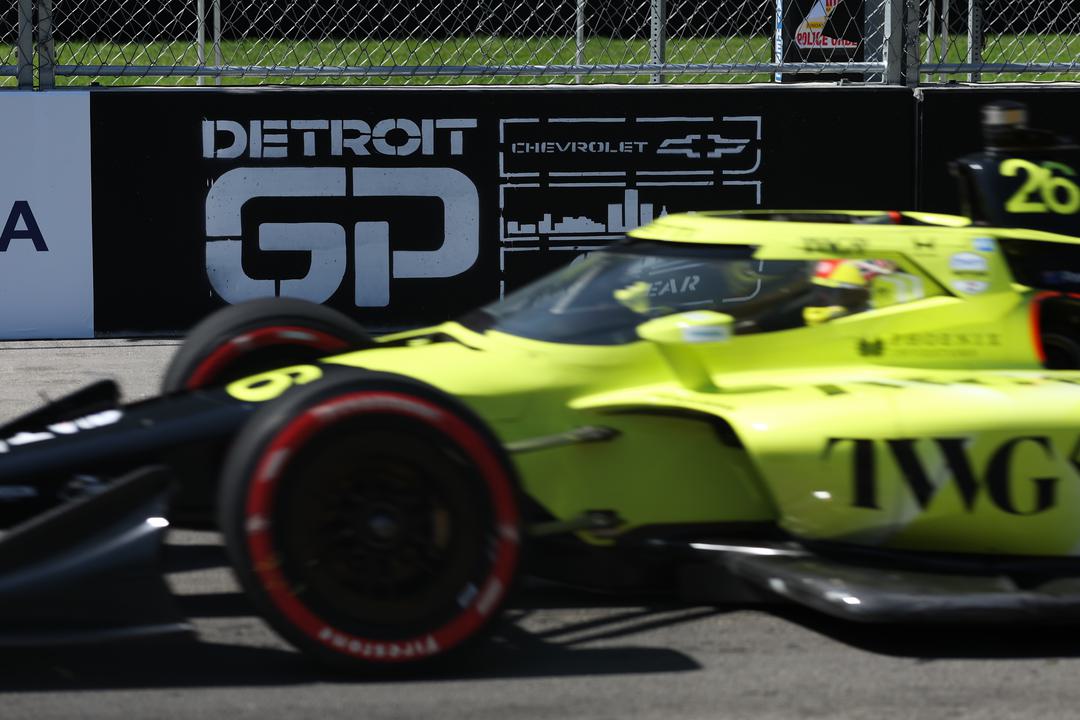
Andretti Global’s Will Power, who was fourth in the No. 26 Honda, echoed O’Ward’s sentiment.
“It wasn't like a big gain,” he said. “I was definitely on a good lap. But yeah, not a couple 10ths-type thing.”
O’Ward actually went slower with the alternates, which led to some head scratching on his part.
“With the blacks, I felt all right,” he said. “With the softer compound, supposed to be faster, but we're over half a second slower; so yeah, I'm as confused as they are, so we'll see. Maybe it wasn't in the right window on pressures or something; it can be really sensitive around this place, so we just need to dive into that.”
Arrow McLaren teammate Christian Lundgaard’s name can be added to the list of those who aren’t sure what to expect from his alternates.
“We lacked a little bit of pace on the alternate tires,” he said. “We need to figure some balance out. It seemed like probably the majority of the grid got something wrong on their alternate tire runs. Very few cars really went faster. So, we have some good learnings from that, but so far so good."
Each driver is required to use two sets of alternate tires in the race, which is unique to IndyCar’s street course rules. With the busy nature of Friday’s three-stage session, and the stoppages for drivers who spun, some like Graham Rahal will head into qualifying on Saturday with more questions than answers on how the alternates will perform.
How long they will (or won’t) last in the race in another key item to discover.
“We were on black tires originally and were pretty competitive,” Rahal said after running 15th. “I think overall we’re good, but we need to find some time for sure. There are a couple of guys that are quite a bit ahead. On alternate tires, I never really got a lap, unfortunately. We actually put them on earlier than a lot of guys did. We thought that it would be early enough, but with two red flags reds in a 12-minute session, we couldn't really get a rhythm going; couldn't really do much. So, I don't really know what to expect on the reds. I feel like the grip was starting to come in, but I never really got to see it through. We’ll have to have to see tomorrow.”
Marshall Pruett
The 2026 season marks Marshall Pruett's 40th year working in the sport. In his role today for RACER, Pruett covers open-wheel and sports car racing as a writer, reporter, photographer, and filmmaker. In his previous career, he served as a mechanic, engineer, and team manager in a variety of series, including IndyCar, IMSA, and World Challenge.
Read Marshall Pruett's articles
Latest News
Comments
Comments are disabled until you accept Social Networking Cookies. Update cookie preferences
If the dialog doesn't appear, ad-blockers are often the cause; try disabling yours or see our Social Features Support.