Robin Miller's Mailbag for February 24, presented by Honda Racing / HPD
hpd.honda.com
and on social media at@HondaRacing_HPD
and https://www.facebook.com/HondaRacingHPD.Questions for Robin can be sent to millersmailbag@racer.com. Due to the high volume of questions received, we can’t always guarantee that your letter will be printed, but Robin will get to as many as he can. Published questions have been edited for clarity. Views expressed do not necessarily reflect those of RACER or Honda/HPD.
Q: Had to chime in on the many criticisms of Johnson, Grosjean, et al. and their reluctance to run the 500 or ovals. First, I’m an Indy guy. Have been for 55 years. Yes, I follow sports cars and F1, but IndyCar is my main love, and the Indy 500 gets the party in my house, not the Super Bowl. For both these guys, and others past or to come, I think we all need to be fair. These are multi-millionaires with families. They have nothing to prove (at least, not Johnson) except maybe to themselves, and that makes this a very personal decision. There is no discounting the risk -- just ask Seabass or The Mayor. And with age comes reduced time and ability to heal should something go wrong. I doubt either of these guys are really willing to risk ending up like Wickens.
Comparing them to the brawny heroes of our past is apples and oranges, too. Gurney, Jones, Foyt, Bettenhausen and just about everyone else never buckled the helmets as multi-millionaires with young families. Do I wish these guys would sponsor a young American driver or start their own team with one? Yes. Would it be better to see Wayne Taylor’s boys or Conor Daly get a good seat? Yes. Will I critique their personal risk limit? Nope. Both NASCAR and F1 "hide" a driver’s talent. It’s just a function of those cars and those series. Look at JPM, Rossi, Sato and Hornish. It’ll be good for everyone to see how these guys stack up. That’s enough for me to welcome the drama without adding to it.
Paul DeClercq, Phoenix, AZ
RM: I don’t think I’ve had five letters questioning anyone’s bravery, but it’s been more of a case that fans are bummed that J.J. has chosen not to run in the biggest race. Trust me, he wants to run and it would be his best chance to be competitive, but unless his wife has a change of heart, it probably won’t happen. And when you’ve got millions and a family, it’s certainly a consideration to lessen your risk factor. But Branson, Bettenhausen, Foyt, Andretti, Vukovich, etc., all had children and Indy accounted for much of their salary, so skipping Langhorne was an option but never IMS. IndyCar racing has never been safer, but you’re still going into Turn 1 at 225 mph and that’s a commitment not everyone is willing to make. But I think the general feeling from the fans is disappointment -- not mocking.
Q: I’m excited for the start of the IndyCar season. Just booked flights and room for St. Pete. Any news on how many fans? When will tickets be available? Paddock access? Pit access? General admission?
Jim Hoffman, Seymour, IN
RM: Tickets for St. Pete will go on sale early next month, that’s all I know for sure.
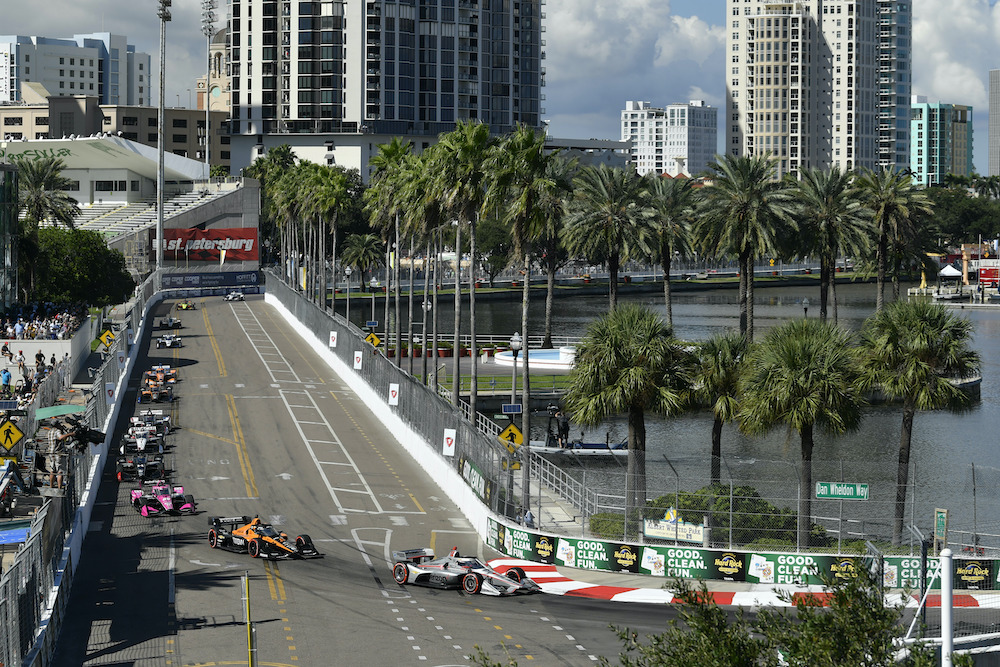
Only 60 sleeps until St Petersburg. Richard Dole/Motorsport Images
Q: I would like to write this week to give advice to fans wondering, "How could I get Indianapolis 500 tickets pending the amount of fans that are allowed?" I was in attendance at the 63rd running of the Daytona 500 this year, and my family had gotten tickets a week and a half before the race. We were looking at going to Daytona anyway, even if it was only for the beach. Being past ticket holders, we just called our account rep and asked what are the odds we could get tickets for the 500! At first, our account rep talked like it would be near impossible. Then we asked, what are the odds we could still get tickets for the Cup Duel races, and for the Truck, ARCA, and Xfinity races? He not only got us tickets for the Duels and the support races, but he also went and found three tickets for my family and I for the 500!
My advice to fans that question odds of tickets to this year's Indy 500 is to ask about tickets to everything leading up to the big day! And never know, you might be able to find a few extra tickets for the Indy 500 for being supportive and being there for everything leading up to the race! What have you heard?
Kevin, NC
RM: Here’s comment from IMS President Doug Boles: “Tickets for the Indy 500 are available now via the website or calling the ticketing office, and some people are still purchasing. We aren’t promoting that at this point, but have remained on-sale for those that want to purchase. Since we still do not know what protocols will be implemented related to seating and attendance on race day, we can’t give much clarity on what to expect yet. And, with the infection rate numbers decreasing and vaccinations more and more available, we believe time is on our side. We anticipate a more detailed update as the next few weeks play out and we have a clearer picture for May.”
Q: Chances are there will be some level of crash damage that will need fixed after Texas before practice for the Indy 500 starts. Since it seems as if the top teams massage their 500 cars like a piece of Kobe beef all winter and spring, will the top teams hold their 500 cars back and not run them there? I’m sure the smaller teams don’t have that luxury, but I would think the bigger teams may not to put their 500 cars at risk.
Don Weidig
RM: All depends on a team’s inventory but there’s plenty of time to repair most Texas crashes and, as you stated, it would affect a smaller team more than one of the Big 4.
Q: With all the talk about which drivers bring money for their rides, which teams have partners, and who owns or co-owns individual cars or teams, it's complicated to understand who makes (or loses) money racing. If a driver brings $3 million to a team and it costs more than that to repair their crash damage, who pays the difference? Does the sponsorship money pay for that car and driver only, or does it go to the team? Do the sponsors of the top teams exercise control over the money they give to the teams? Which car owners take their money right off the top? It would seem like the most important people on a race team would be the accountants. If only they could talk!
Michael Oliver, Miami Beach
RM: You’re asking questions nobody can answer except a select few, and they’re not inclined to share that information. Some drivers take a percentage of their sponsorship off the top and that pays their salary. Some sponsors dictate the driver. I don’t think sponsorship is large enough anymore that owners take much of anything off the top, and crash damage is likely part of the package.
Q: Unlike the "Great American Race," a dark horse rarely wins the Indianapolis 500. But in all your years of covering the 500, who would you consider the unlikeliest winner?
Dave Morganson, Plainfield, IN
RM: Damn good question. Big Al (1987) and Little Al (1992) were two unlikely winners but not because of their ability, rather their circumstances that month. Dad drove a hastily-assembled show car and his son had a Galmer chassis that lagged quite a bit behind the Lolas, but they used their savvy and some Speedway luck to make Victory Lane. A lot of people thought Arie Luyendyk was a big dark horse in 1990 and it was his first IndyCar triumph, but he’d been quick all month. I guess Graham Hill would rank pretty high because of his lack of oval experience and pace in the race, or maybe Fred Frame, who started 27th and scored his lone IndyCar win in 1932.
Q: Last week, fresh from being inducted into the Motorsport Hall of Fame in the media category you stated: "NASCAR only made safety a priority after its biggest star was killed. To hear NASCAR brag about its commitment to safety is a joke."
If any series should be subject to deliberate open criticism from the perspective of safety it's IndyCar, as it continues to be the absolute worst performing series in that aspect, and that remains front and center with a growing number of new drivers refusing to run ovals. It is mindless to accuse NASCAR of wrongdoing when the net result is complimentary of its two-decade-long pursuit, regardless of your perceived opinion of its merit. Please clarify your statement, or better yet, retract it all together.
Lucy from Toronto
RM: I think you need a lesson in racing safety history. CART invented safety in racing, from Wally Dallenbach to Carl Horton to Dr. Steve Olvey to Dr. Terry Trammell to Steve Edwards to Lon Bromley to Dave Hollander, and then Tony George added the most important ingredient. CART had the first full-time safety team that traveled to races, they had Olvey and Trammell on-site to provide instant care (see Alex Zanardi) and they worked hand-in-hand with Dr. Robert Hubbard and Jim Downing on the HANS Device. CART had the first formed seats for driver protection (which, by the way, NASCAR rejected when Scott Pruett tried to use one) and Olvey instituted a concussion protocol that is universally accepted today in most sports. Dean Sicking and George introduced the SAFER barrier in 2002 and it’s saved immeasurable deaths or serious injuries. NASCAR reluctantly started mandating it a few years later. Ditto for the HANS Device. And NASCAR still doesn’t have a full-time safety team. (Find the video of Dale Jarrett’s car burning up and watch the response time). If you listen to the FOX announcers long enough you’ll be convinced that NASCAR was the leader in driver safety. But all it did was gradually follow open-wheel racing’s lead.
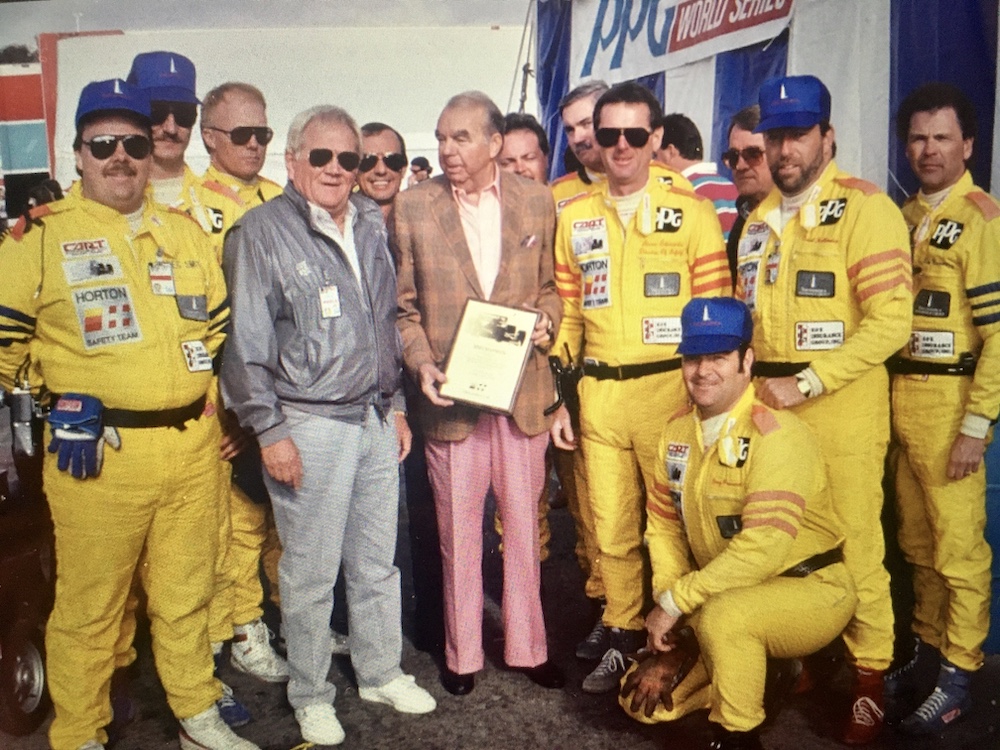
The original CART/Horton safety team. Carl Horton is in the gray jacket next to PPG's Jim Chapman and CART's Steve Edwards, with Lon Bromley on far right. Image via Steve Schunck
Q: IndyCar and NASCAR already scheduled a doubleheader in August at Indy. Are the two series still interested in doing something like that in the future at another track that could be converted into a roval? I can see them going to Charlotte, maybe Texas Motor Speedway, but Daytona may be asking for too much. Your thoughts?
Brandon Karsten
RM: I think Jay Frye and NBC are still interested if the right track and date can be found, but nothing is going to happen until things return to normal (if they do) so it’s not on the front burner right now.
Q: For many years I’ve been disappointed by the lack of press IndyCar gets in newspapers. Seems like since the infamous and ridiculous split, IndyCar lost it identity and status in the public eye. Maybe back when they were called Champ Cars and most drivers were daredevil Americans it was more attractive, but it’s still great, highly competitive racing -- but nobody cares. Even the 500 only gets a paragraph or two in the local papers, and other races will only get the running order at the finish after the high school wrestling results! What do we need to do to change this?
Jim Fischer, Mentor, Ohio
RM: Not much can be done, Jim. Newspapers are dying on the vine and more and more downsizing is taking place, and the motorsports writer has all but been eliminated. It comes down to space and choices when the paper is going to press, and IndyCar just doesn’t generate enough interest.
Q: I’ve read that the Monaco Grand Prix is in jeopardy of being cancelled again this year due to COVID. Hardcore F1 fans think the race should be permanently cancelled because it’s turned into an expensive parade. If Monaco does fall off the F1 calendar permanently, do you think there is a chance that IndyCar could step in and fill that void? Roger Penske has a history with F1 and it would be great exposure for IndyCar. I think the racing may be a bit more entertaining than F1, but would be interested in your thoughts.
Dave Fowler, North Carolina
RM: I can’t imagine that scenario, because Monaco is sacred ground to F1 and The Captain isn’t a big fan of foreign races -- let alone muscling in on the world’s most famous street race. And I can’t imagine IndyCar being asked to replace it anyway. No, we’ve got Long Beach and it’s our treasure.
Q: I don’t think there’s much point in bashing NASCAR so I usually don’t. However, I can say that the Daytona 500 is not like a race but more like a lottery. Get lucky, be in the right place at the right time, and if all else fails, punt, (which we’ve seen many times as well). It baffles the mind. Do you know race fans that enjoy that kind of “racing?” Personally, I don’t. It reminds me of being 7 or 8 years old and looking forward to the Demolition Derby on the 4th of July. Can you give me any rational answer as to why this draws big numbers on TV? I don’t get it.
Jim Patton, Lindale, Texas
RM: It didn’t this year thanks to the long rain delay, but NASCAR’s popularity is difficult to analyze since Little E, Stewart and Gordon are all long gone. But the "fans" seem to love crashes, and they’re never disappointed at Daytona or Talladega. I remember watching a race at Dover and Joey Logano was flipping down the banks and the grandstand was standing and cheering before anyone knew if he was injured. Not all NASCAR fans are like that, but I think a big majority are drawn to all that beatin’ and bangin’, yet the road course races are damn entertaining to me because the drivers are hustling and showing their skills without 20-car pile-ups.
Q: After watching the Daytona 500, I am amazed at the lack of finesse of the drivers. Flat out, block till you crash, and NASCAR offers no penalty for anything. Formula 1 drivers have consequences for their actions. Ok, I know it is obvious, but can you tell me why American motorsport is dominated by NASCAR?
Robert Peterson, Charlotte, NC
RM: The real racers in NASCAR detest those plate races because they know it’s not racing, and they’re victims of the rules and package they’re given at Daytona and Talladega. I’m not sure when blocking became a way of life because it certainly wasn’t like that in the ’60s, ’70s and ’80s in NASCAR or IndyCar. Formula 1 (Senna, Schumacher) perfected it and it slithered into IndyCar in the ’90s. It takes no talent to block, but NASCAR encourages it. And I have no idea how people sit there for three hours and watch it, but there are five times more stock car fans than IndyCar devotees.
Q: I do enjoy your Mailbag, as it provides a glorious insight into the world of IndyCar and U.S. racing that I have admired from across the Atlantic for so long. I even traveled to California just for an IndyCar race a few years ago. It was a wonderful experience, and the Indy 500 is top of my bucket list now. So my question is: How is Phil Hill, America's first world champion, regarded today? He seems to be a bit forgotten, even when those who followed him on the international scene such as Gurney, Andretti and Foyt are hailed as the legends they surely are. Phil never seems to get any mentions nowadays. Why is that?
PaYR, Somerset, England
RM: You’re very observant. Phil is forgotten mainly because so many of his fans are long gone, but also because Daniel Sexton Gurney was such a versatile icon -- as were A.J. and Mario -- and they still have legions of fans. And F1 never got much publicity in the 1950s in the USA, so Hill’s accomplishment was a pretty well-kept secret unless you were a gearhead.
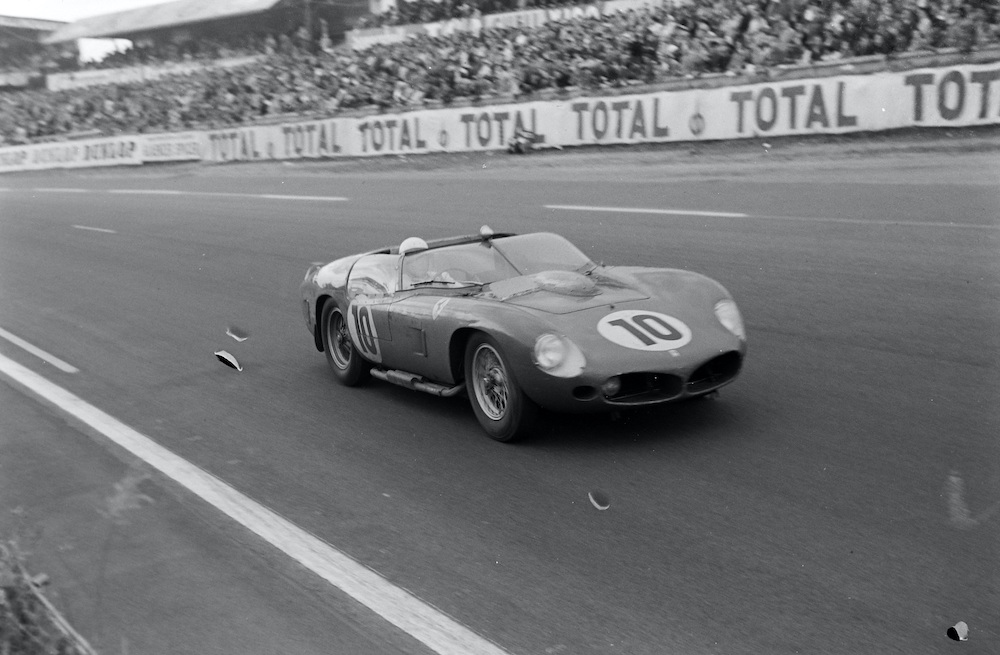
It's very rare that we pass up on opportunity to run a shot of the stunning Ferrari 156 that Hill drove to the 1961 F1 title, but Ferrari 250 TRI/61 that he shared with Olivier Gendebien to win at Le Mans that same year was pretty sweet, too. That was the second of Hill's three Le Mans victories. Motorsport Images
Q: Which do you think are better races: dirt, street and road courses or ovals? Which of these do you like the best?
Chris Fiegler, Latham, NY
RM: AMA flat trackers on a dirt mile and USAC midgets and sprinters on any dirt track are tough to beat, but the Xfinity race and Friday IndyCar race at IMS last year were two of the best, and they were on the road course.
Q: Been going to Indy and following IndyCar since early ’70s. Faithful reader of yours for that whole time. Your mention of being in "the trenches" with a pit board next to the front straight made me wonder: when did Indy teams start using spotters? And was it one team or two trying it out, then others jumping in later? Or did everyone kind of jump in at the same time? Were any teams/owners the pioneers of having spotters?
Mark from Chicago
RM: The first spotter I ever saw was one of Tom Sneva’s best pals named Greg Bogus. He sat high in Turn 2 at Indy and was on the roof at Milwaukee talking to Tom on a two-way radio, mostly to inform him of traffic and track conditions or quick caution. I think spotters became prominent in the ’90s when the seats and cockpits were built up and it was harder and harder to see around a place like Texas or Fontana. But I have no idea which team was first.
Q: Several years ago, I got excited when given my next sales call. I was given info and the name was Lee Kunzman. I was so excited and knew that while it would be tough, I had to be professional, not a fan. Things went well, and he purchased from me. I told him all his memorabilia was awesome and explained I had been to over 40 Indy 500s. Well, that opened it up, and turned a one-hour call into three. I was like a kid in a candy store, just riveted by his stories. I know you have a lot of Lee stories, and I read the Mailbag every week. Any you can share that you haven't, or are you all out?
Kent Odom, Anderson, IN
RM: I guess my favorite is Atlanta in 1979. He’d nearly died in a test crash in 1973, and here he was leading Rutherford, Mears, Sneva, Johncock and the Unsers on one of the fastest tracks in the country with two laps to go. But his mirror had fallen off and he wasn’t sure where J.R. was, so he couldn’t defend and finished second. Toughest guy I’ve ever met, and one of most genuine.
Q: When I was eight or nine years old, my dad took me to the first day of time trials at the Speedway. We were sitting on the front straightaway in Grandstand C. All the cars came out and circled the track real slow to warm up the engine and tires. All except one car, he got on the gas as soon as he left the track. He came down the front straightaway so fast and loud that it shook the grandstands. I asked my dad who that was; Dad just shook his head and took another drink of beer and said it was that “damn Hurtubise.” Been a Hurtubise fan ever since. My question is, what ever happened to his brother Pete who was always his mechanic? I lost track of him.
Steve Fisher
RM: Probably in 1963 with the Novi. Pete is alive and kicking in North Tonawanda, N.Y.
Q: Great seeing your interview with Takuma Sato and Bobby Rahal. Last week's Mailbag photo of you as a racer and your funny comments about not checking to see if your car would fit the trailer and breaking the ring gear points to a missed career as a humorist. You are to racing what announcer Bob Uecker is to baseball. Uecker is starting his 50th year doing play by play in Milwaukee, where he was born. His self-depreciating humor got him the title "Mr. Baseball" from appearances on the Johnny Carson Show. His baseball career was mostly spent in the minor leagues, as was yours. He did play during a legendary era, as you did in racing. His big break came making Miller Lite commercials. He became one of the "Miller Lite All Stars." Did you have any chances to get in TV commercials for race sponsors? Wonder, too, if the first time you met A.J. was when he punched you?
Bob Hunt, Lodi, WI
RM: No, I was very fortunate to have any sponsors, but Dave McIntire Chevy and an apartment complex were kind enough to back me, and all I did was a few movie parties. A.J. didn’t punch me, or I wouldn’t be here today -- he slapped me on the back of the head -- and prior to that we had gotten along famously. It took about a year, but we made amends in 1982 and today he’s a good friend and we talk almost every week, and I feel very lucky.
Q: What's with calling TT racers at the Isle of Man maniacs? They are incredibly skilled and have control over their bikes that most people can't imagine. Racers come in many forms, and I don't appreciate the slam. I don't hear you calling A.J. and the other open-wheel drivers of their era names. Imagine if you did they would cuff you.
Walter Graf, Falls Church, VA
RM: How about amazingly brave, skilled maniacs? My point was that they provide the most breathtaking show on the planet -- if you can stand to watch it.
Q: Given your renowned ineptitude for all things mechanical, I want to know which tool(s) in the garage were your favorite to daydream, "That thing looks cool. I wonder when we need that?" I am not a gearhead. My dad was/is. I learned the terms "feeler gauge" and "piston ring compressor" after seeing them in the garage when I was a kid.
Jody, Brownsburg
RM: When I took my physical for the Army I got called into a private room where a sergeant confronted me. “We see guys like you in here every day, thinking you can avoid Vietnam by flunking part of your written test.” I had failed to properly identify a crescent wrench and Phillips screwdriver, and they were convinced I’d done it on purpose. I never touched a tool until I bought my first race car, and it was not a match made in heaven.
Q: With ARCA running at Milwaukee Mile on August 29 this year, what is the likelihood of IndyCar returning to the Mile in upcoming years on same weekend with ARCA? Could make for one great weekend of racing, wouldn't it? Maybe add Indy Lights to the mix, with Lights running on Saturday after classic Indy cars driven by some retired legends (Dario Franchitti etc.) have taken to the track earlier in the day, with IndyCar qualifying happening after Lights race. Could go as far as to add some big off-track activities such as Q&A sessions with legends that won there like Foyt, Andretti, Unser Jr., Paul Tracy for example.
Jymy Ojanen, Finland
RM: I don’t see any future for IndyCas at Milwaukee, and we let this letter run because you’re from Finland and probably don’t know the Mailbag rules about Milwaukee, MIS, Cleveland or Marco Andretti.
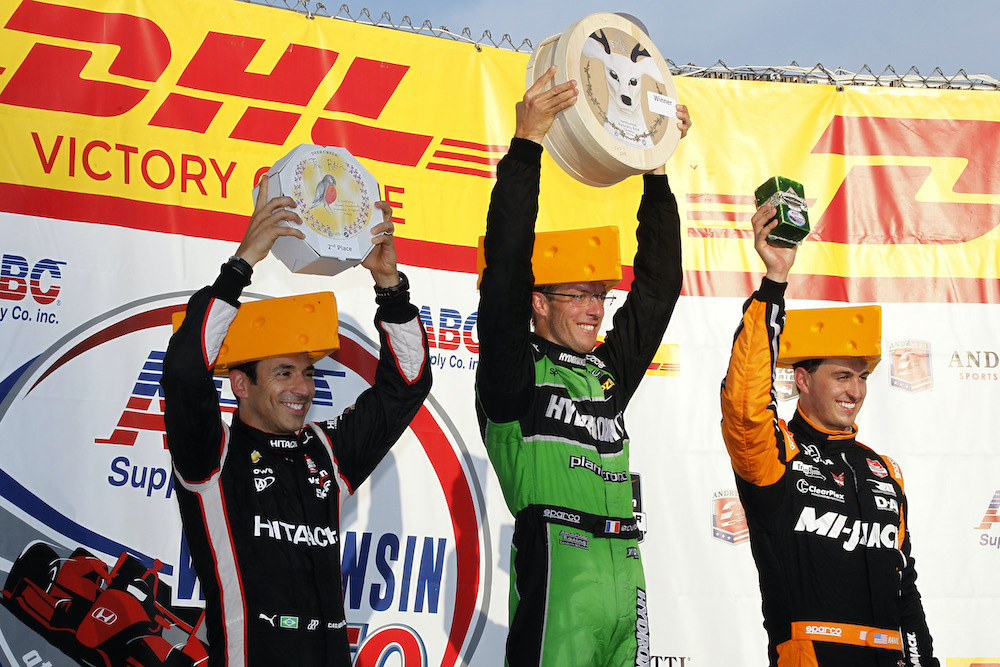
Fine, there's your Milwaukee photo. Enjoy it. Masche/Motorsport Images
Q: I like the current TV guys and the wee bit of tension between Townsend Bell and Paul Tracy. It’s toned down a lot now, so either the bosses said to knock it off, or they reached some kind of truce? I kind of liked their competitiveness and thought it brought an edge to the race. I was a fan of Tracy back in the bad boy days, and frankly, who knew he would turn into a very good IndyCar sportscaster?
Jim Fischer
RM: I don’t think anyone has ever said anything to them about their differences of opinion because it’s good TV. My NBC boss at the time asked me who would be good in the booth and I suggested P.T. because he was a winner, always spoke his mind and people knew who he was. He still owes me a steak dinner.
Q: Any long-time railbird will tell you that watching and listening to your favorite racing personalities and meeting them can be two very different things. While many are what you would expect, or hope, them to be, there are those that fall short. Bob Jenkins is neither of those. He was more than you could hope for, and I had the extreme pleasure of meeting Bob and speaking with him at the Speedway HoF dinner the night he was inducted.
He was approachable, friendly and gracious. A down to earth gentleman. All that you see of the man is what you get. We spoke for several minutes before the dinner, and I told him that in all the years of following the 500, listening to Sid Collins on radio and later Tom Carnegie and Jim Phillipe at the Speedway, I felt that he was a more than worthy successor to those great voices. Being in the Speedway and hearing him on the PA meant I was home again. He greatly appreciated that and thanked me. I meant every word. He is truly a treasure to us race fans. We are praying for a speedy and complete recovery. Please forward best wishes from me and my wife, Yvonne. He doesn't know us, but we sure know Bob and we're pulling hard for him. Thanks for your heartfelt piece on Bob.
Jim Mulcare, Westbury, NY
RM: The “Beloved Jenks” pretty much says it all, because Bob doesn’t have a mean bone in his body nor any enemies, and his interaction with you is simply how he goes through life. Thanks, I sent him your note.
Q: My questions pertains to the safety of the autonomous IndyCar. Will the autonomous car have an aeroscreen? If so, if there was a wreck, how long would it take the safety team to extract the hard drive?
Jared, Reading, PA
RM: God I love it when our writers make me laugh out loud. I believe the time will depend mostly on whether the safety team is refilling their drinks or taking the nachos out of the oven.
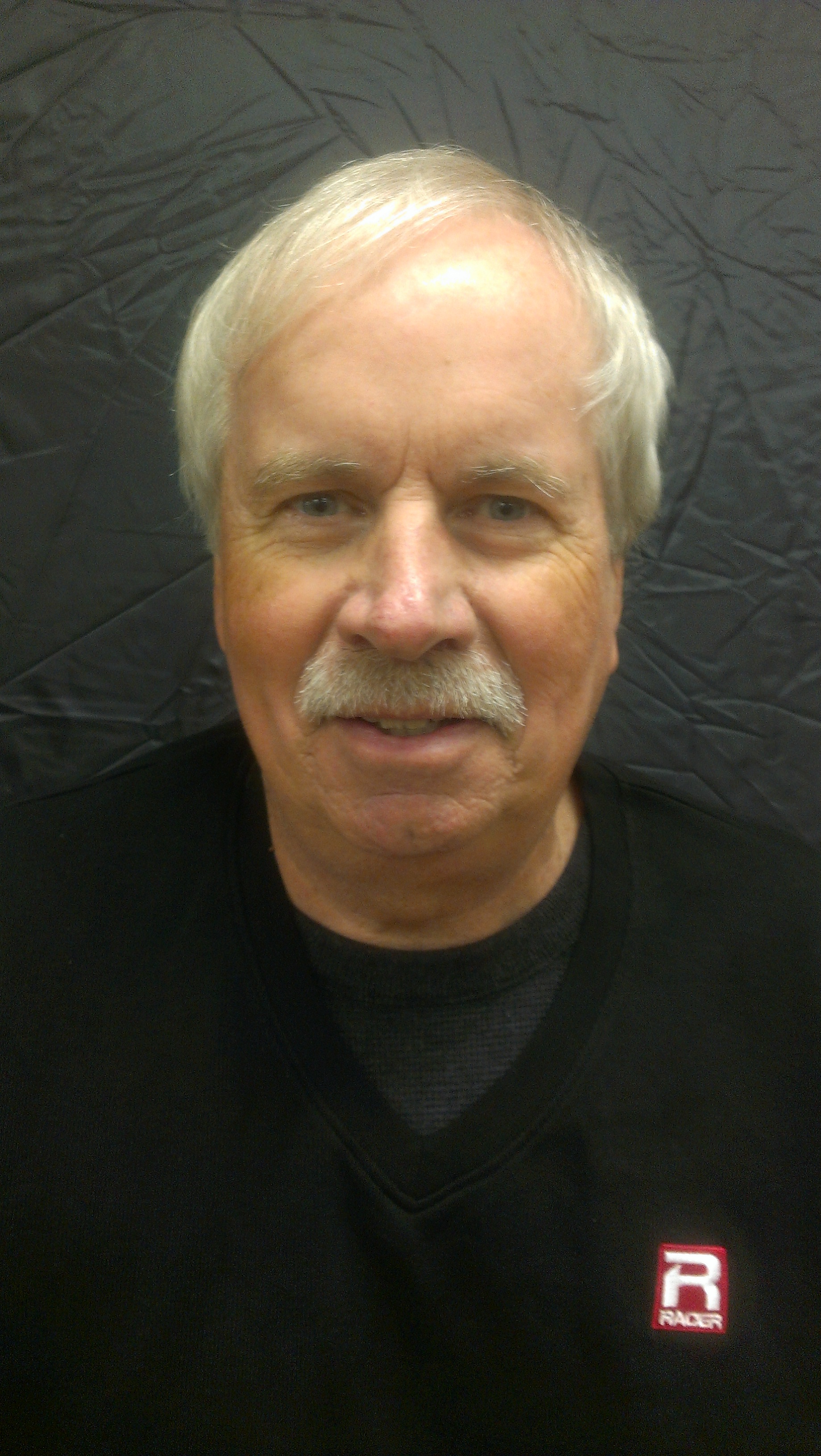
Robin Miller
Robin Miller flunked out of Ball State after two quarters, but got a job stooging for Jim Hurtubise at the 1968 Indianapolis 500 when Herk's was the last roadster to ever make the race. He got hired at The Indianapolis Star a month later and talked his way into the sports department, where he began covering USAC and IndyCar racing. He got fired at The Star for being anti-Tony George, but ESPN hired him to write and do RPM2Nite. Then he went to SPEED and worked on WIND TUNNEL and SPEED REPORT. He started at RACER when SPEED folded, and went on to write for RACER.com and RACER magazine while also working for NBCSN on IndyCar telecasts.
Read Robin Miller's articles
Latest News
Comments
Comments are disabled until you accept Social Networking Cookies. Update cookie preferences
If the dialog doesn't appear, ad-blockers are often the cause; try disabling yours or see our Social Features Support.