Coates/Motorsport Images
No change of approach for Mercedes drivers despite Silverstone problems
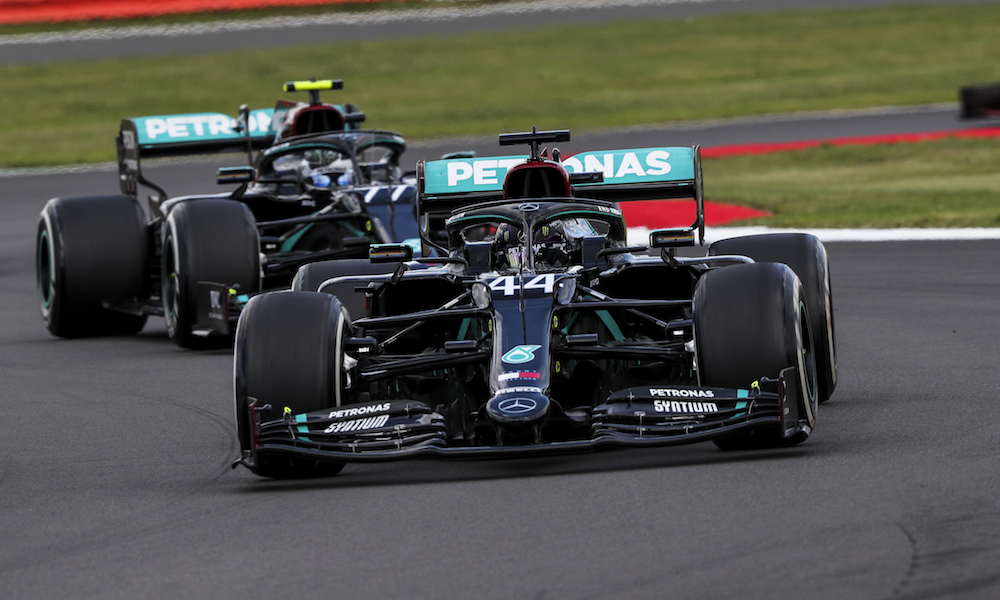
Mercedes will not stop its drivers from pushing each other for race victories despite the costly tire failures the team suffered at the end of the British Grand Prix, Toto Wolff insists.
Valtteri Bottas had been staying within two seconds of Lewis Hamilton throughout the race at Silverstone before a couple of slower laps preceded a front left puncture that dropped him out of the points with three laps remaining. Hamilton then had the same problem on the final lap but managed to limp home ahead of Max Verstappen to take victory, and although Wolff admits the fight at the front could have been a contributing factor, he said the drivers need to be allowed to race.
“Valtteri was complaining about heavy vibration that almost went to a point that his vision was heavily impacted,” Wolff said. “I think we just need to leave it to Pirelli to analyze. Certainly they were pushing each other, maybe a little bit beyond what we would have wanted as a team, but I guess you need to let them race.
“We warned them the tires needed to make it to the end, they were both aware that they could lose P1 or P2 with a failure, and they’re very experienced, so it’s down to their decision once they got all the input from us. I don’t want to interfere. We can’t say to Valtteri, 'back off and let’s cruise home', and we didn’t do that.
“Whatever the reason for the failure was, certainly the front-left was hammered and under heavy duty cycle, but obviously the debris on track didn’t help either. So I’m quite curious to see what Pirelli analysis will show, and I’m sure they’re going to take the right decisions.”
Wolff – who ruled out the team’s Dual Axis Steering playing any part in the failures – said Mercedes did consider pitting Hamilton, but felt his tires were in better shape than his teammate’s.
“That was exactly the discussion we had with the pit wall – are we pitting or not," he said. "We had the gap, enough gap to Max, but it was only one lap to go so the decision that was taken was not to pit. Everything looked fine at the stage, we saw Lewis’ tire was in a better state than Valtteri’s and it still looked a little bit random, and then obviously everything unfolded, the picture of (Carlos) Sainz on the screen and then a few moments later we saw Lewis with the puncture.
“In hindsight, afterwards, probably a pit stop would have been better, but at the end we don’t know the root cause of the failure. It could also have been debris. A newer tire would have had more integrity and rubber and probably protected better against debris so we will learn from that and probably pit if the tires are in a bad condition.”
Chris Medland
While studying Sports Journalism at the University of Central Lancashire, Chris managed to talk his way into working at the British Grand Prix in 2008 and was retained for three years before joining ESPN F1 as Assistant Editor. After three further years at ESPN, a spell as F1 Editor at Crash Media Group was followed by the major task of launching F1i.com’s English-language website and running it as Editor. Present at every race since the start of 2014, he has continued building his freelance portfolio, working with international titles. As well as writing for RACER, his broadcast work includes television appearances on F1 TV and as a presenter and reporter on North America's live radio coverage on SiriusXM.
Read Chris Medland's articles
Latest News
Comments
Comments are disabled until you accept Social Networking Cookies. Update cookie preferences
If the dialog doesn't appear, ad-blockers are often the cause; try disabling yours or see our Social Features Support.