Image by Tee/Motorsport Images
MEDLAND: Austrian GP journal – Friday
As I start writing this entry, I’m still sat in the media center I’ve barely been able to leave all day, waiting for the stewards to discuss a protest from Red Bull against the legality of the Mercedes steering system.
I love it. It’s so... normal.
Arriving at the track on Thursday morning came with some trepidation, but Friday morning was pure excitement. This was further than we got in Australia – I never actually left my Melbourne hotel room on Friday after having been up all night chasing the story about the race being called off – but this today, we were going to see cars on track.
The day started with the FIA taking the time to explain a number of medical protocols that have led to this point, and as interesting as it all was, I’d be lying if I said I wasn’t spending plenty of time watching Formula 3 cars out of the window. It was the first track session of the weekend, and it was so good to see live action again.
That feeling was amplified when the power units fired up for FP1, and Carlos Sainz was the first car out of the garage to officially start the 2020 season.
And just like that, things became so much more familiar.
After Sainz exclaimed his joy at how fast the car felt pulling out of the pits for the first time, radio messages soon turned to car balance reports and complaints about other drivers, and lap times became the focus.
Then came the team principals’ press conference – conducted via Zoom, but a lot more interactive than anything on Thursday – and talk of the strange conditions everyone is working under soon disappeared.
Christian Horner was asked about the Mercedes Dual Axis Steering (DAS) and whether Red Bull would protest, and Toto Wolff waded in by essentially asking Horner to not do so on Sunday night when F1 should be focusing on its return to racing and providing entertainment to fans.
It’s true that uncertainty over the result would not be the ideal way to start the season, and the way Horner and Wolff were on the same page made it pretty clear that the pair had already had discussions on the matter.
This strange new world of F1 meant a protest was lodged after FP2 instead of the race, putting the ball in Mercedes’ court in terms of whether it continues to run DAS or not, but also putting the wider sport ahead of individual fights that little bit more than before.
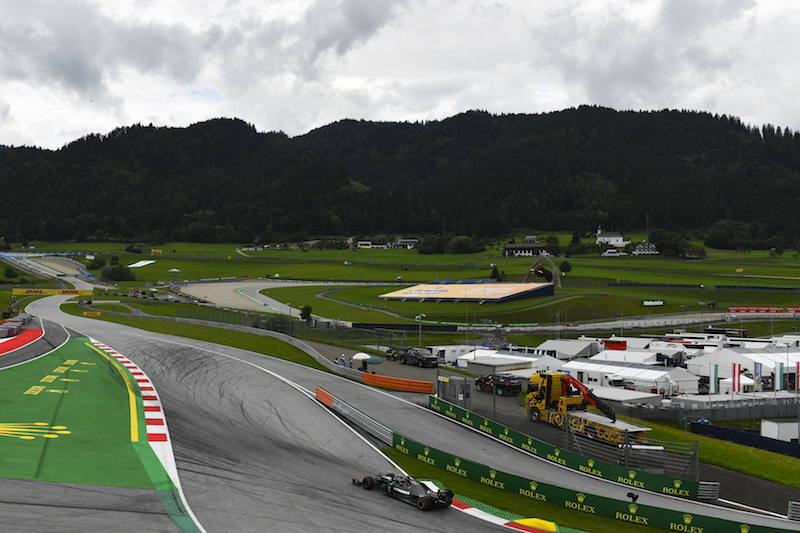
The engines are fired, the cars are on track, the teams are complaining about each other... we've missed you, F1. Image by Sutton/Motorsport Images
The protest itself dropped as I was hosting the socially distant press conferences after qualifying for both Formula 2 and F3, and I’ve never seen equipment cleaned so thoroughly in my life. The microphone and headset are also used when Tom Clarkson hosts the F1 press conferences, but as he is in a separate bubble (with F1’s broadcast team in the paddock, and not allowed in the media center), extra care needs taking to ensure hygiene.
So much here seems over the top, and Wolff said as much when having to wear a face covering, having been used to Austria’s much more relaxed daily approach. But the F1 track is far removed from that situation, as a venue full of 2000 different people from multiple countries who have descended on the Red Bull Ring.
Still, so far it has all gone smoothly, with no positive COVID-19 tests returned. There will be around 5000 tests in total this week, and they are very much a talking point…
After every person takes a test, it is becoming mandatory to tell everyone just how uncomfortable the experience was. The common consensus is pre-event testing was a lot more gentle than on-site, with one F1 employee passing out after the swab was removed from their nose. My next one is tomorrow, so I’m sure I’ll fail to avoid talking about it in the next update this weekend.
Friday ended with very little media access to anyone to reflect on running, with just Guenther Steiner and Mario Isola hosting group video calls, but there was an exclusive session with Lando Norris that also showed some of the pitfalls of remote interviews.
As well as Lando spoke on a number of topics, the lack of anyone physically in front of him meant his attention span led to him losing his train of thought on multiple occasions and having to ask what the original question was. Who knew that a PR over your shoulder and a journalist in front of you was so important for focus?
Speaking of, my attention span eventually waned to the extent I’ve finished this in the car on the one-hour drive back to the hotel, and there’s still not a decision from the stewards at nearly 11pm.
And I still haven’t eaten. And I still love it.
Chris Medland
While studying Sports Journalism at the University of Central Lancashire, Chris managed to talk his way into working at the British Grand Prix in 2008 and was retained for three years before joining ESPN F1 as Assistant Editor. After three further years at ESPN, a spell as F1 Editor at Crash Media Group was followed by the major task of launching F1i.com’s English-language website and running it as Editor. Present at every race since the start of 2014, he has continued building his freelance portfolio, working with international titles. As well as writing for RACER, his broadcast work includes television appearances on F1 TV and as a presenter and reporter on North America's live radio coverage on SiriusXM.
Read Chris Medland's articles
Latest News
Comments
Comments are disabled until you accept Social Networking Cookies. Update cookie preferences
If the dialog doesn't appear, ad-blockers are often the cause; try disabling yours or see our Social Features Support.