Robin Miller's Mailbag for April 18, presented by Honda Racing / HPD
hpd.honda.com
and on social media at@HondaRacing_HPD
and https://www.facebook.com/HondaRacingHPD.Your questions for Robin should continue to be sent to millersmailbag@racer.com We cannot guarantee we’ll publish all your questions and answers, but Robin will reply to you. And if you have a question about the technology side of racing, Robin will pass these on to Marshall Pruett and he will also answer here.
Q: I'd be curious for someone to ask Alexander Rossi to evaluate his personal suitability for Formula 1 today compared to before he started racing in IndyCar. I know he is happy in IndyCar and as a fan I'm thrilled to have him, but after his second half of 2017 and early performance in 2018, I feel like his racecraft has improved so much that he has to already be in the conversation as one of the best drivers in the series. I wonder how he would fare in F1 today?
Ryan in West Michigan
RM: Good question, but if he were driving a Ferrari, Mercedes or Red Bull he'd fare a lot better than the F1 junk he drove before coming to IndyCar. If an IndyCar with the new aero kit is more about driver than car, then F1 is 85 percent car and 15 percent driver.
Q: I just reviewed the recording of Sebastien Bourdais' pass at Long Beach, and Dixon definitely moved over on him. Dixon's right wheels are on the lane stripe as Bourdais comes alongside. Dixon moves over to overtake the car on his left, pushing Bourdais wide. Dixon's left wheels end up on the lane stripe. Bourdais had nowhere to go. If there were calls like this in the CART days, they would have taken back Zanardi's pass at the Corkscrew.
Russell Mill, Austin, Texas
the whole sequence
on RACER.com to go with thecommentary I wrote
and there's a shot where it looks like Dixon is moving right and Bourdais reacts – and you've got to remember how fast they're going at that part of the track. So, yes, making Seb give the spot back was B.S.Q: Long Beach was a fantastic event, and kudos to Rossi for completely dominating the race. You see a guy kill it like that, and you wonder how he could ever lose a race. What is up with the closed pits? Can we just get that abolished? We were robbed of a closer race because of what almost seemed like an arbitrary rule. Why do they even close the pits for yellows? It's not for safety, is it? Bourdais and Dixon got completely screwed. Bourdais was on a tear all afternoon, and to get shuffled to the back for some dumb reason... let 'em race for cryin' out loud. Another great drive for much of the afternoon was that of RHR. He drove the wheels off of that car and even got to the front group for a while. Good stuff. The crowd was great, the attendance looked to be a full house, and the racing was, as usual, pretty damn good!
Bruce Davison, Santa Clarita, CA.
RM: IndyCar tried leaving the pits open a few years ago and teams bitched that it messed up their strategy, so they went back to closing the pits, which always sucks. To drive your butt off and lose a win or podium or good finish because you miss the pits by a couple of seconds when the caution comes on is ludicrous. I'd always leave the pits open like they did in the good old days.
Q: From the video it looked like Seabass had committed to the pits on that yellow and couldn't have gotten back on track without wrecking at pit-in. He drove though the pits and should not have been penalized, unlike Dixon who actually took service. They both had a drive-through. I can understand the penalty for Dixon, but not Bourdais. Maybe tweak the rule a little for a case like this. Your thoughts?
Jeff, Florida
RM: The Race Director can see what scenario is playing out, and Brian Barnhart always seemed to go out of his way not to hose the frontrunners in a similar situation. Seb said he wasn't sure when he pulled in because it was so close, but Dixon's team obviously made a mistake by completing their pit stop.
Q: I was for Rossi in Sunday's race, however why do they have to close the pits so quickly after a wreck? (Why do they have to close them at all?) It killed Dixon and Bourdais' races. Having said that, after the race Dixon was not happy that Mike Hull kept him out so long and got him trapped. Why don't you think Hull brought him earlier?
Perplexed Paul
RM: Dixon was not happy, and this is about the fifth or sixth time something like this has happened to him in the past few years, so you understand his anger. It's fine to stay out as long as possible on the first stint and then try and jump your competition as they pit. But in Sunday's case, the rule of thumb is pit as soon as you can make it to avoid getting caught out like Seb and Scott did. Rossi pitted four laps earlier and took no chances.
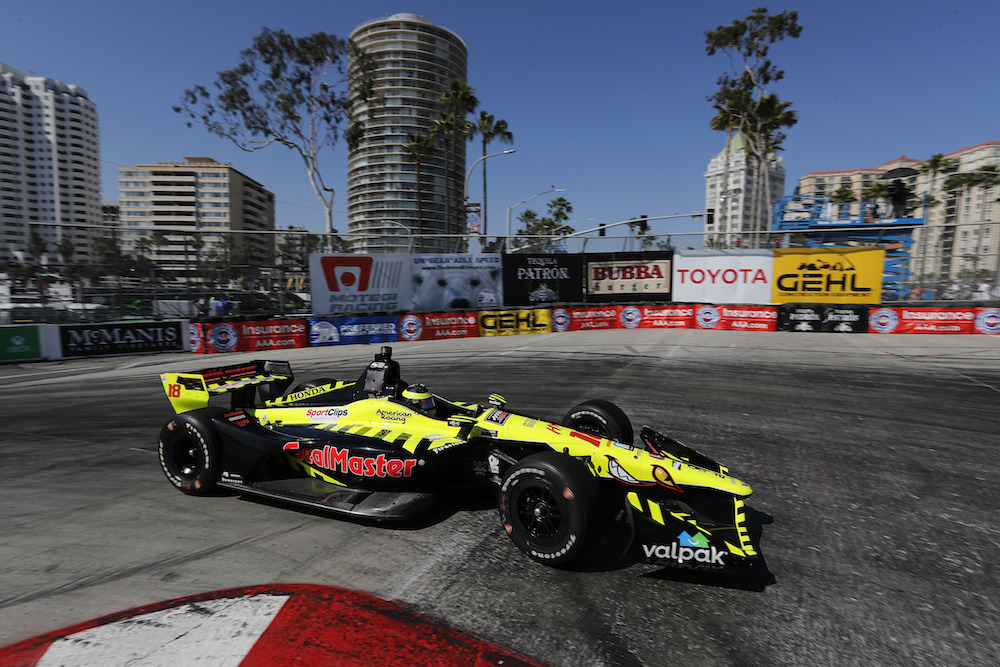
Photo by Phillip Abbott / LAT Images
Q: I think IndyCar fans were robbed of another exciting race, and result and an exciting driver's possible challenge to the eventual winner Rossi because of an ill-timed caution. I'm talking about how Sebastien Bourdais's race went from good to bad to ugly due to an ill-timed caution coming out at the wrong time, and through no fault of his own he got penalized because of the closed pits rule.
I don't understand why and how IndyCar is resistant to change a possible kink in the way the race operation is run. It's too high a price to pay for a team that could be doing everything right, and a driver driving his heart out, to get penalized by the freak timing of a yellow. And please don't tell me it is what it is. In this day and age, things can be figured out easily with cheap technology. How about getting the drivers to hold a predetermined safe speed on track as soon as yellow is thrown, but keep the pits open? Very simple. I hope other fans are demanding this.
Shyam C.
RM: A Virtual Safety Car like F1 uses has been discussed, as well as leaving the pits open at all times, but you really can't have the drivers in charge of the speed limit. As for winning the race, Bourdais had this to say afterwards when asked if he had anything for Rossi after moving into second place before being hosed by the caution: "No, he was on another planet."
Q: There has to be some alternative to the closed pits rule during yellows. I understand why they are closed to avoid people rushing round the track to get into the pit, but could there be a third option like limiting drivers to 100mph or some other speed for the first lap of yellow?
Victor, New Haven, CT
RM: The two alternatives are leaving the pits open, or trying the Virtual Safety Car.
Q: Best Long Beach race in quite some time! Bourdais on Lap 48 was awesome, passing three cars at once! He was the car to watch all day. It was good to see Power finish a race this year and challenge Rossi at the end. Your thoughts?
TJ Spitzmiller, Bradenton, FL
RM: I've been to every LBGP except the first one, and this had more passing and action than 90 percent of them. Plus it had a close finish, even though Rossi never looked pressured. This new aero kit races really well on street circuits, so hopefully it will continue this weekend in Alabama.
Q: For years, many of us had hoped for an Andretti/Rahal rivalry to materialize and give a little bit of natural drama to boost the sport. Unfortunately though, Marco had struggled for the past several years, and only in the last three has Graham become a contender for wins. However, Rossi and Newgarden have easily been the top drivers since the end of last year, and consistently been able to compete and win against Scott Dixon and Will Power. Do you feel they could be the big American vs American rivalry that the series has been waiting for to develop?
Alan Bandi, Butler, PA
RM: I don't know that Rossi and Newgarden have the combative personalities to fuel a good rivalry, or at least the kind fans and media want to see. But obviously they could be battling for championships for years to come – maybe even as teammates some day?
Q: I'm sick and tired of watching the half-assed starts at Long Beach. Awful, embarrassing... words can't describe seeing the starting field strung out two or three turns before the flag drops! The excuses from IndyCar are bull! It's time to move the starting line closer to the first turn (yes, the cars have less time to get in single file) or have standing starts, (but the drivers don't have the skill or high-tech line brakes, or whatever the excuse). How many more years before IndyCar fixes this mess?
Donald McElvain, Polson, Montana
RM: I couldn't agree more, it's a travesty for the paying customers, as well as the competitors. That's why a standing start makes so much sense at a place like Long Beach, and Champ Car pulled it off just fine. It puts everyone on the same stretch of pavement and reduces the speeds heading into Turn 1, which gives everyone a chance to make it.
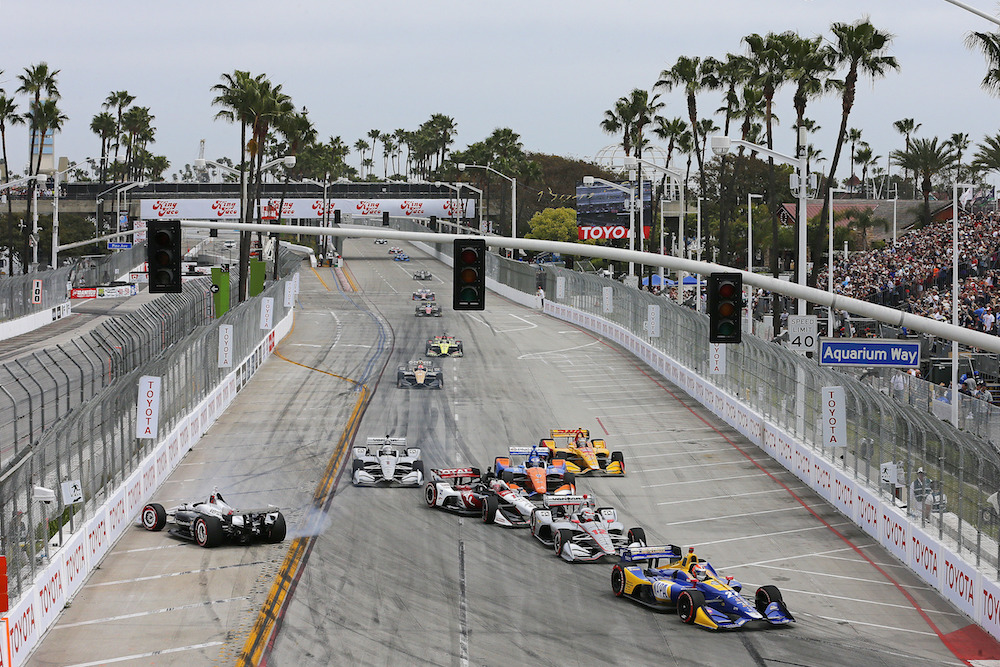
Photo by Perry Nelson / LAT Images
Q: After a long absence from IndyCar, this is my second year back as a fan. IndyCar seems to be in a good place with beautiful new cars, excellent drivers, and tight racing. However, I was pretty disappointed to see the Turn 1 incident at Long Beach. I'm not talking about the wreck. It's Long Beach, Lap 1, Turn 1, drama is almost unavoidable. The problem was that Pagenaud's car was not hauled back to the paddock.
Seems the mechanics and crew should determine if the car can continue, not the series. In contrast, the series dragged an extended multi-lap yellow following an incident where the car was promptly pulled behind the wall. In the second case, I'm sure there were marbles to sweep and positions to validate. But, from a fan's perspective, a longer yellow was justified for Pagenaud to allow a tow to the paddock. Is there a rule on this, or was it an official's call? Thanks for the great coverage of IndyCar.
Jon N., San Diego
RM: From IndyCar race director Kyle Novak:
"There is no rule requiring IndyCar to return a car to a team during a session or race, prevailing conditions dictate IndyCar's ability to return a car, with the primary goal of returning to green flag conditions as quickly as possible for the fans. Street courses such as Long Beach and St. Petersburg, give IndyCar limited options in which to promptly return a car to either the teams pit box or paddock, then return the wrecker to its proper location.
"Factors such as limited and small overlaps to store safety equipment, and also having our safety equipment in the best location to respond to a future incident, all weigh into this decision. As we mentioned in a previous answer to a fan question, each full course yellow presents us with a specific set of challenges with regard to reordering, how spread out the field is, the severity of the incident, track clean up, and when that FCY occurs in the race, which could dictate a slightly longer procedure such as driving lap down cars through the pits to reorder. Should the teams be able to dictate at their discretion when cars could be returned, it would have a knock-on effect of tying up all of our safety assets returning cars, when we could be returning to racing much sooner.
Q: I'm sitting here watching Toronto Maple Leafs vs. Boston Bruins playoff hockey on NBCSN, and the announcers did an in-game promo for Long Beach this weekend, tying in Hinch (the Canadian connection, of course) trying to be the "King of the Beach." Then they mentioned that starting in 2019 the Indy 500 will be on NBC! Nice to see they are trying already to bring in fans.
Brian, Mason, Ohio
RM: I think I've been saying for months now that NBC will blow out the Indy 500, just like it's done for the Kentucky Derby, NHL playoffs, Tour de France, NASCAR, Sunday night football and the Olympics. It thrives on big events, and Indy will reap the benefits. I promise you the ratings won't go down in 2019.
confirmed with DRR for May
and James Davison is running athird car for Foyt
. What other possible entries are out there in the works? Could we see 36 or 37 by qualifying weekend?And here's my view on the topic of starting only 33: I'm all for it. The 500 has been one of the most prestigious races of all time, and those who make the field are often referred to as the "33 Fastest Drivers in the World". I think it puts pressure on the teams to truly give May everything they have if they don't want to go home. And it also will attract more attention, because some guys will be at risk of not making the field and it will bring out the best in the drivers on qualifying weekend. I get the argument that it is bad for the sponsors who don't make the race, but maybe IMS could do something to compensate them on race day. I think IMS should go back to Pole Day on Saturday and Bump Day on Sunday too, to give the extra entries more time to make the field. What are your thoughts?
Ben Neal, Noblesville, IN
RM: I've heard Indy Lights' driver Juan Piedrahita might have enough sponsorship if he can get an engine, and there's always Bob and Buddy Lazier. But Honda is locked into 19 engines so I imagine Chevrolet could field 17 if needed. I always liked three attempts with one car, but obviously that's not going to ever happen again. I do like Pole Day on Saturday, but I guess ABC enjoys having it on Sunday.
Q: What power plant is Scuderia Corsa using at Indy? I would like to think Ferrari, but IndyCar rules probably won't allow it. Thanks, enjoy reading your Mailbag. Been to 64 500's and counting.
Uncle Rex
full-time in IndyCar
.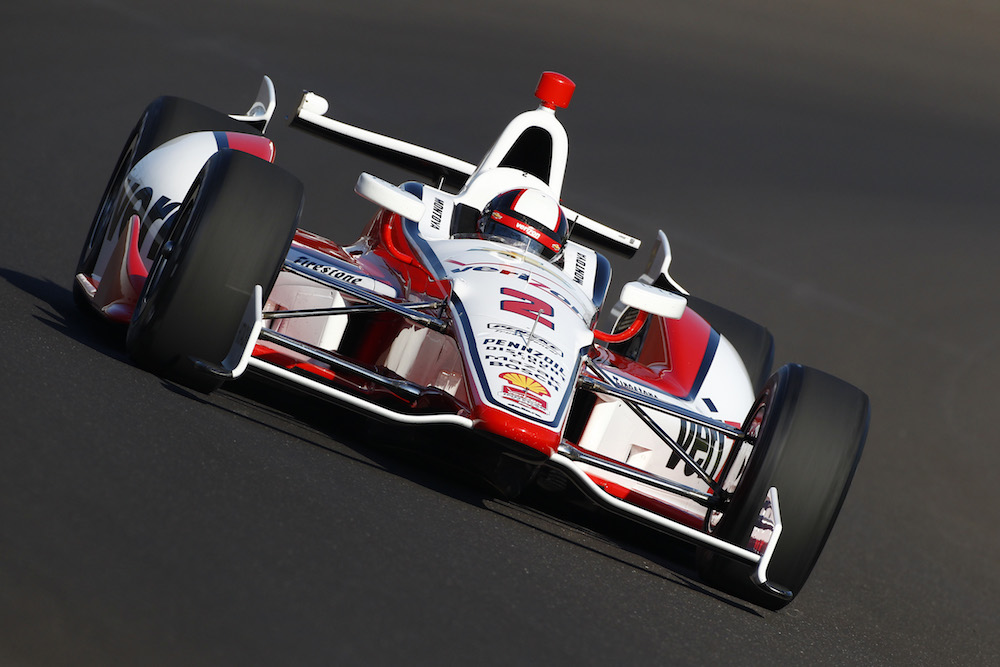
Photo by Phillip Abbott/LAT
Q: As happy as I am we have bumping back at Indianapolis, I am a little worried that the format may make it too complicated or not as great as it could be. Like ,why are there two lines? What does "Last Chance Qualifying" in the rules even mean? Could you please break down the format for us, and share your opinions on it?
Also, the "Fast 9 Shootout" is just dumb; it sounds like something NASCAR would do. In 2014, Juan Pablo Montoya [above] ran a fast enough lap on Sunday that could have gotten himself pole, or at least Row 2, but he could only start 10th. If I am thinking correctly, they started this in 2014 to make it exciting, and yes without bumping it added something, but in years like this we simply do not need it. IndyCar really needs to rethink qualifying on road courses, too. The whole "Firestone Fast 6" round is pointless and a waste of tires. Why not just end it after Round 2? Also, it's totally unfair that in Round 1 somebody in Group 1 could run a faster time than first in Group 2, yet not make it because they were seventh in their group. Do you see a solution to this, or do you think IndyCar thinks what it's doing is fine?
Kyle Cuthbertson, or the Rahal Fanatic from Lucas, Ohio
RM: Here are the qualifying rules for 2018 at Indianapolis:
First-day Qualifying, scheduled 11 a.m.-5:50 p.m. ET Saturday, May 19 – Determines the 33 positions in the provisional field based on the fastest four-lap averages. All entries are guaranteed at least one four-lap attempt to qualify, provided the car is properly and timely presented. No limit on the number of qualifying attempts an entry may make.
Group 1 Qualifying, Sunday, May 20 – Each entry in Group 1 must make one four-lap attempt, in reverse order of qualified positions from the previous day. The fastest qualifier in this session would earn the 10th starting position down to the slowest starting 33rd (barring any special session to determine starting positions at the rear of the field).
Fast Nine Shootout, Sunday, May 20 – The fastest nine cars from first-day qualifying will run in reverse order based on first-day times. Each car receives one guaranteed qualifying attempt, provided the car is properly and timely presented. At the end of the session, the cars are ranked 1-9 based on their four-lap average during the segment. The Indianapolis 500 pole winner is determined by the fastest qualifier in this session.
Last Chance Qualifying, scheduled Sunday, May 20 (if necessary and approved by INDYCAR, time TBD) – If any cars are unable to complete their guaranteed qualifying attempt during first-day qualifying due to a mechanical condition or accident, INDYCAR may approve a special qualifying session involving those cars and an equal number from the rear of the provisional field. For instance, if three cars were unable to complete their guaranteed attempt on the first day, with approval from INDYCAR, they would be permitted one attempt in the special session along with the three slowest cars from the provisional field. The fastest qualifiers in this session would determine the final three starting positions for the race.
Q: I don't worry about teams and drivers getting bumped from the 500. They understand the risk. What does worry me is some of the new sponsors – particularly SalesForce – are getting into this because they want the benefits of being associated with an IndyCar team. They are not signing up for the risk of not making it on the 500 grid. Plus, getting those badly-needed new sponsors is key to them then wanting to come back and sponsor full-season teams. At a bare minimum, if bumping occurs, is there a way that IndyCar could guarantee that the sponsors who got bumped can still be on the grid in some way? We need SalesForce in this sport. We don't want them getting turned off if JR Hildebrand gets bumped. Let's find a way to keep them – and WIX, and whomever else – on the grid and in the sport.
Justin Brown, Louisville
RM: Well, first off, I don't think J.R. is a candidate to get bumped, he's always good at IMS and so is Dreyer & Reinbold. But, in years past, if a sponsor got bumped somebody was always willing to run it on their car, and I imagine that would still be the case.
Q: My solution to the question of more than 33 starters for the Indy 500 is to start the 34th and 35th cars from the pit lane after the green flag. The cars would have to sit in pitlane and not be involved in any of the pre-race ceremony on the grid, but they then get a sporting chance. If there is a first lap Turn 1 or 2 incident, they would be on the pit exit lane and thus avoid the incident, and be going much slower too.
David M-K, Ottawa
RM: I say if you're going to start everybody, then treat 'em all alike. It's not like they're running for a bunch of money.
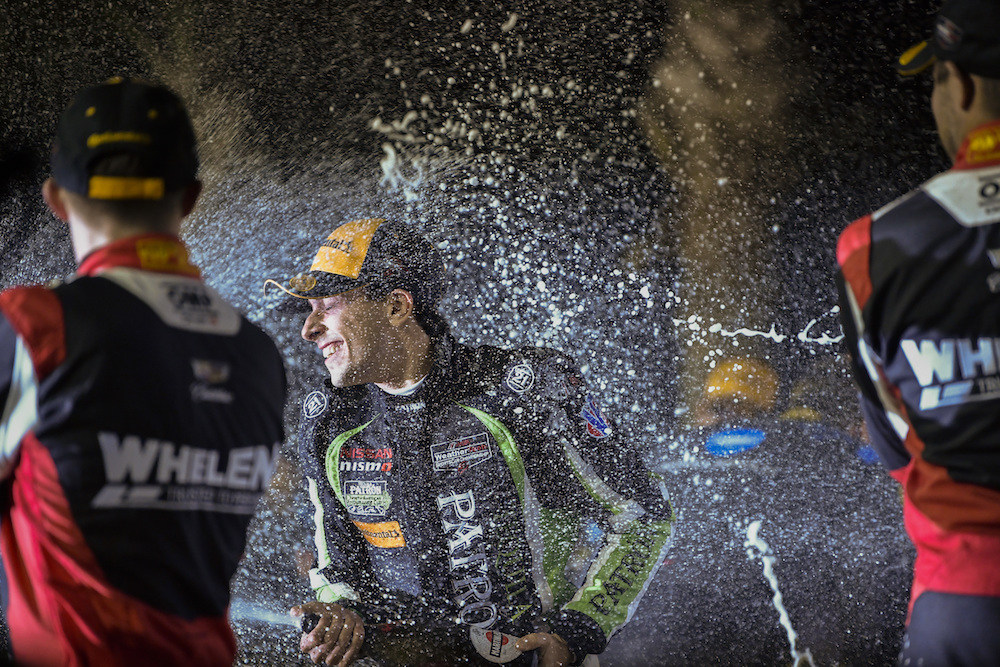
Photo by Richard Dole / LAT Images
Q: Is there any interest in putting Pipo Derani in an IndyCar? Ever since the first time I saw him race in the Rolex Daytona 24, I thought "this kid has unbelievable talent". And is there ever any discussion about bringing back shows like Thursday Night Thunder or Saturday Night Lightning featuring karts, midgets and sprints? I really miss those!
Scott Karst, Madison, Indiana
RM: Derani has had success at Daytona and Sebring (overall winner in both) and won a couple of British F3 races at Oulton Park and Brands Hatch in 2012. He also finished sixth at the Macau Grand Prix. So I imagine if he's so inclined and can raise the money he can certainly come to Indianapolis some day.
Q: I watched your "tribute" to Dan Gurney before the Long Beach race. Very insulting to try to compare Josef Newgarden to someone like Gurney, who accomplished so much during his life. Newgarden had little-to-no success in Europe, and never raced GP2 much less F1, and never even won a race in GP3. Gurney was a legend, and trying to put Newgarden in the same category is just asinine.
E. Barnett
RM: I think maybe you should watch it again. I made it very clear there would NEVER be another Dan Gurney, and the comparison to Newgarden was in the form of becoming a fan favorite in America, which he could be with his talent and personality.
Q: A quick note to say thank you again, for the stories about Dan Gurney in the June 2018 edition of RACER magazine, The Heroes Issue. Wonderful!
Rick Koressel, Evansville, IN.
RM: Thanks Rick, tell your friends we've got 1993 prices for subscriptions – only $23.97 for the whole year.
Q: Longtime reader of yours and hardcore IndyCar fan for roughly 25 years thanks to my Dad introducing me to it early. While overall I am happy with the direction of the series, it pains me to see the downfall of ovals. Personally, the loss of the Milwaukee Mile hurts (but thankfully Road America is back). Now times change but I do believe IndyCar can change with it.
Street races appear to produce the best turnouts (not counting Indy of course) for a number of reasons. First off street races almost advertise themselves. Everybody in and around the city holding a street race will see the construction for the temporary circuit. Ovals are always there, and if you are not promoting it, nobody has a clue IndyCar or anyone is there. Also, street races produce a festival atmosphere where you don't have to always be glued to a seat.
Outside of the need for more promotion, I believe making oval races feel more like a street and festival atmosphere would help. I know Andretti somewhat tried that in Milwaukee, but it was not done right. We don't want carnival rides. Each oval location would change some of the specifics, but for a place like Milwaukee, I don't understand why you couldn't get the breweries and microbreweries involved and set up temporary bars and stands. Also, better food, WiFi, real spectator mounds in the infields (all turns and back straightaway), local music, more historical cars on display and shopping. Bring a street-like atmosphere to the oval, and if you are too cheap to advertise, cross-promote.
I personally don't need anything more than IndyCars, a radio and my phone (for live telemetry, but I could live without it), but don't you think it's time to modernize the oval and try to get families out to the track? Outside of IMS, there usually is nothing to do but sit and watch: fine for a lot of hardcore fans, but we need new ones. What are your thoughts?
Kyle P. from Milwaukee
RM: My thoughts are that ovals are a dying breed because people are no longer willing to come sit around for hours waiting on one race (or maybe two), and there is little for them to do in between. Long Beach is the perfect example. From 8 a.m. until 7 p.m. there is always something on track, and there are another 10,000 people milling around the Expo Center looking at all the cars and exhibits. Most ovals can't offer that, but Gateway is trying to with vintage cars, support races, enhanced concessions and more bells and whistles. Promotion and marketing are also key but IndyCar's ovals don't get much of either.
Q: At a place like Phoenix, which is trying to re-establish itself in the marketplace, why wouldn't they give out thousands of free tickets and earn money on concessions and parking and give it the look of a successful event? The appeal of an event can be enhanced by the appearance that demand is greater than it is.
Vincent Martinez, San Gabriel, CA
RM: In CART's heydays when Honda, Toyota and Marlboro gave away freebies to customers, the tickets still had to be bought through the promoter/track, so if IndyCar is renting Phoenix or co-promoting it then who is going to pay? And if 7,500 people buy tickets and then find out 7,500 people got free ones two months later, you think they're ever coming back? Freebies always sound like a simple solution, but they're not.
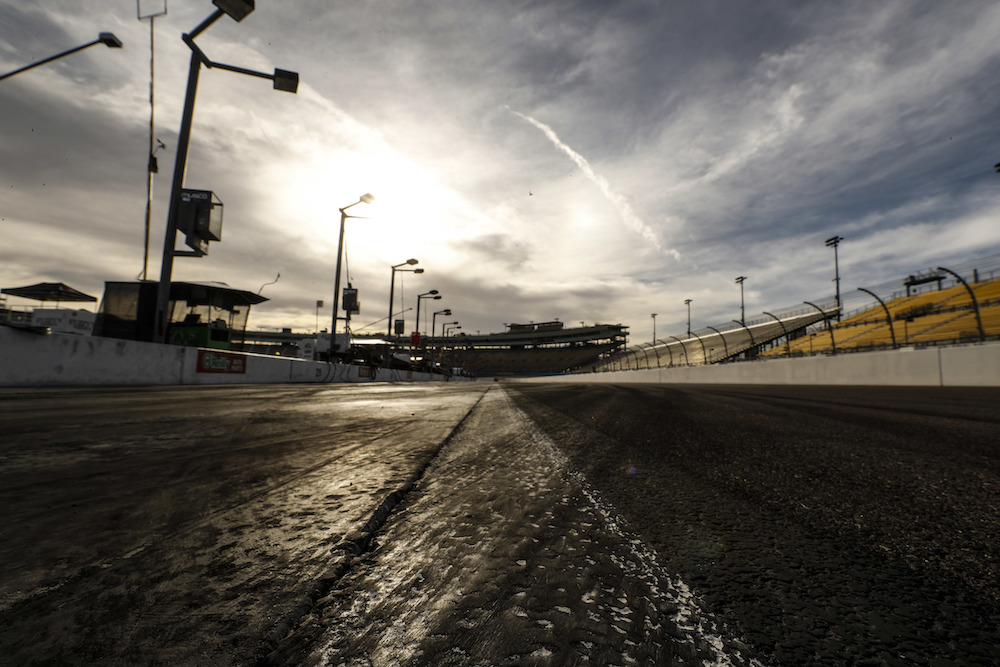
Photo by Michael Levitt / LAT Images
Q: Having attended this year's spring NASCAR race, as well as the last three IndyCar races, I'm simply at a loss to describe why it is that Phoenix has no problem drawing a big crowd for Cup, but can't do it for IndyCar. The only differences I could see were that the Cup race was much longer (and that's not a good thing), and they don't have nearly as much of a problem with lapped traffic. But it didn't feature any closer of a battle for the lead at any point during the race. It probably would've been a runaway were it not for the mandatory yellows.
Does the general public just find passing lapped cars more entertaining than we do? I'm all for watching Rossi drive through the field twice, but watching leaders drive around backmarkers doesn't really do anything for me. I'd love to see the cars get more power, and it might make for a better race, but I have severe doubts that it would result in any improvement in the crowd.
Kirk Lane
RM: The combination of ISC owning Phoenix, hosting two Cup races per year and IndyCar's decade-long absence are the obvious reasons. Forget the fact an IndyCar laps Phoenix 50mph faster than a stock car, the reality is that ISM Raceway was putting up billboards for the November race on the Friday of IndyCar practice this month. It's not the speed or racing, it's the perception, and Phoenix stopped being an IndyCar track after 1995.
Q: We had a great time at Phoenix. Got our infield spot right behind Pagenaud, my five-year-old son's favorite. What a good guy; he came over to the fence and talked to my son for a few minutes. We don't get that in NASCAR.
And we saw you walking down pit row while we sat on top of our RV. I hope you're wrong about successful ovals in IndyCar, I think we just need good racing and an earlier date, when the valley is full of snowbirds and the weather is awesome. (March is always nice.) My question is: What needs to happen to have competitive racing here? Is it the aero kit? Does the track need progressive banking? Are IndyCars just too fast for one-mile tracks? This series is certainly more fan-friendly than stock cars.
Randy Barnes
RM: Some drivers say the aero is still wrong, some say its tires, some say more power is needed to make passes on the short straights... lots of opinions. But the tire strategy at least made the finish exciting for the people like yourself that did support the race. No comparison to a fan's experience at an IndyCar race compared to a NASCAR show, so I'm glad your son got to bond with Pagenaud.
Q: I thought the race at Phoenix was a big improvement from the first two years. As you have said, there used to be so much more separation in speed that maneuvering through traffic was a big part of the show. We saw that with Hinch losing the lead, and Jones getting in the fence because of traffic. I think the new aero and degrading tire moved the show at ISM in the right direction. It seems that aging asphalt, more horsepower and daytime conditions are the other needed steps. I really enjoyed the race.
We live in a time where the technology in most race cars is so advanced that the show is effected. Gone are the massive development curves of the 60s and 70s which many look upon so fondly. Now we need things like: 1) Significantly reduced downforce and Push-to-Pass – IndyCar 2) Air ducts and restrictor plates – NASCAR All-Star Race 3) DRS – F1 4) BoP – IMSA to reproduce the shows we collectively hold in such high regard from the past.
Add on to that the fact that if this current generation does not see something blow up or flip over while they run underneath of it recording themselves for Twitter, what can be done? Even if the best race ever produced at Phoenix or any other track was reproduced through changes in HP, aero, temperature, it seems to me the days of sold-out grandstands are gone, not just in IndyCar, but NASCAR too. Maybe it is a natural cycle?
If your review of Saturday's improved race was so poor, I am left feeling like auto racing in general is in trouble. Please tell me there is a way out of IndyCar racing at different race tracks every two or threee years. How does IndyCar grow in this current environment if Phoenix 2018 was a failure?
Jordan, Binghamton, NY
RM: It was a much better finish, obviously, and there seemed to be more passing (Rossi un-lapping himself), but as I wrote, Phoenix and Milwaukee were always about lapped traffic and how the leaders handled it. With spec cars and stronger teams, there is no longer the big disparity of the old USAC/CART days, so a lot of people are running the same speed. Gateway made a grand re-entry a year ago because it had Bommarito Automotive as a great title sponsor and a group of people that understood promotion and the audience. But without a big title sponsor that is going to sell your race, an oval track has zero chance of surviving. Road courses and street circuits are easier sells because of non-stop action, camping, three-day tickets, etc. But as Mark Miles said recently, how long does IndyCar keep propping up a place like Phoenix?
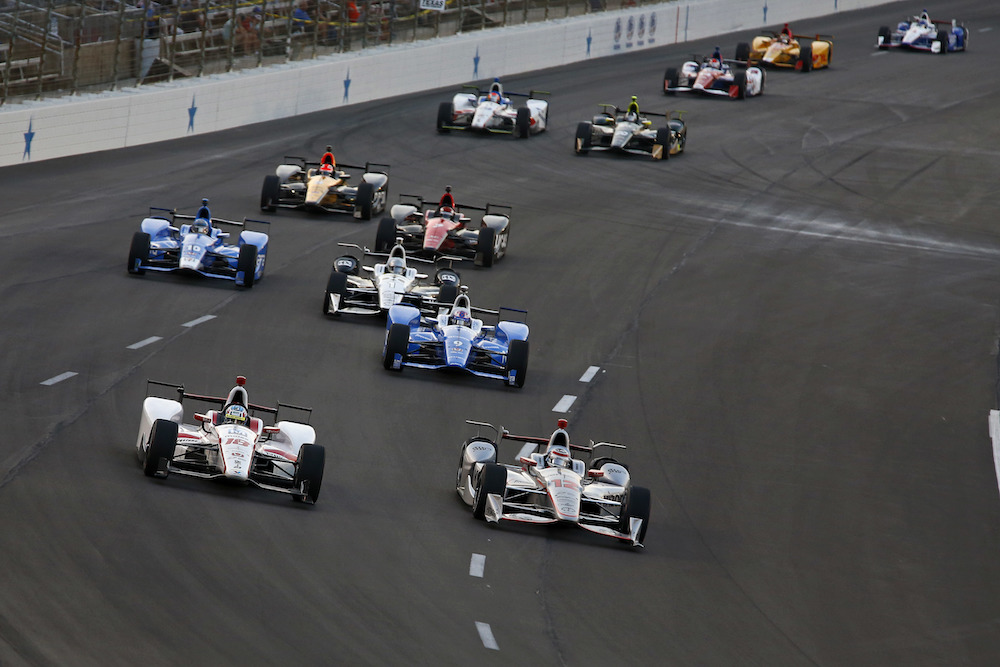
Phil Abbott/LAT
Q: At my job, I only get enough time off to make one race a year. Where I live, my two nearest races are Texas and Barber. In 2014 and 2015 I went to Texas and had a great time, but it wasn't the party that Houston was in 2013, so in 2016 and 2017 I went to Barber.
Barber Motorsports Park and its museum is a sight to behold. The Indy race weekend there is not just a race, it's a festival. There is so much to see and do there. However, actually watching the race there in person leaves a lot to be desired. No matter where you sit, you can only see the section of track in front of you. The cars go by, then for the next minute and 20 some odd seconds you watch the race on TV monitors set up around the track. That's also how Houston was. I assume all road/street courses are like this.
After doing a lot of soul-searching I decided I'm going back to Texas this year. I realized that there's no way seeing road racing in person can match the thrill of seeing these same cars constantly roaring past at 215mph. You can't appreciate what these cars can do until you witness them running wide-open. At the oval you can pretty much see the entire track from a seat only halfway up the stands.
Although they've got a great TV there, if you're watching the race, you don't have time to watch the TV. It's my belief that if the ovals can figure out how to reproduce that road course festival feeling that brings in the causal fans, they will have the goose that lays the golden egg. Take a friend to an oval race! #Savetheovals!
John in Arkansas
RM: Texas is one of those races you can't look away, and you can't watch with both eyes because one is always covered up. It's intense and breathtaking and scary and entertaining all in one lap. When it's over, the spectators seem to be breathing as hard as the drivers. Barber has been one of the real pleasant surprises of IndyCar during the past decade because it's nestled in the heart of NASCAR country but draws a nice, enthusiastic crowd, and is usually a damn good show despite the fact the track was built for motorcycles.
your article
, I sadly think you may be correct about the future of oval racing and IndyCar. We have lost almost two generations of prospective fans. Potential followers who have no idea of the history, the connection, an understanding of open-wheel oval racing in America. Without referring to past mistakes by league management, etc., other than us hardcore IndyCar fans, most associate oval racing with NASCAR.Too much time has passed and tradition lost for any young fan to understand that most IndyCar drivers of the past cut their teeth in midgets, for example. It's hard enough these days to find people who know what a midget is, and those that do, relate it – along with modifieds and sprints, etc – to NASCAR. The transition of drivers like Jeff Gordon and Tony Stewart from those cars to NASCAR hasn't helped, either. With the road course/street race transition over the past 40 years, and foreign drivers headlining, it's amazing any of the current Indy ovals, other than the Indy 500, survive. Again, the future of ovals in Indy car may be passing. One thought though: 10-lap heat races and a 100-lap main with betting on all heats. A pick 6, Exacta, Trifecta... well, maybe I had too many beers.
Ron Hampton
RM: It's not hard to envision the IndyCar schedule only having one oval some day, because it's too tough to make money (or break even) as a promoter. But betting at the track would be one way to pump some life into things. Randy Bernard ran that idea by the Hulman family many years ago and it got no support, but why not beat NASCAR to the punch? People love to bet, and it would give them a vested interest in watching the whole race.
Q: I was kind of surprised to hear that you and many others felt like the Phoenix race was a dud. On TV, all the action in the pits and such made it a pretty good show, even before the crazy finish. I spoke to a few others who watched it on TV, who also felt it was a great race. That said, I've been to enough races to realize that a lot of that pit road/strategy drama stuff doesn't really translate when you're there in person. I was also disappointed to see how few people showed up. I've got my 500 tickets waiting, as well as my Road America weekend pass. My buddy and I also have our sights set on Gateway and Iowa as well, as they're all in striking distance of our home in Chicagoland. This season is shaping up to be a great one, I can hardly wait to see the cars in person!
Dylan Burgett, Villa Park, IL
RM: I'll be the first to admit that I've seen too many races and sometimes they all look the same, so I'm glad you and a lot of other people felt it was a good show. It was certainly an entertaining finish, and that's usually what people remember. As for 2018, three races, three different winners and that's why it's fun to watch because you never know who's pulling into victory lane.
Q: I enjoyed the Phoenix race, but I recognize the pickle IndyCar is in with oval tracks. Are we at the point where its more economical for IMS to just buy unused and run-down oval tracks instead of trying to turn a profit with ISC promoters? Think Rockingham, Milwaukee and Nashville. I realize it's spending money to make money, but I'm wondering how important keeping ovals on the calendar is to IMS brass.
Michael Nice
RM: Can't imagine a scenario where Hulman & Company buys a track; it's much more affordable to lease, but that's also a big expense to do it right. I think ovals are important to IndyCar's heritage – to a point. Does that mean two or three ovals out of 17 or 18 races some day? I think so. It's got to make economic sense to a promoter or to IndyCar to stay on the schedule, and right now it's tough to see more than a couple surviving into the future.
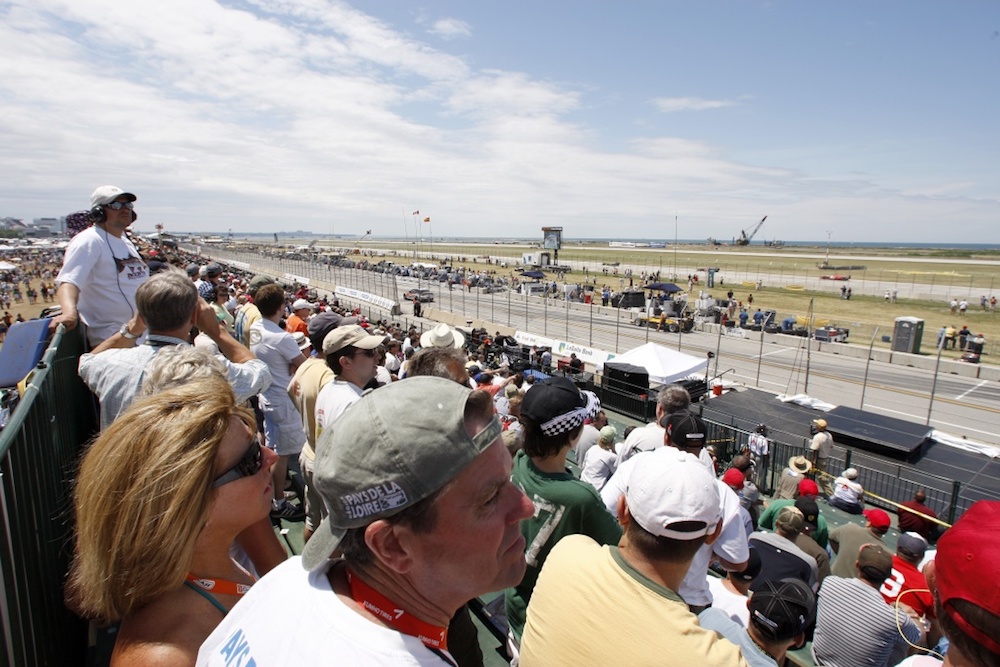
Photo by Anthony Kent/LAT
Q: I really enjoyed the race at Long Beach, though Rossi was on another planet. Any way I heard that NBC was going to help IndyCar with the race scheduling – will it include the increase number of races from 17 to 20, and ending the season in October instead of September? Plus, will NBC help IndyCar find new racing venues or renew venues like, Cleveland [above], Montreal, Mexico, Austin, Virginia International Raceway road course and maybe a return to Watkins Glen?
Alistair Fannell
RM: I imagine NBC can make suggestions on dates/times of races to coordinate with its massive sports schedule, but can't imagine it will have any input on adding races or where to go racing. That's IndyCar's call.
Q: After reading your recent article about Phoenix, I sat thinking about the subject. I do not believe you can compare today and yesterday at any track. Like it or not ,the driver demographics have radically changed from the 80s/90s. In those years, 90-plus percent of the drivers were from North America, with the vast majority of those from the U.S. Today, 36 drivers are listed on the IndyCar website with 15 from North America, and they are not all active. What would that list look like if Roger and Chip hired nothing but North Americans?
I do not know about others but when I go to a race I have to have a point of interest; that is, a driver that I follow. I would expect others are like me. That following used to start at the small town/bullring tracks. I do not know where it starts today. The next point is the cars. In the 80/90s we saw a lot of car/engine diversity, not so today. In open-wheel we see a lot of spec series. I could make a case that that applies even to Formula 1, and it surely applies to NASCAR.
Tightened rules packages have squeezed initiative right out of the toolbox. If I attend a race today, am I ever surprised about any team's package? Even at Indy, the only surprise is what the rules makers might change to ensure everyone gets a participation trophy.
Finally, a point that applies to virtually every series. The race that I see and the race the driver sees is drastically different. How many of them have ever bought a ticket and sat through several hours of follow-the-leader? I have seen post-race interviews with drivers exclaiming what a great race it was, while those in the grandstand have fallen asleep. Yes, at 150-200 mph I am working my butt off and having a great time. In the stands, I just went to get another beer! I do not think that some of them have a clue.
Chuck & Carol Genrich
RM: CART was lucky enough to have American heroes like Andretti, Unser, Sullivan, Rahal and Mears at the same time Emmo, Tracy, Mansell, Villenueve, Zanardi and Montoya were filling the grandstands. Rivalries use to sell tickets but not sure we've got any right now. Maybe Wickens and Rossi develops, or Newgarden and Pagenaud. As for drivers saying it was a great race, that's just PR speak, but most of the time it's usually BEFORE the green flag.
Q: I drove from Vancouver to Phoenix to watch that race, and I had a great time and got exceptional bang for the buck. For only $55 I got to see an entertaining USAC event, a parade of some classic vintage vehicles, an IndyCar race that was actually pretty good live, and free parking. There seemed to be a lot more people present than when I was last here in 2016, and everyone around me seemed to have a great time. So with Rossi proving that this new car can definitely race well at ISM, is there really a big problem here other than teams just finding a decent setup?
Dave, Vancouver
RM: Driving from Vancouver to Phoenix has already earned you Fan of the Year and I'm glad to hear you had a good time.
Q: I am happy that NBC and NBC Sports will have all of the races starting next year. The production and on-air personalities are so much more enjoyable to watch. I am happy for more races on network TV, and happy it is all one company to help with more promotion. With that said, what's the scoop on the numbers? Did IndyCar get a pay raise over their old deal? Will this help the Leaders Circle, and if so how much? Better ratings and all that are great, but I am sure IndyCar teams would love to have Leaders Circle money bumped up.
Andy Brumbaugh
RM: Not privy to that information, but what IndyCar got was a partner that's going to air more network races, and do a much better job of promoting IndyCar and making it entertaining. That's worth more than money in some instances.
Q: I agree that IndyCar is has not produced a good race on a short oval at Phoenix, but I don't see us throwing away all of the ovals (obviously not Indy or Texas). Hell, I think ending the season in an October night race at Fontana would be good for the series. I listened to Will Power's idea of running cars on the second line with new tires to rubber it in, but I think that the marbling would just make this a moot point after 25 laps. Not sure what can be done to save Phoenix, but I would rather see if we can find another track like Kentucky and Fontana to see if that would work. I know that Mark Miles would have to extend the season to October but I think it would be a good idea.
Jim Christ, West Chester, PA
RM: The title won't be decided on the west coast after 10 p.m. (take that to the bank) so no Fontana, but I do think it's very possible that Gateway could host the season finale in 2019. The Midwest is IndyCar's core audience and Gateway would have as good atmosphere, and ovals always give you a chance at something dramatic at the end of the race. But it won't be in October.
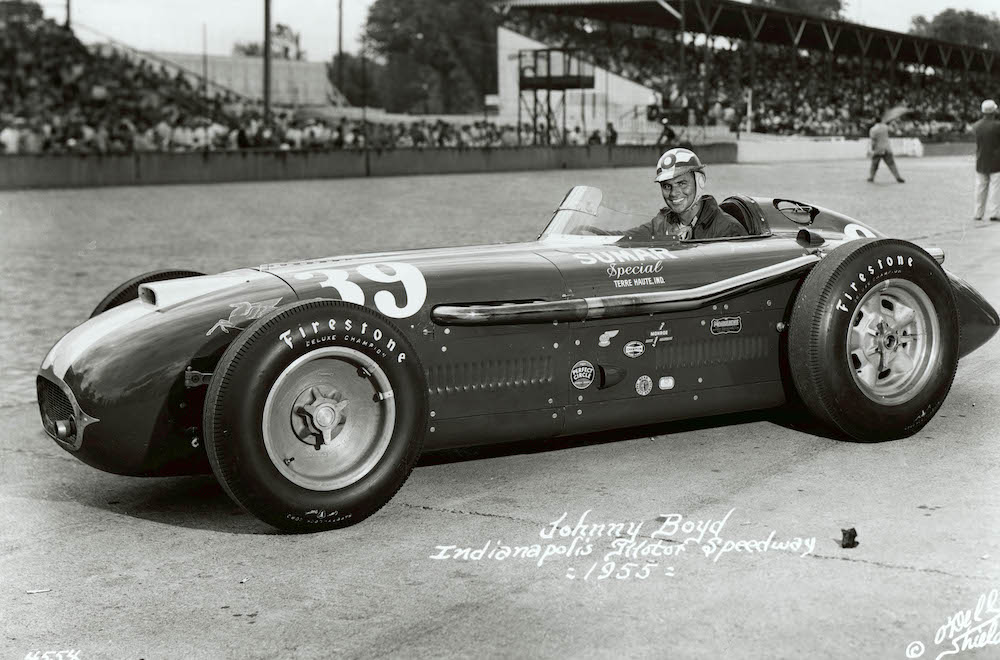
Photo by Indianapolis Motor Speedway
Q: I can't agree more with you more regarding the IMS Hall of Fame changing its policy to allow drivers outside of the 500 to be inducted. In my opinion it takes away the prestige of the HOF, and is preventing more deserving individuals to be inducted – particularly those who drove in a time when you had to earn your spot to drive at Indy. My hope was that Johnny Boyd would be inducted for all that he did during his career, and afterwards as a great ambassador of the race. My question for you is, outside of Art Pollard, who you've stated you would put in the HOF, who would be your top three nominees?
Brett, Indianapolis
RM: Jim Hurtubise, Mike Mosley and Bill Finley.
Q: In almost every series we hear about drivers not being able to pass. The tire companies rely on feedback from the teams and drivers in developing tires for each track. My question is, when the drivers and teams are asked, what do they want: tires that make it easier to pass, or harder to pass? The answer is always, "we want tires that make it harder to pass." What do we expect when the tire companies purposely make tires that make it harder to pass? Go figure.
Sam Scott
RM: I hear drivers say they favor tires that go off so you have to try and protect them, but I don't hear much "make 'em harder to pass."
Q: As successful as the natural road course events have been at Barber, Mid Ohio and Elkhart Lake, has IndyCar ever looked at Road Atlanta? Seems like they would put on a great show there.
Dan Eversole, St. Louis
RM: They probably would but the concern has always been the speeds and lack of runoff area, so sadly, Road Atlanta isn't likely to ever host an IndyCar race.
Q: I am a European IndyCar fan. I got hooked after watching Takuma Sato - the only driver I knew from the whole grid, to be frank - win the 2017 Indy 500, so I can call myself the Alonsoboomer, I guess
Being a fan of Indy, in Europe, in a country far away from any European Indy drivers to cheer for, and any race drivers in particular apart from the one trying desperately to save Williams from drowning (hint - I live in Poland) ain't easy, but it also gives an unique perspective on what the IndyCar situation looks like. So why does it seems to me that IndyCar sucks at marketing anywhere outside the U.S.? Hell, it sucks at marketing outside the state of Indiana!
The greatest example is Alonsomania - there was little to no attempt to benefit from it here across the pond. Even IMSA managed to gain from Fernando running the Rolex 24 - they sold three hours of the race to Eurosport, the Europe's ESPN, and the series got at least some money and some exposure around Europe. Not much, but still something! IndyCar had the biggest European star since Mansell, and they haven't managed to gain anything in Europe outside of the most hardcore racing fan base. All they had to do was to try and make a deal with Eurosport, or some of the national broadcasters, to put the race on TV and try to expand here.
It worked here before - CART and CCWS managed to get a following, because they were on TV for many years since Mansellmania (and even before that) until the death of CCWS and reunification. Maybe I am too naive, but it seems to me like a wonderful opportunity was wasted. I watched the race on a dodgy internet stream, not being able to give any money to IndyCar, but am able to watch NASCAR's Coca-Cola 600 nearly anywhere in Europe. They seem to be successful, even despite a questionable on-track product. Who is to blame here? Lack of strategy on IndyCar's management side? ESPN International's I-don't-give-a toss approach? Given that next year the TV deal goes to NBC, is there any potential for change? Without it, any future attempts at returning to racing in Europe, or luring significant European talent, may be met with indifference.
Filip, Poland
RM: I think IndyCar benefitted greatly worldwide from Alonso (two million watched his IMS test online) but I don't think there was a way to quantify what the total numbers were for the month of May. Mansell was easier to calibrate because of all the F1 journos who covered him at Indy and during the season, but IndyCar's biggest challenge isn't selling F1 champs that dabble in Indy cars – it's marketing its full-time American drivers in North America.
Q: I love and respect you, but you are all wrong. You keep wondering why IndyCar isn't popular when it has the best racing in the world, besides Phoenix. Just a few years ago everyone was all-in on different aero packages to make the cars look different. We wanted a difference. Now, all of a sudden, we have to go spec for price and competitiveness. What does it take to satisfy this crowd? When I was a kid going to the 1967 Indy 500, I wasn't going because it was extremely competitive, I went because I loved A.J. Foyt, and there were all kinds of crazy cars to look at,and it was the fastest thing going. It's not the tracks, it's the cars!
People don't care if it's competitive if all the cars look the same. NASCAR is popular because you have a bunch of lame brains that don't understand real racing. They just want to root for one certain driver or brand. I don't know how people watch those races. I DVR, and fastforward yellow to pit stop to yellow until the end. I watch every lap of an IndyCar race still. They just intrigue me more every lap. I'm sad about the present condition of IndyCar. I still love it. I spend every moment I can at practice, in the garage area, and qualifications at Indy every year. When I retire next year, I plan to follow as many races I can, God willing. Lord help our sport! Where's the Duke Tumato when we need him?
Tim B.
RM: I know a lot of us older types miss those great days of Indy innovation, but I'm not really sure it would make much difference today in terms of how many people watch or attend. I always argue with A.J. when he says Indy made him and I differ: no, I came to Indy to watch you and Rufus and Mario and Herk. The cars were part of the lure, but the drivers were my hook. And the speeds. But since everything is spec nowadays, the close racing is all we've got to promote, and that doesn't seem to be enough.
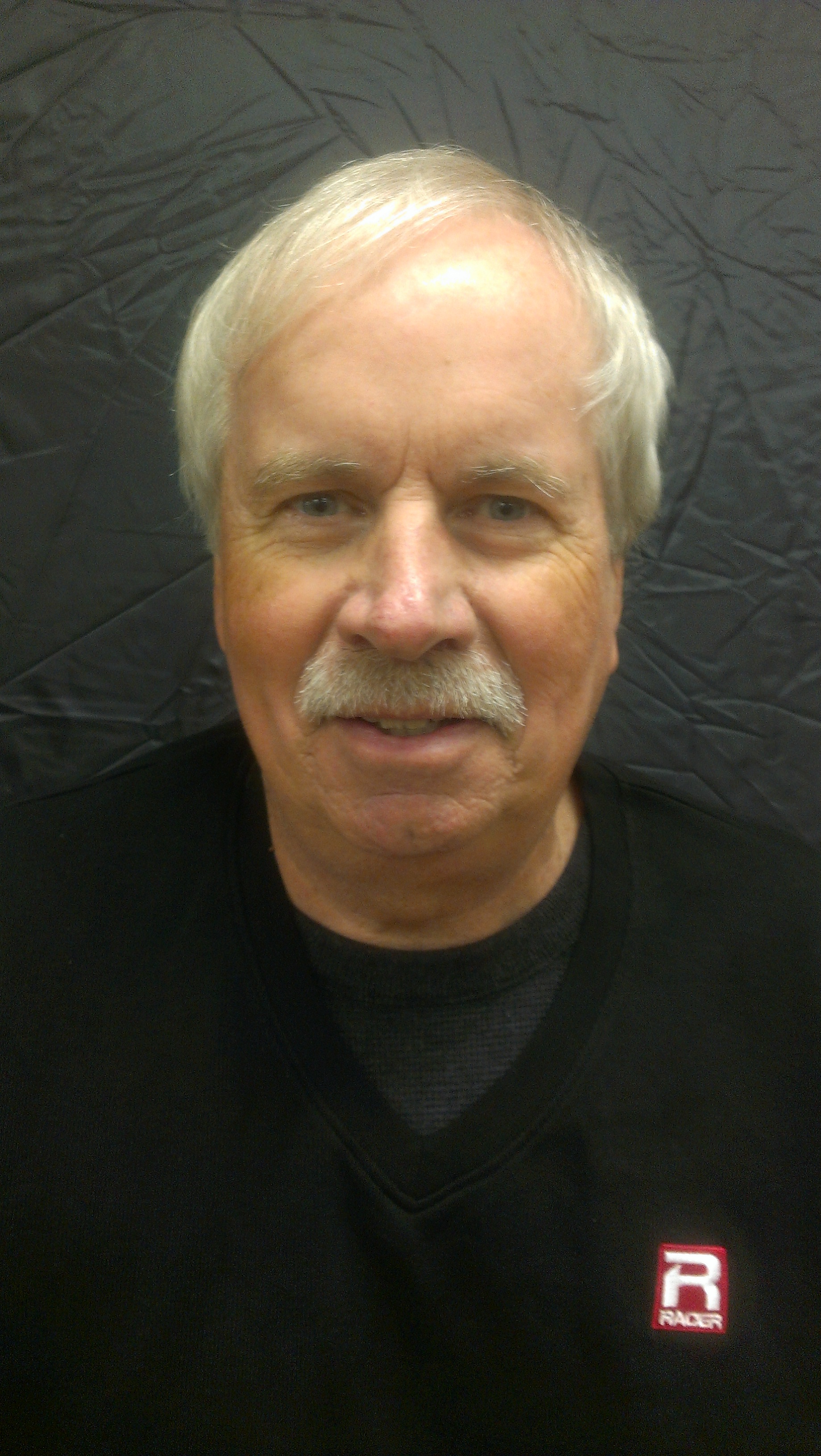
Robin Miller
Robin Miller flunked out of Ball State after two quarters, but got a job stooging for Jim Hurtubise at the 1968 Indianapolis 500 when Herk's was the last roadster to ever make the race. He got hired at The Indianapolis Star a month later and talked his way into the sports department, where he began covering USAC and IndyCar racing. He got fired at The Star for being anti-Tony George, but ESPN hired him to write and do RPM2Nite. Then he went to SPEED and worked on WIND TUNNEL and SPEED REPORT. He started at RACER when SPEED folded, and went on to write for RACER.com and RACER magazine while also working for NBCSN on IndyCar telecasts.
Read Robin Miller's articles
Latest News
Comments
Comments are disabled until you accept Social Networking Cookies. Update cookie preferences
If the dialog doesn't appear, ad-blockers are often the cause; try disabling yours or see our Social Features Support.