BUXTON: Malaysia joins the 'calendar of dreams'
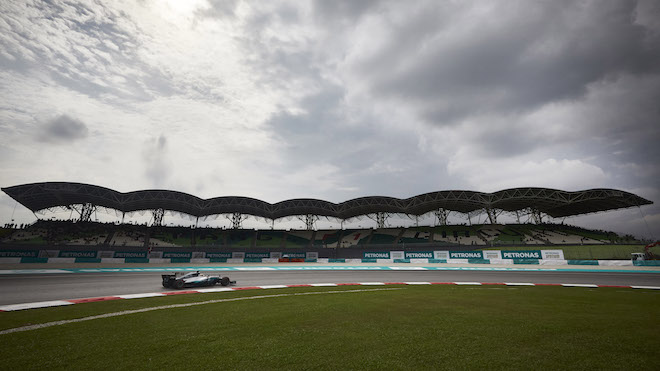
So, this is it. After 18 successive years the Malaysian Grand Prix will cease to be after this weekend. And I, for one, will miss it. I'm not alone. Sepang has provided a happy home for the Formula 1 World Championship for the better part of the past two decades, and the prevailing sentiment within the paddock is that losing this race is a great shame.
Malaysia was the door that opened the South East Asian continent to Formula 1. It was one of the first countries that utilized government subsidies and funding to promote itself as a tourist destination through the sport. Sepang was one of Hermann Tilke's first fully-fledged track projects. In every respect it heralded a new dawn for Formula 1, and set the benchmark for new venues that has existed for the last 20 years.
It remains one of those races that feels truly foreign. Tropical weather, exotic countryside, charming people, good food, fascinating culture... Malaysia seemingly had it all. And to top it off, it's a race track that the drivers loved.
But such is the manner in which Formula 1 race deals were done over the past years that from an affordability standpoint, the venue no longer remained viable. As tracks subsidized by governments forced affordable hosting rates ever higher, the cost became too much. A victim of its own success, if you will. And so we will lose a genuine highlight of the calendar.
It isn't the first time we'll lose a much-loved track. It won't be the last. But in losing Sepang, it feels as if the sport is losing one of its historic tracks. Only Buenos Aires, Imola, Indianapolis (if you include the 10 runnings of the Indy 500 between 1950 and 60), Kyalami, Magny Cours, Watkins Glen and Zandvoort have hosted as many or more races and then fallen by the wayside. Given that 73 circuits have hosted a round of the Formula 1 World Championship in its nearly 70-year history, Sepang thus finds itself in rarefied air.
Personally, I'm as sad at losing Malaysia as I was at losing Turkey. I enjoyed both nations, discovering their cultures, and most of all, watching Formula 1 on their brilliant race tracks. They were places I looked forward to visiting, and races that always delivered something of genuine interest.
Posters signalling that this will be Sepang's "F1NALE" got me thinking about the tracks we've lost along the way, and, in turn, the fabled calendar that secretly we all try to create for an alternative championship. So here it is.
For starters, we're going back to a 16-race calendar. No back-to-backs, a bit more in-season testing. Simple.
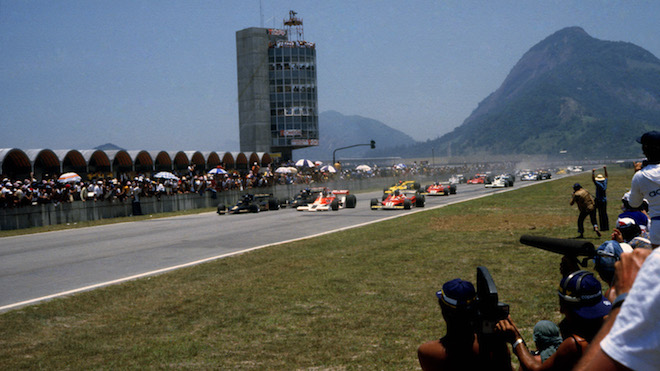
The season begins in April, in Brazil, at Jacarepagua (above, 1978). The challenging Rio circuit was torn up and destroyed to make way for an Olympic park that now sits in ruins. So tear the white elephant up and repave that glorious circuit once more. Where better to launch a season than the carnival city on the shore?
From there we move on to Buenos Aires and the Argentine Grand Prix. The recent suggestions of renewing the old track with a few more twists and turns haven't, to my mind, gone nearly far enough in exploiting the possibilities that exist on the ground, but the old Autodromo would make a welcome return to any Formula 1 calendar, be it imaginary or, in the near future, very real.
We return from the South American season-openers to Europe in May and to Estoril, the Portuguese favourite of the 1980s and 90s. The circuit bears an uncanny resemblance to the usual European F1 season-opener in Barcelona, but was always a happy home for the sport and would create a neat transition back to Euro-land.
F1 then marks a triumphant return to Istanbul Park. The mighty 3.3-mile track, featuring the awesome quadruple-apex Turn 8, was one of the great challenges of the 2000s and is much missed by racers at the top level. Its popularity remains in the online gaming community as it poses such a brilliant challenge for the driver, but allows for tremendous racing with its wide, flowing swathes of asphalt.
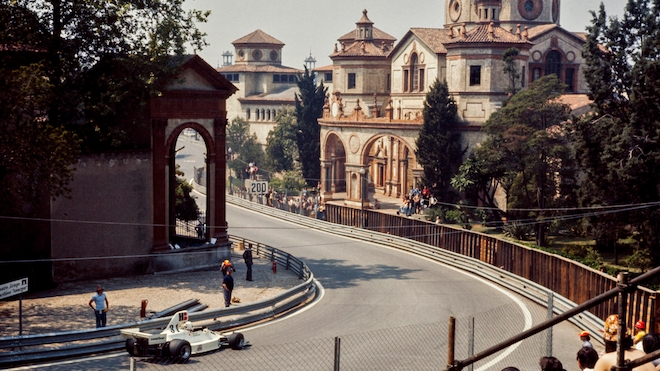
In the absence of Monaco, Formula 1 then moves on to Spain and the streets of Montjuich Park (below, 1975). Perched high on the hill overlooking the Barcelona port, Montjuich has all the old world glamor of Monte Carlo, but will pose a faster and far more demanding challenge. The paddock returns to the Olympic stadium, allowing fans to sit in the grandstands and watch the teams at work, with hourly tours available to all.
A quick hop skip and a jump, and the championship leaps over to Africa for the first time in 25 years with the South African Grand Prix at the recently-rejuvenated Kyalami. The sport decides to stay predominantly in Sandtown and commute to the track, but its proximity to Johannesburg makes it a well-attended and successful return to Africa.
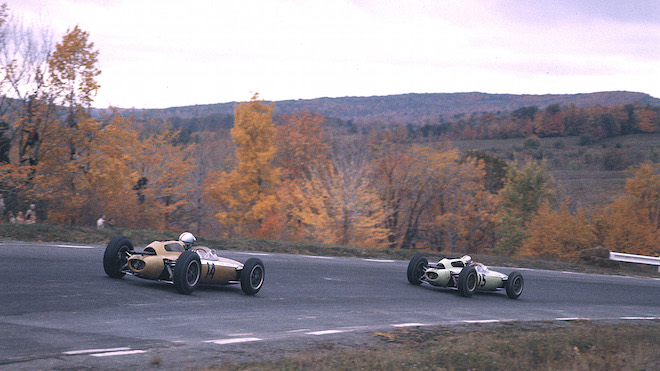
Into June now, and Formula 1 nips across the Atlantic for the American Grand Prix (East) at Watkins Glen (above, 1962). Having established itself in America over past seasons and with interest at an all-time high, the moving of the race closer to New York brings valuable investment and attention. Again, the drivers revel in a raw, gritty and challenging circuit that pushes them and their equipment.
Next up, the Canadian Grand Prix at Mont Tremblant. Now owned by Lawrence Stroll, Saint-Jovite returns to F1 with the full course in use. The 15-corner track had a partial redesign in 2000 but maintains its original character, winding through the undulating Quebecoise countryside.
July brings with it a return to Europe and the British Grand Prix at Brands Hatch. After many years of dispute, the track is finally returned to Grand Prix standard with an additional loop heading south after Westfield bend in the unused land adjacent to the M20 motorway. While many are dismayed at the loss of Dingle Dell, most agree that the extra corners have added a new complexity to an already-classic circuit.
As summertime hits, the sport heads to the beach with the Dutch Grand Prix at Zandvoort. Verstappen fans are out en masse. With the golf club to the south making the return of the full original track impossible, the current short version of the track is used in year one, with the expected influx of finance from Verstappen fever used to extend the circuit at Turn 1 to the north for an additional 1 mile loop for years three and beyond.
Formula 1 returns to Spain for the end of the mid-season at Jarama. Much like the Hungarian Grand Prix, which formerly signalled the beginning of the summer break, the nature of the track makes overtaking difficult, but the tricky and challenging nature of the hilly, dusty Spanish track means mistakes are frequent and unexpected results the norm.
A full five week break over the whole of August allows the Formula 1 fraternity to spend a proper summer holiday with their family and children, before F1 gets back to racing ways in Imola with the Italian Grand Prix.
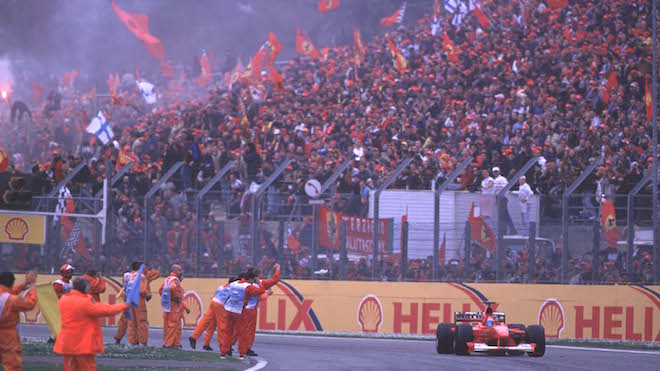
It pains me to say it, but they've ruined Imola (above, 2000). It was never that great for overtaking, but the removal of the final chicane means they've completely obliterated any chance of it happening again. Acqua Minerale remains as tough a sequence as you'll find on a race track, but there'd need to be significant changes to the layout if we were to get a proper race around it. However the pizza in town is second to none, so it gets a reprieve.
Next up, it's back to America with the United States Grand Prix (West) at Long Beach. Do we like street circuits? Not a lot. But Long Beach is Long Beach, and the West Coast is overjoyed at the return of F1.
Having been dropped from the actual calendar, Sepang returns as if it had never been away and hosts the Malaysian Grand Prix at the start of the final flurry of fly-away rounds. Put back to the end of the year in its traditional slot, it forms an unpredictable roll of the dice at a critical part of the season.
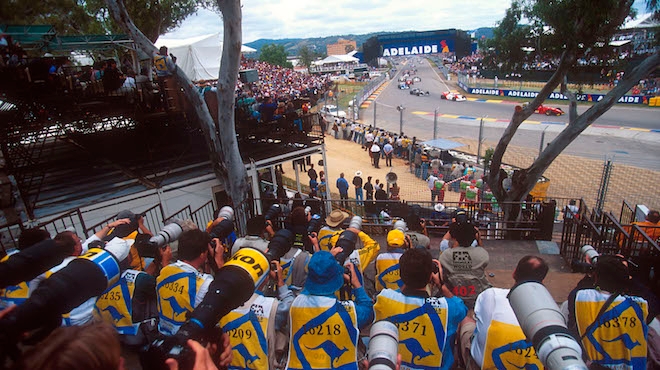
Two weeks later, and the Japanese Grand Prix takes place at Fuji. High up in the hills under the shadow of Mount Fuji, the weather is usually cold and miserable with heavy rain and treacherous conditions. It is borderline whether it's an enjoyable event or one everyone has to endure, but it never fails to provide a nail-biting race and the perfect set up for the season finale in... Adelaide (below, 1994).
Perhaps it's because it was always the season finale that I remember waking up to watch as a kid, but there was something magical to me about Adelaide hosting the Australian Grand Prix. The street track was a pretty meaty challenge and one that everyone tells me they loved. It was a city that really embraced Formula 1, and as a season closer it has rarely if ever been matched.
So there we go, 16 classic tracks lost from the calendar to create an all-new one. Perhaps you'll see a glaring omission. Please let me know in the comments below. I'd genuinely love to hear your thoughts.
As the years go by and we lose other circuits from the real F1 season, I guess we could up the number on our imaginary tour of the world, but April to October seems to me a perfectly decent duration for a sporting year. What's interesting in this process, however, is that it's quite hard to make a proper calendar the size of the one we have at present (20 plus races) from tracks we've lost, certainly from ones that still exist at least in suitable enough form to rejuvenate them and get them back to racing standard.
Which perhaps shows us that the sport is doing it right. There'll always be tracks we love and tracks we hate. There'll always be ones we wish were still around.
But when you look at what we've got, and compare it to what we could have instead, its tough to argue against the fact that that we're actually doing alright.
Presented by:


Latest News
Comments
Comments are disabled until you accept Social Networking Cookies. Update cookie preferences
If the dialog doesn't appear, ad-blockers are often the cause; try disabling yours or see our Social Features Support.