Rear View: 1967's STP Paxton-Turbocar
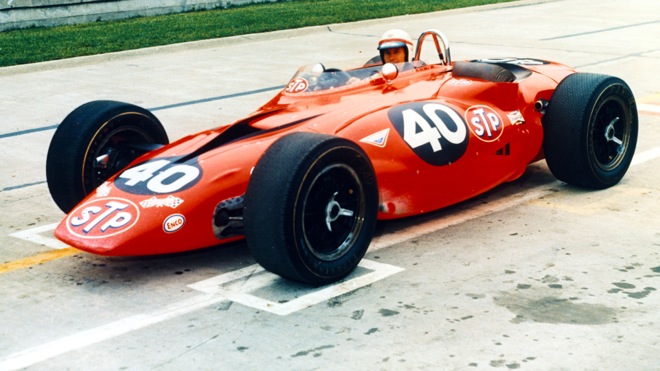
It's the Indy 500's defining car. Radical, mind-bending creations came before 1967's STP Paxton-Turbocar and a few have followed since, but nothing has come close to matching the engineering insanity or the undying interest brought by Andy Granatelli's dayglo orange machines.
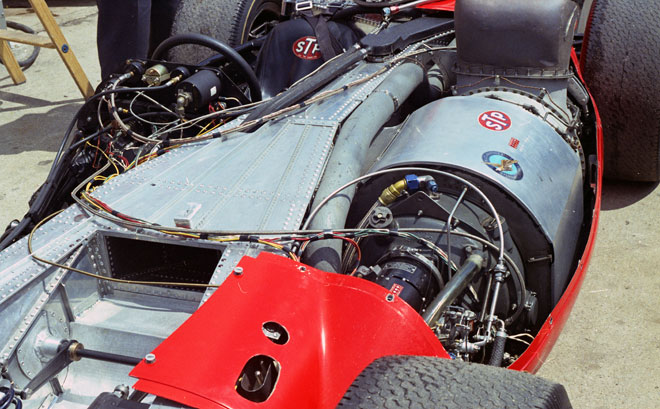
Penned by Ken Wallis, the car – known simply as the "Turbine" – attempted to assemble every far-reaching Indy 500 concept at once in a single vehicle. Crafted with a chassis that used a central spine, its driver, Parnelli Jones (pictured below) would sit on the right of the backbone.
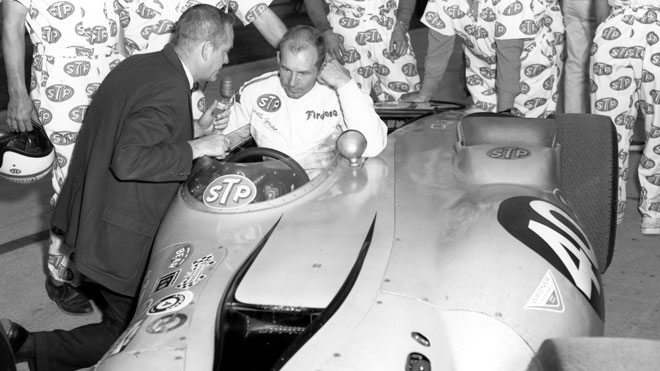
The only thing the Turbine needed was an extra set of wheels to be hailed as certifiably crazy. Wallis' car wasn't the first to arrive at Indy with a turbine; the use of AWD wasn't new, and other builders had played with offsetting the driver in the chassis. As a single package, however, the Turbine was the ultimate expression of, well...everything a driver could ask for. (Additional photos in image gallery on next page).
"It was just an exciting time, actually for something like that to happen and be as successful as it was," Jones said on the 50th anniversary of the car's debut. The 1963 Indy 500 winner, like most drivers at the time, was skeptical of Granatelli's wacky car. It not only defied convention; by the looks of it, the Turbine also defied common sense.
"Andy and I became pretty close friends at the time – we did a lot of socializing and he'd invite me to dinner and stuff like that," Jones said. "One day he called me up and he says, 'Come over to Paxton. I want to show you something.' So, I went over and they had the turbine pretty far along. I thought it was another wild and crazy thing on his venue. He wanted me to drive it.
"I said, 'Gee, I don't know, Andy.' I was testing my car over in Phoenix. I says, 'Well, bring it over and I'll take a ride in it, see what it feels like.' When they finished and brought it up over there, I took a ride in it."
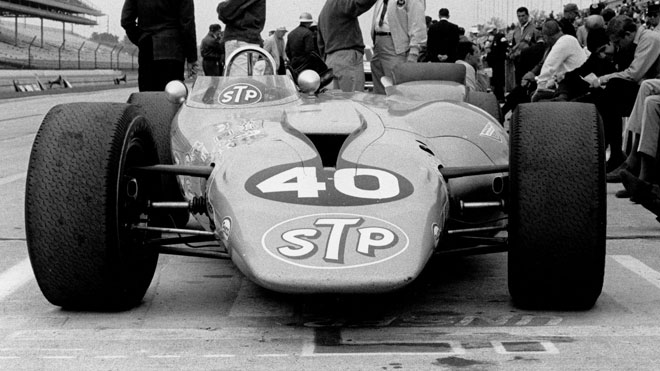
Its whooshing engine made hellacious power just as turbocharging was becoming the rage at Indy. Its chassis, with the centrally-located motor and driver, was a marvel of poise and balance on its four skinny Firestone tires. There were also a few drawbacks, and those came from trading a high-compression internal combustion engine for the free-spinning Pratt & Whitney turbine. Of the many legends about the car, the delayed response between mashing the throttle and waiting for the big turbine to spool up and make power gave Jones plenty to figure out.
"It had a three-second throttle [lag] in it at that time," he said. "You kind of had to guess at a lot of it. We ran pretty good. I was pretty impressed in Phoenix. Andy kept hounding me to drive the Novi, or the Turbine. So I thought, Wow. Gee. I had mixed emotions about it in between that and my car.'"
Granatelli needed a star to drive the Turbine – someone who would validate the concept and charge as hard as possible. Well aware of the situation, Jones made sure the compensation matched the potential risk to his reputation.
"I did have some pretty good thoughts about it," the 83-year-old said. "I thought, 'Why don't you just let money decide whether you drive it or not? That's a good way to make up my mind.' I asked myself, 'Would you do it for $25,000?' 'No,' I said, 'Would you do it for $50,000?' I said, 'No, I wouldn't drive it for $50,000. Would you drive it for $100,000?' I said, 'Well, I think $100,000 might convince me to do that.'"
In today's dollars, Jones commanded approximately $740,000 to race the Turbine at Indy. That's not far from what Carlos Munoz took home for finishing second more last year at the 100th Indy 500...
"I figured that I could make the race," Jones continued. "I never thought it was going to ever be as good as it was. But I thought it would be OK. I figured I could make the race, so ... Part of the deal was I had to qualify the car. If I didn't qualify the car, or I didn't make the race, I would be out the $100,000."
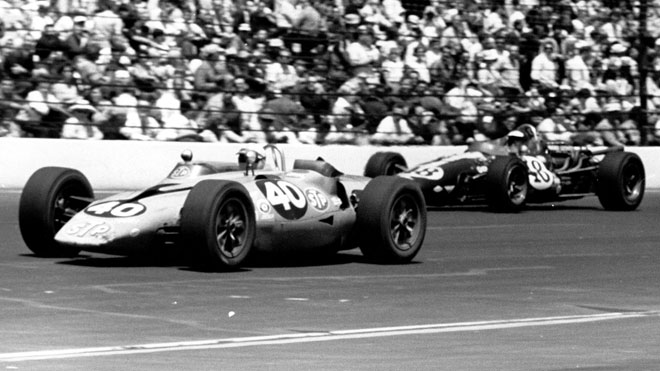
The well-known end to the story, with the failure of an inexpensive transmission bearing that disconnected the turbine from its AWD system, spoiled Jones' surefire run to a second Indy 500 win. Jones' loss would be A.J. Foyt's gain as the Texan took his third 500 victory. Credited with sixth, Jones would sit idle in the pits as the final laps were run.
50 years later, Jones still finds humor in the sandbagging allegations.
"They thought I was sandbagging because it would quit accelerating about halfway down the straightaway," he said. "They'd drive by me and they figured that I was backing off. That's what created the sandbag. I had no reason to sandbag. I drove the car as fast as I could. I could put a higher gear ratio in the car. But I couldn't run as fast in laps time. So you run the gear ratio that gives you the opportunity to run the fastest lap, so to speak."
And despite a half-century of distance from the race he lost with three laps left to run, Jones hasn't softened his stance on where the blame belongs for the transmission failure.
"I never was a very smart race driver," he said. "Really. I wasn't an Al Unser or some of the others – Rick Mears for example – that were premium race drivers. I knew how to go fast. I just didn't know how to go long enough. I was smart. Not smart enough to realize how good this car and how much of a lead I had and everything else. I just did stupid things.
"I accelerated too hard going out of the pits. It was like a dragster because it had all that torque. That certainly hurt it. I just kick myself in the rear when I stop and think about how I blew that race away by my driving style.
"That's what I did. Anyway, Andy just cried like a baby because when it broke down in the garage afterwards. I felt so guilty because it was me that created the problem."
Click on the thumbnails below for larger images of the Turbine. Below the gallery, listen to the podcast in which Jones tells the full story of 1967 and the Turbine, the "gifts" that were left in front of his hotel door, the driving and development side of the car, and other tales from an amazing year at the Indy 500:
{igallery id=3089|cid=641|pid=9|type=category|children=0|addlinks=0|tags=|limit=0}

Latest News
Comments
Comments are disabled until you accept Social Networking Cookies. Update cookie preferences
If the dialog doesn't appear, ad-blockers are often the cause; try disabling yours or see our Social Features Support.