PRUETT: Six shifts that saved Seb
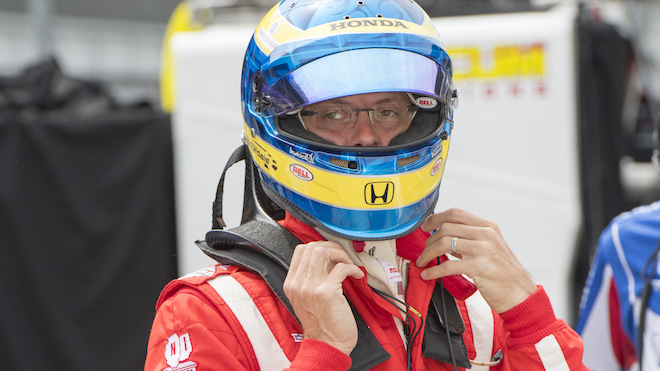
Two hundred and twenty-seven miles per hour. 227 mph. That's the speed Sebastien Bourdais was traveling when the nose of his Indy car damn near went head-on into the Turn 2 wall at Indianapolis.
The impact recorders in the Frenchman's car said the violence of the crash peaked at 100Gs. Fractures in his pelvis and hip – possibly as a result of the lap belts that restrained his body's explosive forward deceleration – were the only forms of significant physical damage.
And there were no cockpit intrusions by suspension pieces when his Dallara DW12 rotated and slammed the wall with enough force to compress and narrow the right side of his carbon fiber safety cell.
Those jarring numbers – 227 mph and 100Gs – and nothing punctured or badly broken after a fiery meeting with the SAFER barrier. The outcome of Bourdais' crash reminded me that miracles are still possible at Indianapolis Motor Speedway. And as much as I'd like to lavish a higher power with praise for saving Sebastien's life, the real stars are found among a group of men and women with great vision and even greater resolve.
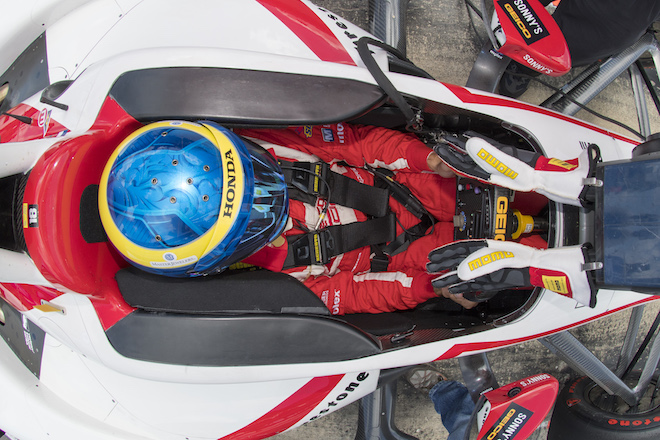
On a timeline of thank yous, we need to make six stops. The first comes in 1986 with IMSA sports car champion Jim Downing and Dr. Bob Hubbard for their Head And Neck Safety device, better known as the HANS. It allowed Sebastien to survive a massive frontal impact without suffering the basal skull fractures that killed many drivers prior to its invention. In fact, Seb was awake and alert when IndyCar's peerless Holmatro Safety Team arrived on the scene.
The second stop takes place in 1998 when IMS assembled and funded a development team that created a forerunner of the SAFER Barrier. Credit Tony George, two Midwestern universities and a number of engineers for taking what they learned in 1998 and pouring more money and time into the second, SAFER version that dissipated some of the energy in Bourdais' crash to lower the overall damage he incurred.
Thank Bourdais himself and Josef Newgarden for the crash and centerpunch Seb received at the Sonoma IndyCar race in 2012. The road course tangle occurred when Bourdais slid though the high-speed Esses, forced Newgarden off course, then smashed into the back of Newgarden's car with the left side of his cockpit.
With Newgarden's gearbox breaking Seb's safety cell and pushing the split carbon fiber cockpit wall inwards temporarily – like swinging doors opening and falling back in place, the momentary wall movement impacted Bourdais' ribs and arm.
The 37-year-old was in great pain after the hit, and while no modifications to the car were immediately made, IndyCar's competition department was sufficiently concerned about side impact strength. Consider this the first mental note within the series that something better would be needed, and soon.
Next, let's acknowledge the late Justin Wilson and Tristan Vautier for the scary slam Wilson took on the big and fast Fontana oval in 2013--one that was nearly identical to the Bourdais/Newgarden incident.
A spin by Wilson exiting Turn 2 exposed the right side of his car to Vautier who, with nowhere to go, speared nose first into the side of Justin's cockpit at a high rate of speed. Like a battering ram, Vautier's DW12 pushed in the side of Wilson's tub with the same Sonoma-style cracking and flexing motion before the wall returned to its original position. The Briton, like his close friend Bourdais at Indianapolis, endured a fractured pelvis from the wall movement. Wilson was sidelined for many months while his fractures healed.
Finally, we'll give thanks to James Hinchcliffe, the Holmatro team, first responders and doctors who saved his life when he crashed at a similarly unabated speed into Turn 3 in 2015. From his brutal wall strike, which sent a lower rear suspension arm through the tub and into his right leg and nether regions, IndyCar reacted by mandating new and increased suspension anti-intrusion pieces to prevent the same outcome from happening again.
From HANS to Hinch, six key events brought track safety, open-wheel chassis protection, and driving equipment technology to a place where the married father of two will get to kiss his wife and children after he's out of surgery. Good work, by good and creative people, made it possible.

Latest News
Comments
Comments are disabled until you accept Social Networking Cookies. Update cookie preferences
If the dialog doesn't appear, ad-blockers are often the cause; try disabling yours or see our Social Features Support.