IndyCar's stream dream
The Verizon IndyCar series captured something fresh and unexpected with its live streaming presentation of Fernando Alonso's test last week at the Indianapolis Motor Speedway. And now it wants more.
The broadcast-style production, distributed free through YouTube, Facebook and other online outlets, showered the series with domestic and international audiences that dwarfed its normal Nielsen rating returns on cable television. Many new fans of the series were created during the six-hour event, and in the days that followed, a common sentiment was expressed: Trust in the power of free live streaming.
Having seen the vast potential and reach of online streaming with Alonso, IndyCar and its TV partners are now tasked with sustaining the newfound interest in the 101-year-old American series through creative means. IndyCar's TV audience, a loyal group of diehards, continue to deliver modest Nielsen ratings on cable, and the figures increase with the select visits to a network audience, but widespread growth – capturing large swaths of new viewers – has eluded the series in recent years.
Free streaming, as the 800,000 unique visitors to the Alonso broadcast would suggest, is the big untapped audience for IndyCar to mine.
"We love to try new things, and experiment with new technology, because we are the challenger brand in the United States," IndyCar chief marketing officer CJ O'Donnell told RACER.
"There is no risk in trying new things. We have an eye on what is breaking and could be potentially very strong. So if you rewind back to the origins of our Live Streams, we were probably the first sport, if not the first motorsport, to leverage Facebook Live. We took advantage of it for the stream of our practice sessions over a year ago. Did we have any viewership then? Very little, very small. But we didn't give up on it."
O'Donnell points to IndyCar's February open test at Phoenix International Raceway, a pre-season event that was not televised through ABC/ESPN or NBCSN, as the first indicator its free streaming product was in higher demand.
"Opening day of the season, we had a full-field test at PIR. With a single camera and no voiceover, just the sound of an engine and the sweet look of a car going fast, we had hundreds of thousands of viewers," he said. "Over the two days of testing, it was 700,000 to 800,000 uniques. And we knew we were finally tapping into something really special.
"It quickly went from having 50,000 people to 100,000 people in our early streams. Then all of the sudden, over two days at PIR we have nearly 800,000 unique viewers. That kind of growth was just surprising. Not in the sense that we didn't think we would get there, but how quickly we got it there."
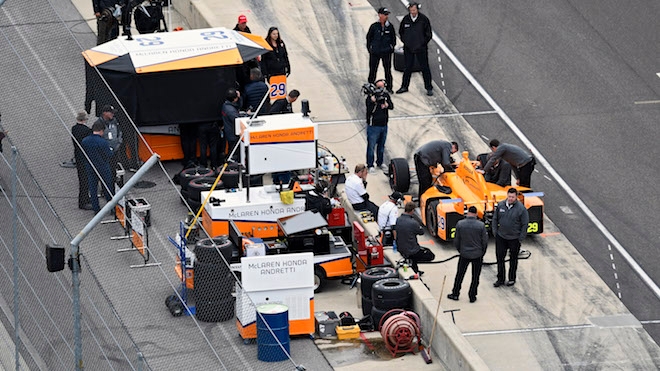
Using the PIR test as its model, IndyCar and IMS Productions applied the same streaming format to Alonso's test, albeit with studio and pit lane commentators and multiple cameras throughout the 2.5-mile oval.
"When we made the Fernando Alonso Indy 500 announcement, we knew we had a global opportunity for IndyCar," O'Donnell continued. "We then decided to throw everything at it, we did what was almost equivalent to a TV broadcast for about six-plus hours and it worked. It was a really, really good opportunity to share with the world what IndyCar is.
"And even with one car on the track and one phenomenal driver, it worked. It took Fernando, his McLaren team, Andretti Autosport, it took IndyCar, and IMS, all coming together as a team to make it happen the way it did. It was spectacular."
Although the Alonso test brought considerable awareness to IndyCar's live streaming capabilities, the series started broadcasting via the web in 2009. In a renewed effort between IndyCar and NBCSN, fans have been following practice sessions and some qualifying sessions free online via YouTube since 2014.
"We have no right, as far as the broadcast contract is detailed, to live stream any on-track content, but we have a gentlemen's agreement," O'Donnell said. "It says if you are not going to do a live broadcast of qualifying, etc, then they willingly offer it up to us to stream."
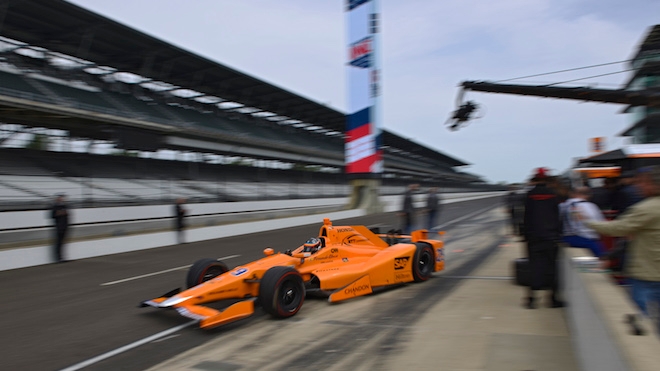
Where the conversation begins to change is in the live streaming of IndyCar's races, and the number of complexities that emerge. Free streaming for a Friday practice session isn't a concern, but when it comes to the main event, ABC/ESPN and NBCSN rightfully control the distribution of the product they pay to offer their viewers.
Considering the advertisers who pay the networks for their commercials to air on TV, and the need to monitor and track viewership numbers through Nielsen ratings, IndyCar will not be severing ties to network or cable TV in favor of free race streams anytime soon. The one convenient workaround for those who do have access to ABC/ESPN and/or NBCSN is authenticated streaming through their respective apps or web portals.
"The funny thing is that we do stream races; our races are available live on the NBC Sports App, and that's something we're doing because we realize viewing flexibility is at the forefront of everything we're doing these days," NBC motorsports producer Rich O'Connor told RACER.
It's fair to suggest the convenience of free global streaming to the Alonso test was a major contributor to its popularity. Getting IndyCar's broadcasters to a place where authentication is not required for the races and their advertisers find ratings value from commercials being consumed through social media and the web is the free streaming unicorn to pursue. The timeline on if (or when) that day will come is open for debate.
"From a metrics perspective, Nielsen and a lot of other ratings agencies are trying to find a new way to capture viewership numbers beyond TV," O'Donnell said. "So that could include live streams, which are pretty easy to capture, that could include how many people were in a Buffalo Wild Wings watching a sporting event.
"There's a definite desire in the industry to find a metric that includes total viewership in a way that goes well beyond the definition of traditional TV. When that happens, that will change the industry in a whole new way because we will be able to have a third party who can validate what is going on, capture all of this and really substantiate where the interest and viewership is in every platform available. But we are not there yet."
O'Connor agrees with O'Donnell's assessment.
"I think for the next few years the traditional [broadcast model] is what will be in play, but clearly everybody is looking at where it's going," he said. "The traditional is still the easiest way to measure things today."
Although IndyCar will continue with its current routine of free practice and (occasional) qualifying streams prior to the broadcast (or authenticated streams) on race day, O'Donnell says live streaming will be a central negotiation topic when the current TV agreements conclude after the 2018 season.
"You look to where we are now, and, in fact, any sport in the nation today that is negotiating a contract, there is interest that we have seen from Amazon, from Facebook, and other entities that we haven't seen in the past," he revealed. "You can't deny that there's something very interesting happening with IndyCar that shows the future of broadcast and other forms of media that we haven't seen the likes of in a long time.
"We are searching our soul now to determine what the next choice is going to be. It is early days for streaming, but it has to be considered as part of our future, and I can tell you that [IndyCar CEO] Mark Miles and the team are including those forms of distribution in our discussions as we go forward towards 2019, which will be a whole new opportunity for IndyCar."
Presented by:

Latest News
Comments
Comments are disabled until you accept Social Networking Cookies. Update cookie preferences
If the dialog doesn't appear, ad-blockers are often the cause; try disabling yours or see our Social Features Support.