MEDLAND: Up from the midfield?
What can we expect from McLaren in 2017?
The build-up to a new Formula 1 season is always an exciting time, full of anticipation and speculation as car launches draw near; a feeling that is further heightened this time around by new regulations. This off-season has been so busy that it has felt like there has been little time to really analyze where each team stands, as focus has been on the front of the grid – as Mercedes sought a replacement for Nico Rosberg – and the back, with Manor's collapse.
However, the midfield has the potential to be extremely close this year, even with a shake-up of the competitive order, with big teams like McLaren, Renault and Williams all targeting clear steps forward while the likes of Force India and Toro Rosso look to muscle in on the action once again.
Of those big teams, it's fair to say the pressure is greatest at McLaren. Renault can be afforded time, having only owned the keys to Enstone once again for a little over 13 months, while Williams only slipped from being a top-three team under the V6 regulations last year. Over in Woking, however, McLaren has truly become a midfield team. And it hurts.
It has now been 78 races since McLaren last tasted victory, and four full seasons have passed by with very limited success. Just two podiums were scored in that time, both in the same grand prix as Kevin Magnussen and Jenson Button finished second and third, respectively, at the 2014 Australian Grand Prix – the first race for the current power units in 2014. The last four constructors' championship positions were: fifth, fifth, ninth, sixth.
To put that last stat in perspective, aside from its exclusion in 2007, McLaren had only been lower than fourth in the constructors' championship once in the 29 years prior to 2013, finishing fifth in 2004 but still winning at Spa.
Of course, Honda's return has been a significant factor in McLaren's recent form, but it was a move designed to deliver success, as Ron Dennis felt the team would not be world champions again as a Mercedes customer.
confirmed this week that team manager Dave Redding will head to Williams
. Change is afoot at the MTC, and it brings with it renewed optimism."I've been impressed but not surprised as to how deep the passion is at McLaren through its employees and their desire to win," Brown told RACER. "I think they're all frustrated, as you can imagine, and eager to get back to our winning ways. I don't think our results the last couple of years are something that the team is accustomed to. They don't like it, and they want to turn things around.
"At the same time, it's one step at a time, so while we're doing all the right things, [to get the] success we need to move up to the grid. I would caution we're not going to be winning any races in the next year, I don't anticipate. So we need to be measured on forward progress as opposed to ultimate results in 2017. We've got the enthusiasm to be winning races and the championship, but I don't think we're there yet with our overall package, and therefore I'm just eager to see us keep moving up the grid and get ourselves into a position to start winning races in 2018."
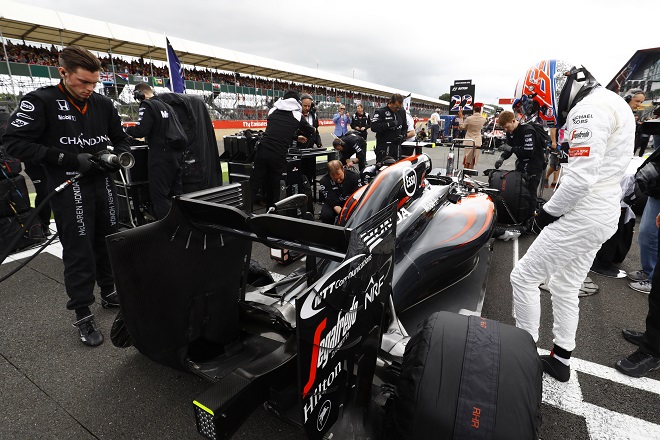
"[There's a] massive number of people making the program work, so there really isn't one person where we're successful because of this guy or girl," says Brown.
"Ultimately the buck has to stop with someone, and in my case that's myself and Jonathan Neale running the enterprise and reporting in to the executive committee. Eric Boullier is ultimately responsible for the racing team, so the buck stops with him as to whether we're competitive."
As focus has moved away from the Mercedes driver line-up and on to the ever-closer launch dates, McLaren has come to the fore with its new car name and livery teasers. The team is expected to run a "papaya orange" color scheme, and that has got fans excited, but these are trivialities compared to performance.
The new regulations provide every team with new opportunities, and McLaren should be reveling in the changes, considering that it helped develop the concept that was finally approved last year. But when was the last time the team produced a great car aerodynamically?
Even before the V6 power units were introduced, a decline had begun: Jenson Button and Sergio Perez failed to score a podium in 2013. Honda has become a scapegoat in recent years, but Button would often point out that the chassis was far from the best on the grid. Of course, McLaren does need Honda to make significant progress – without it, the team has little chance of challenging anywhere near the front – but that alone will not return the team to winning ways.
There is some encouragement to be taken from the expected development race in 2017. McLaren has traditionally been very good at improving a car during a season, even when starting with a poor one like under new regulations in 2009, but Boullier has previously stated that such an approach is less successful in the current era. The stats would back him up, as the "relentless development" Boullier described last year yielded little progress in terms of the team's finishing position: McLaren was outscored by Toro Rosso – with a year-old power unit – across the final five rounds of the season.
So McLaren is left with a management changes that are unlikely to have a major impact on car performance, a power unit that is similarly not expected to make a massive leap compared to its competitors, and a development program that appears to have become less effective in recent years. Sound promising? Didn't think so. But ...
You may have noticed a theme running through many of the previous points: recent logic dictates McLaren is unlikely to make a game-changing step forward in any one aspect. But if each area provides slight progress, as they surely can, adding all of those gains together will result in a more noticeable improvement.
One area where McLaren has not struggled in recent years is driver talent. Fernando Alonso remains among the best on the grid, and has a habit of getting absolutely everything out of a car whenever it is slightly competitive. Add in the arrival of Stoffel Vandoorne – who truly is one of the most exciting talents to come through the ranks in recent years – and it seems safe to assume that McLaren has no concerns on that front.
McLaren-Honda's biggest weakness as a partnership could be that very determination and desire to win again that Brown referenced. Try and achieve too much in one go, and it increases the risk of failing to make any significant improvements. As much as it pains the team to admit, the best thing it can do is accept its midfield status for now, chase the small gains across the board, and target the position of "best of the rest." Then the future will look bright, orange car or not.
Additional reporting for this story by Marshall Pruett

Latest News
Comments
Comments are disabled until you accept Social Networking Cookies. Update cookie preferences
If the dialog doesn't appear, ad-blockers are often the cause; try disabling yours or see our Social Features Support.