Rotational Force
The first wheel on a vehicle appeared some 6,000 years ago, and the first pneumatic tire and wheel combo dates back to 1870. Yet, when it comes to Formula 1, they really do reinvent the wheel every year.
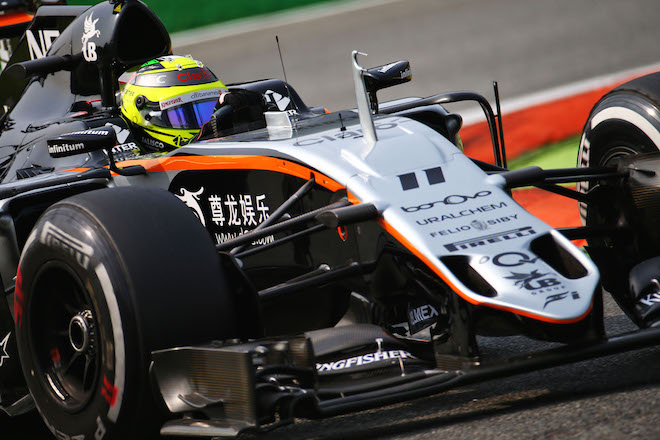
Headquartered just outside Los Angeles, California, with motorsport manufacturing taking place in Italy, Wheel Pros oversees a portfolio of 14 different wheel brands, including Motegi Racing, which have been technical partners to Sahara Force India F1 Team for the past three seasons.
To date, Sahara Force India are having their most successful season ever as they vie with Williams Martini Racing for fourth place in the Constructor's Championship. Among the dizzying array of elements that go into making an F1 season successful, Force India Technical Director, Andrew Green, credits Motegi Racing as one of the keys.
"We get measured 21 times per year in terms of success and progress," says Green. "Undoubtedly our collaboration with Motegi Racing has been instrumental in getting us to where we are."
Lest you think that Green is simply being kind to a sponsor/supplier, he goes on to describe the depths to which the partnership has gone to extract the best performance from their wheels.
"Wheels are the last link between the chassis and the tires," he goes on to say. "All of the loads are channeled through those four points. So in relation to other technical partners and suppliers, we treat wheels as a 'category1' component, of which there are only a handful."
To that end, the team gives the design brief to Motegi Racing some 12 months prior to when the finished wheels are needed in hand. Initially, Green and his team gave Motegi racing some very basic parameters for weight and stiffness to start the project. In turn, Motegi Racing came back with some ideas on how they would like to build the wheels. From that point, it's a constant collaboration between the two that will result in more than a dozen wheel iterations before arriving at the final wheel for the season.
"We have to set a limit in design time, otherwise given the choice, we'd design ad infinitum," says Green. "We have some 150 wheels (37 complete sets, approximately 18 per car) that need to be manufactured by the beginning of the season.
"Because we begin the design of the car in the wind tunnel with models, the first area that we focus on are aerodynamics. As the design of the car comes together we create parameters for weight, stiffness, durability, ease of changes during a pitstop. If we were to compromise on any one of those, then the whole system would fail," he adds.
Luigi Lucaora, Technical Director for Wheel Pros, is charged with taking Green's brief and making it a reality.
"When you work with a team like Sahara Force India, we are not a supplier, but truly a partner," insists Lucaora. "Together you see the car's improvement through every race, so we share information as much as possible to double the power of our development potential."
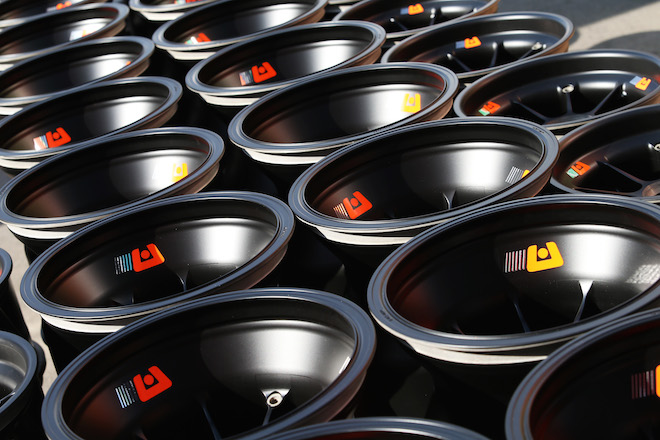
The creation of a Formula 1 wheel is a bit of a puzzle whereby the technical regulations, tire requirements and car design all play a role in determining how the wheel is developed. It goes so far as to view the requirements of the front wheels being distinctly different from the requirements of the rear wheels, going well beyond the obvious parameter of tire size. In effect, Motegi Racing are developing two wheels each season.
"From the FIA we have very specific requirements about the wheel material, which must be a forged single piece of magnesium alloy 8780," says Lucaora. "There are also specifications for the wheel rim thickness and the bead so as to comply with Pirelli's requirements. Where we can really focus our development is on the center of the wheel, in particular on loads and airflow."
Interestingly for a wheel manufacturer, Lucaora stresses that aesthetics play no role in the design. Unlike other manufacturers who may have a signature look, Motegi Racing starts from a clean sheet where only the performance data drives the look of the final product.
Because the wheels are manufactured before the start of the season, both Force India and Motegi Racing must factor into their design the likelihood of performance from both the car and the tires improving throughout the year. This also means that in-season development at a certain point becomes dictated by the wheel design, especially when considering aero updates.
That said, the team has made in-season design changes that have required the manufacture of new wheels. However, due to the enormous cost and logistics involved, this is the exception rather than the rule. In a hypothetical world where cost and logistics are not an issue, Green admits that they would design a different wheel for practically every track if given the chance.
As F1 teams live in the data-driven real world instead of a hypothetical one, success lies in the efficiency of the collaboration. Crucial to their success has been a mutual learning curve arriving at a point where communication has become nearly seamless that predictive modeling has yielded identical results from both Force India and Motegi Racing.
"The first year, our wheels were much simpler, and now we have a hollow spoke wheel that would have been hard to imagine at the start," says Lucaora. "It's important to note that the development of the wheels follows the development of the car and as one has improved so has the other."
Clearly in F1 it's not a case of selecting a wheel with the proper fit that looks reasonably good. As Green puts it, the wheels sit at a remarkably complex area of the car where there's a lot going on. What we learn is that Motegi Racing doesn't so much reinvent the wheel each season so much as they build a wheel that is in absolute harmony with the car, and in that quest they leave no stone, or wheel, unturned.

Latest News

Comments
Comments are disabled until you accept Social Networking Cookies. Update cookie preferences
If the dialog doesn't appear, ad-blockers are often the cause; try disabling yours or see our Social Features Support.