ANALYSIS: Honda's IndyCar revival roadmap
When future students of IndyCar history look back at the current era, Honda will be cast in a reasonably complimentary light. Time has a way of stripping out context and leaving us with raw figures, and while HPD's recent stats aren't great, there's enough there that you can spin into a positive.
In the first year of aero kits, Honda won six races and had Graham Rahal in the title hunt until the final weekend. In the second year, it won the Indy 500. That's what history sounds like when you let the numbers do all the talking.
Obviously, those who are actually living it – teams, drivers, HPD itself – have a different, rather more frustrated perspective on how things have played out. But if the past couple of years have been a rough ride for those on Honda's side of the fence, the real question is, what can it do to change it? The expected return to standardized aero in 2018 will remove one of the sharpest thorns, but Honda's teams aren't going to relish spending another season on the fringes waiting for a rule change.
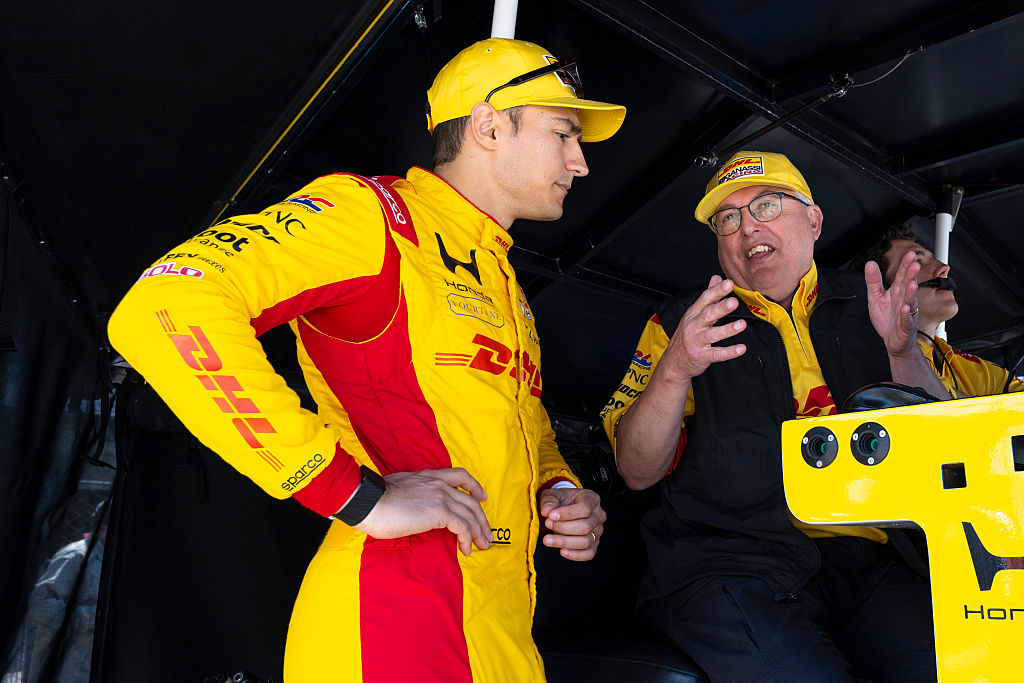
In the meantime, the first step is identifying exactly where Honda is losing ground. And according to HPD president Art St. Cyr (pictured with Honda racers Graham Rahal and Ryan Hunter-Reay), that's a question without a simple answer.
"I think it's clear that we have a gap in qualifying, especially on the road courses, and on the courses where it is hard to pass – like Long Beach – if you don't qualify well, you don't finish well," he told RACER.
"We don't have enough speed. It's probably a combination of lots of things. It's hard to pin down exactly what the issue is, but to go fast you need to have a good chassis package, you need to have a good engine, you need to have good aero. And sometimes it's hard to narrow down what the key issue is on that. But it's some combination of those."
Aero is clearly a big one: last year, Honda was able to successfully convince IndyCar to grant development relief under Rule 9.3. That's the clause that opens the door for a manufacturer to make aero improvements outside of the regular off-season development restrictions if it can prove that the performance deficit is so large that it's detrimental to the series.
And it was able to do so after a year in which it won six races to Chevy's 10. Based purely on wins, this season is already guaranteed to be worse – even if Honda sweeps all of the remaining races, the most victories it can achieve is five.
Honda has no plans to take advantage of the same rule again this year
and, with ongoing talk of a freeze in aero development for 2017, there's still no confirmation regarding what exactly will be fair game during the winter. But with hindsight, says St. Cyr, the work that HPD put into improving the areas of the car that were opened up under 9.3 last year detracted from the performance-based enhancements needed elsewhere."The whole 9.3 was only meant to get us equal to where the competition was last year," he says. "That was the whole intent. Part of the handicap with 9.3 is that we spent a lot of our time and resources just getting to the point where our competitors were last year, as opposed to working on the three [development] boxes that would help us to move forward. So that put us a bit on the back foot with regard to catching up on those things.
"Would we have liked more time to do development? Of course we would. Anybody would. But those are the rules that they work under. And as far as the 9.3 relief that we got, yes we did achieve what we wanted to, which was to get to the same starting point that the other side was."
Assisting teams with damper development could provide one avenue to performance gains, and another obvious area is engines. But with the latter at least, St. Cyr is unsure how much scope there is to make a leap.
"We're studying what is possible and what is not possible," he says. "The rules are in a bit of flux right now. It's not a big year for engine development – if you look at the homologation table for the engine, there are big years and small years. This year was a big year for changing things; next year is not so big. So the potential [to find things] in the engine is not huge."
But possibilities for improvement lie beyond the raw limitations of Honda's equipment. While HPD admits that it has underperformed, it's also fair to question the degree to which its teams have made the most of what they have been given. This was illustrated vividly by single-car RLL's exploits with Rahal last year. On the other hand, Honda's multi-car flagship team Andretti Autosport is still working to find its way out of a two-year spell that has been, by its own high standards, disappointing.
Andretti team rocked by the bumps
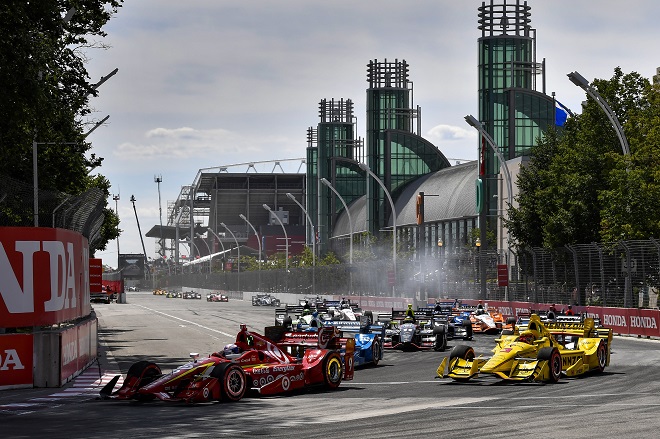
HPD has conceded for several seasons that it is at a disadvantage on that front, and has been proactive in trying to address it: RACER recently viewed leaked documents outlaying negotiations between Honda and a multi-car Chevy team about a potential switch next year. (Honda has confirmed that the documents were genuine, but said that the negotiations have since stalled).
St. Cyr admits that strengthening Honda's team roster is on the radar, although he says that it is not a move that would be made lightly, and that the option exists as part of a broader suite of upgrades that HPD is constantly chasing.
"[Luring a team across] is always something we consider," he says. "At Honda we look at the teams as partners and part of our family, and we don't add and subtract teams lightly. But we always look at how we can build our program. To say that we don't look at strengthening teams is a misnomer. But always look at how we can make our program stronger; what are the pieces of the puzzle that would make our program stronger. And obviously teams and drivers are part of that formula ... [although] we think that we have a really strong driver line-up. It's not as experienced as the other side's, but a lot of our drivers are strong and very talented."
That such conversations had taken place is no surprise: both manufacturers routinely review their team rosters, and Honda was doing exactly what it should have been in trying to strengthen its hand. But if it can't, then it needs to look for ways to make life easier for its existing teams. St. Cyr believes that last year's scale of off-season changes to Honda's aero kit put its teams at an additional disadvantage compared to Chevrolet at the start of 2016, which could be less of a problem this time around if its 2017 developments are more of a refinement than a leap.
"Like last year, this year was a brand-new aero kit that [our teams] had to start with all over again," he says. "Much like us with the development, the teams themselves were starting a little bit on the back foot.
"They had to start with a whole new kit, and also the way we created downforce changed this year. We [now] have a Coke-bottle shape to our sidepods, [and] the air going around the sidepods creates downforce that we didn't have last year. So the way the center of pressure is developed changed between 2015 and 2016.
"It was about creating efficient downforce, and making the car much more predictable in its handling. Now, it's less sensitive to pitch and ride height [than in 2015]. But I think it's fair to say that the competitor's teams, who have had the same fundamental kit for two seasons now, have had more time to sort through it and figure out how best to optimize their settings."
In the absence of a major reset button within the regulations – like standard aero – St. Cyr believes that optimization of the current package is Honda's best hope for medium-term gains.
"Trying to extract the most out of what we have is one of our main things," he says. "This was a very strong learning year in terms of what works well and what doesn't work well, but also, how do we balance the chassis performance – whether that be springs and dampers and that kind of stuff – to go with our aerodynamic package to make sure we can balance the cars through all these types of tracks that, quite frankly, are the first-time through with our teams."
The implication being that there is still untapped potential in what Honda currently has?
"We expect so, yes," he says. "But you don't know you have untapped potential until you find it."
Presented by:

Latest News
Comments
Comments are disabled until you accept Social Networking Cookies. Update cookie preferences
If the dialog doesn't appear, ad-blockers are often the cause; try disabling yours or see our Social Features Support.