PRUETT: Behind the Davison penalty
There's nothing to debate. Intent, fault and other forms of judgement hold no value. The court of public opinion was never opened. And don't waste your time filing an appeal.
one-race suspension
by the Pirelli World Challenge series, the matter was an open and shut case the moment it happened. The specifics are easy to digest: The hard-charging Australian, who was placed on probation for three races after the event at Canadian Tire Motorsports Park for violating PWC Rule 1.11.3 (failure to provide racing room), was involved in a crash at Mid-Ohio. As a result of that crash, he's sitting on the sideline for this weekend's race in Utah.His surrogates have been pleading his case on the Internet and lobbying all those who will listen in the media, but those efforts are a genuine waste of time for one simple reason: PWC's stewards were compelled to assign an automatic penalty due to their rulebook. It's a cold and impersonal way of handling business, and unfortunately for Davison, he triggered its mandatory use.
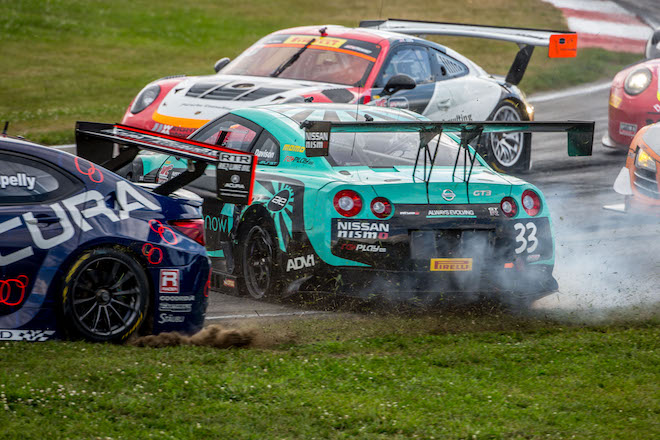
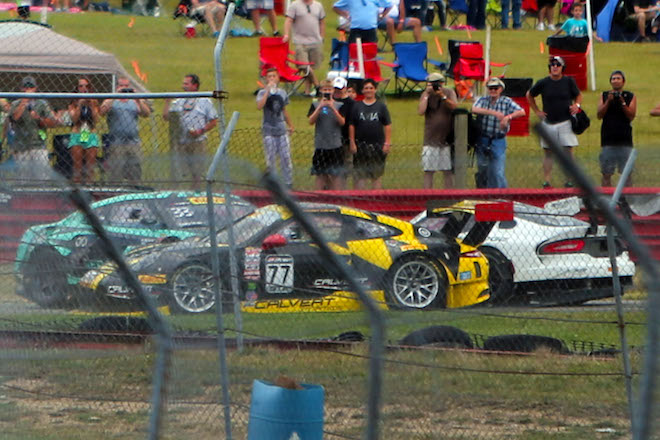
Parsing through the black-and-white nature of what led to Davison's one-race suspension in Utah, we'll start with the fact that Mid-Ohio was the third and final event run under Davison's post-CTMP probation. As we now know, his involvement in contact during Race 1 on Saturday that initially included Colin Thompson and Spencer Pumpelly (above), and then added harder contact with Preston Calvert and Michael McCann (below), is where he tripped over Rule 1.11.3 for the second time.
Cited for 'Making avoidable contact while on probation' in its penalty log, PWC's rulebook spelled out the judgement-free consequence its stewards had to follow. As a PWC Series official told me this morning, "[Davison] was serving probation for an incident during Race 2 at CTMP on May 22nd, and per Rule 1.31.8, any further infraction during probation would result in suspension."
And there you go. I'm usually against automatic penalties, but I must admit that this one has a certain appeal. Rule 1.31.8 is written in a very broad manner, and it isn't by accident. Thanks to the very simple wording that states "any further infraction during probation would result in suspension," Davison could have ended up in his current situation for running afoul of 50 different things in the rulebook.
Showing up late for an autograph session, which is an infraction, would have carried the same consequences. I'm not averse to the loose wording of Rule 1.31.8, and it's designed to affect two things of value.
First, it places full and clear expectations on a driver to behave at a higher level while on probation. If Rule 1.31.8 could speak, it would say, "We have doubts about you, but if you conduct yourself like a model citizen for the next month or two, we'll forget it ever happened." It's a behavior-based correction device, and only the person on probation has the power to flip the switch and activate its use.
Second, and this is the part I like the most, it removes the stewards from having to make a judgement call. If that driver acts a fool, drives like an idiot, or does something – anything – that is listed as an infraction, Rule 1.31.8 steps in to intervene.
Under most circumstances, we'd be dissecting the initial contact between Thompson and Davison, and anyone with functioning eyes could see Thompson was the first aggressor. He took the fight to Davison, side-by-side contact happened, Pumpelly went around the outside at Turn 4 and pinned Davison in place, more contact took place, Davison spun, other cars got involved and it became a big mess.
But none of that matters because of Rule 1.31.8. It's a blind and automatic one-strike-and-you're-out policy for any driver on probation. The only question I have to ask is why Rule 1.31.8 wasn't applied at Mid-Ohio for Round 2. Davison's Saturday infraction should, in theory, have resulted in a suspension for the next race, which was held approximately 24 hours after his multi-car crash.
Granted, PWC's rules do not have mandatory guidelines on when a suspension must be served, but with the clearly defined must-use nature of Rule 1.31.8 in mind, its swift application would have been expected.
As much as we like to fuel up the flamethrower and aim it at racing stewards for questionable decisions, I find something refreshing and clean about letting the rulebook drop the hammer on a repeat offender. Maybe it should happen more often.

Latest News

Comments
Comments are disabled until you accept Social Networking Cookies. Update cookie preferences
If the dialog doesn't appear, ad-blockers are often the cause; try disabling yours or see our Social Features Support.