PRUETT: Honoring the Eagle Mk III, 25 years later
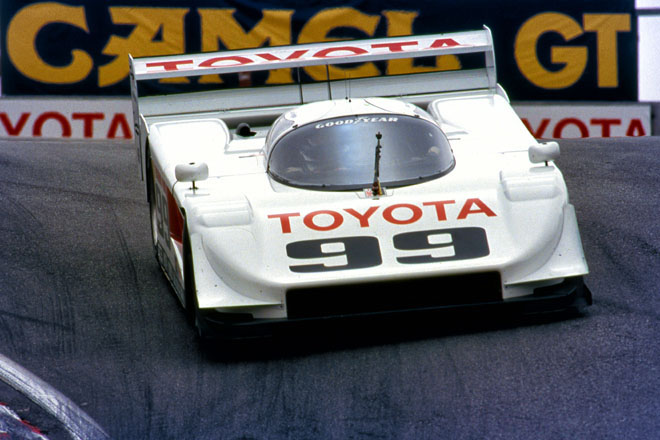
All American Racers' Eagle Mk III chassis made its debut at Laguna Seca's IMSA GTP round in 1991, and with IMSA's WeatherTech SportsCar Championship ready to race at the same track, it's worth taking a moment to celebrate the 25th anniversary of the fastest, most dominant prototype this country has ever produced.
"Wow, you're not the only one that forgot it!" Dan Gurney said of this weekend's Monterey milestone. "Twenty-five years ago? I don't feel younger when I hear that news, but I don't feel old."
The Mk III's first presence in the Monterey paddock drew the attention of most fans – and plenty of teams – before the opening practice session got under way in 1991. The 2.1-liter, turbocharged four-cylinder engine carried in the back of the Mk III was familiar; AAR had been using it in GTO Toyota Celicas and in its earlier GTPs, but the motor wasn't the primary point of attraction.
Fans, including this writer, marveled at the sheer size and volume of the Mk III's high-waisted bodywork, the through-flow channels running from the nose through the sidepods to the back, and its next-level aerodynamics.
"We got a ton of criticism about what we had done by the experts, which was kind of like the establishment in those days," Gurney (RIGHT) said. "You had to do things the way they thought it ought to be done. Or so they thought.
"They said our air inlets on the front were too big. They didn't realize what it was doing. Just generally they were negative about it. Most of the 'experts' didn't realize what we were doing aerodynamically and still don't. If he had realized, and saw what happened even in that first race, it was the beginning of the end for the rest of those guys."
This Eagle looked like it was from the future, and once Juan Manuel Fangio II hit the 2.2-mile track with the No. 99 car, its performance confirmed our suspicions: Every other GTP car was made redundant.
Short on testing mileage, Fangio and AAR used the Laguna Seca event as a test within a race, and despite the lack of setup knowledge with the Mk III, the Argentinian was able to qualify second behind Wayne Taylor in the one-lap-special Chevy Intrepid. With its track-pulverizing downforce and instant torque, the South African claimed an impressive pole with a lap of 1:14.928 to Fangio's 1:15.223.
Once the green flag waved, Taylor's Intrepid was a sitting duck. The Mk III came close to winning the first time out as Fangio built a staggering lead of more than 50 seconds by the close of the contest, but those chances were derailed by a pit lane violation during a splash-and-go that resulted in a one-lap stop-and-hold. Another violation leaving the pits after serving the one-lap fine led to IMSA tacking on 35 seconds to the No. 99 after the checkered flag. Fangio was credited with an unrepresentative seventh.
Fangio did manage to set the fastest lap during his fiery charge after the first penalty – a 1:15.741 – as Davy Jones went on to win in the TWR Jaguar XJR-16. To fully grasp the raw nature of the Eagle Mk III on its premiere 25 years ago, AAR returned for the Laguna Seca GTP race in 1992 – with a full season of development under its belt – and shattered the track record with a pole lap of 1:11.294 set by PJ Jones. That's damn near four seconds faster (3.929 to be precise) from where the MK III started in 1991.
And to appreciate the Mk III's frightening speed, the pole for IMSA's visit to Monterey in 2015, set by Wayne Taylor's son Jordan in the No. 10 WTR Corvette DP, was a 1:18.718. Jones' 1992 pole, a full 7.424 seconds below last year's benchmark, says more about the changes in prototype technology than the caliber of driving talent.
On the Mk III's return to Laguna Seca in 1992, it had Europe's most fearsome prototype to contend with as TWR brought the all-conquering Jaguar XJR-14, with its Cosworth/Formula 1 engine and revolutionary aerodynamics to attack the Eagle.
The XJR-14 vs Mk III battle wasn't even close; the bird pounced on the cat without mercy, capturing nine wins from 15 races and the GTP title with ease. Jaguar, along with every other factory program, ran and hid after 1992. AAR returned for 1993 with the same two-car team and swept GTP along with setting 10 lap records at 11 tracks on the calendar.
"The Jaguar (RIGHT) was a terrific car," Gurney said, "but it wasn't quite terrific enough. But it was one whale of a good car. And it had exceeded the Formula 1 lap time at Silverstone we were told. So no doubt it was very good. And the TWR people were a great group. One of the things about the Jag was that it seemed to like really smooth racetracks like a Formula 1 car does.
"And our car liked those but it wasn't bothered by the rough ones. That really made a difference. We had a bigger sweet spot in terms of ride height and angle of attack, and all that stuff. That was really special. What we ended up realizing is our car was even better than we thought it was."
The Mk III's aero played the greatest role in the car's GTP dominance, but as Gurney says, Drino Miller's Toyota engine wasn't just along for the ride.
"Drino did a lot of our development work," he added. "I was told that he blew up three dynamometers working on that thing!"
From cleaning out the GTP class by the end of 1992 to rewriting IMSA's history books and closing the GTP era at the end of 1993, the Eagle Mk III turned American sports car racing on its head, starting with a simple and unassuming debut a quarter-century ago in Monterey. And despite the car's age, Gurney didn't shy from sending a reminder about the Eagle's looming presence in today's IMSA series.
"I must say that with PJ driving, the Mk III still holds the lap record at the Daytona 24 Hour circuit," he said of the WeatherTech Championship's season-opening event. "We set that in 1993."
(Click on the main images to view larger versions.)
{igallery id=609|cid=497|pid=9|type=category|children=0|addlinks=0|tags=|limit=0}

Latest News
Comments
Comments are disabled until you accept Social Networking Cookies. Update cookie preferences
If the dialog doesn't appear, ad-blockers are often the cause; try disabling yours or see our Social Features Support.