How to start racing: SCCA RoadRally
When petroleum companies had ads on television touting their product as a preventative for fuel line freeze-up, the other memorable catch phrase was that it also prevented hesitation. Sports car fans are constantly looking for a great drive in their cars. And similar to the petroleum companies, we're hopeful that some good stories, the promise of great competition, and a few hundred words of explanation can end any hesitation you might have about giving SCCA RoadRally a try.
The Sports Car Club of America RoadRallies talked about here are not the unlimited speed professional rallies that are run on unpaved, closed courses. Rather, these rallies are conducted on open public roads at speeds below the legal limit. Instead of a two or two and a half mile track length or a minute or so of Solo time, the range is 50 to a few hundred miles and often takes from a few to many hours.
Understanding SCCA RoadRally
There are many types and styles of RoadRallies to choose from for entry into the sport, including gimmick, time-speed-distance (TSD), time-speed, course (sometimes called "trap"), course marker, Monte Carlo, regularity runs, minimum distance, searchlight, question, poker runs, tulips, stick maps and probably a few more. Combinations of all those also occur.
SCCA gathers those types into three main groups: Tour, Course and GTA. The primary focus of Tour rallies is keeping on time and the time-speed-distance format has developed as the SCCA Tour standard.
(By the way, nothing discussed here about these rallies is always true. To avoid the tedious "sometimes," "usually" or "typically," know that some variation in format and type will occur throughout SCCA's 115 Regions.)
Course rallies, while continuing the timekeeping requirements of the Tour events, have instructions written purposely to tempt contestants into following a course other than the correct one ("traps"). GTA, which stands for Game-Tour-Adventure, eliminates the staying on time aspect of Course and Tour rallies but retains the keen observation aspect of the course series en route following and being observant of the RoadRally route.
Before concluding that your initial hesitation might have been well founded, know that RoadRallies are based on two simple goals: staying on course and staying on time. History will help in understanding those ideas.
Rallying could well claim to be as old as racing in the category of things to do with your car. A few years back, SCCA's Old Dominion Region published a photo in their e-newsletter – it was from an early 1900s article in the Richmond, Va., newspaper in which the American Automobile Association was promoting an automobile "rally" in eastern Virginia, from Washington D.C. to Richmond.
The written route instructions of a contemporary rally have a format of mileage, instruction number, instruction, that is very similar to the AAA's early trip books.
Unlike SCCA's Club Racing, Solo and RallyCross, where the goal is to finish ahead of – or with a quicker time than – the competition on a specific course, RoadRally's goal is to repeat as precisely as possible what someone else did over a specific route.
Instead of looking for the best way through a corner or watching the efforts of other competitors, the rallyist's goals combine carefully observing the roadside while traveling at exactly the same speeds the rallymaster did when he wrote the course. RoadRally cars contain a driver to follow the course and a navigator to keep the car on time.
Although RoadRallies use public roads, their basis is a predetermined route purposely avoiding high traffic routes and concentrating on roads with great scenery, freshly paved winding roads or a long stretch of smooth gravel far from the everyday drive.
Don't get lost
The first rule of RoadRallying is "don't get lost." "Buying a trap" (by following the incorrect course) should not get you lost. Rally courses are usually designed so that they loop back together. The reason "don't get lost" is repeated so often is that when things go wrong, even the best teams compound their problems by forgetting that the first rule is to follow the course.
RoadRallies are based on General Instructions. These instructions could be contained in the SCCA RoadRally Rules (the RRR), a division's or region's standard rules or a set of rules written by the rallymaster for the specific event. Some are available well before the event and some are distributed at registration.
The "generals," as they are called, need to be studied carefully. For Tour rallies, they are direct and to the point. On GTA and course events, errors in following the route or incorrect answers will hurt you in the final standing.
The generals contain an explanation of: roads, priorities, route instructions, main road, mileages, signs and landmarks, speeds, controls (open, passage and DIYC – Do-it-Yourself Controls), scoring and a glossary.
The roads portion of the generals will explain which roads are used or not used. It will discuss in some detail the status of unpaved roads, dead ends, private roads, highway on- and off-ramps, and so on.
The route instructions contain the actual turn-by-turn directions for where you are going, but the generals will explain how the instructions are to be executed.
A section of the generals will describe how the course was measured, how exact the measurement was and where the official mileages will be placed in the instructions. A signs and landmarks section will describe which signs are used and where they are located. Similar discussion will be made for landmarks that are observed along the rally route. Careful reading of this section will prove very valuable in course and GTA events.
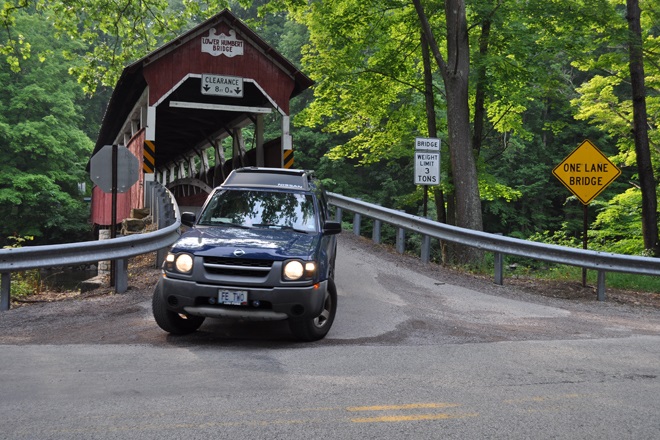
RoadRally speeds must be less than the speed limit. The assigned speed is called a CAST, an acronym for Commence, Continue or Change Average Speed To. They are rarely in anything other than miles per hour, although there are a few apocryphal tales of rallymasters using kilometers per fortnight.
The route instructions describe a course and give the CASTs to travel it. Theoretically, a RoadRally car should be on time at any point along the course. Controls are placed along the course to see if that's true.
Each RoadRally can be divided into "legs." A leg starts at a given point or a control and continues until the next point or the next control.
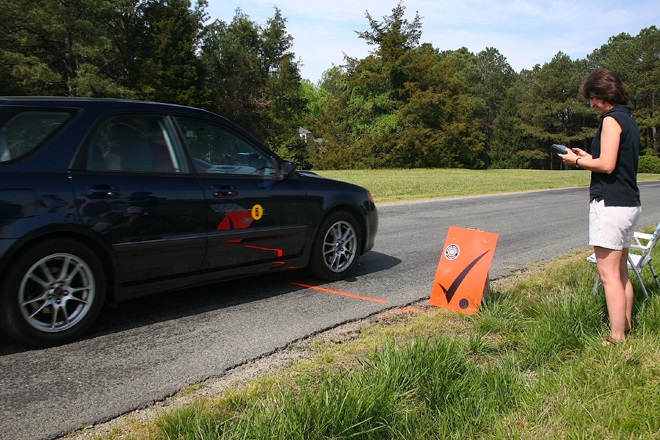
At a control, there is a RoadRally official to record the time of day that each car crosses the timing line, identified by a "checkpoint" sign. On GTA rallies, where there may not be any specific time to travel the course, the controls are a place to collect answers, give new instructions for the next part of the route or confirm that you are on course.
Open controls are probably most typical. At an open control you stop past the control vehicle so as not to block the official's line of sight to the timing line. You'll carefully walk back to the timing vehicle and receive the time you entered the control, the time you should leave the control (your "out time") and information on the leg you just completed.
Parts of a RoadRally may be indicated as "free zones.'' Free zones do not contain controls.
Like golf, the low score wins in RoadRally. The scoring section of the general instructions will list the penalties. The penalty for arriving early at a control is the same as arriving late, usually one point per hundredth of a minute to a certain maximum. Wrong answers will also have their penalty points listed here.
A glossary at the end of the generals defines many of the terms used, including things like "T"s, traffic lights and stop signs. Course and GTA traps are often hidden here, so read them carefully.
Staying on Time
Once following the course is under control, you can work to stay on time. On timed events, RoadRally clocks are synchronized to radio station WWV, the national time standard. SCCA timed events are measured in hundredths of a minute instead of seconds. It's very odd until you start calculating leg times and then the advantages become apparent.
On most RoadRallies and especially on timed events, cars are spaced one minute apart. Events start at a time of day "plus your car number in minutes." This allows contestants to slightly vary their pace if they need to but doesn't permit one car to follow another that may be closer to "on time."
This is a fascinating aspect of TSD rallies. If everyone is on time, at any given point along the route an observer should see a rally car pass exactly one minute after the previous one.
The rallymaster measured the course using his odometer. It is unlikely that a contestant's odometer will read mileage close enough to that mileage for use in calculating the correct time.
To compensate for this variation, the beginning of each RoadRally contains an odometer calibration run, or OCR. It's usually about 10 miles in length and at a minimum there is an official mileage at the end.
At the end, you record your mileage and divide it into the rallymaster's mileage. "Theirs over ours" is the mnemonic. This gives your "factor." The first thing to do is to go through the instructions and change all the rallymaster's mileages to your mileages by dividing them by your factor. For the remainder of the event when a mileage is encountered, you can use your odometer to make and confirm the action.
But there is another set of corrections that need to be made. Using your mileages you also have to use your speeds. To use them, make a table of every CAST. Convert each CAST to minutes-per-mile by dividing the CAST into 60. Then multiply each result by the factor.
You can now use your mileage and your speed to stay on time. For any location ahead of your current position, multiply your mileage or mileage from the last speed change, by your minutes per mile number. When the driver reaches that future mileage, the navigator records the time and compares it to the calculated time. The navigator can announce to the driver, "You're up five" (five hundredths early), "Down seven" (seven hundredths late) or "On time." If you're early or late, adjust your speed down or up a bit to compensate, but regardless of current time, continue to compare the true and calculated times at intervals farther along the course.
If you are really late, SCCA does not want you exceeding the speed limit to get back on time. All SCCA events are required to have "time allowance" or "bought time" provisions. The idea is that contestants still have to determine how late they are, it's just that they don't have to resort to unsafe efforts to achieve it.
Contestants "buy time" by recording how late they are up to 19.5 minutes on a form prescribed by the rally committee. The times must be to the even half minute; 0.50 minutes, 1.50 minutes, 2.50 minutes, and so on. It's not an even minute because there is probably another contestant one minute behind you. Because everyone drives their own style in RoadRally, you still can't "share their minute." The half-minute offset takes care of that.
The 19.50-minute maximum exists so that the controls can "close." A map of a RoadRally route tends to look like a squiggle that may even overlap itself, allowing a minimum of control workers to time contestants at one location and then move only a few miles away and time those same contestants again. The contestants themselves may have driven dozens of miles. The 19.50 minutes gives participants a chance to get to the controls even if they get lost but still permits the workers to go to the next location and time cars again.
Written down, much of this sounds as clear as mud, but a few hours with pencil, paper and some effort to recover those suppressed memories of first year algebra will soon convince you that it will work, and produce a method so you keep on-time.
On many SCCA region websites, including Detroit, South Jersey and Indianapolis, there are more detailed instructions for staying on course and on time. You can find those websites on www.scca.com and clicking the "Find you Region" link under "About SCCA."
This link is also the location where you can find your local region and discover where the nearest RoadRally is to you so you can give it a shot. And to read more about RoadRally, head to www.scca.com and click the "RoadRally" link under the "Programs" tab.
- This list originally appeared in magazine, the official publication of the Sports Car Club of America. For more information on the SCCA, head to www.scca.com.

Latest News
Comments
Comments are disabled until you accept Social Networking Cookies. Update cookie preferences
If the dialog doesn't appear, ad-blockers are often the cause; try disabling yours or see our Social Features Support.