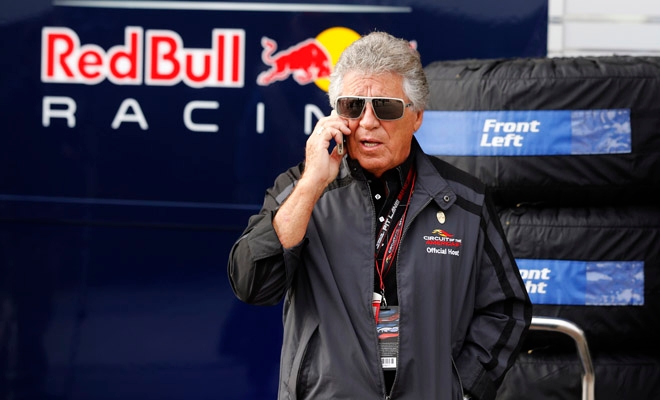
How Mario Andretti would fix Formula 1
Formula 1 legend Mario Andretti has joined the chorus of calls seeking changes that would restore the world championship to its position as the pinnacle of motorsport.
has been joined by defending F1 champion Lewis Hamilton
and many others from the world of grand prix racing who have been dismayed by the championship's rudderless state. Lingering complaints regarding the lack of dynamic sounds and increased lap times during F1's recent return to a turbocharged engine formula were recently compounded by the new-for-2016 change in qualifying procedures.The confusing process – introduced in the name of adding excitement to qualifying – was universally panned after the season opener in Australia. The format was nixed following the race, then restored for this weekend's event in Bahrain, emboldening the belief F1's bosses have lost touch with the sport's core qualities.
As F1's leaders fumble through technical changes and procedural alterations designed to appease fans, Andretti is among those who would welcome a recalibrated approach that places excellence above all other motivations.
"You have to maintain what Formula 1 was known for," Andretti told RACER. "Leading in technology from day one; that is what interests the manufacturers. Along the way, however, there has to be a balance because the spectacle is all important too. It's not about changing qualifying; I think qualifying was brilliant before. Everybody liked it. I don't see what was wrong with it, and what they did--it was almost a certainty that it was going to be worse. Does that create interest? There's a lot of confusion nowadays about the spectacle, qualifying, and things that weren't a concern a few years ago."
F1 engine suppliers have coaxed more power from their 1.6-liter single-turbo V6s since they were introduced in 2014. In concert with battery-based energy recovery systems (ERS), today's F1 cars make prodigious power while ERS is activated, but Andretti believes that without the wailing sounds from high-revving motors, the current engine formula will fail to stoke the passions of F1's followers.
"They have a lot of power; the hybrid engines with the ERS they can go to 800, 850hp," the 1969 Indy 500 winner added. "So they have the power, but because of hybrid and the power it gives, and the fuel [flow] limitations, they lost the revs, they lost the sweet sound of 18,000 RPMs with the [previous] motors. That was a spectacle in itself. I mean, it made the back of your hair stand up just leaving the pits. That was music like never before when we had those with the V8s, the V10s, V12s.
"But there's got to be some kind of balancing between the manufacturers having technology they want and what the sport needs for its fans. This is where [F1 boss] Bernie [Ecclestone] is also arguing what they have now is too technical to be interesting to the vast fan base. The fan base loves the screaming engines, you know, but [Bernie] isn't sure about the state of the technology. It's at odds."
Andretti likens quiet F1 cars to a boring musical performance.
"Anybody that thinks a quiet racing car is exciting, I think that is one way to kill motor racing, quite honestly," the 76-year-old continued. "I don't care what anybody says, the sound is half of the excitement, and you cannot ignore that side of it because you've got young people – to attract them you have to have that excitement. If you go to a concert and you turn everything down, who the hell is just going to yell and scream? Nobody. So that's what we are now. And they are talking about how to come up with an artificial sound, if you will, to make more noise. That, I would never support. That to me is totally stupid. You change the makeup of the engines, you don't make something artificial."
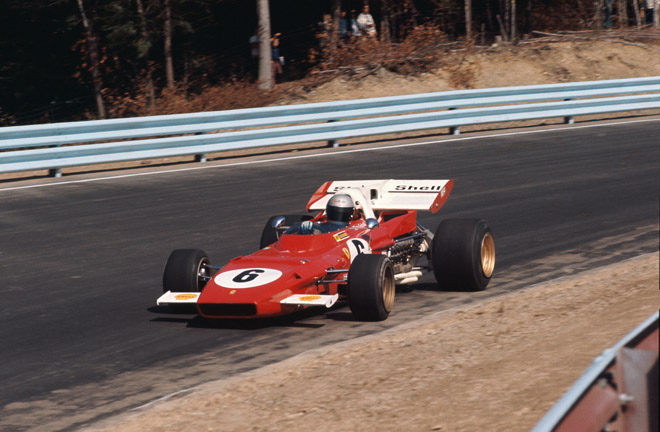
like to see again – at Watkins Glen in 1971.
With the extreme costs to produce small-displacement turbo engines and ERS systems, Andretti doesn't expect F1 manufacturers to support sweeping regulation changes aimed at bringing the noise back to the grand prix circuit.
"Right now they're so much into that hybrid thing that I cannot see after all the money, hundreds of millions of dollars that were spent to develop those, that it's going to change anytime soon, quite honestly," he said. "I think, at least at the moment, you've got to try to create some interest otherwise, in other ways."
One item Andretti has continually championed would, in theory, draw more fans to each race and strengthen national support for each Formula 1 round.
"I keep hammering on this – to create more interest, why aren't teams able to, if the situation warrants it, allowed have guest drivers at different times," he said. "What if Mercedes or Ferrari, for instance, a top team, would ask one of the IndyCar drivers to be part of their team in a third car for the USGP? What would be wrong with that? How many extra American fans would go to Austin, or watch on TV? A lot, I bet. That is how my Formula 1 career started. I won poles as the third driver, and I won my very first Formula 1 race in a Ferrari where the Ferrari was capable of winning, and I wasn't the full-season driver.
"Things like I'm talking about I think would improve the interest or create more interest in any particular country. Say you go to Baku, you have a Russian, Azerbaijani driver, somebody local the first time. Put them in a top team, let them test, get ready, and give the local fans one of their own to cheer for. You can't tell me that some of the top drivers like in IndyCar, or sports cars, or wherever – the best drivers – could not show well in a proper Formula 1 car. Think about what you're giving the fans who pay all their money to go to these races and what they would like to see most. And this doesn't require changing the cars one bit."
Drawing from six decades of involvement with F1, Andretti sees many areas that would benefit from immediate improvement, but also cautions those who believe the current woes are a newfound experience for the sport.
"I think you're dreaming if you think things were a lot better many years ago," he declared. "They were not. I hear that all the time: 'Oh, it used to be so much better than today.' No. Honestly not. When Michael Schumacher was dominating with Ferrari, he was winning everything for seven years. So what are they screaming about now?
"The only saving grace I think with Mercedes being so dominant is the fact that, probably thanks to Niki Lauda (with Andretti, RIGHT), they're allowing Lewis [Hamilton] and [Nico] Rosberg to go at it. When Schumacher dominated, that wasn't particularly exciting for a lot of people. Things have not changed that much. The problems are different, but I wouldn't say they are any more or any less than before."
Like most F1 fans, Andretti looks forward to the sport rediscovering its groove and relegating the unsavory changes to the past.
"That's the only thing that would make me happy," he said. "And we've got to keep fighting for it."
Presented by:


Latest News
Comments
Comments are disabled until you accept Social Networking Cookies. Update cookie preferences
If the dialog doesn't appear, ad-blockers are often the cause; try disabling yours or see our Social Features Support.