SVRA: Historic Trans Am at Sebring
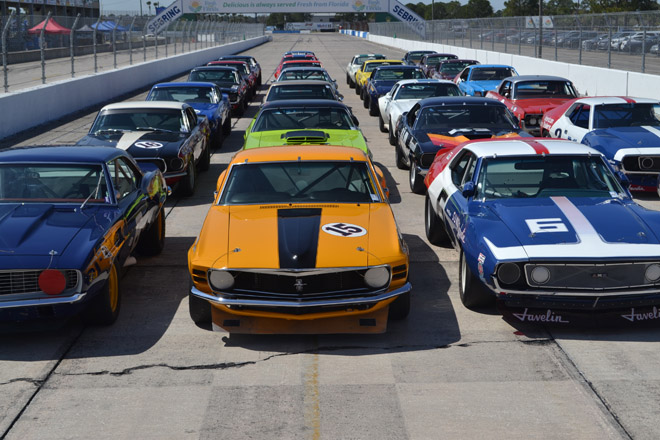
So, where did all those great Trans Am Series pony car racers go? You know, the ones of that magic era from 1966 through '72. We're talking the yellow school bus-painted, Bud Moore-prepared Mustang Boss 302s of Parnelli Jones and George Follmer, the Sunoco blue Roger Penske Camaros Mark Donohue piloted or Dan Gurney's and Swede Savage's All American Racers pitch blue Plymouth Barracudas. Or how about Penske's red, white and blue AMC Javelins and the blindingly lime green Dodge Challenger of Sam Posey?
Thankfully the answer to the above question is that they did not go to a museum – at least not full time. No, thanks to a loose-knit organization of fanatics with means known as Historic Trans Am, all the above extraordinary machines and many others of their kin are run in anger on some of America's top road racing circuits today. There was no better evidence of this than this past weekend's SportsCar Vintage Racing Association (SVRA)-sanctioned event at Sebring.
With the theme of the weekend – the 50th Anniversary of Trans Am – the cars of the Historic Trans Am association are right at home at the 64-year-old iconic track that is Sebring International Raceway. The people behind Historic Trans Am are the ultimate enthusiasts for the first generation machines of the sport, generally accepted as ending with the demise of factory support after 1972.
"When the American factories like Ford, Chrysler, GM and American Motors retreated after 1972," says Bill Ockerlund (LEFT), owner of several such machines like the ex-Roger Penske AMC Javelin Mark Donohue drove to the 1971 championship. "It fundamentally changed the series and a group of us want to preserve as much of the magic of the early days as we can."
Ockerlund had two of Donohue's championship-winning cars in the Sebring paddock, the 1969 Penske Camaro as well as the '71 Penske Javelin. He also brought Parnelli Jones' 1970 championship-winning Ford Mustang as well as the AAR Plymouth Barracuda Gurney and Savage drove in 1970. For Ockerlund and his colleagues at Historic Trans Am, it's all about authenticity.
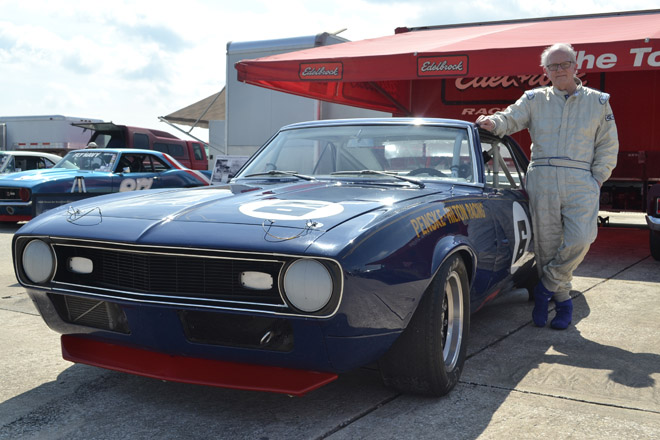
This quest for authenticity has been the unifying tenant of everyone involved with Historic Trans Am from the get-go when a few owners got the idea to huddle some 23 years ago. Tom McIntyre, the owner of Mark Donohue's 1968 Roger Penske Sunoco Camaro championship machine, (RIGHT, leading Terry Bookheimer’s 1967 Mercury Cougar. Randy Harbaugh photo) has been a driving force since the beginning.
"We were just a handful of friends in California," McIntyre says. "One had an ex-George Follmer Boss 302, another had the University of Pittsburgh Camaro. We ended up putting a show on at Sonoma. The response of fans was so enthusiastic we looked at each other and decided our idea had some real potential."
That potential has blossomed into what might be described as a traveling road show with six stops in 2016. In addition to Sebring the group will perform at Sonoma, Laguna Seca, Lime Rock and Watkins Glen. Always supporting a larger event, the Historic Trans Am will be part of the SVRA weekends at Sonoma and Watkins Glen while their two appearances at Laguna will be associated with the Monterey Motorsports Reunion. The Lime Rock round is part of that track's annual historic festival.
LEFT: Mark Donohue during a 1971 Trans Am pit stop for his Roger Penske AMC Javelin. (Photo courtesy of HTA)
While a broad swath of Americans harbor a cult-like affection for old-school muscle cars, the authenticity McIntyre, Ockerlund and the core leadership stress is what differentiates their road show and makes it special. Among the early advisors to the group was Steve Earle, widely recognized as the founder of what is now known as the Monterey Motorsports Reunion and a visionary in vintage racing. Earle encouraged the group to race at the original Sonoma event in 1993 and counseled on how to verify the lineage of the extraordinary cars.
"We strive for real documentation to avoid reproduction," says McIntyre. "We can't have people claiming a car is something it isn't, either by mistake or otherwise."
One of the interesting aspects of Historic Trans Am is the governance of not just the certification of authenticity and the associated tech inspection but also every aspect of the activity. McIntyre and Ockerlund both describe the ultimate democracy in their operations – there are no officers and no rulebooks. Everything is done by consensus and a trust in the wisdom, experience and honor of everyone involved.
As the group expanded (there are now 72 cars on its website) various people were recognized for their expertise in different marques. The vetting process was informal but a healthy culture of camaraderie bred trust. Leaders emerge based on a respect for their knowledge and a belief in their fairness. Enthusiasm counts too, and that is where McIntyre finds the energy to step forward to help organize agreements with people like Tony Parella, the CEO of the SVRA.
"Ken Epsman is another group leader, he and I do a lot of coordination," McIntyre stresses. "In many ways our entire group is a social club. We do everything together. We plan; we share meals and travel together. We help each other with our cars. Our families know each other. It's that kind atmosphere."
AMC Javelin rides in the Historic Trans Am paddock.
By supporting events such as the one at Sebring with the SVRA, Historic Trans Am teams can rely on the event infrastructure in place such as timing and scoring, corner workers, safety crews and other officials. The group does its own tech inspection and conducts drivers' meetings to plan race conduct. No surprise, the organization has a zero tolerance for trading paint. Some of the cars, such as those that won championships, are valued at more than $1.5 million.
While drivers are encouraged to go fast and pass, everything must be done with the utmost care. Starts are frequently managed and drivers may be asked to hold their position for the first few turns. Painfully and albeit rare, the group has been forced to discipline one or two overly enthusiastic drivers by sending them home.
As for tech inspection, the authenticity issue is paramount. Cars must be absolutely authentic and backed up by documentation. The obvious point is that none of the cars are reproductions. The nuance comes into play with respect to specific cars. For example, the cars of Ockerlund and McIntyre mentioned here were all factory entries. Many others were independents. Some cars were purchased right off a dealership's showroom floor with limited modifications beyond safety equipment.
"An independent driver could go buy a Z/28 Camaro together with over-the-counter parts and race against Parnelli Jones," says Ockerlund, who won the group's Sunday race and finished second Saturday driving his Javelin. "There are many great stories of independents who went home from dealerships and turned their new cars into Trans Am racers.
All of that means the old factory cars still have an edge because they had million dollar budgets for modifications such as special engines, suspension parts, differentials and brakes. The experts at Historic Trans Am want each car to be exactly as it was, so no upgrades are allowed. If a car was "tricked up" back in the day, that's the way it stays. The owners of the original independent entries have bona fide classic Trans Am cars, they just lack the technology developed by a group like AAR who brought what they learned racing in Formula 1 or the Indianapolis 500 to the equation.
Pragmatic changes are allowed for engine maintenance. There is more standardization of repairs to keep the cars running and people have learned more about rebuilding engines over the decades. To some extent this closes the horsepower gap, but everything visible to the naked eye is restored to the exact components and dimensions as documented and reviewed by the resident experts. If something is out of step the owner is required to conform.
The spirit of Historic Trans Am is really the epitome of purest vintage racing. Owners and drivers push the car to go fast and onlookers can take joy in seeing and hearing the cars sincerely stretch their legs much as they did in their glory days. A measure of the competitive spirit is permitted as well, but with rigid constraints. It still requires skill, drivers can still have a big moment – or worse – but like flag football no touching is permitted.
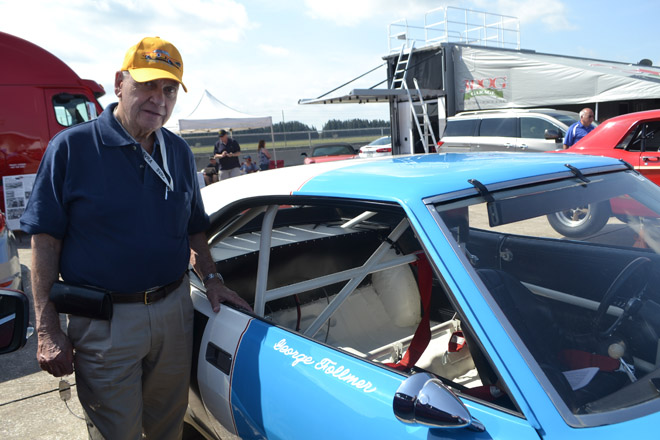
Appropriately, there are no trophies, medals or any kind of incentive for winning races. The one award they do have is the Roy Woods Memorial Trophy which was presented to the group by two-time Trans Am champion George Follmer. Woods, who lost a battle to leukemia in 2004, was the owner of the American Racing Associates team that campaigned the AMC Javelin Follmer drove to become champion of the series in 1972.
The current recipient of the Woods Trophy is Ken Adams, who drives an independent 1969 Mustang. The trophy is awarded to the Historic Trans Am racer best exemplifying the spirit and dedication of the group in preserving the special original era of the series. Fans see this spirit in spades as the group takes special care in arranging their cars on the pre-grid so people can walk between them, capture photos and ask questions of the owners and drivers.
Later this year, McIntyre's '68 Donohue Camaro (BELOW) will be at the Indianapolis Motor Speedway Hall of Fame Museum as part of a massive display celebrating Penske's 50 years in racing. If you see it there it will be docile and behind a rope. At Historic Trans Am events you can touch it and then hear it wail like a banshee as it goes like hell.

Latest News

Comments
Comments are disabled until you accept Social Networking Cookies. Update cookie preferences
If the dialog doesn't appear, ad-blockers are often the cause; try disabling yours or see our Social Features Support.