INDYCAR: RACER's 2016 aero kit comparisons
2016 Verizon IndyCar Series aero kits were on full display last week in Phoenix, giving RACER an opportunity to compare and contrast the changes between Chevy and Honda from their 2015 aero packages. Although Chevy's revised road course/short oval kit (RC/SO) broke cover a few weeks ago at Sonoma, Phoenix provided the first look at Honda's heavily updated RC/SO bodywork.
Thanks to IndyCar's use of Aero Kit Rule 9.3, which allows a manufacturer to make changes to its baseline package in the name of increased competitiveness, Honda's RC/SO underwent significant alterations for 2016. Most notable is a new sidepod profile and rear tire ramp profile that mirrors Chevy's 2015 sidepod. Those changes, according to IndyCar, are only for RC/SO configuration. At superspeedways, Honda teams will revert to the 2015 sidepods. Honda also changed its front and rear RC/SO endplates for 2016 under Rule 9.3.
Other than the exceptions given to Honda from Rule 9.3, both brands have been limited to updating smaller regions on the Dallara DW12 chassis (under Rule 9.2, which does not require special permission). Front wing attachments – everything that bolts to the stock DW12 front wing mainplane – and rear wheel pods have undergone varying degrees of modification from both brands through Rule 9.2. Manufacturers are limited to three updates per season, and so far, Honda has used two and Chevy has used one.
In a series of 16 photos below, some changes are subtle, some are obvious, and in many cases, each manufacturer took the elements it liked from the other's 2015 kit and incorporated it into its 2016 package. If there was any question regarding whether imitation is a form of flattery, one look at IndyCar's latest aero kits will provide a firm answer.
FRONT WINGS
Honda's set of stacked and curved front wing elements were among the most visually striking aspects of its 2015 RC/SO kit. The lack of a traditional endplate to cap those wings also stood out (IndyCar asked Honda to abandon its tall endplates due to routine contact-related debris fields after the Indy GP). For 2016, Honda has taken Chevy's trumpet-style endplate and made modifications to the concept, and gone away from the stacked/curved triple-element arrangement in favor of a dual-element package.
The similarities speak for themselves. Among the differences, Honda's endplate extends to the front of the mainplane, and Chevy's trumpet-like endplate is continuous from its inlet to exit while Honda's is shallower and splits, using a separate ramp to divert air over the tire.
Shown in yellow, Chevy feeds the air flowing beneath the front wing into its endplate/diffuser system from a rounded profile which continues rearward until the shape expands upward and outward. Honda's new endplate system goes about the same process while feeding from a square profile that slowly builds towards a rounded profile as it moves rearward
Here's another look at how closely the front wing packages from both brands now look.
A full-width look at the 2016 RC/SO front wing arrangements. Other than the Chevy's single-piece endplates vs. Honda's two-piece endplates, fans can tell one brand from the other by the location of wing adjusters. Chevy's sits in the middle of its elements; Honda's are attached to the inner endplates.
Although they weren't seen in Phoenix, Chevy did test an outer front wing package at Sonoma that borrowed heavily from Honda's 2015 RC/SO kit. With the aero kit rules allowing manufacturers to introduce the changes to the three regions on the car at any time, Chevy's Honda 2015 front wing concept could appear as early as St. Petersburg, or go unused if it felt the update did not perform as desired in testing.
SIDEPODS
The greatest single change to aero kits for 2016 can be found with Honda's sidepods. The single, unbroken 2015 units, featuring wing elements in front of the rear tires, forced air to go out and around those tires, and over the top. They have been replaced with Chevy-style split sidepods that open a channel between the back of the sidepods, the rear tires, and the transmission. Using a term coined in the 1980s, Honda has gone to the "Coke bottle" sidepod solution, which refers to the shape of the rear of the car when viewed from above.
Where the 2015 sidepods had a channel built into the rear – to the inside of the wings in front of the rear tires – to feed the rear brake ducts, the 2016 RC/SO sidepods allow the use of a more standard brake duct. IndyCar found Honda's aero kit to be very close to Chevy's on the superspeedways, which led to the restricted use of the revised sidepod system outside of Indianapolis, Texas, and Pocono. For those three tracks, Honda-powered cars will revert to 2015 sidepods.
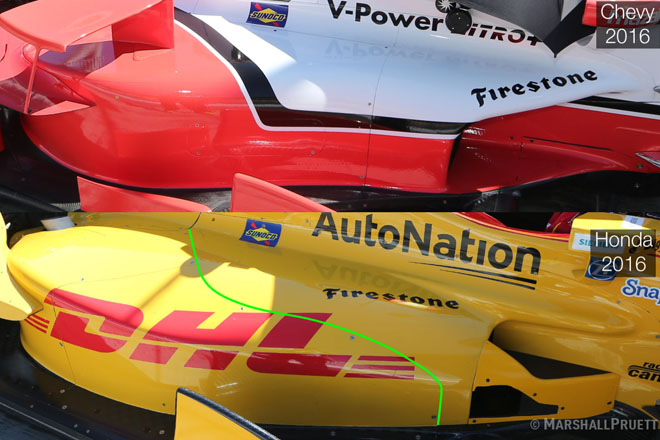
Honda's request to use Rule 9.3, and IndyCar's permission to employ the rule, was made to follow Chevy's approach to sidepod size and airflow. Chevy's small, efficient sidepods were, without question, a contributing factor behind the Bowtie's aerodynamic superiority in 2015.
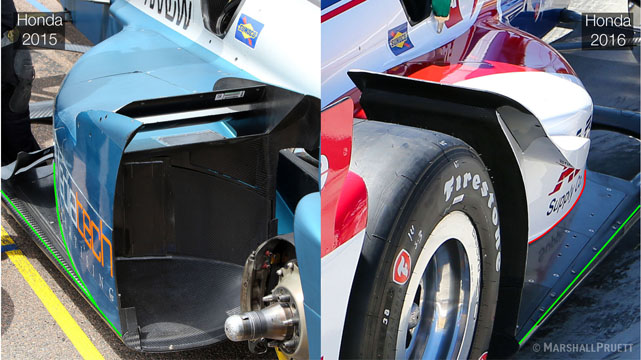
The sheer width of Honda's 2015 sidepods, as shown by its relation to the edge of the floor, and the vast, new gap from the edge with its tiny 2016 sidepods reaffirm the reason for bringing rile 9.3 into the equation.
And finally, here's how the two 2016 sidepods compare. IndyCar limited Honda's 9.3 revisions to the section aft of the green line, meaning its 2015 radiator inlet profile and everything ahead of the green line attaches to the DW12 in the same manner. Honda's new sidepod profile isn't an identical copy of the Chevy; where the 'L' section in 'DHL' is rounded, the same location on Chevy's sidepod is curved inward, followed by a more pronounced bulge to accommodate the Chevy V6's exhausts. Chevy's sidepod shape is unchanged for 2016.
Honda's smooth, rounded sidepods appear to be a bit shorter and tighter to the chassis near the 'D', and a wider opening between the sidepod and airflow diverter (below the tire ramp) is also visible.
REAR TIRE RAMPS
Once more, the similarities between Chevy's 2015/2016 solution and Honda's new-for-2016 bodywork are evident. Honda has gone in a few new directions, starting with the tire ramp profile. Where Chevy's ramp is a flat piece that surrounds the teardrop bulge atop its flow diverter, Honda uses an actual wing profile for its ramp. Honda's new flow diverter is shorter from front to back, and narrower than Chevy's.
A year-to-year comparison of Honda's tire ramp and rear wheel pod wings
A comparison of Chevy's existing 2015/2016 ramp and new 2016 rear wheel pod wings, and Honda's new ramp and revised wheel pod wings.
REAR WHEEL PODS AND WINGS
Honda has gone from its dihedral 2015 wing profiles to straight wings in 2016. One interesting note regarding the aero kit rules: Modifications like this, which is part of the three zones open for updates, allow teams to use either option as desired. Simply put, providing a new wing profile like the 2016 version that's shown does not obsolete the curved 2015 wing; teams now have two choices instead of one.
Chevy made two sizeable changes to its rear aerodynamics for 2016. It borrowed from Honda by incorporating wings atop its wheel guards in place of the rounded ramps, and also went toward Honda with boxier wheel guards. Where Chevy has made a significant departure is in the height of its wheel guards. The tall profile shown (in red) now sits well below the top of the tire (in yellow), which helps expose the new wings to the oncoming air.
IndyCar enacted new rules after cars flew at Indianapolis to cap rear wheel guards on superspeedways, and for 2016 – at least at the Phoenix test – we saw Chevy and Honda go about RC/SO rear wheel guard airflow in completely different manners. Chevy's guards ran wide open while Honda sealed its guards, barring the through-flow channel shown on the outer edge. Honda teams also have the option to remove the small rectangular bar that mounts to the inside of its guards – the piece just below the beam that affixes the guard to the chassis.
The last major item of change we found on the RC/SO kits is Honda's move to vent its rear wing endplates. Chevy was the first to do it in 2015, and it continues unchanged so far in 2016. Where's Chevy's six-vent louver system follows the contour of the rear wing profile, Honda's four-vent louvers are more reminiscent of venting seen in Formula 1 over the last decade or so.
We anticipate more new RC/SO items to appear once the season gets under way; check back for new comparisons as they're unveiled.
Click on the thumbnails below for larger versions of the comparo images:
{igallery id=3789|cid=467|pid=9|type=category|children=0|addlinks=0|tags=|limit=0}
Presented by:


Latest News

Comments
Comments are disabled until you accept Social Networking Cookies. Update cookie preferences
If the dialog doesn't appear, ad-blockers are often the cause; try disabling yours or see our Social Features Support.