WEC: Toyota opposed to 2017 hybrid limits
An extension of the new limit on hybrid power for next year's Le Mans 24 Hours to the rest of the World Endurance Championship in 2017 is opposed by Toyota
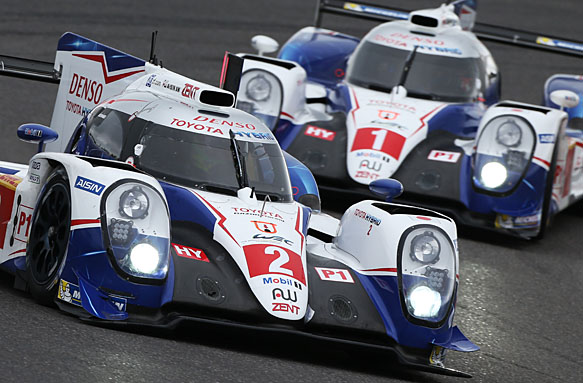
The Japanese manufacturer is arguing that the rule limiting hybrid power release to 300kW would hurt its concept more than those employed by rivals Audi and Porsche. It says it agreed to the limit for the 8.47-mile Circuit de la Sarthe at Le Mans because the rule change will have a negligible effect on performance courtesy of the proliferation of long straights. But Toyota argues that the sharper burst of energy release required on other tracks where the straights are shorter would disadvantage its hybrid concept because it is the only manufacturer to deploy through both axles.
"This kind of limitation hurts a double KERS [kinetic energy retrieval system] more than one KERS and an exhaust system," Toyota Motorsport technical director Pascal Vasselon said. "It is not fair to introduce a rule that hurts one technology more than another."
Vasselon expressed surprise that the rule makers, the FIA and the Le Mans organiser the Automobile Club de l'Ouest, wanted to extend the rule to the Formula 1 tracks that make up the rest of the WEC in 2017.
"It is difficult to understand, because what was discussed originally was to apply the limit only to Le Mans because it is a grade two circuit," he explained. "The delivery is not so important because the straights are very long; we were surprised at the suggestion that it could be applied generally."
Vincent Beaumesnil, sporting manager at the ACO, explained the thinking behind the extension of the 300kW rule by saying it was "best to have one rule for all circuits, because otherwise it is confusing."
The 300kW limit pre-empts a projected change to the way circuits are licensed by the FIA. Under a system that has yet to be signed off, the grading of a circuit would be determined by power-to-weight ratios of the cars allowed to run on it.

Latest News

Comments
Comments are disabled until you accept Social Networking Cookies. Update cookie preferences
If the dialog doesn't appear, ad-blockers are often the cause; try disabling yours or see our Social Features Support.