GLENDENNING: IndyCar's Competition Clause

And that's why Rule 9.3 of IndyCar's aero kit regulations makes me feel uneasy. If you need a recap, here's what it says:
"In the event that an Aero Kit is not competitive to such extent that it would be detrimental to the Verizon IndyCar Series, INDYCAR may permit in its sole discretion Approved Suppliers to implement modifications to their respective Aero Kits."
The purpose of the rule is straightforward. Whatever else has been going on with IndyCar during the DW12 era, the one thing you've always been able to rely on is the quality of the racing. Opening up a variable as massive as the car's aerodynamics to competition places that quality of racing at risk. Basically, Rule 9.3 is an insurance policy against one of the manufacturers getting it wrong.
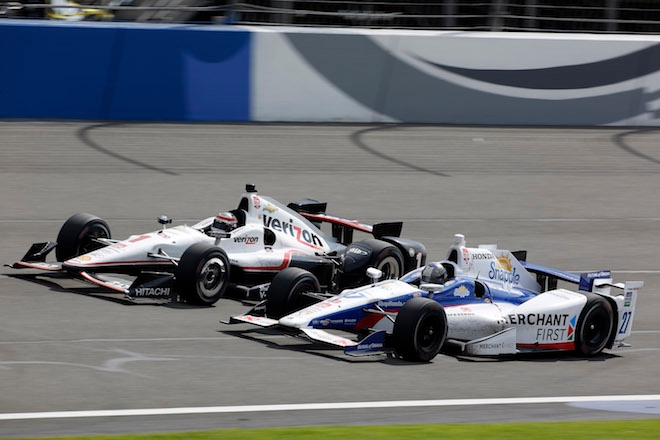
And the 2015 IndyCar season has since shown us that one manufacturer did indeed get it wrong. Honda's Wirth-designed kit, RIGHT, scored lots of points on the flamboyancy scale, but was draggy and recalcitrant when sent into battle.
The various components of the aero kits fall into one of a series of 'legality boxes' defined by IndyCar, and normal rules only allow manufacturers to make off-season upgrades within three of these boxes. Rule 9.3 is the side door that allows manufacturers to request permission to overhaul their kit above and beyond the permissible changes if they fear that they're in too deep a hole. The rule can also be invoked by IndyCar itself.
This is the situation that Honda currently finds itself in. Under the rules as they were originally written – rules that both Chevy and Honda had a hand in changing at the start of the year – manufacturers would have had the opportunity to make upgrades within three legality boxes during the season. With hindsight, had that rule remained intact, Honda's 2015 campaign might have played out differently.
Instead, it currently has a 9.3 request under consideration by the series, and HPD's Allen Miller told RACER.com in Sonoma that
Honda does not believe that it can match Chevrolet
without that additional help.Miller's comments included the admission that "We're not convinced that we can exceed [Chevrolet's] performance based on the limited number of changes that we're allowed to apply. We could probably get closer, but I don't believe that we can match them, or try to get ahead. And ultimately, we would like to get ahead."
An immediate problem is the 'get ahead' part, because that isn't what the rule is supposed to be about. It's not to help a struggling manufacturer to beat a superior one; it's merely a safeguard against an unusually wide performance gap. The responsibility for 'getting ahead' should remain with HPD and Wirth, operating with in the same framework as their rivals.
But more fundamentally, we're tripping over what 'competition' means in the first place. This rule, as it currently stands, effectively penalizes Chevrolet for doing a better job. Granting substantial concessions to allow HPD to close the gap is like inviting Bryan Clauson to start from the front row at the Indy 500 to make up for his not having the car speed to match the Penskes and Ganassis during qualifying.
The other issue is that Honda's shortcomings in 2015 were not limited to its aero kit. It was working its engine harder than it wanted to in order to match Chevy, which accounted for a lot of its unscheduled engine changes and consequent point deductions. It has also admitted that it was outgunned in terms of top-tier teams and drivers. And yet it nearly won the drivers' championship. The question of why there wasn't an Andretti Autosport car flying the flag alongside RLL in the title fight is one for the team to answer, but Graham Rahal's performance suggests that it should have been possible. And that raises questions of its own regarding what exactly constitutes 'detrimental to the IndyCar Series': both manufacturers were still players in the drivers' championship at Sonoma. Nobody was walking around the paddock complaining of Lotus flashbacks.
There's no argument from here against the fundamental need for a Rule like 9.3, but there should be a penalty for its use; something that at least gives a manufacturer cause to stop and think before requesting that it be enacted. Restricting track time or imposing time penalties to that manufacturer's entries in qualifying would certainly achieve that. But that unfairly punishes the teams and drivers, and would be hugely repellant to potential team sponsors.
Allowing the same freedoms to Chevrolet isn't the answer, either: all that will happen is that both manufacturers will spend a lot more money, and we risk ending up with the same performance gap that we started with.
Perhaps the only fair solution is a significant - almost insurmountable - manufacturer point deduction for the new season; one that takes a step towards forcing the manufacturer in question to concede the next year's manufacturers' crown in advance. Chevrolet's manufacturer points tally was 1645 in 2015, so something in the order of a 500 point penalty as the cost for being granted the freedom to make additional updates might seem reasonable.
Honda is a smart and proud company, and whether an exemption under Rule 9.3 is granted or not, it's hard not to see it getting back onto equal terms with Chevy sooner or later. But if you're going to have a rule aimed at preserving the competition, you have to ensure that the integrity of that competition isn't compromised in the process.

Latest News
Comments
Comments are disabled until you accept Social Networking Cookies. Update cookie preferences
If the dialog doesn't appear, ad-blockers are often the cause; try disabling yours or see our Social Features Support.