MALSHER: Castellotti's poignant heroics at Spa
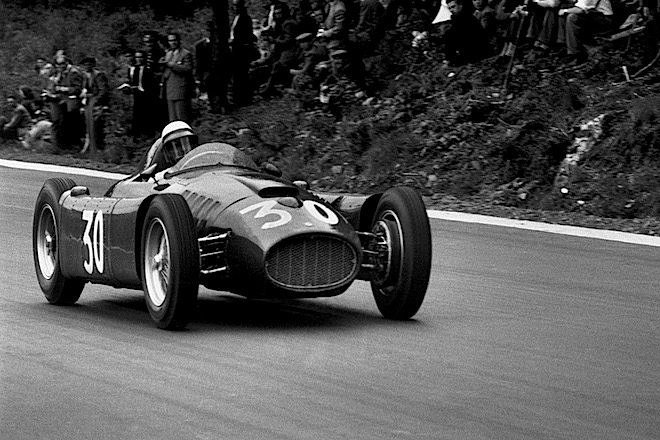
The sights and sounds reveal how hard the blood-red Lancia D50 is being worked. Over the crest exiting Raidillon, it appears to be barely touching the pavement as the 2.5-liter V8 tries to transmit 280hp to the ground through skinny, treaded rubber. Moments later its left-side tires are bending and their wire wheels singing as lateral G force drags hard on the car through the fast right-handers at Burnenville and Malmedy. Finally, the driver wrestles with both the steering-wheel and his sense of judgment as he goes through La Source hairpin at 30mph, initially understeering, then straightening up with an abrupt blat of throttle as he heads for the finish line.
Job done. It’s a 122.377mph average around the 8.761-mile “old” Spa-Francorchamps course on a sunny Friday in June 1955 and it’s sent Eugenio Castellotti to the top of the time sheets. When it rains throughout the second day of practice, the 24-year-old Italian is guaranteed to start from pole position for the Belgian Grand Prix. It’s a more significant milestone than usual, though: this is the final event for Scuderia Lancia. Merely days later, the financially troubled team will fold and its assets will be acquired by the other Scuderia.
That fact alone would earn Castellotti’s pole-winning performance a poignant footnote in F1 history. But there was far more to his achievement than that.
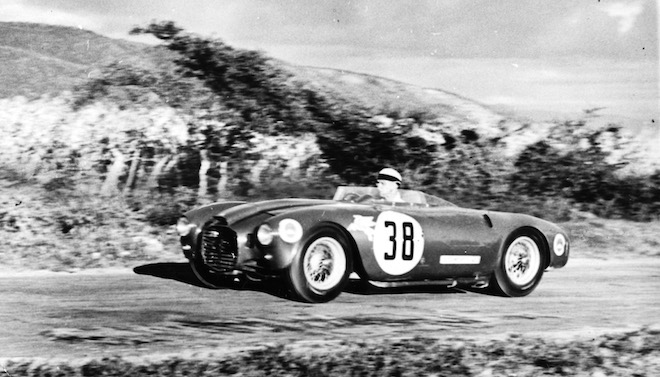
When it arrived in all its innovative glory, Vittorio Jano’s masterpiece was revealed to have an engine that was a stressed chassis member, but was also canted and off-center to allow a lower car altogether. Externally, the D50’s most distinctive feature was the side pannier fuel tanks slung between the wheels for better weight distribution and aerodynamics.
And in principle it worked. Team leader, double world champion Alberto Ascari, took pole on the car’s grand prix debut, the final round of 1954, then qualified second for the initial round of ’55 in Argentina, but crashed. His teammates – raw debutant Castellotti and aged veteran Gigi Villoresi – were only and 11th and 12th on the grid for that race, some two seconds slower, and their cars fell to a crash and a fuel leak respectively.
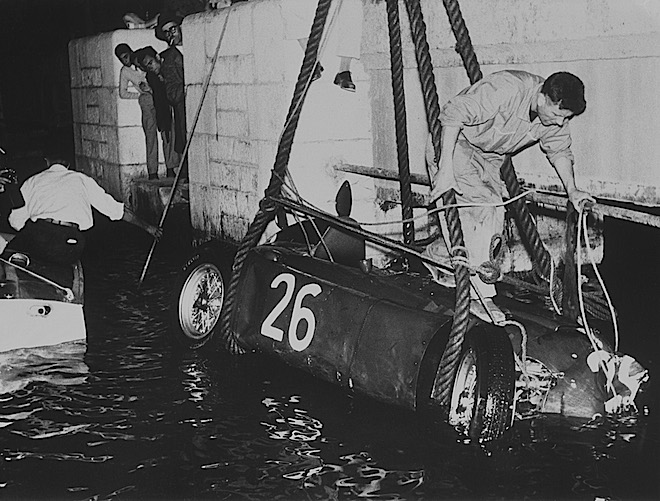
But Eugenio was a fast learner. At the next round, on a track he knew (Monaco), he was fourth on the grid, less than a second slower than Ascari and 1.7sec ahead of Villoresi. The dominant cars of the second half of 1954 and into 1955, the Mercedes W196s, had a rare off-day that weekend with both Juan Manuel Fangio and Stirling Moss hitting trouble, and Ascari had a rare off, plunging his Lancia into the harbor. Castellotti might have been able to take advantage of his principal rivals’ misfortunes had he not had a long pit stop and a brief spin while trying to catch eventual winner, Maurice Trintignant in the Ferrari. However, EC suffered both and had to settle for runner-up – still a highly admirable result in only his second F1 grand prix.
He also left Monaco mighty relieved that Ascari had escaped his dip in the sea (BELOW, the post-race car-rescue operation) with nothing more serious than a broken nose. Castellotti, like most of the Italian population, absolutely revered Alberto and recognized him as the fastest of the era, but their time as teammates had also cemented a friendship, despite the 12-year age gap. Just as Villoresi had mentored Ascari, so Alberto regarded Eugenio as his protégé. That’s why the 1952 and ’53 World Champion headed to Monza four days after his Monaco swim, in order to watch Castellotti test the Ferrari 750 they were due to share in the 1000km race there.
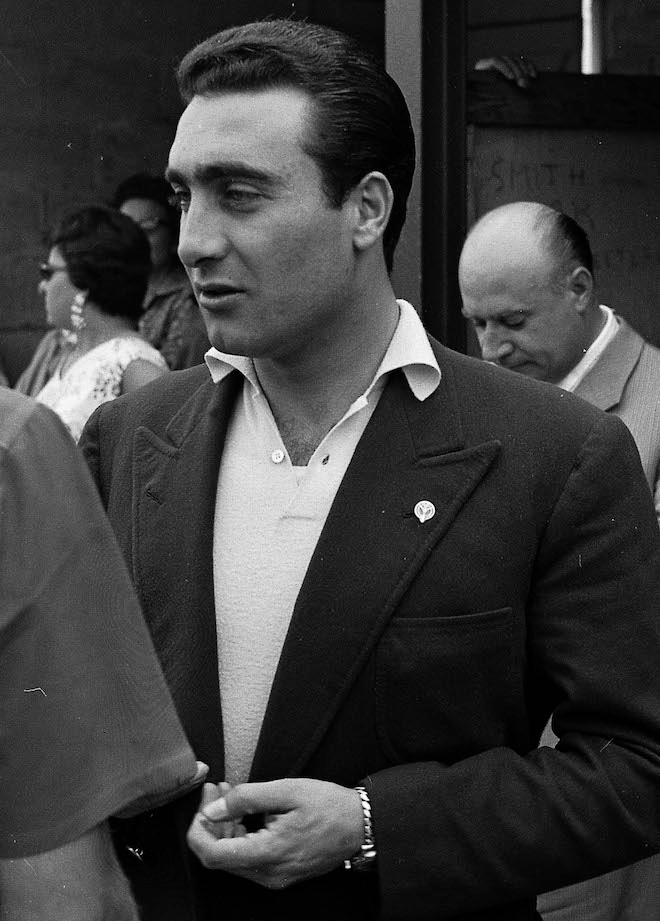
Italy and racing was plunged into mourning. “I have lost my greatest rival,” acknowledged a somber Fangio, while Castellotti and Villoresi were grief-stricken. While the elder driver’s career would trickle to a natural halt the following season, the youngster found some inner strength, even in the face of Scuderia Lancia’s imminent demise…and despite yet more grievous news, this time from America. Just four days after Ascari’s death, his “equivalent” in Indy car racing, Bill Vukovich, perished in an accident while trying to capture his third consecutive Indy 500 victory.
And so it was in those mournful circumstances – just seven days after losing his mentor – that Castellotti broke the dominance of Mercedes for a brief moment at Spa and claimed pole at one of the world’s most fearsome tracks. And he would hold the record as F1’s youngest ever polesitter for a further 13 years. Of course on race day he had no answer to the silver uber-machines, and his car eventually broke, but Eugenio had given his crew members something to smile about, even as their organization went through its death throes.
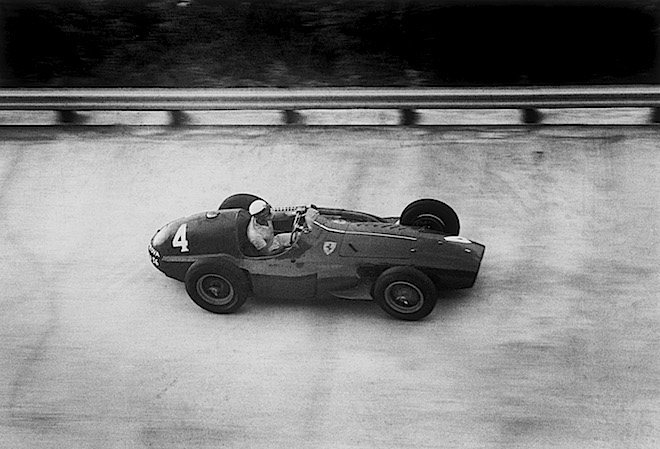
As he switched to Ferrari, Castellotti had to deal with a regression in equipment – the 625 model was out of date and the 555 had never been on the pace – yet in only his second grand prix for Il Cavallino Rampante, the British Grand Prix, Eugenio was able to outqualify his vastly more experienced teammates Mike Hawthorn and Maurice Trintignant. Then on home soil at Monza (TOP, in the 555), Castellotti was on top form, beaten in qualifying and race only by Mercedes-Benzes and thus finishing third.
That was enough to earn the young Italian third in the World Championship in his rookie season, and much was expected of him in 1956, particularly as Mercedes was now gone, and Ferrari had taken the sensible decision of running the D50s they’d acquired from Lancia.
Yet it didn’t really happen for Castellotti. In Argentina, the opening round of the new season in January, he lined up alongside Ferrari’s new team leader Juan Manuel Fangio on the front row of the grid (albeit more than two seconds slower), but it was their teammate Luigi Musso’s car that Fangio commandeered when his own broke, and drove on to victory. Meanwhile, Castellotti’s ground to a halt with transmission failure.
In March, Castellotti shared a Ferrari 860 Monza with Fangio in the 12 Hours of Sebring and they won by two laps. A month later in Syracuse, Sicily, for a non-championship race, Castellotti was again closest man to Fangio in qualifying (this time within a second of the master), but an accident at half-distance on race day meant that it was Musso and Peter Collins who followed Fangio home to complete a Ferrari 1-2-3.
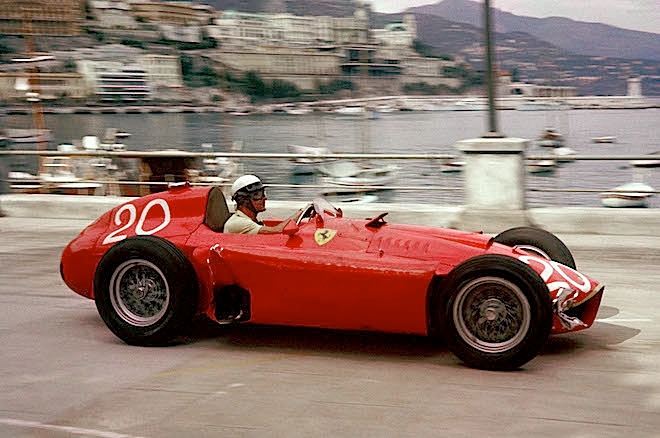
Later that month, Castellotti had his finest hour, at least in terms of sports cars. Driving a Ferrari 290 MM, he won the mighty but infamous Mille Miglia, averaging 85mph over the 992 miles, despite driving rain causing several huge accidents and some fatalities. Heading home Ferrari teammates Collins, Musso and Fangio on that occasion must have felt like some reward, but he still couldn’t catch a break in F1. At Monaco, EC qualified on the front row but his clutch burned out in the race, and although Fangio handed over his car when he pitted, that was only after uncharacteristically bouncing it off hay bales and a concrete wall! [ABOVE: The damage is clear to see…]
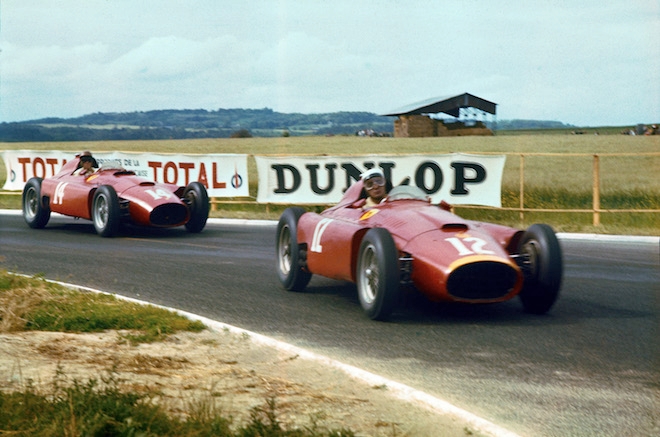
At Spa, Castellotti couldn’t replicate his form of a year earlier and again transmission failure cost him any hopes of a decent finish (it also afflicted Fangio), so the pair of them could only watch as Collins won for Enzo. At Reims, Castellotti beat Collins by 0.3sec in qualifying but lost to him by the same margin in a mighty slipstreaming battle [BELOW, EC ahead at this point], as they both left behind their heavily delayed polesitting teammate Fangio. Just a week later it was time for a French consolation prize for the proud Italian; in Rouen’s sports car race, Castellotti’s Ferrari held off Stirling Moss in an Aston Martin to clinch victory.
In January 1957, at the Buenos Aires 1000km, Castellotti would share the winning Ferrari 290MM with Masten Gregory and Musso, but fate would rob him of more opportunities to try and win an F1 Grand Prix. In April, while in Florence with his beautiful fiancée Delia Scala, a famous actress and ballerina of the day, Castellotti was called by the Ferrari team to go to the Modena Autodromo. Maserati’s Jean Behra had just set a new lap record, and this could not, apparently, be tolerated. OK, so the track was in Enzo’s back yard, but it’s amazing that redressing this matter was deemed important enough to summon its local hero at short notice… Reluctantly, Eugenio caught a train and headed north.
The outcome of the trip was calamitous. After just a couple of laps, urged on from the pits, Castellotti braked later than ever for the corner at the end of the front straight. The Lancia Ferrari slewed sideways, then gripped and tipped, eventually tumbling into an empty grandstand. The driver, thrown from the car mid-accident, was killed instantly. This was a perilous era of racing, of course, but I will always regard Eugenio’s death as one of the most needless in auto racing’s dark history, the result of a tragically futile gesture driven by the egos of others.
Best not to dwell on that, nor on the loss of a potentially fine career and happy life, but instead remember Signor Castellotti’s best days, of which June 3, 1955, was undoubtedly one. In the ensuing years, I’m sure there have been technically greater laps of Spa-Francorchamps than Eugenio’s pole-clincher, but I’m equally sure there were few braver and none more poignant. Sixty years later, I hope the Belgian Grand Prix produces a similarly inspirational performance. If not, I can always watch this beautiful documentary.

Latest News
Comments
Comments are disabled until you accept Social Networking Cookies. Update cookie preferences
If the dialog doesn't appear, ad-blockers are often the cause; try disabling yours or see our Social Features Support.