Throwback Thursday: Racing in the streets of Watkins Glen
How a Cornell Law Student’s Dream of Holding the First American GP Became a Reality
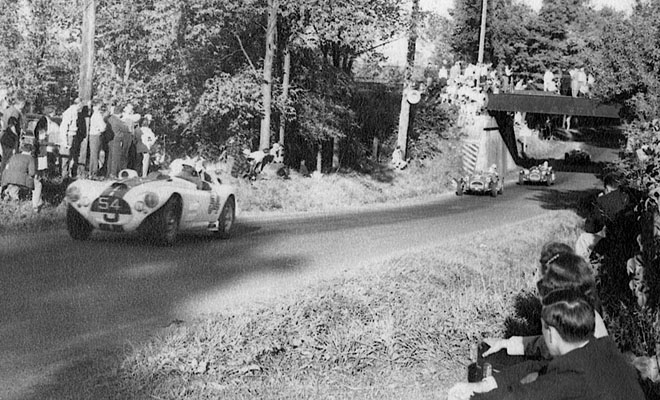
Cameron Argetsinger caught the racing bug while serving in Europe during World War II. When he returned to America in 1945, the Youngstown, Ohio native began attending law school at Cornell University in Ithaca, N.Y., not far from his family’s summer cottage near the village of Watkins Glen.Argetsinger began dreaming of building a race course on the challenging roads near his summer home, where he could race his Duesenberg. He then
worked to make that dream a reality. He traded in his Duesenberg for an MG TC so he could join the Sports Car Club of America, and began reading everything he could about the fledgling sport. By the spring of 1948, he took his plans to the Watkins Glen Chamber of Commerce, where President Don Brubaker Sr. and other businessmen enthusiastically backed the idea.At the time, the SCCA held hill climbs, acceleration and braking trials, and match races. When Argetsinger met club officials at a dinner prior to the Indianapolis 500, plans continued to hold an “American Grand Prix.”On October 2, 1948, the dream became a reality. Using the 6.6-mile course that Argetsinger laid out on the rug of his family living room, 23 cars competed in a four-lap Junior Prix and an eight-lap Grand Prix, which were the first sports car races in the United States following World War II. Frank Griswold won both races in an Alfa Romeo 2900B, followed by well-known American sportsman Briggs Cunningham, driving a BuMerc – the first successful American-European hot rod.Estimates of the crowd for the inaugural event ranged from 5,000 to 10,000 – and the race took root. By 1949, the crowd increased ten-fold, overflowing in the village at the southern tip of Lake Seneca. Miles Collier won the race in the “Ardent Alligator” Ford-Riley. For 1950, Erwin Goldschmidt won in a Cadillac-powered Allard, while Phil Walters and John Fitch placed 1-2 in Cunningham C2Rs in 1951.
Tragedy struck in 1952, when a young boy lost his life and a dozen other spectators were injured when a car brushed the crowd while preparing for Turn 1 in the heart of the village. While the accident halted the race – and ended street racing in Watkins Glen – Argetsinger’s dream was not diminished. Competition was held on temporary roads from 1953 through 1955, with a permanent circuit build the following year in the Town of Dix, southwest of the village. The circuit hosted its first professional race, for NASCAR’s premier series, in 1957, and attracted international stars with Formula Libre races in 1959 and 1960. Argetsinger realized his ultimate dream in 1961 with the United States Grand Prix, and Formula One made Watkins Glen an annual stop for the next 20 years. Watkins Glen International – a partnership between Corning Inc. and the International Speedway Corporation – began running the circuit in 1984, and will again serve as gracious host of the Sahlen’s Six Hours of The Glen next weekend.The spark ignited on Oct. 2, 1948 caught fire and spread across the United States. Within a few years, races were held in Sebring, Fla., Elkhart Lake, Wis., Lime Rock, Conn., and Bridgehampton, N.Y. – among other venues. Sure, there were rough days ahead, but Argetsinger’s dream had taken root, and continues to this day.
Source: IMSA

Latest News
Comments
Comments are disabled until you accept Social Networking Cookies. Update cookie preferences
If the dialog doesn't appear, ad-blockers are often the cause; try disabling yours or see our Social Features Support.