INSIGHT: HPD, from sea level to summit
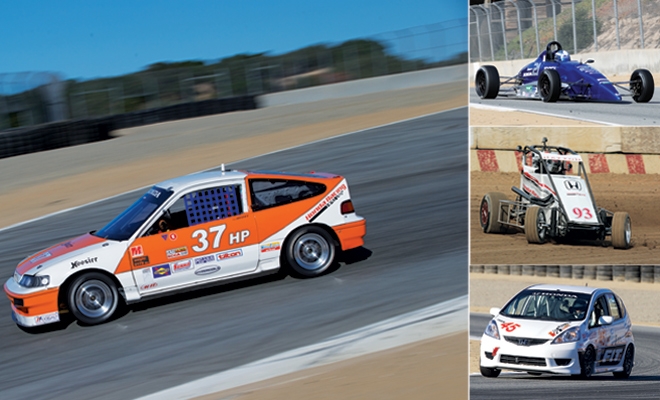
ABOVE: Honda Performance Development provides parts and support in a remarkably diverse range of motorsports, including SCCA Club racing (LEFT, Steven Hussey’s H Production CRX; BOTTOM RIGHT, Michael Tsay’s B-Spec Fit), Formula F (TOP RIGHT) and midget racing (CENTER RIGHT). For racers with aspirations to rise through the ranks, HPD offers engines, support and contingency up to its pinnacle programs, IndyCar and prototype sports cars.
Many companies in a variety of industries strive to support the breadth of their customers' needs, assisting them to whatever level they aspire, whether it's a new customer or one with years of product experience.
In motorsports, few can offer products and support all along that spectrum. One of the exceptions is Honda, through its racing arm Honda Performance Development (HPD), with its presence in karting, Indy cars, and practically everywhere in between.
In terms of ultimate destinations, HPD has two pinnacle programs – IndyCar and prototype sports cars – and is proactive in nurturing multiple paths for racers with aspirations to reach the summit.
"If you have a pinnacle program to aim for, I do think it influences your choice when you're starting out," says Jeff Barrow, Commercial Motorsports Manager for HPD. "If you're a young racer and you want to pick a brand – and of course we all like brand loyalty – Honda has got to be one of the first you'd choose just because of the breadth of offering that we have."
HPD’s CR125 engine (LEFT, installed) was available to kart racers in 2011. The CRF250 was added in ’12 and a factory-sealed GX50 Kid Kart engine in ’14.
That breadth starts with power solutions for karts for the road racers and quarter midgets for the oval-oriented. From there, Honda can power your Formula F in SCCA Club Racing, or your midget. On the production car side, it can start with the Honda Fit in club racing, SCCA Pro Racing Pirelli World Challenge or IMSA Continental Tire SportsCar Challenge.
"It shows there's a path," explains George Harmon, the marketing coordinator for Commercial Motorsports at HPD. "We can support a racer on his or her journey from quarter midget or GX50 Kid Kart to Le Mans or IndyCar. They can stay in a Honda all the way up through their career.
"We're focused on the racer," he adds. "We'd like to develop a relationship with the racer as early as possible. We offer programs and support to keep that person in the Honda family as long as possible. Relationship marketing is a big buzzword now, and this is kind of the ultimate way to do that – getting people in a car and offering them the support and programs they need to keep going."
Support is a key part of any successful manufacturer racing program. There will always be some manufacturers with "factory teams," but Honda keeps the base broad and provides a source for more directly supported teams and drivers.
In Honda's case, that program is the Honda Racing Line, a conduit for parts, advice and contingency money for racers not only in the aforementioned categories of motorsports, but virtually anywhere people race a Honda or with Honda power, from SCCA Club Racing, Solo and RallyCross, to NASA Honda Challenge, to Rally America B-Spec, to shifter karts.
Just about any part a racer needs, all the way up to crate engines, is available.
"We're trying to keep the barriers into pro racing down to a reasonable level," says Barrow. "Lots of people have aspirations to move up, and we want to be able to provide entry-level options that are not going to break the bank."
Contingency money for winning with Honda products can definitely always help a racing budget, but advice and support when a racer needs it may be the most valuable piece of the package.
"When you race a Honda, you have the option to sign up to be a Honda Racing Line member," says Barrow. "You can't buy parts without doing that. But once you sign up, part of our obligation is to provide support for the racers.
"A lot of that is at the events themselves, whether it's HPD engineers such as Lee Niffenegger, Julian Macias, or Aaron Hale walking around, or myself. We are at the SCCA National Championship Runoffs for the whole week. We're there supporting racers and troubleshooting whatever comes up. We'll even provide setup or mapping assistance."
Adds Niffenegger: "People can email or call us, too, and we have representatives who help to resolve their issues. They have access to the technical info and experience. If they can't answer your question personally, they'll find someone who can."
Building on the success of its Formula F program, HPD now offers a race-ready, 2-liter engine for Formula Atlantic. The K20 engine (LEFT) comes in two HP spec levels, and HPD makes installation kits for the Swift 014 and 016.
Niffenegger is an HPD engineer, as well as a racer (see sidebar below). He came from the production side of the company when all the motorsports programs were brought under the HPD banner in 2009 and, at the same time, greatly expanded. He specializes in production-based racing programs and is one of a small staff that manages to get an awful lot done.
One of the bigger achievements of that small staff is getting the company's 1.5-liter Fit engine approved for the class formerly known as Formula Ford. Sure, it helped the company sell some engines; but the easy availability of the Honda unit, its lower operating costs and greater durability have helped revive the flagging class, now renamed Formula F, that was once a direct conduit to the top levels of professional racing. HPD is currently aiming to do something similar with Formula Atlantic, having recently introduced a new engine for that class.
Obviously the company wants to see "Honda" on more engine valve covers throughout the paddock, but those efforts speak to a desire to elevate motorsports overall, at every level. As Barrow notes: "We're here to stimulate the desire to race, and to race a Honda."
INSIDER KNOWLEDGE
Presence at the track is a cornerstone of HPD’s support of grassroots and entry-level pro racers
(LEFT) HPD engineer Lee Niffenegger’s Honda Civic SI finished fifth in the Touring 4 class at the 2014 SCCA Runoffs.
Lee Niffenegger knows respect has to be earned. And as one of the engineers for Honda Performance Development who’s responsible for production-based racing programs, that’s exactly what he’s done.
“One of the series I’m responsible for is the Continental Tire series, but I’ve also raced in that series,” he says. “There’s a certain level of knowledge and respect that comes with that. People know you’ve been there and you’re not really just taking their concerns and blowing them off because you don’t understand.”
Niffenegger understands all right. He’s been racing Honda products since before he came to HPD and was still an engineer on the production car side of the company. He’s raced at every SCCA National Championship Runoffs since 2003; he may be the only person to have raced in every NASA 25 Hours of Thunderhill.
Having people at the track is important to a manufacturer racing program at whatever level. When they have the level and depth of experience of Niffenegger, that’s a major bonus. But it’s not only Niffenegger. At a variety of races across the country, there are HPD support staff doing whatever they can to help Honda racers. It’s just another reason why so many of those racers remain loyal to Honda.
The Honda Racing Line is a program for licensed participants in sanctioned amateur and entry-level pro racing. It provides its members with a wide range of race parts and services, contingency programs, and a direct connection to Honda Performance Development. Find out more at
hpd.honda.com
.
Latest News
Comments
Comments are disabled until you accept Social Networking Cookies. Update cookie preferences
If the dialog doesn't appear, ad-blockers are often the cause; try disabling yours or see our Social Features Support.