.jpg?environment=live)
IndyCar 2018 by Rick Mears
I’m going to focus on the cars. I have my opinions on the other aspects of Indy car racing, but they’re not something I want to get in the middle of because I’m not necessarily seeing the big picture. There are enough people already who know only half the facts about a situation and give their opinions anyway.
I’m old-school, as you know, and the great racing we’ve had over the past three years makes it hard to argue against the current philosophies. So am I coming out of leftfield with some of my opinions? Probably.
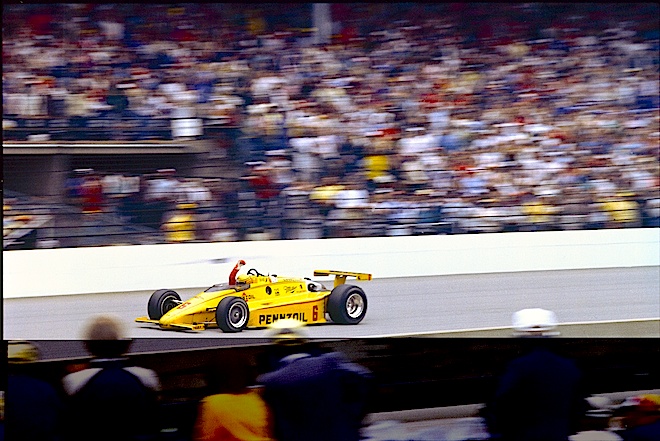
Just based on me as a driver, on what I liked to drive, IndyCars need less grip and more power. It puts it back into the driver’s control, where I can make a difference, control my own destiny by doing something different than the other guys. The more the car has to be driven, the more tools I have to work with. To me, we need to go more along that line. We’ve never tried to go big on downforce reduction; we always seem to go be going in the opposite direction because everyone’s worried that we’ll hurt the racing. Well, how do we know if we never try it? I didn’t know I could go flat through Turn 1 at Indy until I did it. If I hadn’t have tried it, I’d never have known.
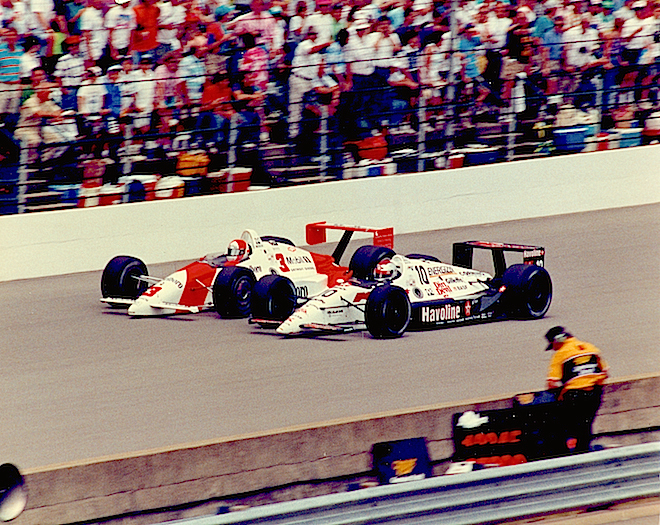
IndyCar 2018: Mario Andretti
IndyCar 2018: Diego Rodriguez
If you could drive a roadster around the Speedway – no wings, narrow tires, front engine – and hold a race, that suggests that it is possible to race there with minimal downforce. Tires that go off, like we’ve seen at Texas, Iowa and so on, they’re just a Band-aid for an aero problem. At the moment, on most ovals, there has to be a dramatic difference in speed for one car to pass another because, although this car creates a lot of tow, the car behind can get dragged up close, but the air is so disturbed that he can’t get to the car to actually make the maneuver. This is that constant dirty air problem. Geese know better than to fly directly behind one another; it doesn’t work. Planes don’t fly direct behind one another, and all an open-wheel car is an upturned plane wing, trying to get the opposite of lift. So don’t expect it to work going nose-to-tail in an Indy car.
The hard part is that there’s so much you have to do in response to stripping the car of downforce. All those years going in what I would say is the wrong direction downforce-wise – piling on more and more – forced other aspects of the car to change in response. The tires were built a certain way, spring rates changed, and so on. So now, the first time we try to take downforce off, the drivers hate it.
Well, there are a few factors going on there, because there are some drivers who never want to lose downforce, period. I’ve said it before but downforce is like your paycheck: once you have it at a certain level, you never want it to go down, you only want it to increase, and if you reduce it by 20 percent or whatever, you’ll tell me you’re going to starve to death. But if you’re made to lose that 20 percent, you’ll remember that, OK, yes, I was able to live on this amount once upon a time. Well, in the same way, a driver can reset his feel, get comfortable with the downforce at the new level.
One of the reasons we get so much pushback is that we never do a proper analysis of what a tire needs to go with a reduction in downforce. Drivers say it will feel like the car’s on its tip-toes, it’s on the track rather than in the track. Well, any time you’ve got a real stiff spring and the tires are stiff or have too much air pressure in them, that will be how it feels. So taking the downforce off will affect the vertical forces on the car, and also the lateral forces because you can’t go through the turn so quick, and all of a sudden you’re running this unstable car that feels like it’s skimming along on top of the track. So there would have to be other changes made.
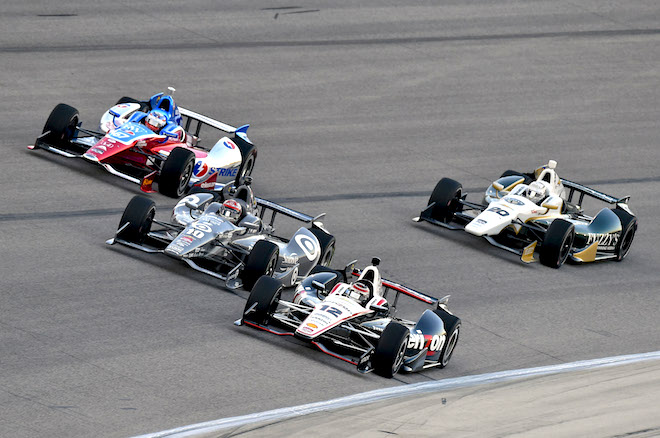
And having cars that are slower through the turns but faster on the straights, not only increases the challenge but also improves safety. If you’re going through the turns at a reduced speed, relatively speaking your walls are softer, your fences are stronger, your chassis is stronger, because you’re going to have an accident with a lot less force. You’ve effectively strengthened everything without touching it.
One of the key things, too, that some of the drivers don’t appreciate until they try it, is the huge improvement to drivability. With less lateral load, everything becomes more progressive. The grip isn’t all or nothing. Instead of the string breaking – sending the car into the wall – it stretches. Combine that with a tire that brings the feel back to the driver, that makes it even more progressive because now he or she is ahead of the car. For example, there was a NASCAR race this year – I forget which track it was – where all the teams and drivers were moaning about the lack of grip, really wailing on about how bad the tires were. Within a couple of laps, the cars were coming out of Turn 1 looking like they were dirt-tracking. Anyway, that race ended up with the fewest cautions than they’d seen for a long time, because the drivers could feel the breakaway point and they could catch it because it was progressive. Entertaining to watch, too!
Doing that for IndyCar is a gamble at this stage because it is a big move that would require somebody to get all the necessary pieces in place. Build a car for it, build tires for it, and get an open-minded driver to try it at a variety of tracks. Someone with no agenda.
Some of the fans who want endless side-by-side pack racing at Texas Motor Speedway, who want the cars stuck to the track, won’t be satisfied with the direction that I would take oval racing…but on the other hand, there’s some legitimacy to their complaints about the racing having suffered since this car came along and it’s because we’ve only nibbled at the problem. The wake affects the car behind so much that it can’t get up to the one ahead. I’m not an aerodynamicist, so I don’t know about how much downforce you’d need to take off the floor of the car and how much from the bodywork, to make a big step forward. But doing that, reducing the corner speed, will give you acceleration, whereas now the cars are flat from mid-corner; there’s little or no deceleration so there’s no acceleration, so all a driver is relying on is the tow, which is fine if he can get it done on the straight, but not if he can’t follow a car closely through the corner. It becomes stalemate.
Gearheads will always be fascinated by technology and they will always be the ones who want more innovation, looser rules to allow teams to develop their cars, get away from the single-chassis supplier, allow anyone to enter a car at Indy, and so on. But do the majority? I don’t think so. In the overall picture, I think greater technical freedom would help because it would give more for you guys to write about, it would give more for the teams to do, it would be more interesting for those already into the sport. But would it attract new fans? Probably not. Would it attract more manufacturers…? Maybe but entering IndyCar is still a big financial commitment, especially now that it goes beyond engine supply and into aero kit manufacture.
And so we’re now into a cost discussion and how it’s paid for, and if we open up the technical rules, we run into the “not fair” mentality among team owners. “My driver only brought X amount of sponsorship money, and that guy’s driver brought X+Y amount of sponsorship so that team owner can do more wind tunnel development, more shaker rig testing than I can and that’s not fair.”
So maybe the cars are going to remain spec – and if so, they should be difficult. Difficulty is the best tool a driver has, the best tool the series has. It needs to be utilized. If there are bumps in a braking zone on a street course, you don’t complain about it, you use it, because that can cause mistakes and that creates passing opportunities. The more you equalize the cars, make it easier for the drivers, the fewer opportunities you get for passing.
Removing downforce alone won’t solve the problem. Adding another 400hp alone won’t solve the problem, although I like that idea if you can impose a simple cable throttle once more. Unfortunately, the engines are so tunable now that you can have the power come in exactly where you want it – that’s why there are engine maps for dry conditions, wet conditions, etc. – like a mild version of traction control. Make power delivery depend entirely on the driver’s right foot.
Yes, if the cars suddenly had 1,000hp and lost half their downforce, of course there’d be a bigger degree of separation between the front of the grid and the back. Maybe the lap difference would be, let’s say four seconds on your typical road course, but only at first; it wouldn’t stay that way. As people learn, as people adapt, they will get better. The series needs more faith in its drivers; the drivers need more faith in themselves. We have raised the bar, the average, so much in the last 10 years that almost everyone out there has a lot of talent. Some switch it on and off more than others, but the talent is there. If you take a lot of downforce away, they will figure it out, but until they’re made to do it, they’ll never want to do it…
• RACER would like you to send your thoughts and ideas to Indycar2018@racer.com and we will compile them and send them on to IndyCar.

Latest News

Comments
Comments are disabled until you accept Social Networking Cookies. Update cookie preferences
If the dialog doesn't appear, ad-blockers are often the cause; try disabling yours or see our Social Features Support.