.jpg?environment=live)
TECH INSIGHT: AEM Infinity ECU in motorsport

Electronic fuel injection (EFI) improved tuning in many ways, but it was only the beginning. Variable valve timing, drive-by-wire, traction control, launch control... much of it is in the name of making cars safer and more efficient, often in response to government regulations. OEMs are putting more and more electronics into cars to make more power and get more miles with less fuel.
And every last bit of it goes through the cluster of processors that we refer to as the computer.
For those racing classes or series where they can't mess with the computer, it makes things easy – no changing jetting as the air starts getting heavy, no worrying about the air/fuel ratio until a sensor goes out. The next step, where it's allowed, is a reflash – a reprogramming of the computer that allows the engine to perform outside the OEM's narrow window of efficiency.
Maximum effect requires, where it's allowed, a whole new engine control unit. Obviously, this is a solution for pure racecars, where the computer doesn't have to take into account the climate control and audio systems or remember drivers' seat settings. But while standalone ECUs don't concern themselves with such mundane tasks, they can do so much more when it comes to making the racecar perform at absolute optimum level.
AEM Infinity ECU
system was tunable to my own personal driving style," says Andy Lee, driver of the GTS-class No. 20 Crown Seven/BestIT Chevrolet Camaro in SCCA Pro Racing's Pirelli World Challenge. "We can tune the motor for how I like the power to come on, and when I want the power to come on. It can make the car a little bit easier to drive in some conditions, especially if you're talking about rain or some kind of inclement weather."Pirelli World Challenge is one arena where stock ECUs can be swapped for standalone units. But even in PWC, there are some things the AEM Performance Electronics Infinity ECU can do which the teams can't take advantage of, such as launch control. There are some tricks, however, that the Infinity can perform that other systems couldn't.
Take a Ford Mustang with the Coyote engine, for example. Previously, a team using a standalone ECU in this price range would have to lock out the variable cam timing and swap the drive-by-wire for a cable throttle control. That's not necessary with the AEM Infinity.
While there are other systems that can control up to four variable cams and handle the drive-by-wire, along with all the other things already mentioned plus extras such as pit lane speed limiters, or handling various types of fuel and providing useful feedback, they can cost much more – as in, many times more. But a racer can get into an Infinity for as little as $1,500, and that speaks a lot about AEM's philosophy.
"You've got to understand who we are to understand why we're used in so many places," explains Lawson Mollica, director of Marketing and PR for AEM Performance Electronics. "Historically, everybody here at AEM is involved in racing at some level, whether they're supporting a team or they race themselves. We've got a lot of engineers who race. You'll find us in land speed racing, drag racing – our roots go back to drag racing; we had our own drag racing team in house for a while and our own drift team for a period. We were the quickest and fastest in our class.
"Where our philosophy in making products comes from is, we've always wanted to do one of two things when we make a product. One is innovate – come up with something to really help racers that nobody has ever really created. The second one is, if we're going to build something that's already out there, let's find a way to make it better and also make it less expensive. We like to say we take higher levels of technology and make them affordable for the racing masses."
The Infinity ECU family falls into the latter category. It's a huge step forward for the company, able to process more than 10 times as many instructions per second as the previous generation – in the order of 400 million – and uses airflow-based VE tuning, just as the OEMs and many in the upper levels of motorsports use.
"VE tuning allows you to characterize the airflow of your engine," says Mollica. "Once you've done that, it makes tuning much simpler. Whenever you make changes, you don't have to go in and modify correction factors. You just go in and change the parameters in the wizard. As long as you don't change the airflow, you can change a lot of things without having to remap your fuel.
"When you start to factor in its capability and stack it up against some of the systems out there that were considered, with good reason, the cream of the crop in standalone engine control, we stack up pretty well. Where we really shine is affordability. The beauty is that it's powerful enough for higher-end motorsports, but packaged in a way that club racers can afford it and have the same level of technology."
That perhaps why the system is found in so many places, from club racing to drag racing, Global RallyCross Lites, off-road racing and, of course, Pirelli World Challenge.
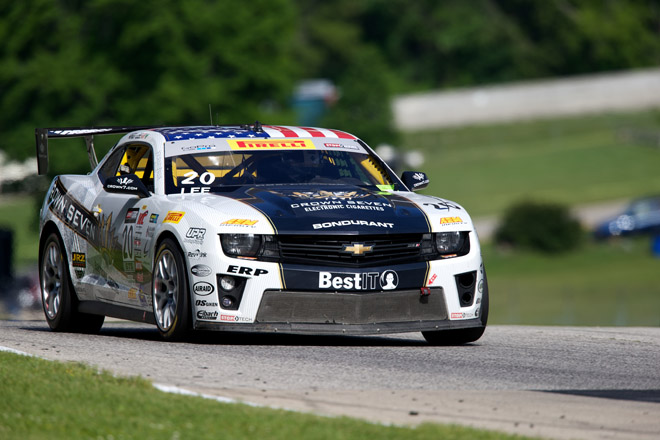
"A lot of people think they want the ECU to pull the most power out of the motor all the time," says Lee. "I think after you've raced with the Infinity, you realize there other advantages to it. Not only getting the peak horsepower and torque out of your motor, but being able to put the power down and use the tuning to actually do that.
"For example, at Sonoma we came into the pits in practice. Paul St. Clair from AEM was sitting there with his laptop. We were having trouble coming off the hairpin [Turn 7]. Our Chevy Camaro has a ton of torque, and this corner was very low speed, very tight, and we were getting a lot of wheelspin. So we adjusted the fuel mixture in pit lane to make it a little easier to drive off the corner. That gained us several tenths right there."
Lee didn't win that race last year, but finished fourth in the 2013 championship thanks in part to the win at CoTA. Not bad for a team only a couple of years old that began by building racecars out of race school cars at the Bob Bondurant School of High Performance Driving, where Lee is an instructor.
In 2014, Lee finished second in the PWC GTS-class season opener on the streets of St. Petersburg, and backed that up with podium finishes on the natural-terrain road courses at Road America and Sonoma. He ended the season 10th overall in the GTS standings, despite not competing in the GTS finale.
With PWC's mix of street and road courses supplying a variety of challenges, but with limited track time over the course of a race weekend to hone a car's setup, having an ECU as flexible as the AEM Infinity system is key to optimizing performance at each venue. Not only can it control every aspect of engine performance, but it's able to give plenty of feedback, and quickly, through data.
"You can plug the memory stick in the car while it's out on track," says Lee. "Then you walk over to the car, pull that stick out and plug in another one and boom, you're done. Other systems we've used can be a real pain to pull the data from. In racing, when you think it doesn't count, it counts. Every second matters. Any time you can shave time off of gathering data to use it and be able to analyze it, that's important."
That data is most useful to someone with a complete understanding of engine control and air/fuel mixtures. Since a racer will want that person to program the system in the first place – any programmable standalone engine management system isn't a tool for novices – that shouldn't be difficult. But once it's programmed and a racer has an understanding of the function, it may not be too long before they can make adjustments themselves.
Whether it's a team, an individual racer or an engine builder programming and making adjustments, though, the tool itself is extremely powerful. It's not the kind of system where a user will find him or herself thinking, "If only this thing would..." It's not called Infinity for nothing.

Find out more about AEM's programmable engine management systems at
aemelectronics.com
.
Latest News
Comments
Comments are disabled until you accept Social Networking Cookies. Update cookie preferences
If the dialog doesn't appear, ad-blockers are often the cause; try disabling yours or see our Social Features Support.