.jpg?environment=live)
PRUETT: Searching for IndyCar’s Unicorn Jesus
The Verizon IndyCar Series officially parted ways with race director Beaux Barfield
this week, and with Barfield's choice to move back to greener, happier pastures in sports car racing, IndyCar's most volatile job is back on the market.Barfield (LEFT) accepted the IndyCar job after leaving his post as race director at the American Le Mans Series, taking over for the beleaguered Brian Barnhart who was booted from race control by former IndyCar CEO Randy Bernard at the end of the 2011 season.
As an autonomous entity in IndyCar's tower, Barnhart embraced the role of Jesus Christ Race Director and had a penchant for ruling like Moe from the Three Stooges. Snap decisions were the norm, penalties were instant, and with little time being taken to hear alternate viewpoints, the eye pokes, slaps and punches came fast and steady under his watch. Although he had help in the tower, the buck started and stopped with Barnhart.
Ignoring the times when things went horribly wrong like at Loudon's oval race in the rain (maybe Curly took over for a few moments), drivers and team owners were often critical of Barnhart, but there was also an appreciation for his willingness to take immediate action. I won't pretend that Barnhart's all-eyes-on-me structuring of race control was popular for everyone in the paddock, and some of his foibles can be attributed to the lack of a balance of power, but there were definitely supporters on his trigger happy side.
With Barnhart's ouster from race control, Barfield was installed in a revised system where an increased level of input from multiple race stewards was used as a remedy for what went awry under the previous regime. Early on, Barfield ruffled more than a few feathers within the driver ranks with his flashy, outspoken ways, and took plenty of heat for shooting from the hip more often than some felt he should.
He was surrounded by an evolving team of stewards, yet established a good groove with the likes of Gary Barnard and a few others. By the season finale last weekend at Fontana, and after three years together, it's fair to say Barfield and his drivers had reached a mostly positive working relationship. Barfield still had his detractors – some firmly entrenched in the Beaux Must Go camp – and it makes me wonder if the poor bastard that fills his shoes will face the same kind of intense scrutiny.
Compared to Formula 1 or NASCAR where race directors and race control as a whole is rarely mentioned, IndyCar finds itself with a need to figure out how to lower the volume of the venom spewed at its Barharts and Barfields.
If IndyCar's race directors are no more (or less) inept than those in any other major series, yet seem to get thrown to the wolves at a much higher frequency, it makes me question whether IndyCar needs to restructure its race control org chart before the next Barfield is hired, or if it's more of a public relations issue than an operational problem. One thing is for sure: Changing race directors every couple of years isn't what IndyCar needs as it searches for stability and growth in the marketplace.
IndyCar's close-quarters action makes calling fouls a busy and thankless task. (LAT photo)
So if Jesus Christ Race Director isn't the right way of doing things, and the Party of 5 method stretches power across too many people, should the series revamp race control or leave it alone?
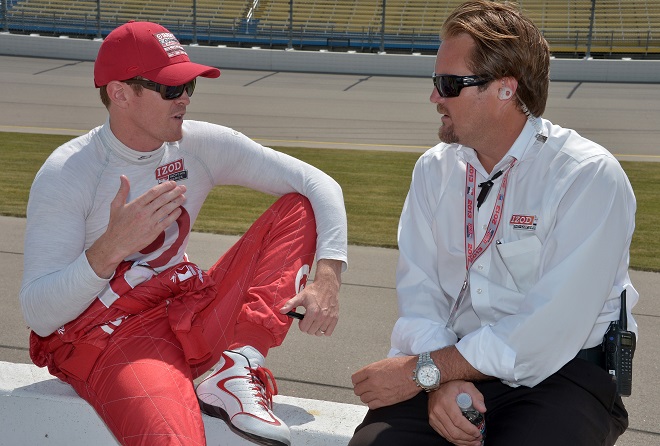
Three-time IndyCar Series champion Scott Dixon (with Barfield, ABOVE, LAT photo) says the current construct was working rather well and should be maintained.
"It sucks to see [Barfield] go because I think we had things working in a really good way," said the Target Chip Ganassi Racing driver. "A lot of people want to backseat drive; I'm as guilty of that as anyone, but things were running pretty smoothly. Especially this year, and it felt like they had their act together, for sure. And it's a thankless job, no matter how well you do.
"There might have been one or two calls; the [blocking] penalty against Marco [Andretti] at Houston was a bit suspect, but overall, I thought there were really no dramas with race control this year. You spend enough time getting to know somebody and they get to know you, which is what happened with Beaux and the drivers. Starting that over again won't be easy, but we'll get through it."
2012 IndyCar Series champion Ryan Hunter-Reay echoed Dixie's sentiments and added some thoughts on what he'd like to see in the new race director.
"I think lately is has been drama free and working well," said Andretti Autosport's Indy 500 winner. "Overall, the thing they need to work on is consistency; I wouldn't say it isn't so much how things are run [that is the problem]. On whatever side it is, we need consistency. We can't have new rules coming out of nowhere or controversial decisions that could go either way and end up affecting the outcome of a race. You just want a firm line in the sand on things, and I'd say things we're going the right way lately."
Like Dixie, RHR isn't looking forward to starting a new relationship from scratch when the next race director is identified, and he'll press the need for consistency once he or she appears.
"I think you always work toward gaining the trust and respect of the drivers, and the same for us with them, so losing Beaux – and I thank him for the work he's done – is a setback, but most drivers have gone through this process before," he continued. "Do I think they need to change things up in how they run race control? Not really, but I do want to see the same calls made one weekend get made the next. That's my biggest thing. If we have that, we'll be OK."
Schmidt Peterson Motorsports driver Simon Pagenaud thinks IndyCar's race director is placed in the spotlight more often than is needed, which adds to the PR problems that emerge.
"We know who [F1's] Charlie Whiting is, but you rarely see him interviewed on TV or available to the media, and I don't even know who NASCAR's race director is, so maybe that says something," the Frenchman suggests. "These guys have important jobs, but I'm not sure they should be jobs that are very public. I think it's OK for there to be separation between the guys in race control and the outside world."
If three of IndyCar's most successful and outspoken drivers are confident the series' race control structure is sound, the next question is the biggest one to answer: Who's the best candidate for the job?
Barfield was surrounded by a good supporting cast, but it's hard to identify a new colonel among his lieutenants. Frankly, some are perfectly positioned as lieutenants, and for the others who might want the promotion, I'm not sure they're hardened enough to withstand the cuts and bruises.
The one person who comes to mind for the role also comes out of left field, and that's former championship-winning Indy car chief mechanic-turned-sports car team manager-turned Pirelli World Challenge race director Geoff Carter (LEFT).
A 25-year veteran of the sport, Carter worked for Chip Ganassi during his dominant years in CART, worked for Player's Forsythe Racing afterward, worked for IndyCar President of Competition Derrick Walker at Walker Racing, and spent four years managing Greg Pickett's Muscle Milk ALMS team before joining PWC as its race director in 2012.
If you're looking for a well-rounded, sturdy professional who's seen the sport from all sides, Carter is a compelling figure to consider. He's called the shots from inside the tower during PWC's big resurgence, has dealt with the Chevy and Honda factories with their PWC efforts, and has earned a stellar reputation for his even-handed officiating style from drivers and owners in the series.
I'm sure there are others that will come to the fore, but I like the idea of a longtime open-wheel man returning to Indy car racing where he knows most of the players, many of the drivers, understands what it's like to be on the wrong end of a bad call, and has presided over a diverse series where incredibly close racing breeds contact and flared emotions. I want the guy who's dealt with enough chaos to be cool under fire when drivers ignore his instructions and start getting rough.
Give me a battle-tested guy who wants the job, and I'm sure Carter would be interested if asked, and IndyCar could have its answer by looking outside the pool of familiar names.
Granted, even Carter could be pushed out of his comfort zone with one wrong call in Barfield's old position. IndyCar fan Ross Bynum dropped a gem on my Facebook page today which could be the best description I've read of what might await the next IndyCar race director.
"You could put Jesus in that role and within 2 races they'll be armchair fans calling for his head, teams quiet because they got a good call, others pissed because they got a bad one," he wrote. "You find someone who would take that job and do it any better, [and] you've found a unicorn."
Hopefully Carter – my Unicorn Jesus – or someone with equally impressive credentials takes the plunge.

Latest News
Comments
Comments are disabled until you accept Social Networking Cookies. Update cookie preferences
If the dialog doesn't appear, ad-blockers are often the cause; try disabling yours or see our Social Features Support.