.jpg?environment=live)
YOUR favorite racecars – 3. Lotus 38
Back in January, we ran a story about favorite racecars and asked RACER.com readers to select their top five. Your votes flooded in and, in the end, we had more than 400 different racecars to consider… but 10 clear favorites emerged.
Many of you had found it tricky to narrow your favorites down to just five, yet some of you had a clear No. 1 and no others. And, like ours, many of your selections were ones that fulfilled multiple criteria from a personal point of view – aesthetic beauty, period when you were first becoming addicted to racing, success, livery, piloted by your heroes. We understand, completely!
Your favorite racecars #10: Porsche 956/962
Your favorite racecars #9: Chaparral 2K
Your favorite racecars #8: Lotus 49
Your favorite racecars #7: Lola T70
Your favorite racecars #6: Ford GT40
Your favorite racecars #5: Porsche 917K
Your favorite racecars #4: Ferrari 330 P3/P4
3. Lotus 38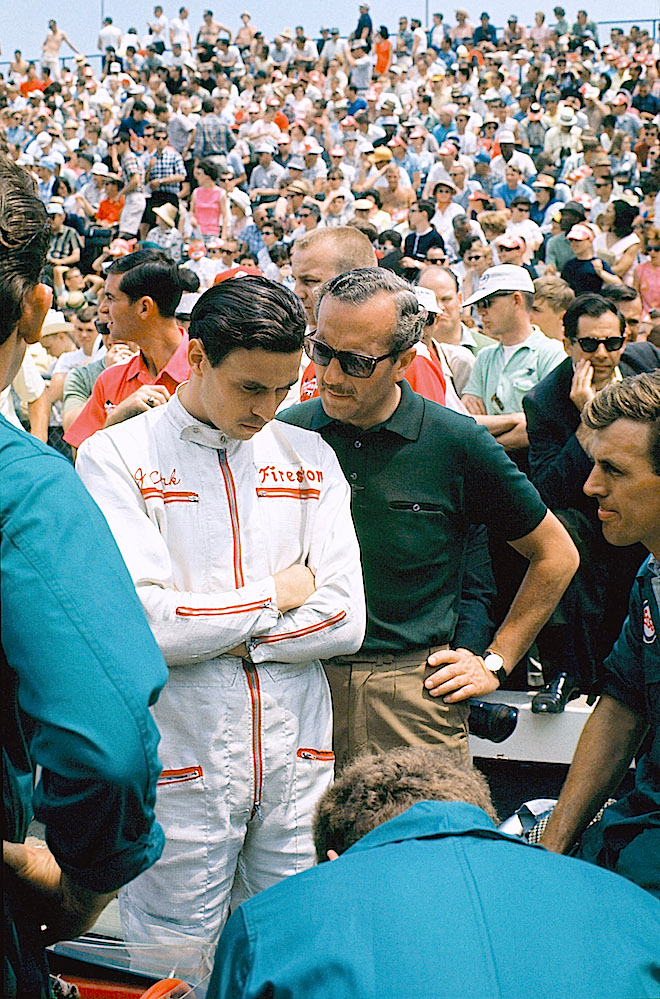
The Lotus 29 had confirmed the concept of a rear-/mid-engined car at Indianapolis Motor Speedway. The 34 had shown what not to do – namely swapping from Firestone to Dunlop without adequate testing. And then the 38 sealed the deal – a win in the greatest race of all. Now, almost 50 years on, RACER/RACER.com readers have voted Colin Chapman’s third Indy car at No. 3 in their all-time list of Favorite Racecars.
How the wheel turns! Lotus was not exactly pilloried for the way its 1963 Lotus 29 kept up with the far more powerful roadsters of the day at the Indianapolis 500, but certainly Colin Chapman’s gang wasn’t made welcome that first year. It just seemed too easy, too foreign and too untraditional at a venue with over a half a century of brick-built tradition.
Jack Brabham’s performance in 1961 had first shown the potential of the mid/rear-engined concept at the Brickyard. Despite his 171 cu. in. (2.8-liter) Climax-engined Cooper T54 being burdened with a 200hp deficit, and being 8-10mph down on terminal speed at the end of the two straights compared with the roadsters, it was that same amount quicker through the turns. As a result, “Black Jack” qualified 13th and finished ninth – pretty impressive for an underpowered, modified F1 car.
So after Dan Gurney had urged Chapman (RIGHT, with Clark in ’65) to visit the “500” in ’62, “Chunky” did the obvious math. If he brought a highly modified and strengthened Lotus 25-type chassis to carry on smoking the roadsters through the turns but used a more powerful engine to get closer to matching the big boys’ straightline performance, suddenly racing’s biggest payout could be heading back across the Atlantic. A couple months later, Gurney and Chapman headed to Dearborn, Mich., and convinced Ford to build a very heavily modified version of the Fairlane’s 256 cu.in. (4.2-liter) motor.
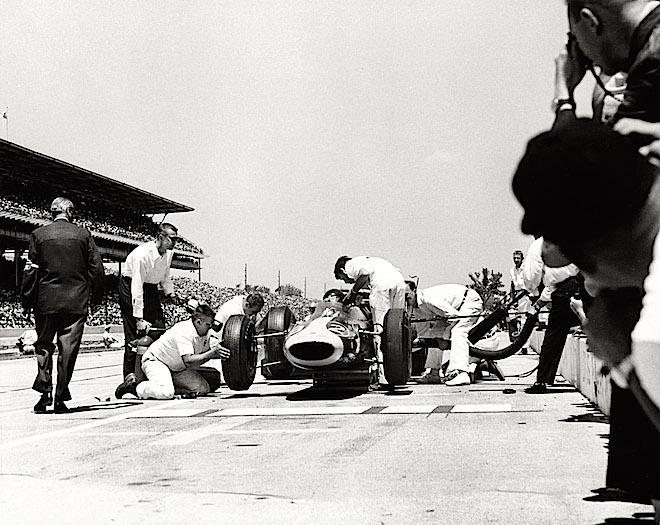
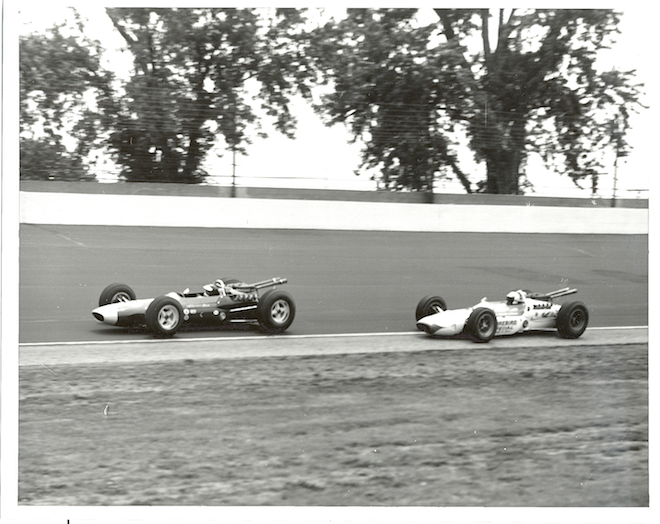
However, the inherent rightness of the Lotus 34 was proven by Parnelli, as he used a Lotus to dominate at Milwaukee and Trenton. The following year, A.J. Foyt, who’d scored the last Indy win for the roadsters a year earlier, used a 34 to beat Clark to pole for the “500.” In fact, five of the top seven places on the grid for the 1965 Indy 500 were from Lotus. But it was Jimmy’s new 38 that dominated.
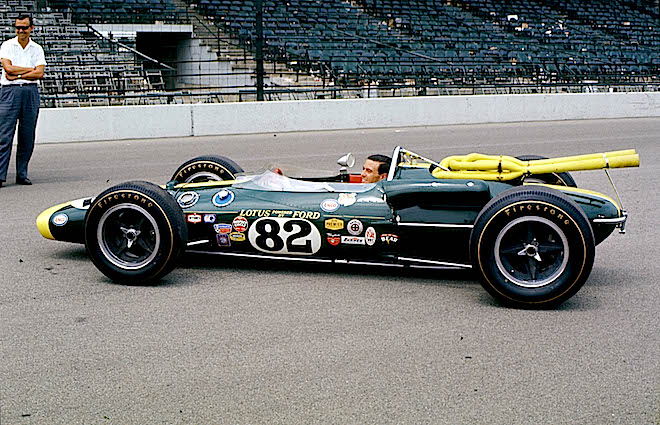
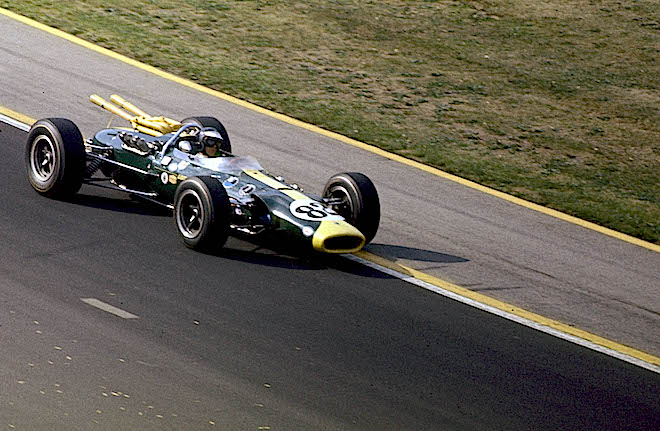
Designer Len Terry, who’d just finished helping Colin Chapman evolve the 1963 F1 World Championship-winning Lotus 25 into the 33, had been assigned the task of designing the 38, and what emerged was a sleeker-looking car than its two predecessors. Its nose was longer and its air intake narrower because, unlike in the 29 and the 34, the Ford engine in the 38 would be running methanol, which runs cooler, allowing for a smaller radiator.
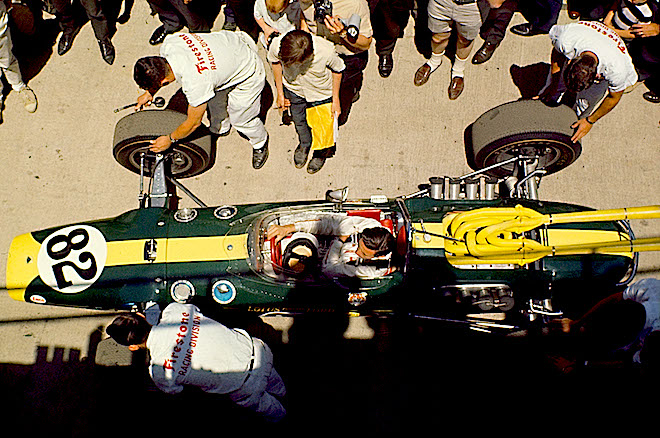
The stars had aligned perfectly for ’65, then. Aside from a brief moment of resistance from Foyt at the start, and a distant challenge by Jones, Clark won as he pleased, leading 190 of the 200 laps and setting a new record average speed of 150.686mph to become the first non-American to win the race since 1916.
These many years on, we'll never know for certain. Maybe it's immaterial, though: Lloyd Ruby was clearly the quickest at Indy in ’66, driving an Eagle designed by…Len Terry. An oil leak robbed him of justice.
In ’67, Team Lotus was back, again with the 38s, but a dropped piston caused Clark to DNF.
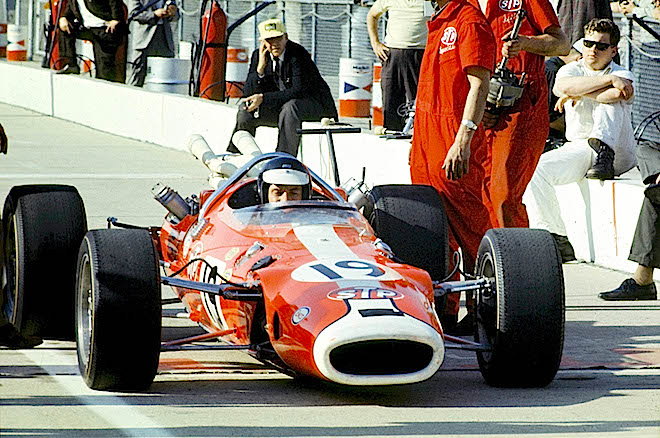
Regardless, the Lotus 38 has passed into immortality now and your votes (along with the comments below) reflect that. Even aside from its provenance, its visual appeal can’t be faulted. In the early to mid 1960s, Formula 1 cars were pretty but spindly, with anemic 1.5-liter/200hp engines. The 38 had a 4.2-liter V8 with more than twice the power, and its necessarily more substantial chassis gave it a far more aggressive stance than its European contemporaries, yet it was still clothed in a Lotus-typical sleek body that perfectly suited the glorious British Racing Green-and-yellow color scheme. And while the idea of yellow exhausts sounds garish, they actually enhanced a car whose livery was relatively simple compared with the roadsters it was up against, covered as they were by sponsor names, logos and the names of the principal players on the team. (And this author thinks Andy Granatelli's STP Orange livery with white exhausts suits the 38 just fine, too.)
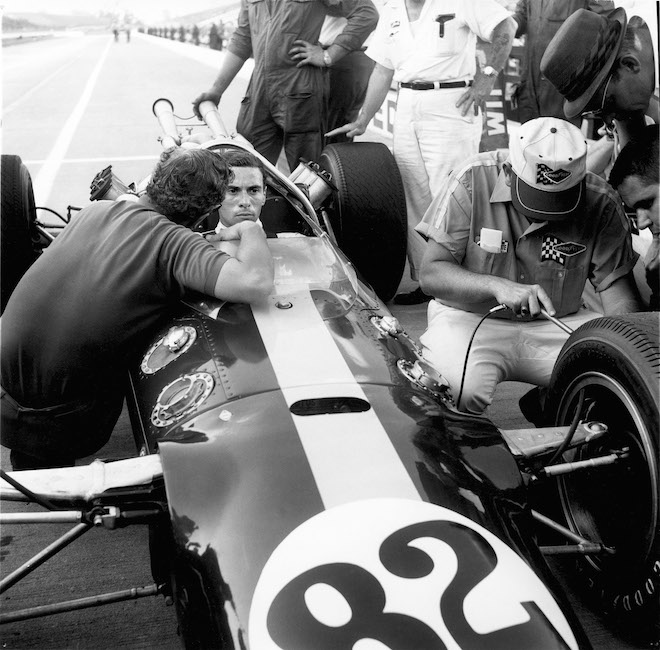
For many of us, the early rear-engined Indy car era is still one of the most fascinating times and places in motorsports history, and leading the pack of game changers is the Lotus 38.
Some of your comments…
Dennis Wingfield: “This is the best looking racecar ever, hands down!”
Lindsay Fraser: “Interesting to see the frequency with which the 49 is mentioned but I feel that may be more associated with its significance from a technical advancement perspective and less from its looks. The lines on the 38, with the exhaust system dominating the flow of the shape, would make it stick out even if it never won anything!”
Brian Henris: “Maybe it's because this car and Jim Clark attracted me as a small child to auto racing, but it still looks fast.”
Jerry Sudduth: “The first rear-engine car to win Indy had both the form and function you'd expect from a Lotus, especially in a British Racing Green and yellow livery.”
John G. Hill: “There is a fondness in my heart for Dan Gurney's F1 Eagle, but for me the car that really took my breath away, and made America pay attention to the new changing of the guard, the Jim Clark Indy Lotus 38, with that magnificent green and yellow paint combination. Who ever thought of yellow painted headers and exhaust?”
Royal Richardson: “Visually stunning, perfectly painted and very effective. As a kid, A.J. Foyt was the driver in our household; then Jimmy came along and stole my breath away. I still love this car…”
John Fulton: “Perfect by the standards of that era. It's as if Len Terry was saying, ‘Top this, if you can’”
Tom Jensen: “The Lotus 38 that Jim Clark drove to victory in the 1965 Indianapolis 500 was so beautiful and so right that it needs no words to enhance. The perfect car and the perfect driver at the perfect moment in history.”

Latest News

Comments
Comments are disabled until you accept Social Networking Cookies. Update cookie preferences
If the dialog doesn't appear, ad-blockers are often the cause; try disabling yours or see our Social Features Support.