.jpg?environment=live)
YOUR favorite racecars – 9. Chaparral 2K
favorite racecars
and asked RACER.com readers to select their top five. Your votes flooded in and, in the end, we had more than 400 different racecars to consider… but 10 clear favorites emerged.Many of you had found it tricky to narrow your favorites down to just five, yet some of you had a clear No. 1 and no others. And, like ours, many of your selections were ones that fulfilled multiple criteria from a personal point of view – aesthetic beauty, period when you were first becoming addicted to racing, success, livery, piloted by your heroes. We understand, completely!
YOUR favorite racecars – 10. Porsche 956/962
9. Chaparral 2K
It’s arguably the most fondly remembered Indy car since Parnelli Jones’ Ol’ Calhoun, but whereas the driver elevated the performance of Agajanian’s gorgeous roadster above its peers, the “Yellow Submarine” was a technical marvel that, with its ground-effect venturi tunnels, redefined the limit and encouraged its driver to push further and harder than he’d ever been pushed before.
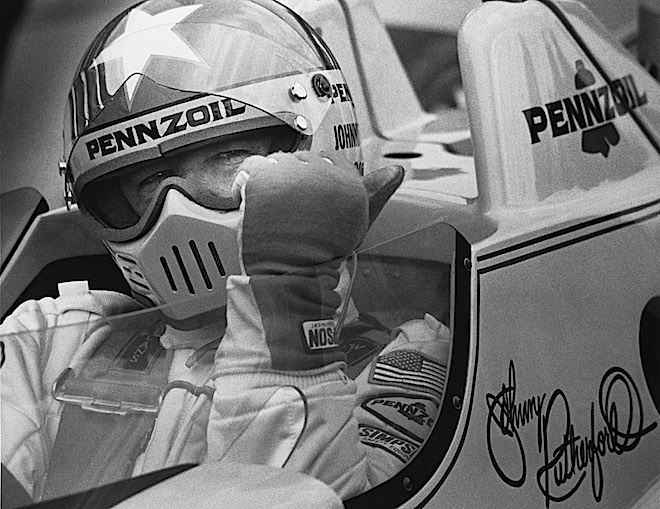
Johnny Rutherford, the man who used it to score his third Indy 500 triumph and win the IndyCar championship in 1980, said: “At Indy that year, we had quickest time on every day but one. What I had driven there before, the McLaren M16 and M24, they only let you go so far. The Chaparral let you go so much farther, it really put you into a nervous situation. The edge of the universe was a lot shallower in the 2K than the M24…”
And John Barnard’s masterpiece was already a year old at that stage. Everyone had seen its potential at Indy the year before, when Al Unser (RIGHT, IMS photo) qualified third on the car’s debut and then dominated the first half of the race. Chaparral’s renowned founder, Jim Hall, recalled in amazement the opening lap of the race: “When they came down to take the green flag, everyone backed off for Turn 1 except Al. It was the most amazing thing you ever saw. He stretched 100 yards in the first turn, 100 yards in the second…By the time he came past us at the end of Lap 1, he had a lead of about 400 yards. But then…”
A melted transmission seal allowed all the gearbox oil to drain away by half-distance, and throughout the remainder of the season, minor issues haunted the team, preventing them from displaying the car’s true potential. But at Phoenix, the season finale, Unser was finally able to run trouble-free the entire distance and nailed the car’s first victory. His departure, along with Barnard and Hughie Absalom (chief mechanic), left the keys to the best Indy car to Johnny Rutherford and he brought with him Steve Roby, chief engineer at McLaren. Both had found themselves left high and dry when the English marque withdrew from Indy car racing to focus on Formula 1. Now they were back together but with plenty of work to get done.
At this point, let me hand the story over to Mr. Roby himself who voted for the Chaparral 2K in its 1981 form, pointing out that, “The 1980 car had lots of bodywork joins and parts which we did away with in the 1981 version.” The evolution of the car from the end of 1979 is perhaps more significant than many of us appreciated at the time.
TOP The 1981 iteration of the Chaparral 2K is the favorite of our guest writer, Steve Roby, who was Johnny Rutherford's engineer. LAT photo. MIDDLE Al Unser qualified third on the 2K's debut at Indy in ’79, and dominated the first half of the "500." IMS photo. BELOW The 2K's legend started with these guys – designer John Barnard, Chaparral founder Jim Hall, and Al Unser. LAT photo
“For the last race I designed and made a development rear underbody which was worth nearly a second a lap in private testing. JR could feel how good it was as he did a warm up lap at Phoenix and came back in as he needed padding to keep his left knee off his right knee! Then he went out and drove it flat through Turn 3 at Phoenix for his first time ever. I did not want to run it for the race and show our competitors what we had for the following year but lost that argument so we painted the underbody yellow and ran it. That was the race where we qualified second with a blowing up engine and dominated the race but unfortunately Johnny tripped over a slower car and went upside down. He had some head injuries and wore the tip off his little finger and missed the championship banquet, but I was most upset over the world seeing our new underbody on TV!
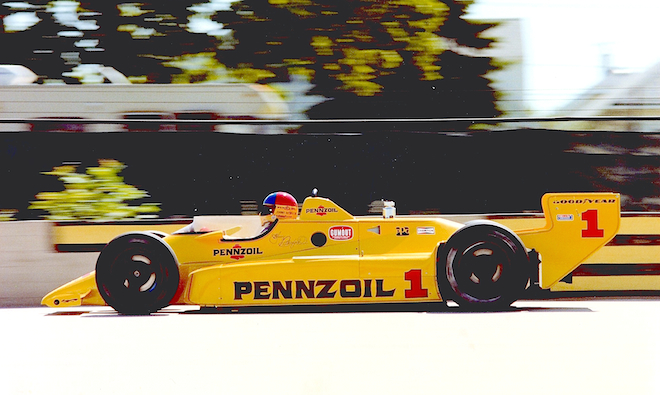
“For 1981, the upper body split lines were changed and the sidepods were a little different. If I remember correctly, articulating skirts were banned so we made the bodywork go down to just above our polyurethane skirts and did away with the parts on which the articulating skirts operated and this gave Pennzoil more space for their name. With the loss of the articulating skirts, the center of pressure moved to the rear so I made longer sidepod nose pieces (which you can see in the photo taken at Milwaukee, LEFT) to try to get the center of pressure more forward. We also found that the wake off the front wings influenced the flow into the tunnels so any reduction in front wing frontal area resulted in more total downforce. Later in the year we managed to achieve a good balance with good total downforce with a set of much smaller cord wings.
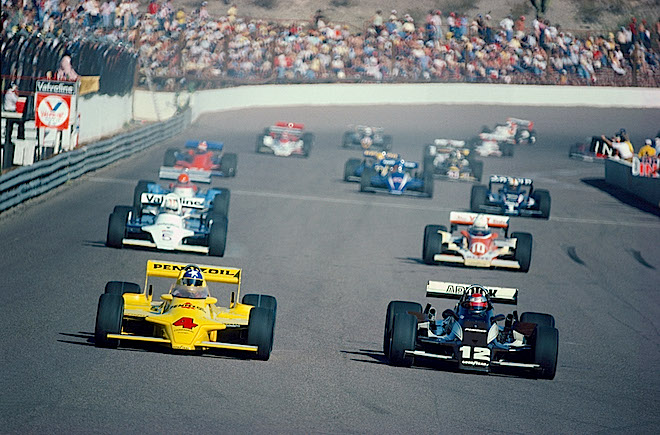
TOP Johnny Rutherford qualified second, alongside Mario Andretti's Penske PC9 in the 1980 season finale at Phoenix. Unfortunately, this was the race where the Chaparral's secrets would be revealed…. LAT photo. ABOVE RIGHT The 2K helped deliver Rutherford his only IndyCar championship. LAT photo. BELOW By Indy 1981, the opposition were catching up, but Rutherford still finished the season fifth in the championship. Photo courtesy of Steve Roby
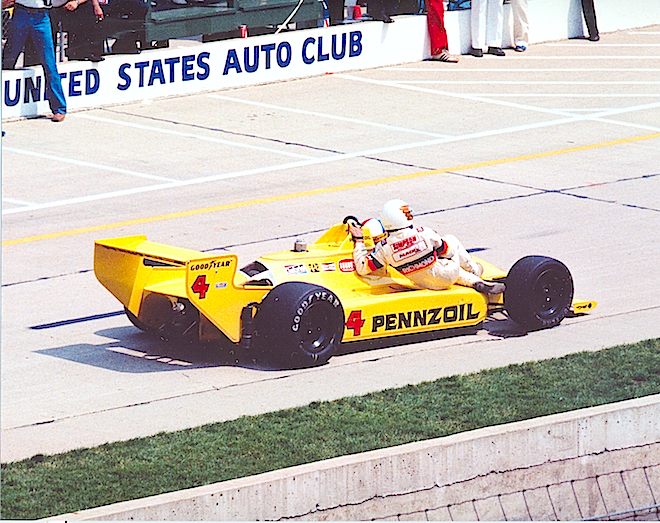
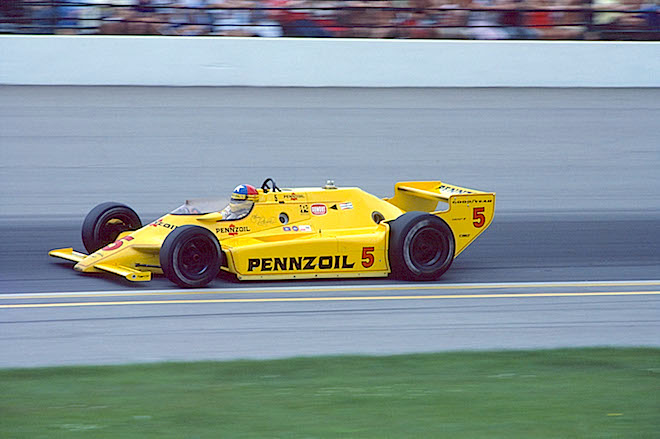
“Contrary to the standard of the day the car and pinstripes were hand-painted, not decals. This small detail caused me much anguish as our sign painter in Midland was a biker and a little tardy to say the least. We had to send out search parties to find him and drag him out of a bar in order for the car to go in the truck and we never left him alone while he was working. He did tell us that a few drops of alcohol served to keep his hand steady while doing the pin striping!
“During early testing of the car we found that the silver spun aluminum wheels were not up to the task so we had Max Boxtrom cast us some three-spoke black magnesium wheels. The Pennzoil folk wanted us to polish the wheels but I wanted the guys to be able to concentrate on the car itself, not polishing wheels, and I thought the black wheels transformed the look of the car from pretty to forceful so I made a bet with them that if we won Ontario the wheels could stay black. We won and the wheels stayed black.”
Some of your comments –
Preston Proctor: “The Yellow Submarine was not perhaps the prettiest car but was a dominating functional design.”
John Fulton: “This car was like the girl that walked into the room and made you realize all the girls you thought were beautiful were just average.”
Karin Nelson: “All of Jim Hall's cars were awesome and unique, but this one ran and won as good as it looked.”
Paul Lewis: “One of the most aesthetically pleasing cars of all time.”
Steve Ross: “Growing up in Indianapolis in the 1970s and 1980s, a lot of cars jump out at me as being beautiful but this is my all-time favorite. Not only was Lonestar J.R. my favorite driver in my youth but that car, with its wonderful yellow paint job and turn-terrorizing low profile, captured my imagination. At the time, I took my bicycle, painted it yellow and affixed cardboard signs with the No. 4 on its handlebars and between the frame bars, and rode up and down the street dreaming of Indy glory. Simply one of the best.”
TOP 1980 Indy 500, and Rookie of the Year Tim Richmond hitches a ride on the winning 2K's wide sidepod after his car stopped on the slow-down lap. IMS photo. MIDDLE By 1982, the Chaparral was bulky and not especially quick. The team switched to a March 82 chassis after five races. LAT photo. BELOW First pole for the Chaparral 2K came on a road course, Unser starting first at Watkins Glen in ’79. LAT photo

Latest News
Comments
Comments are disabled until you accept Social Networking Cookies. Update cookie preferences
If the dialog doesn't appear, ad-blockers are often the cause; try disabling yours or see our Social Features Support.