Joe Portlock/Getty Images
E1: Boat racing’s bolt from the blue
We’ve seen a lot of electrified motorsport series in recent years. Open-wheel racing of course has Formula E, while the likes of touring car racing, rallycross, and rallying have dabbled too. Even bike racing has had a crack at it.
But motorsport is a broad spectrum. There’s a lot of ground still to be trodden. You’d think it’d be predictable too – there are countless four- and two-wheel championships that could go in an electrified direction. E1, however, has taken none of those somewhat predictable routes.
It’s boat racing. Born from the mind of Alejandro Agag, the same visionary behind Formula E, Extreme E and Extreme H, E1 is racing in the wet, that doesn’t require specific tires or jet driers.
I say it’s a less obvious avenue to take, but for E1 Series CEO Jamie Copas, it’s an “incredibly relevant” idea.
“If you go back in our history, the family that we’re part of, Alejandro Agag, who founded E1 also founded Formula E. He also founded Extreme E, which is now Extreme H. It was an inevitable next step to go on to water,” Copas told media that included RACER at last weekend’s E1 Series season three finale in Miami last week.
“And if you look at what’s happened with electric mobility on land in the last decades, many people drive electric cars now, and a lot of that technological development has been through what’s happened in Formula E. If you look at that now on water, why aren’t we talking more about sustainable fuels on water?
“If we can make a difference, as much of a difference on water as we do on land for everyone… we’re only going to make a small difference, it takes a world of movement to make a change, but the more we can do, the more we can show the technological developments, we can show the excitement, we can show the innovation. We’re already making steps in that, but the more we can do it, the more people understand, and the more we’ll get electric powered marine mobility.”
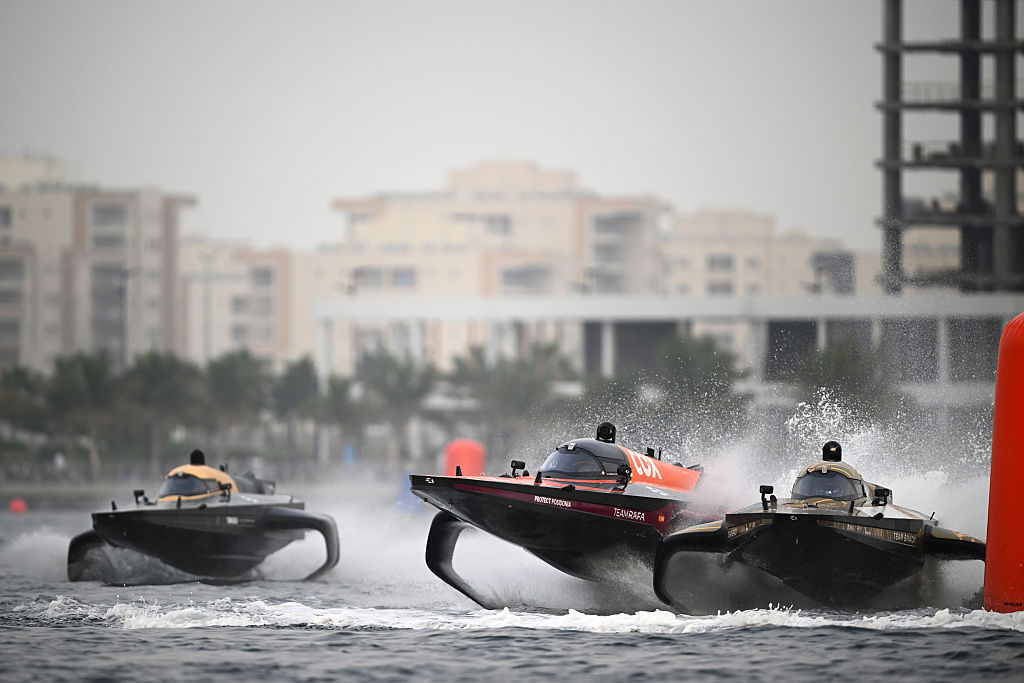
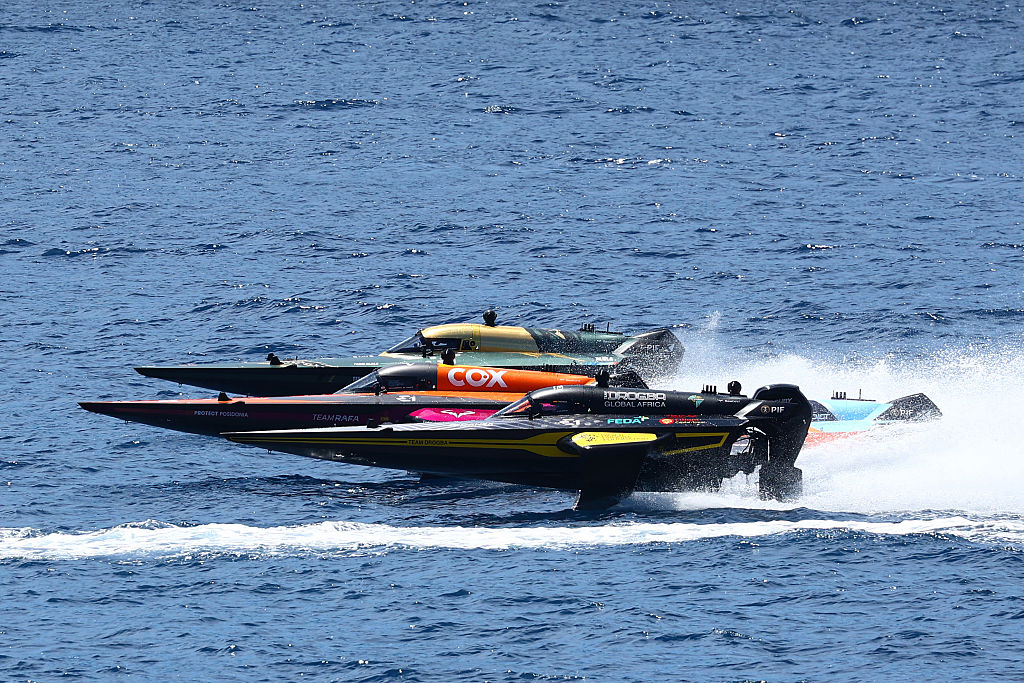
The spec RaceBirds produce some intense battles. Clive Mason/Getty Images
Helping carry that message is the race vehicle. The purpose-built Racebird is an all carbon fiber hydrofoil with a top speed of 50 knots (around 57 mph) and a power output of 150kW (200 hp). Every one of the 10 teams has equal equipment, much like in the first season of Formula E and all seasons of Extreme E. But as Copas mentioned, the opening of areas for development in Formula E has accelerated innovation, so could E1 follow its land-based sibling’s lead?
“It’s not an immediate plan,” Copas says. “We love the fact that we’re a stock championship, and it works really well. It means that we can move as a championship. We can develop the technology across the fleet if we put it open to all of the teams; for a start, it means their costs go up.
“We don’t want to rush anything. I see it being a stock championship for the foreseeable future, but of course it’s something we’ll look at and maybe one day we’ll welcome it.”
Each event features a two-day format with the first day devoted to practice and qualifying, the second being group stage races, then a knock-out competition culminating in a final and a “place race” for those that don’t advance. Teams comprise a male and female “pilot,” with them alternating time behind the wheel across the sessions.
This season featured seven rounds across six locations, with Miami hosting the series’ first doubleheader. Wednesday was qualifying for Friday, and Thursday qualifying for Saturday. Doubleheaders for every round was a direction sister series Extreme E took from its third season. Now at the same age, E1 introduced its first, but Copas doesn’t see every event turning into one and effectively doubling the calendar.
“We’d consider growing the calendar, but definitely not doubling it because it does put a lot of demands on the teams, on the pilots,” Copas says. “You’re right, it does reduce our cost per race, but you still have to take the venue for longer. Sometimes it’s actually harder to get the venue for longer, because we go to places that are very busy at times.”
For example, the racing in Miami had to be done by 3pm local time each day to allow cruise ships to enter and maneuver around the port. Not something that’s encountered at Indianapolis…
The steady, sustained development of E1 could be a result of experience from Agag’s other series. Formula E has steadily grown over more than a decade by not running before it can walk, while Extreme E also didn’t stray beyond its means before it took the bold decision to press the reset button and pivot to a hydrogen competition.
“If we spotted mistakes that they did, we would never copy that,” Copas says. “But also, we’re very lucky. Alejandro Agag has been in the sports business for decades. He’s owned football teams, he’s worked in Formula 1, he launched Formula E, so we’ve got lots of learnings from his experience, but also all of the team members that we have.
“We have a small team, but we have a very strong team and they come with great experience. And then you’ve got the team owners and the team principals. We work very closely with the teams themselves as we’re making decisions for it to be in their best interest, but also they come together, they meet and they talk about the future of E1. It’s very collaborative and we bring the lessons that we’ve all learned through the experiences we’ve had.”
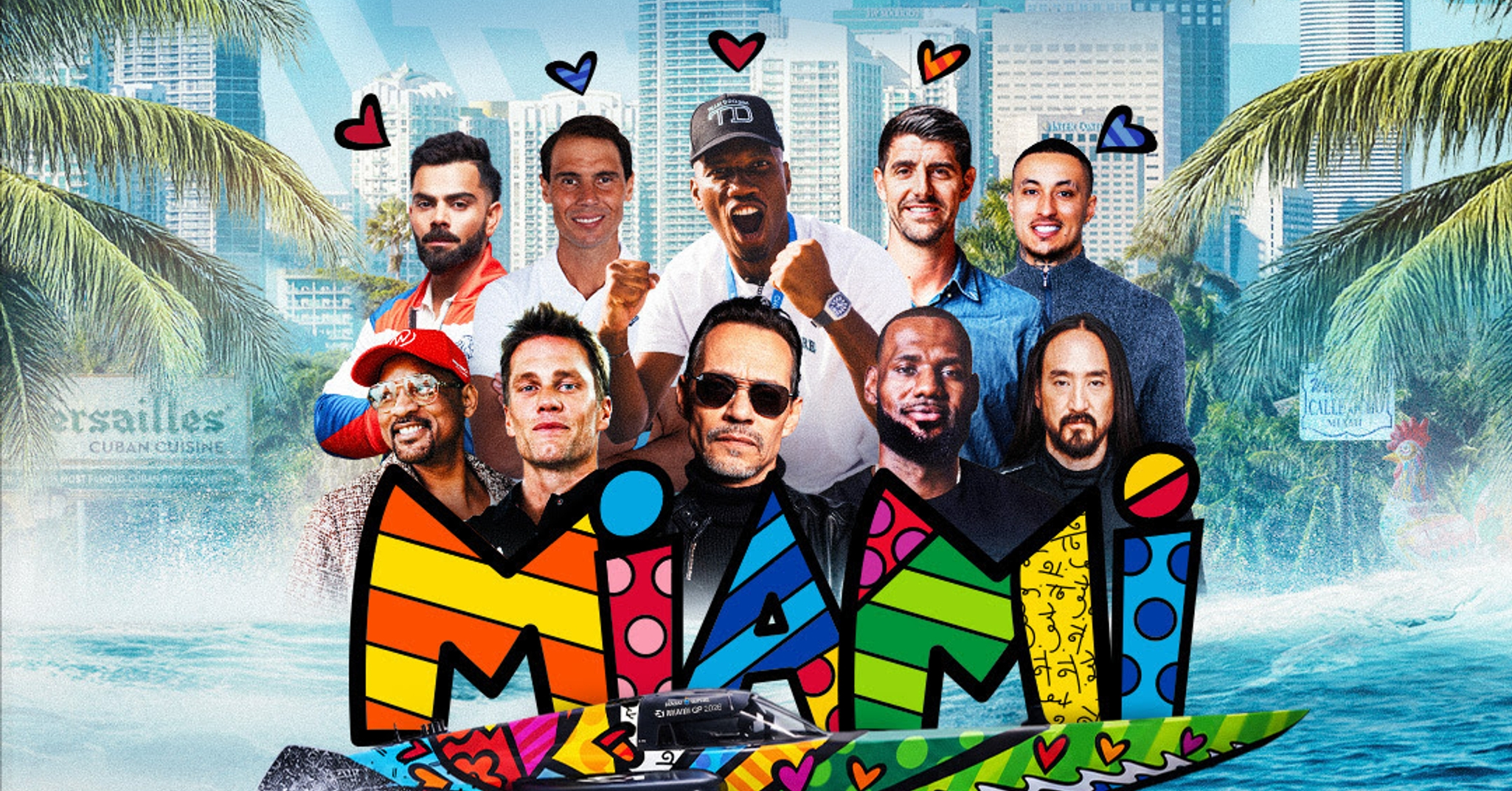
Celebrity owners, exotic locations pump up the glamour factor for E1.
As Copas alluded to, there’s also the team owners. Each has a celebrity backer from a wide range of backgrounds, among which are musicians Steve Aoki and Marc Anthony, actor Will Smith, soccer players Thibault Courtois and Didier Drogba, tennis legend Rafael Nadal, NBA superstar Lebron James, and NFL icon Tom Brady. But they’re not just mere figureheads throwing money away in rich guys’ playgrounds. They really are involved.
“Tom is absolutely insanely involved. He’s supporting us, he’s pushing us,” says Team Brady’s Emma Kimiläinen, who along with teammate Sam Coleman wrapped up a third straight title for the seven-time Super Bowl winner’s team on Saturday. “He loves data, he loves strategy, he loves absolutely everything about the sport. He wants us to find our best performance everywhere we can, and he’s pushing us as well as cheering us.”
Aoki, backer of the eponymous Team Aoki, added that while he’s put together a team of people that know the sport well, he also keeps involved throughout.
“I can’t speak for other teams, but the kind of conversations that I’m having in our multiple chats – because I’m on different chats for different reasons – they’re running the show and I’m trusting that, but they’re definitely keeping me informed of any updates, any developments, any internal strategy,” he says.
Right now there are 10 teams, with Copas saying that they will expand to 12. But whoever comes in – and it doesn’t necessarily need to be a singular celebrity; Team Monaco competes, while Real Madrid footballer Courtois runs his team in partnership with Milwaukee Bucks power forward Kyle Kuzma – they’re onboard with the series’ message.
“We talk to many people but the reason we work in the way we do, and the reason that we have the team owners that we have is they’re all very enthusiastic, they’re all very competitive, they all love being part of it,” he says. “So when we meet people, we want to make sure that they join for the right reasons, but also they bring great awareness, they help us with our storytelling.
“Our 10 celebrities at the moment have got over a billion followers. Now we need to activate them more. We need to grow that momentum so we can tell our stories much better. The racing is the spectacle and the excitement, but it’s everything around that that we want people to really understand. And by gaining the momentum off the back of the celebrities, it helps us to tell our stories more.
“So there’s a benefit on both side. Obviously, we’re careful with the people we work with because it’s a partnership where we want to succeed for ourselves and for them, and for the greater good of sustainability.”
The celebrity glamor is therefore a huge selling point of the championship, and its emphasized not just by the names involved, but the locations the series visits as well.
Timmy Hansen, who has raced in all corners of the world from the middle of the Saudi and Atacama deserts to bare-bones rallycross tracks in central Europe and almost everywhere else in-between, remarked that “this is so glamorous. It’s way out of my league here.
“I’m used to being dusty and rallycross and sliding and everything,” he says. “E1’s an incredible setup with Ocean Club and the VIP and we’re in beautiful locations like here; it’s quite cool.“
Race locations this year included Jeddah in Saudi Arabia, Lake Como in Italy, Dubrovnik in Croatia, Monaco, Luanda in Angola, and Miami. It previously visited Puerto Banús in Spain, Doha in Qatar, Lake Maggiore and Venice in Italy, and Lagos in Nigeria. Copas says there’s a high level of interest for additional events, too.
“We get an awful lot of requests to take the race around the world, and it starts with some very simple principles: is the body of water long enough, wide enough, deep enough and calm enough? It has to be somewhere that’s safe for our pilots and for our Racebirds,” he explains. “It has to be beautiful – we race in beautiful locations. We don’t want to go somewhere that isn’t aspirational, that isn’t beautiful, because part of what we deliver is a spectacle that people want to come and enjoy. We need to go to places that are close enough to sort of transport hubs because we need to get people in and out.
“So there are lots of logistical questions that we need to answer before we go there; but then it’s also about the locations we go to, what their ambitions are, because it shouldn’t just be about putting on a race. It should be about the foundational stories, because where we travel the world, every port we go to, it’s not often that you go there and there are electric chargers in place. So we try, we take everything with us, but what we would like to do over the coming years is, as we leave, you see that we’ve made a mark, and more electric charging has been put in.
“Electrical mobility on water is growing and growing. If you look at sort of smaller boats, the tenders, many of them now have electric engines, which is fantastic. So the more we can travel the world and show that story, the more they’ll install the infrastructure.”
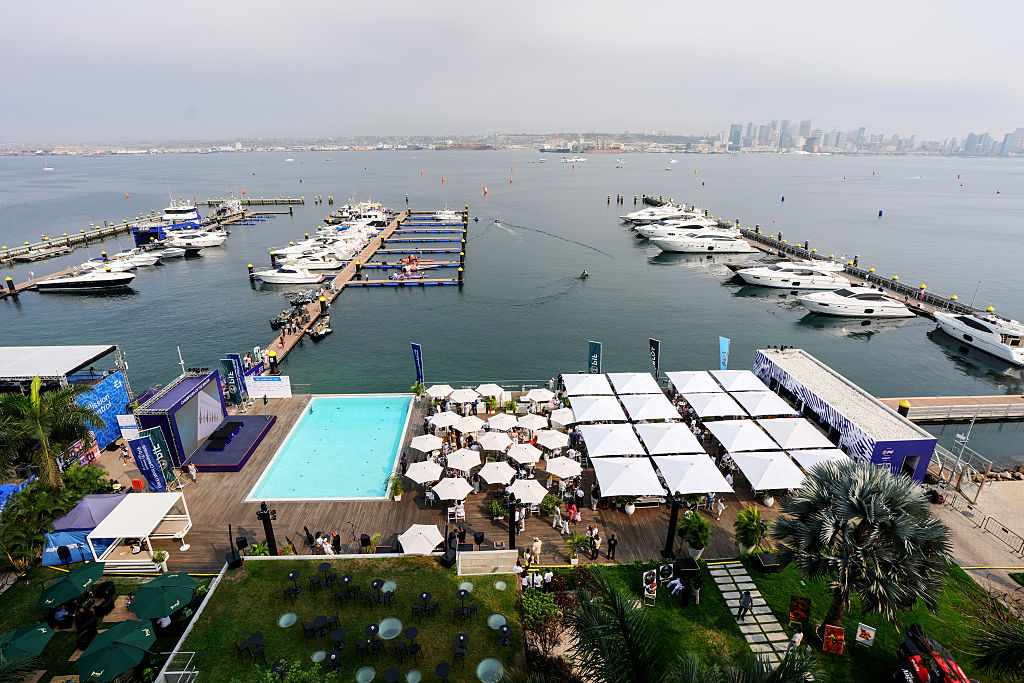
The action’s not all just on the water: Ocean Club provides additional entertainment and people-watching options that heighten the appeal of an E1 weekend. Malcolm Griffiths/Getty Images
With celebrity participants, pilots from a wide range of backgrounds from car racing to boat racing, gaming and even windsurfing, and being a motorsport that’s also on the water, E1 casts a wide net in terms of its target audience.
“I think that we’ve got a great opportunity,” Copas says. “There are motorsport fans that watch us, there are those that have been historically into power boat racing or water sports. We probably have a bit of crossover with Sail GP. We have a crossover with the the other formulas that are out there, the power boat racing, fossil fuel racing.
“But also if you look at sport now, sport fandom is not necessarily about just being a football fan or a motor racing fan. They’re also into it for the lifestyle element, and we bring a great amount of lifestyle to what we do because of the celebrities, because of the Ocean Club, so there’s a lot more storytelling to be told.
“It’s a very broad answer to who is our audience, and I think we’re still developing that at the moment. We know what it is at the moment for our people that come to the Ocean Club, but as we build out fan zones, we’ll learn more. We’ll test and learn, and we do whatever we can to get more people seeing it, because again, the more people that come and see the races, the more they’re going to interact with the stories that we’re telling and the more we can talk about sustainability, the more we can talk about men and women racing against each other, and then the innovation story.
“So they might be discrete target groups, but we want to attract all of them. We don’t want to dispel anyone.”
Dominik Wilde
Dominik often jokes that he was born in the wrong country – a lover of NASCAR and IndyCar, he covered both in a past life as a junior at Autosport in the UK, but he’s spent most of his career to date covering the sliding and flying antics of the U.S.’ interpretation of rallycross. Rather fitting for a man that says he likes “seeing cars do what they’re not supposed to do”, previously worked for a car stunt show, and once even rolled a rally car with Travis Pastrana. He was also comprehensively beaten in a kart race by Sebastien Loeb once, but who hasn’t been?
Read Dominik Wilde's articles
How the Blue Oval tamed the Green Hell
Latest News
Comments
Comments are disabled until you accept Social Networking Cookies. Update cookie preferences
If the dialog doesn't appear, ad-blockers are often the cause; try disabling yours or see our Social Features Support.