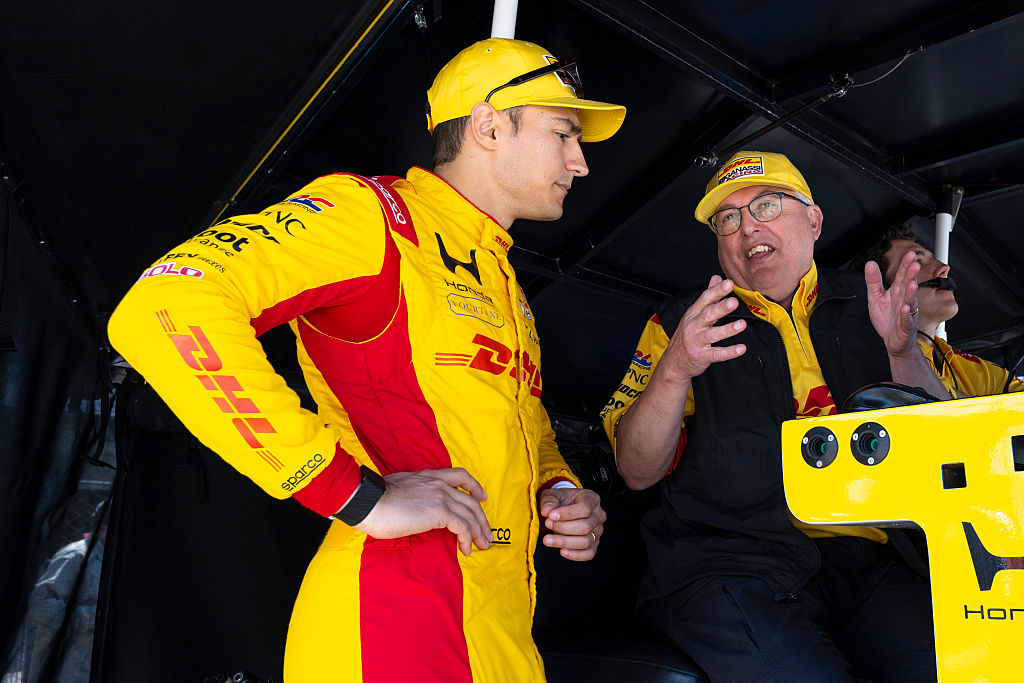
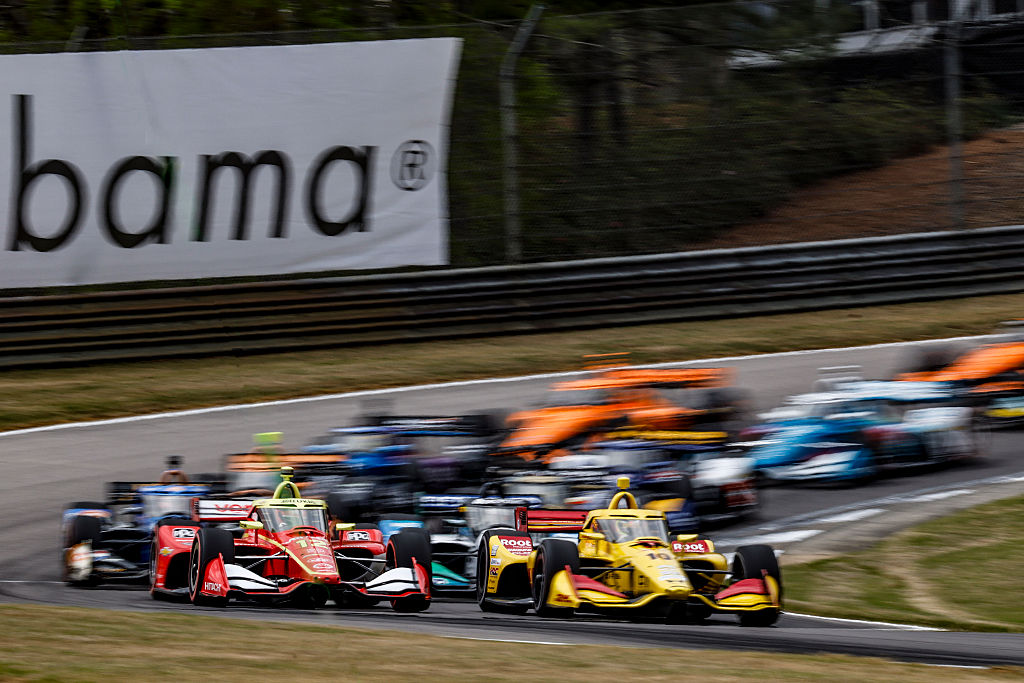
Joe Skibinski/Penske Entertainment
Palou wraps up promising first speedway test for new IndyCar IR-28
Two days of running on Indianapolis Motor Speedway, 151 combined laps turned, and a peak speed of nearly 218mph was achieved during the IndyCar Series’ highly conservative approach to running the new Dallara IR-28 on Wednesday and Thursday.
Alexander Rossi opened the test in hot and steamy conditions on Day 1 and handed off to Alex Palou for Day 2, who enjoyed cooler running that was interrupted by rain and the drying process for approximately 90 minutes.
Palou went straight out and ran laps in the 215-216mph range on each of his short runs, which rarely lasted more than three to four laps per outing.
“It was awesome,” Palou said. “We got lots more laps than I expected with the weather, and the car felt good. We actually got quite a lot of speed. We got like over two miles an hour throughout the day, and we didn't really work too much to to get it. So yeah, it was good.”
An unofficial best of 217.9mph was captured by RACER on Thursday which, with modest power on tap from the 2022-spec non-hybrid 2.4-liter twin-turbo V6 built by Ilmor, and a very safe setup applied to the IR28, was not unanticipated.

Palou was quickly up to speed despite limited runs and a conservative setup. Joe Skibinski/Penske Entertainment
“I'm gonna sleep better tonight, I’ll tell you that,” IndyCar competition VP Mike O’Gara told RACER. “It's been really good. The original plan was for Palou to go first, but because of media obligations (as the new IndyCar champion through Wednesday), Mr. Rossi was kind enough to go on Day 1 for us. We got through a lot of good stuff with him yesterday. It was a tale of two weather days because yesterday was blinding hot. So we worked on the base setup. Everyone worked together and that was a big help, a heavy lift from between Dallara, HRC, and Chevy to all.”
With the early validation tests of the IR-28, the series and Dallara have two goals to accomplish at a variety of tracks. The first is to verify the prototype components on the car either work as intended, fall short of expectations in whatever way, and to correct them for upcoming tests to sign off on all parts before they go into mass production.
The other overarching goal is to correlate the IR28’s performance data which was generated first in computer simulations and real-world wind tunnel testing. Both were achieved on the Speedway and revealed some improvements to make in the coming weeks and months, and confirmed the accuracy of the virtual and static testing information for the 2028 car.
“So yesterday with the initial running, with it being the first running on the oval, the Speedway car, there's a lot of ride height changes, wing angle changes, just to make sure that the deltas that we saw in the Dallara tunnel, in CFD, in Windshear, all correlated with this car, and they did,” said O’Gara, who was an IndyCar race engineer for many years.
“It was pretty impressive. Dallara would say, ‘All right, we're going to trim level two from one, and the these number of flats on front and rear ride height and these wing angles,’ and man, the car came in spot-on every time.
“So knowing that all that stuff correlates is huge for us because we know that the power we're running right now isn’t representative. But if we know that the deltas all check out, then they can put all these models in, including an engine model on the power that they think the full 2.4 is going to make, and then we know where we're going to be.
“So that's why it's easy before a test to say, ‘Ah, we don't care how fast we go,’ but everyone cares how fast we go, right? So, what we saw the last two days doesn't bother any of us in the least because we know there's margin in many different areas of the car. The last couple days were honestly about checking boxes for Dallara. Everything was pretty conservative and we’re pretty happy.”

The IR-28 production run is just about ready to go, O'Gara says. Joe Skibinski/Penske Entertainment
Separate from the positive results with correlation, O’Gara says most of the IR-28 is ready to go into production while some revised components will be readied for the next test, which is likely to take place on the Sebring short course in Florida.
“I think we've learned enough that we can basically push go on most all of the stuff for the car, the big pieces,” he said. “There's some stuff to work on, but everything's behaving like it's supposed to. There's some areas of the bodywork where we need to look at strengthening it. We really held Dallara to a high level of expectation when it comes to making the car lightweight, and the weights are coming in where we want. But I think there's some areas, now that we've run it, that we probably need to strengthen this area, or maybe we need to think about making this blanking panel a little thicker or reshape it. But that's easy stuff.
“The big parts of the car – suspension, the tub, the bellhousing, the gearbox – that’s all doing what it's supposed to, and those are the things we need to get rolling now. So, I think we're good on that. Really, the next step over the next month, the car is going to get blown apart and obviously gone over with a fine-tooth comb, and then we’re gonna run it at a an extremely bumpy former World War II training airstrip and put it through that experience to see how everything behaves.”
Presented by:
Marshall Pruett
The 2026 season marks Marshall Pruett's 40th year working in the sport. In his role today for RACER, Pruett covers open-wheel and sports car racing as a writer, reporter, photographer, and filmmaker. In his previous career, he served as a mechanic, engineer, and team manager in a variety of series, including IndyCar, IMSA, and World Challenge.
Read Marshall Pruett's articles
Latest News
Comments
Comments are disabled until you accept Social Networking Cookies. Update cookie preferences
If the dialog doesn't appear, ad-blockers are often the cause; try disabling yours or see our Social Features Support.