Lola Cars/Jakob Ebrey photos
Why Lola’s reborn T70S is more about the company’s future than nostalgia for its past
Lola's comeback so far has been all about new technologies and sustainability. Its headline project since its 2024 revival has been in Formula E, the all-electric championship that’s about as far away as you can get from the motorsport traditionalism you might associate with Lola. It’s also had a strong focus on future technologies and materials.
So earlier this year when it announced that the iconic T70 was coming back, albeit with modern materials and build methods, and in road-going flavor to-boot, it seemed as if Lola might be somewhat contradicting its own ambitions. After talking up its future it was going back out on tour, but instead of performing all new material, it was relying on one of its big hits from back in the day.
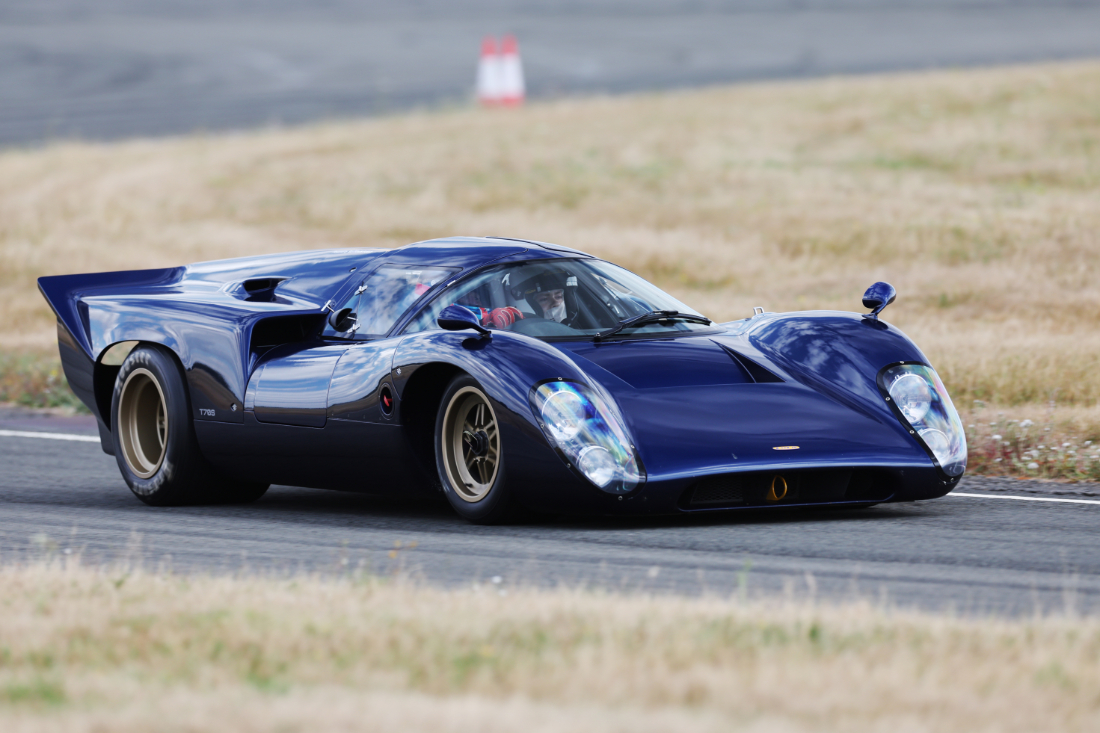
Yet while the original designs were used, and to the untrained eye it looks virtually the same, the T70S isn't quite an exact reissue of a 1960s hit. It’s more of a remaster, helping to demonstrate where the business is today.
“Lola is a technology company as well as a race car manufacturer, as well as many other things. To be a good, capable, successful race car manufacturer in the modern world, you also need to be a technology company,” Matt Faulks, Lola Cars’ executive innovation director, tells RACER. “It's very hard to be one without the other, and certainly very hard to do bleeding-edge products without being a technology company.
“Lola has been racing in Formula E but at the same time, we're developing new technologies. The first demonstration of those technologies is really on the T70S and T70S GT. That's the first use of LNCS (Lola Natural Composite System) in a low volume, but production environment. First use of LNCS in a road car. First use of low carbon cost magnesium in a road car, etc. So this is our proof of some of our technology in a relevant environment, and it's part of our development process for those technologies.”
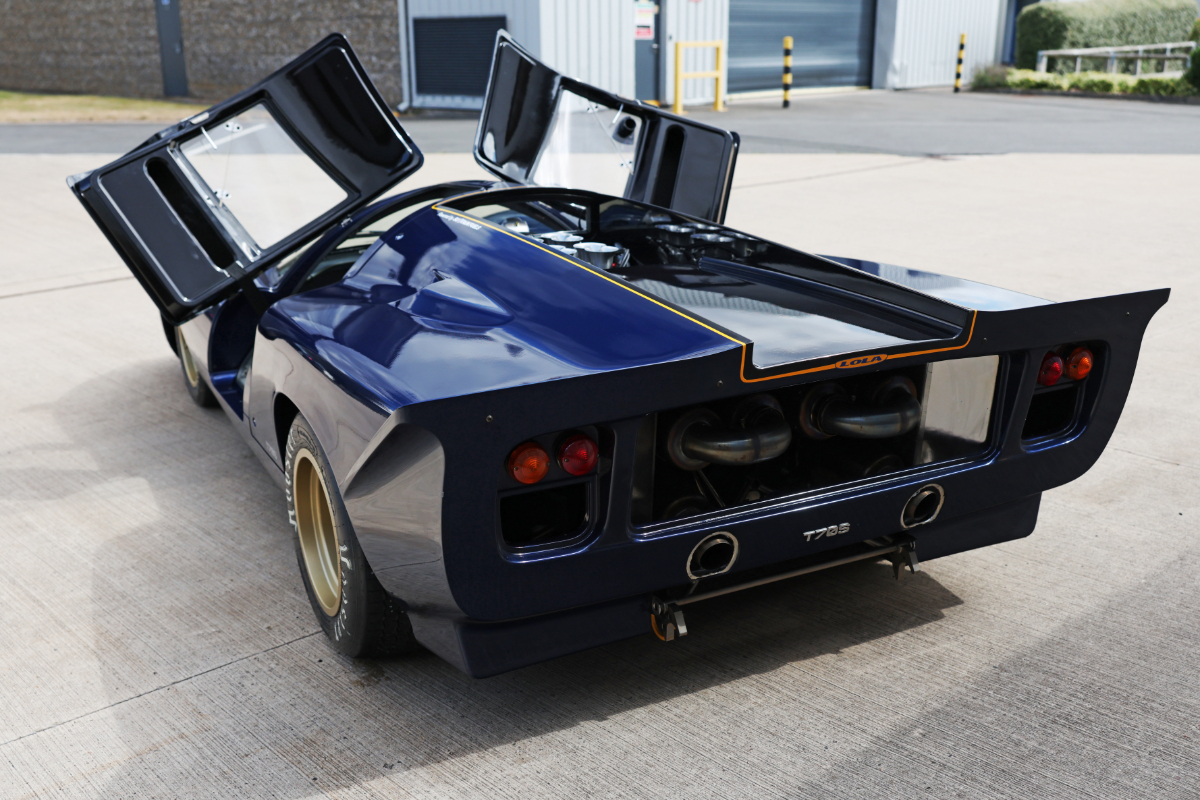
Old dog, new tricks. The first product of its revival may look retro, but Lola is performing the perfect balancing act in looking through its back catalog while continuing to move forward.
“It's the most wonderful thing for Lola to do, because T70 means an awful lot to us, and we're very both aware and protective of our heritage and our history,” Faulks says. “So [it's about] being able to bring T70 back to the modern world, and especially with T70S GT, showing that we can also do a road car program and we understand functional safety, we understand emissions requirements and all of these things, which are such a consideration in the world today, not just in a motorsport environment, but also in a road car environment.”
Just 16 examples of the T70S will be built, with prices expected to be north of the million dollar mark. And while it’s not homologated specifically for the U.S., Lola has done all the work to enable it to get in under the "Show or Display" amendment. Despite those 16 cars being freshly built, and for some, even road legal, the end result is authentic to the car that gave Lola more than 230 race wins in period.
RACER had a chance to experience the T70S from the passenger seat with three-time Formula 1 grand prix winner Johnny Herbert behind the wheel. After taking this writer round the MIRA handling course in England’s Midlands, Herbert offered his take on a comparison with an original T70, specifically a 1969 Lola T70 Mk3B GT previously campaigned by David Piper that Lola reacquired to provide an authentic reference point.
“The differences are small,” he told RACER. “The things I’d point to are that in the Piper car from a chassis point of view, there is perhaps a little more roll bar effect; tiny contrasts really and most anything else is just setup differences.
“The main characteristic I notice is from a drivability perspective, the new car is more comfortable, but otherwise they are directly comparable, the gearbox feel, the pedal feel, etc., is all the same.”
So, with the T70S, present day Lola has proved it can match the company’s legendary past. And it’s done that in a greener way, too.
“T70S was really a bit of a statement of our new technology, but also that Lola is back,” says Faulks, “because it's so important to Lola. Lola is a sustainable business, but that doesn't mean it's EV. We are very aware of the majority of sustainable technologies that are available out there.
“I look at the T70 as a sustainable vehicle, which people will laugh at because it's a big V8. But the carbon cost of that vehicle is four and a half tons. The carbon cost of a Model 3 Tesla, according to their own sustainability report, is 14 and a bit. So, to my mind, we can do sustainable motorsport. We've just proved that with this. Those technologies are available to do other things with.”
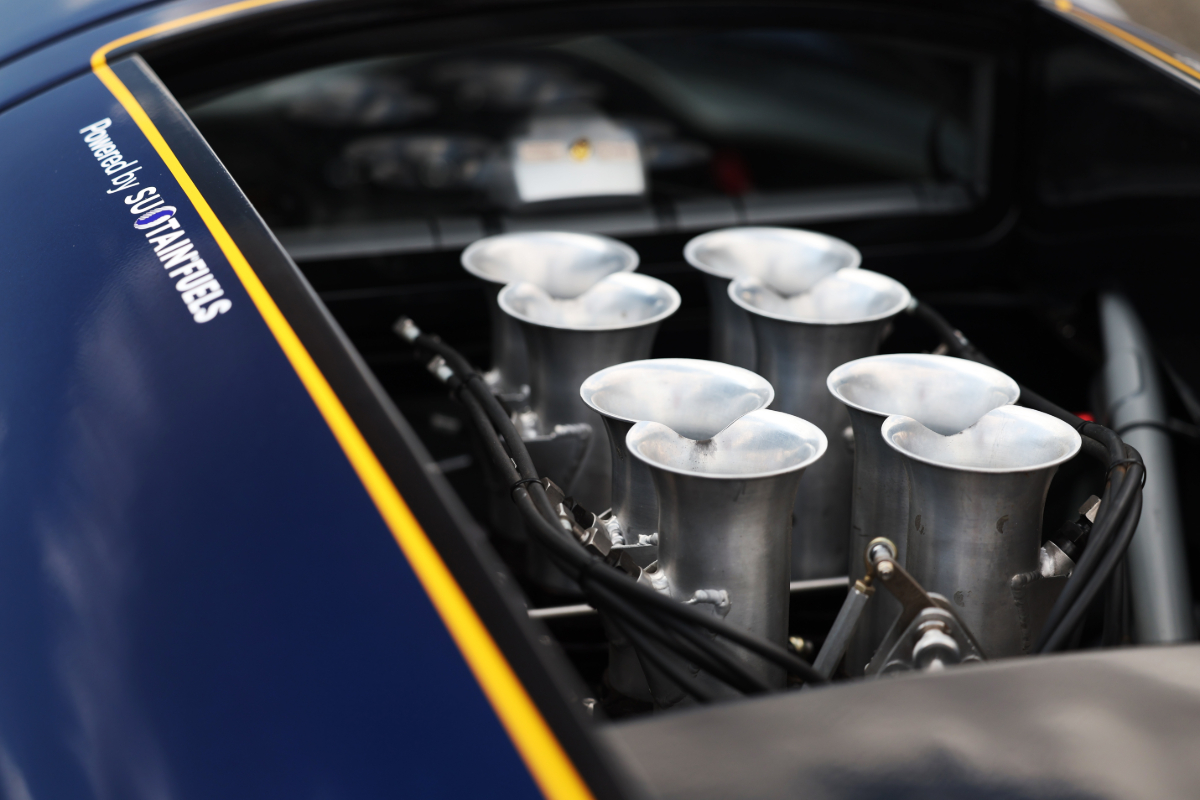
Proved that motorsport can be sustainable with the T70S perhaps but what about Lola’s Formula E team with its zero-emissions EVs? While in the past you’d see Lola competing in a wide variety of championships, these days it still aims to have a breadth of applications, and handle all of them sustainably.
“The conversation around sustainable motorsport is a really interesting one, and Lola is incredibly well positioned for it,” Faulks says. “But I can't stress how much we're not just EV because we raced Formula E, or we're not just V8s because we built the T70S. We have a very pragmatic and I think really sensible view in the world that we live in today on what makes the biggest difference.
“What is the appropriate technology to get the result you want? Could we have done an EV T70? Yeah, absolutely. We developed the whole back end of the GEN 3.5 [Formula E] car alongside Yamaha, and we've done the same for the GEN4, but would we have done it? No, because it's not honest to the history. It was always a V8.
“But I think being able to say, look, we've got one and a half ton of carbon cost in the build of that vehicle, and we can run it on an 80% sustainable fuel, that's pretty cool. That to me is definitely a sustainable vehicle.”
So with a reborn, howling historic at one end of the spectrum and a whispering Formula E machine at the other, it begs the question of what’s next for Lola. And the possibilities have no bounds.
“There are various discussions going on at the moment about next projects, with OEMs, with other manufacturers. Likewise, there are various conversations going on internally about what we may do next, and we are aware of our options,” Faulks says. “I think there will always be an intent at Lola to build race cars because we're a race car manufacturer. That's why we're here.
“And to me, the focus really has to be, what does that mean for a car design? What championships are we going to race in? An LMDh car is wildly different to a GT3 car. A GT3 car would require a road car program to build a GT3 car. Do we do a GT3 car in a partnership with an existing manufacturer? These are all the discussions that are going on at the moment.
“But Lola’s in a wonderful position right now. We've launched the first Lola that's been produced for several years. The response to it's been incredible, we've demonstrated some amazing tech, we move into our new factory in a few weeks' time, which we're very excited about. That gives us room to expand and grow and get to the next stage, and the future is looking really, really bright for Lola.”
Two years in, Lola's Formula E project has been a big learning process given that it entered the series midway through a regulation cycle, and doesn’t have the experience of the others on the grid.
“In Formula E you have a two-year window to develop the powertrain. The car is the first that Lola developed, so the car has a deficit,” team driver Lucas di Grassi tells RACER. “The car is not as fast as the others. We know that, but that does not mean that with the perfect strategy, with the perfect execution, we cannot get there. And that's what we strive for, and what we've been working very hard to try to get the results.”
A headline achievement for the team came last month when it won its first race at the Shanghai E-Prix., making Lola the only constructor to have won in every kind of FIA single-seater championship. It provided a huge boost ahead of the company taking the entire team in-house from next season after two campaigns aligned with former Audi works partner Abt.
“It gives a good motivation to everybody because everything is becoming Lola, and sometimes it's hard for the mechanics, for the engineers to be working so hard and having no results,” di Grassi says. “So the win changes the mood of the team, changes the momentum quite a lot.
“I think the team has the potential to become a great team,” says di Grassi, who will retire from competitive driving after next week’s London E-Prix. “You need a little bit of time. If you look back, at Porsche and Jaguar, it took them three years to win a race. Lola already won. But everything takes time, so patience is also very important.”
There were a few years when Lola was in the doldrums, with fears that the name might be lost for good. But these days it’s looking strong, with a multi-pronged attack on the motorsport world once again.
“The next chapter of Lola is, who wants us to do stuff really well for them?” Faulks says. “Regardless of what you want to go racing in, Lola can do it. We're doing big combustion. We're doing sustainable combustion. We're doing EV. We're doing the highest-performing and most-powered EV powertrains that there are in the world in Formula E.
“The question of, ‘Can you do that?’ should already be answered. And that's really what we've set out to do over the last few years, to prove that there isn't anything we are not capable of doing very well.”
Dominik Wilde
Dominik often jokes that he was born in the wrong country – a lover of NASCAR and IndyCar, he covered both in a past life as a junior at Autosport in the UK, but he’s spent most of his career to date covering the sliding and flying antics of the U.S.’ interpretation of rallycross. Rather fitting for a man that says he likes “seeing cars do what they’re not supposed to do”, previously worked for a car stunt show, and once even rolled a rally car with Travis Pastrana. He was also comprehensively beaten in a kart race by Sebastien Loeb once, but who hasn’t been?
Read Dominik Wilde's articles
Latest News
Comments
Comments are disabled until you accept Social Networking Cookies. Update cookie preferences
If the dialog doesn't appear, ad-blockers are often the cause; try disabling yours or see our Social Features Support.