Sam Bagnall/Getty Images
Hypercar title battle renewed as WEC hits post-Le Mans stride
The dust has settled on Le Mans, and with five races remaining in the FIA World Endurance Championship season, the focus has shifted squarely to the title fights in both classes.
The six-hour contest at Interlagos on Sunday marks the start of the championship's stretch run, and with significant uncertainty about the end of the calendar due to the conflict in the Middle East, this weekend's encounter, plus the upcoming rounds at Circuit of The Americas and Fuji, carry greater weight than usual.
The teams are set to be briefed later today on the current situation regarding the races in Qatar and Bahrain, but RACER understands that the final decision has been pushed back again, beyond what was previously communicated. In sporting terms, it means the teams are still not sure which circuits they’ll need to prepare for, or what the formats/points system will be, for the deciding races.
For Toyota's Mike Conway, who leads the Hypercar drivers' world championship with Kamui Kobayashi and Nyck de Vries after winning Le Mans in the No. 7 TR010, that's reason enough to view this weekend as a pivotal moment in the campaign.
"There are still five races, including this one," Conway tells RACER. "And the ones at the end of the season could be six-hour races, instead of eight or 10, like we were expecting. So in terms of points, it's really going to count this weekend; you have to bank what you can.
"We know it'll be tough with BMW, Cadillac and Ferrari all there. Alpine has had great speed as well."
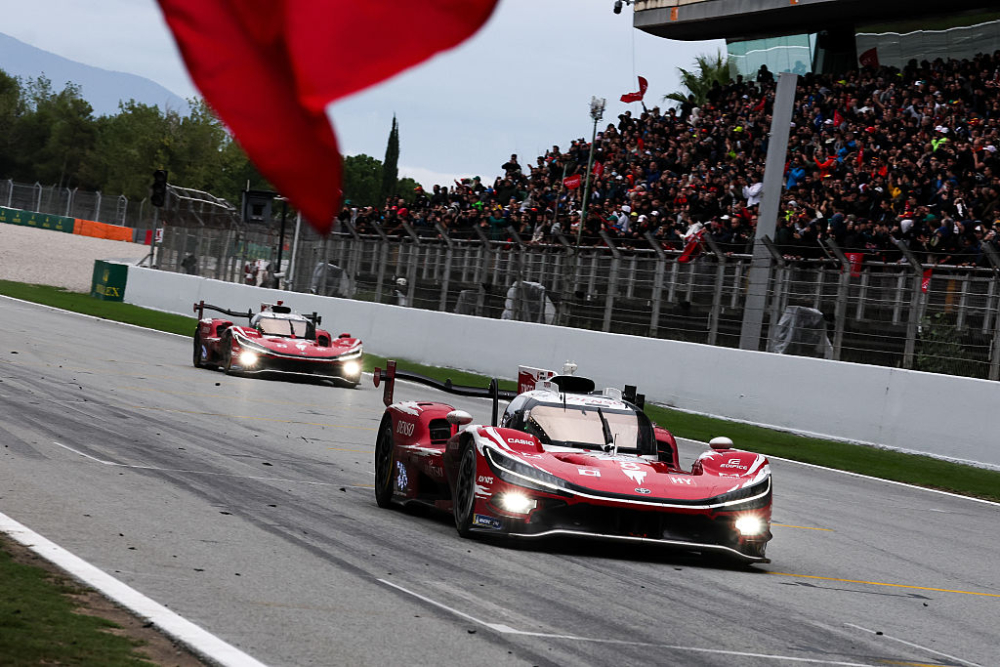
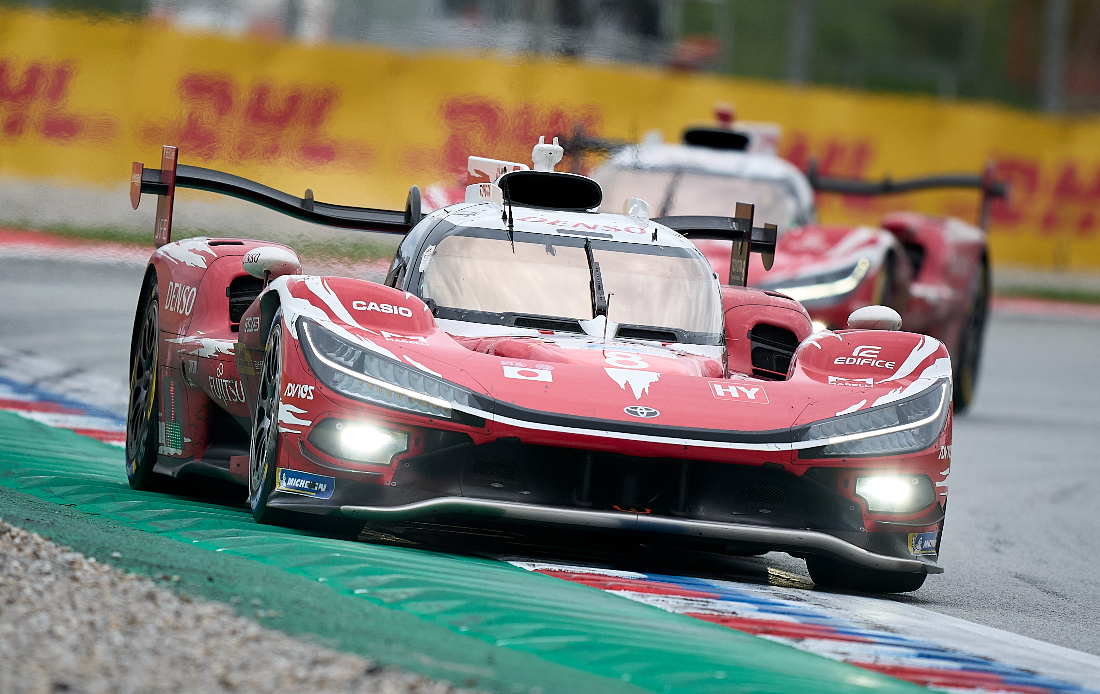
The championship picture reflects just how competitive the Hypercar field has become. Ferrari hasn’t won in over a year now, and the top two crews in the drivers’ standings are separated by just four points, with Robin Frijns and René Rast – the two full-season drivers in the No. 20 BMW – hot on the tail of Toyota’s leading trio.
It’s a slightly different story in the Hypercar manufacturers’ ranking. The result at La Sarthe, where double points were on offer, enabled Toyota to build a relatively comfortable 36-point cushion over BMW. The reigning champion, Ferrari, sits third and 70 points adrift.
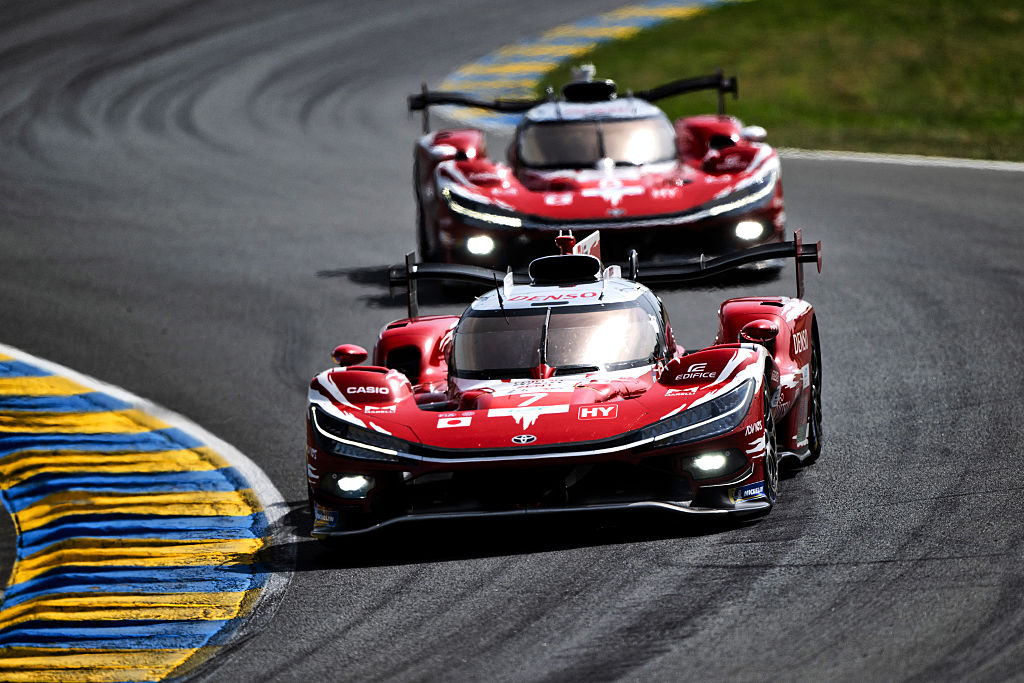
Toyota gained considerable championship momentum at Le Mans, but Conway cautions the margins are slim. James Moy Photography/Getty Images
Conway expects that tiny margins will separate the leading manufacturers in the remaining races, especially if the calendar features two circuits that the championship hasn’t visited for a while, on short notice.
"It's super tight, so you've got to score well," he says. "Interlagos is normally a decent track for us, whereas Austin, we've not been super quick. Obviously, in Japan, we're normally good, then we'll see where the next ones will be, maybe Barcelona and Monza, I've heard? But it could be Bahrain and Qatar…”
Nevertheless, Conway and the team around him at Toyota still have high hopes that they will continue to unlock performance from the TR010’s updated aerodynamic package as they gain a better understanding of tire behavior across varying conditions.
"Now it seems like most people are on similar strategies in terms of tires," Conway explained. "If you look at Ferrari, when they first came in, they were always opting for the harder compounds; we'd do the opposite, but now they don't need to do that anymore. And the tires now last well.
"We're still learning with the new aero and the new car. At Le Mans, we thought we'd be on a harder compound, and it didn't work as well as we expected, so we ended up on medium and soft tires.”
Sunday’s race may throw in an additional curveball, though, with forecasts suggesting that rain may be on the menu.
"We've had a little bit of running in the wet,” Conway says of the TR010. “It’s definitely better (than the GR010). In the past, when it did rain, we weren't super strong, so to have more consistency in the new aero package has made a big difference for us."
With so much racing still to come, there’s every reason to believe that two or three of the factories chasing Toyota could enter the fight. Right now, though, it looks like a two-way battle, with BMW standing out as the principal contender, in the spotlight alongside Toyota. Indeed, it has looked like the biggest threat to a fifth world manufacturers’ championship for the Japanese brand since the season started. After Toyota won the season opener, the Team WRT-run operation finally converted flashes of promise into a 1-2 finish Spa, and followed that up with an outstanding run at Le Mans. A second-place finish for the No. 20 firmly established it as a title contender.
Frijns, driver of the No. 20, admits that the result at Le Mans was tough to take, but could still prove pivotal in his and his teammate's world championship mission.
"I would be lying if I said I wasn't thinking about the championship," Frijns tells RACER. "The goal was always to win Le Mans, especially when you're competitive all week, lead 100 or so laps. So it was a bitter pill to finish second as we really felt we had a shot.
"So the next target is to go for the championship. We are in a good place – we work well as teammates, we have bonded a lot, and we know our strong and weak points internally. "If everything goes well and we don't have unlucky moments, I don't see why we can't be in the mix at the end.”
The level of confidence and the general atmosphere within WRT are noticeably different from previous seasons.
"I've been with WRT since 2015, and all they care about is winning; they don't care how they do it," Frijns adds. "We've been frustrated the last two years because we'd come close to winning and didn't, and we got annoyed.
"Now we have the monkey off our back because we got the 1-2 in Spa and showed we can win races. It's been such a morale boost. And last year we performed well when I was watching from afar in Formula E.”
Frijns’ teammate Rast, meanwhile, wants to avoid being consumed by the championship permutations.
“If we gain points to Toyota, or lose points, it is what it is," Rast says. "As long as we maximize our package, I think we can be happy."
He is also cautious about BMW's prospects at Interlagos after Cadillac's dominant showing here a year ago. "Here, I think if we can put everything together, we can fight for another top-five result," Rast says. "It depends on pace because last year the Cadillac was outstanding and lapped us.”
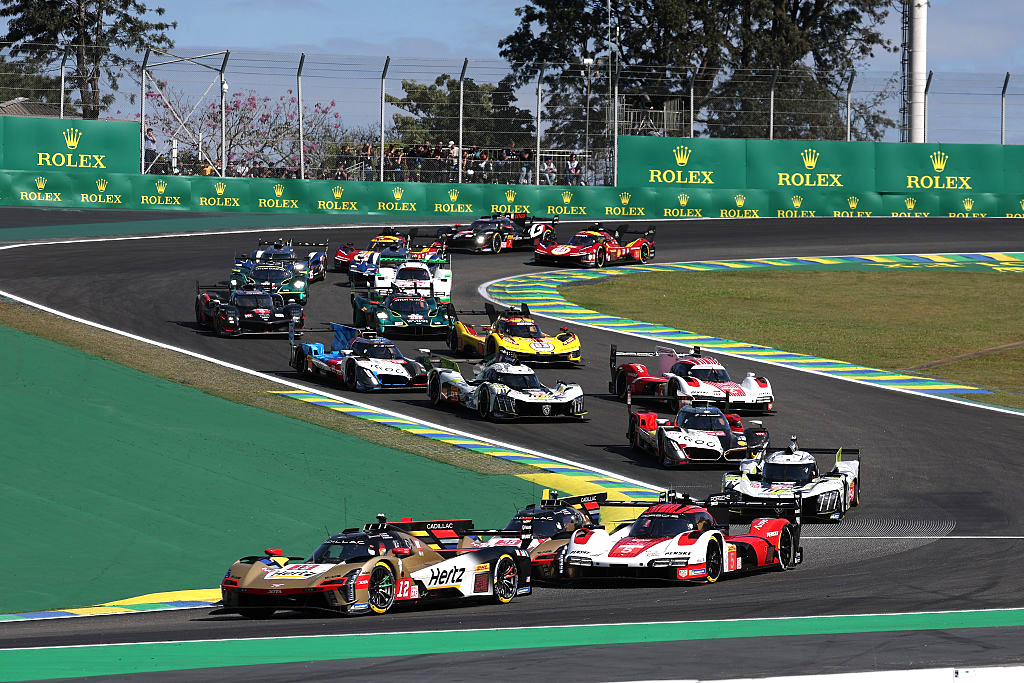
Cadillac tackled tricky Interlagos best last year. And this year, it could be wet... James Moy Photography/Getty Images
Interlagos, the shortest circuit on the calendar, presents its own challenges, however. Overtaking is extremely difficult within its tight, twisty confines, making qualifying critical. The race has never been won outright from a car starting off the front row.
Tire management is also key to victory here, as the circuit is so abrasive. For Hypercar’s supplier, Michelin, there’s a lot of learning to do, as it takes on the track with its 2026-spec Pilot Sport Endurance tires for the first time.
At present, it’s not clear how the teams will approach the race if it’s dry. In 2024, the hard compound was used by everyone in the field bar Toyota, which managed to get the Mmediums to work en route to victory. Then last year, after the circuit was fully resurfaced, there was a tidal shift to the mediums, with many teams opting to switch only the right-side tires at certain pit stops due to the track layout placing significantly less load on the left.
With the new compounds now in use, there’s a whole new set of questions to answer.
“For us, it’s going to be a new challenge again,” Michelin’s endurance manager, Pierre Alves, explains to RACER. “We are going to discover new tire behavior, because it’s the first standard WEC race where we will supply the medium and hard tires, as before Le Mans, we took the soft and medium to Imola and Spa.
“Last year, the teams had mastered the range by the time we came here, they knew exactly how the medium performed, so there was no question about strategy; the only variable was when everyone changed the left sides. And with the resurfacing, we had a lot more grip; it was a lot better. But with better grip and the new grooves on the track, it was very abrasive, and it’s still a high-degradation circuit.
“These tires have been designed to have less degradation, so it will be interesting to see how different these tires are on a high-deg track for the first time. And it will be interesting to see if teams use hard or medium tires on the right side.
“If it’s raining, then it’s all about the level of water. If there’s a lot, there’s no degradation – it’s just hydro performance and how capable the tires are at evacuating the water.”

Stephen Kilbey
UK-based Stephen Kilbey is RACER.com's FIA World Endurance Championship correspondent, and is also Deputy Editor of Dailysportscar.com He has a first-class honours degree in Sports Journalism and is a previous winner of the UK Guild of Motoring Writers Sir William Lyons Award.
Read Stephen Kilbey's articles
Latest News
Comments
Comments are disabled until you accept Social Networking Cookies. Update cookie preferences
If the dialog doesn't appear, ad-blockers are often the cause; try disabling yours or see our Social Features Support.