Brandon Badraoui/Getty Images
IndyCar Officiating acknowledges errant pit lane availability messages
IndyCar Officiating has given incorrect pit lane entry information to three drivers during the last two races. The ongoing errors have been acknowledged by the independent officiating body through its new post-race reports, where penalties are chronicled, technical inspection matters are detailed, and its mistakes are documented.
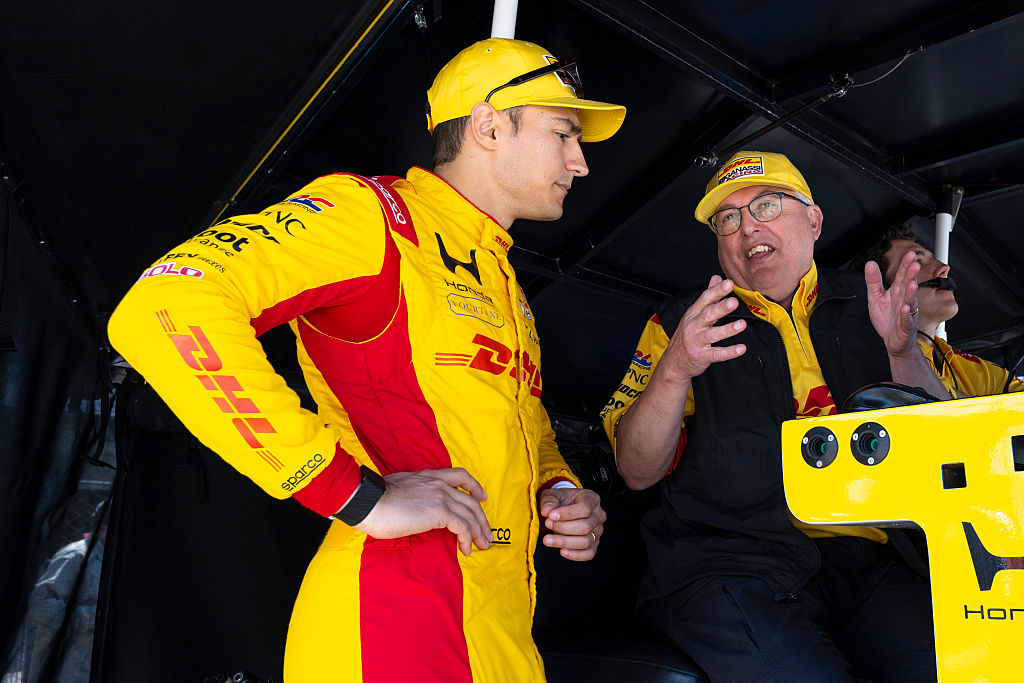
The first of IndyCar Officiating’s new post-race reports was filed after the June 7 World Wide Technology Raceway oval race, and it cited a pair of false messages given to the No. 20 ECR Chevy driven by Alexander Rossi and the No. 60 Meyer Shank Racing Honda piloted by Felix Rosenqvist.
Both drivers received errant information from IndyCar Officiating’s trackside communications system, which said the pits were closed while they were on approach to pit lane. IndyCar uses display panels connected to Race Control, which alert drivers to the status of pit lane’s availability — a red X is shown when it’s closed — as they reach pit lane. Secondarily, teams also receive an automated alert on their timing stands via SMS when their cars trips the pit-in timing line.
Those messages either say it’s OK to pit or the pits are closed, which teams then use to convey instructions to stop as intended or keep driving without stopping.
Despite being open, the display of wrong pits-closed information in front of both drivers led Rossi and Rosenqvist to drive through the lane with their speed limiters engaged before returning to the track. The race was red flagged the following lap for rain.
Rosenqvist, in ninth, was able to resume in ninth, but Rossi lost three positions, falling from 15th to 18th.
“During the post-race review, it was determined that the automatic pit-closed message had been assigned to an incorrect scoring loop,” IndyCar Officiating wrote. “On lap 196, Cars 20 and 60 entered an open pit lane correctly off Turn 3; however, because the scoring loop designated to trigger the automatic alert was located at Turn 4, both cars were incorrectly notified that they had entered a closed pit lane once they activated the scoring loop in Turn 4. The root cause has been identified, and corrective measures have been implemented to prevent recurrence.”
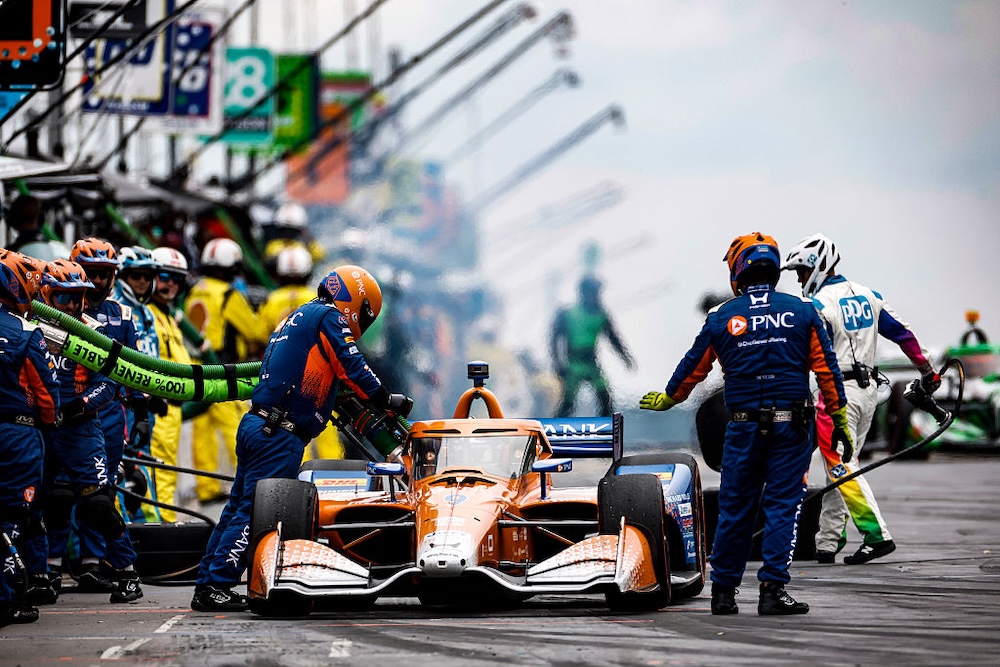
Chip Ganassi Racing’s Scott Dixon was the latest driver to receive the wrong pit-access information, which led to a cascading series of setbacks caused by IndyCar Officiating for the No. 9 Honda at Road America.
While running eighth on lap 13, Dixon attempted to pit under green and refuel. Like Rossi and Rosenqvist at WWTR, Dixon was shown the wrong pit-access light, which said the pits were closed. At the same time, Dale Coyne Racing’s Romain Grosjean was losing his left-rear wheel at Turn 5, which triggered a full-course yellow.
Dixon beat the caution by a fraction of a second, but with another technology communications failure to contend with, the wrong light was displayed and Dixon was instructed by his race strategist Mike Hull to continue driving down the long pit lane on the speed limiter without stopping and rejoin the field.
While under caution, with his fuel tank on fumes and pit lane officially closed, Dixon returned to the pits at the end of the lap to receive emergency service and took two seconds of fuel on lap 14. On the next lap, once the pits opened under caution, Dixon returned to pit lane and received a full complement of fuel.
Upon rejoining the field, he was assessed a penalty for receiving emergency service on lap 14, which sent the No. 9 Honda to the rear of the running order.
While circulating under the caution, and with his race already impacted by the mounting volume of unnecessary visits to pit lane, Dixon was called in to top up his fuel tank on lap 18 before the race resumed on lap 19.
But the decision by Chip Ganassi Racing to perform the last stop ran afoul of an obscure regulation — Rule 9.2.2.4 — which says a driver who received a repositioning penalty like Dixon cannot pit after the penalty.
The rule says a repositioned driver — sent to the back of the field, in Dixon’s case — is only allowed to make use of pit lane after the race has returned to green.
IndyCar Officiating notified the No. 9 team that it was being penalized for a “Pit After Repositioning” violation, and Dixon was ordered back to pit lane once more to perform a drive-through penalty on lap 21.
The entire sequence from Dixon’s legal pit lane entry on lap 13, which was incorrectly depicted as being illegal, to the need for emergency service, to the return for full service, to the penalty for the emergency service, to the penalty for topping up after the first penalty, was created by IndyCar Officiating.
“I think I had three drive-throughs for the same pit penalty,” Dixon told RACER after the race, where he rallied to improve from 24th following the drive-through penalty to finish 11th. “It was bizarre. They started calling people for topping off at the end of a pit sequence. I don’t think that’s ever happened before. I don’t know what they’re up to. Then they screwed us because they kept the pits closed, then on the next yellow they opened it immediately. A bit of a rough day.”
IndyCar Officiating attempted to describe what went wrong in its post-Road America report.
“On lap 13, Car 9 received an incorrect ‘Pits Closed’ message at pit entry when the pit lane was in fact open to the car,” it wrote. “A review found that the timing system was measuring two events from two different starting references — the pit-closed light from midnight, and the car’s crossing of the pit-entry line from a separate internal reference — so the two times were not on the same scale. As a result, any car crossing the pit-entry line while the pit-closed light was on would be returned as ‘Pits Closed.’
“Car 9 reached the pit-entry line 0.0175 of a second before the pit-closed light came on and should have been shown ‘Good to Pit.’ After both times were aligned to the same reference, the sequence was re-tested multiple times and produced the correct ‘Good to Pit’ result in every case. The cause has been identified and corrected.”
Asked for comment, Ganassi’s Mike Hull told RACER, “The report speaks for itself.”
And in a welcome adjustment following Road America, IndyCar made an alteration to its rules to remove the “Pit After Repositioning” penalty for drivers like Dixon who’ve already been penalized for emergency service.
Starting this weekend in Mid-Ohio, once that penalty is served and the car is moved to the back of the field under full-course caution, the driver is free to return to the pits and top-up on fuel before the race returns to green.
“IndyCar and IndyCar Officiating sees this update as being in the best interest of competition, and [it] is re-written to better reflect the spirit of the original rule for which it was intended,” the series wrote.
Presented by:


Marshall Pruett
The 2026 season marks Marshall Pruett's 40th year working in the sport. In his role today for RACER, Pruett covers open-wheel and sports car racing as a writer, reporter, photographer, and filmmaker. In his previous career, he served as a mechanic, engineer, and team manager in a variety of series, including IndyCar, IMSA, and World Challenge.
Read Marshall Pruett's articles
Latest News

Comments
Comments are disabled until you accept Social Networking Cookies. Update cookie preferences
If the dialog doesn't appear, ad-blockers are often the cause; try disabling yours or see our Social Features Support.