Clive Rose/Getty Images
F1’s battle with the law of unintended consequences
The law of unintended consequences is powerful in Formula 1. A sporting entity as complex as this cannot fail to be at the mercy of it, whether that’s external geopolitical influences that led to the cancellation of April’s Bahrain and Saudi Arabian Grands Prix, or the impact of rule changes on the on-track product that remains at the heart of F1’s global growth. This weekend’s Miami Grand Prix could almost be renamed the 'Unintended Consequence Grand Prix'.
This will make it a fascinating event both on and off track. F1 has always been as much a political battle as a sporting one, which has been underlined over the past month as the competition behind the scenes has rumbled on even with the cars falling silent. What’s not clear yet is the impact this could have on the racing, both for the rest of this season and in the longer term.
The first fight was over the rule tweaks adopted heading into the Miami Grand Prix. Conceived to increase the level to which drivers can push on the limit in qualifying, primarily via the mechanism of lowering the per-lap energy harvest limit to 7MJ and allowing superclipping to charge at 350kW rather than 250kW, the changes are subtle. But they will have a genuine impact by lessening the extent to which cars reach a high top speed on long straights then drop off dramatically. While that curve will still be visible, it will be less pronounced.
The same applies to the limit on push-button boost to 150kW, conceived to reduce the potential power offset between cars and avoid a repeat of the Ollie Bearman/Franco Colapinto Suzuka crash. Perversely, while this should improve safety, it might also reduce the overtaking that has been heralded as proof of the races being more dramatic. The offsets will still be there, but they will be less extreme. That’s a good thing, as while there has been criticism about complaints on the grounds that multi-class racing produces dramatic speed offsets while avoiding such accidents, the difference there is that speed profiles are consistent, whereas in F1 today there can be a relatively sudden drop of hundreds of horsepower. The key here is predictability.
A plethora of proposals were discussed, so it would have been possible to go further. While the exact machinations remained ‘in the room’, it wouldn’t be F1 if there hadn’t been competing agendas in place, motivated by the potential to gain an advantage, or mitigate a disadvantage to the point where there was a non-zero chance that no agreement might have been reached.
Fortunately, F1 as a collective these days is reasonably effective at recognizing when something must change for the greater good, but it’s unclear what the impact will be on the competitive order. We’ll get a feel for that in Miami, although as it’s a circuit that’s relatively harvest-rich – a little less so than China based on the amount of braking, but vastly better than either Australia or Japan – it will only offer an incomplete picture.
The off-track messaging will be just as telling. There’s always an element of gamesmanship at play, with teams and drivers justifiably pursuing their own agendas. We’ve seen that during the break, with McLaren’s Lando Norris recently highlighting the edge that was missing from qualifying – the aspect that most, if not all, drivers privately dislike about the rules – as a negative.
“It’s that extra [question of] who can push it 1-2% more in qualifying went away,” said Norris. “Those 1-2% are the special 1-2% that make it exciting, that might surprise you in terms of this guy is suddenly on pole because he’s taken those little risks. And you’ve taken that element away.”
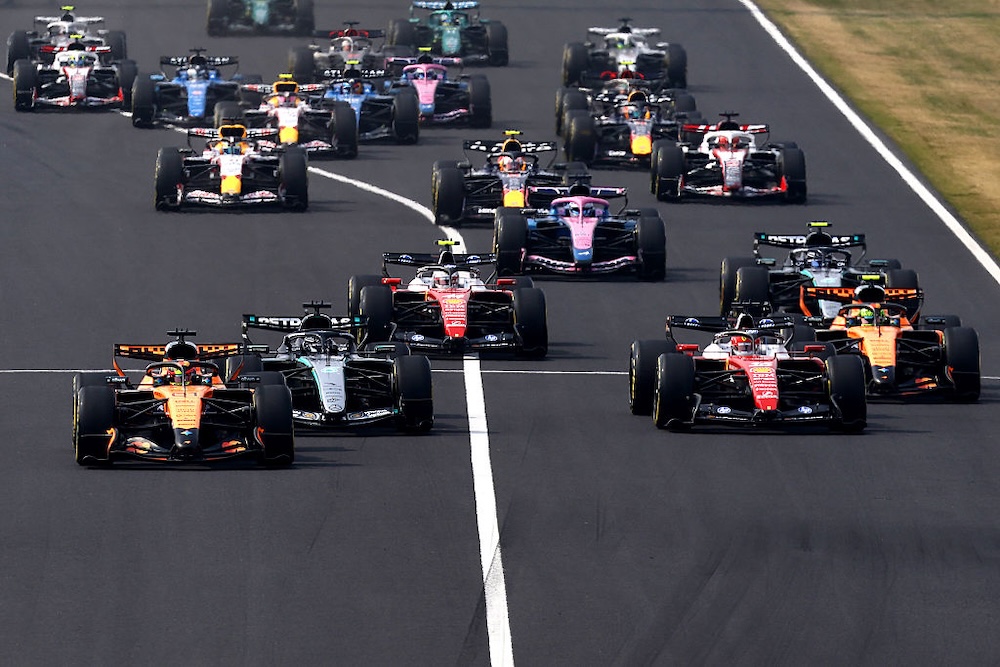
F1 has always been as much a political battle as a sporting one, and recent events have brought that to the fore. Mark Thompson/Getty Images
Contrast that with George Russell, who has a stronger package and is therefore closer to the F1 ‘party line’. When Norris’s comments were put to him in a BBC Radio 5 interview, he pushed back – as you would expect, given he’s in such a strong position. And rightly so, given Mercedes has done nothing wrong and simply aced the new rules.
“With the regulations as they were in the first three races there were some quirks that if you drove it in a certain way with how you released the throttle you could gain a little bit of extra energy,” said Russell. “Anybody who thinks drivers are going slow in corners to be faster on the straights are wrong, because there's a reason why the fastest team around the corner is also the fastest team over the course of a lap, and the slowest car in the corners is the slowest car over the lap. So it's not a case of you just go slow around the corner and you've got more power on the straight. I don't share those views.”
There will be plenty of this kind of thing in Miami, particularly with discussions in the background about potential power unit hardware tweaks for next year or 2028. Based on comments from Mercedes team principal Toto Wolff and his opposite number at McLaren, Andrea Stella, there are differences of opinion even across teams using the same power unit. The public media forum is one of the ways to have such debates even though the real horse-trading happens behind closed doors, and everyone will be positioning themselves according to their best interests.
Those arguments will have a downstream impact, but in the shorter term there’s potential for disruption in the competitive order. Watch out also for comments about ADUO, the ‘additional upgrade and development opportunities’ mechanism that will allow changes to the V6 engines for any manufacturer deemed to be two or more percent off the benchmark power unit. That has proved more complicated than originally advertised, and with manufacturers set to be told soon, probably between Montreal and Monaco, what is permitted, the political rhetoric could be abundant.
The power unit rule changes for Miami are unlikely to cause dramatic performance swings in isolation, but car improvements are a different matter. This weekend has the potential to be one of the biggest shakeups in relative pace thanks to the extent of the changes. Not only has it been five weeks since the last race, but the canceled Bahrain weekend had already been earmarked for significant upgrades. Those parts, plus anything planned for Miami, as well as anything that might have been brought forward thanks to the cancellation of the races and the resulting reallocation of resources, could have a big impact. However, with relative gains the key, there’s also the possibility it will only represent a subtle shift. Whatever the effect, it will be telling.
Everything that has gone before is effectively a prelude. It’s not irrelevant, as it represents the foundation of the competitive order and many of the trends established will remain. However, Miami and the events that follow, certainly after the stuttering restart created by the three-week gap to the next race in Montreal, will paint the true picture of the championship fight that will play out over the rest of the year.
Without the decision five years ago to head in the direction of the 50/50 power split and the baffling refusal to make adjustments before this year even when the problems became apparent in simulation, or the loss of the two Middle East races for reasons entirely outside of F1’s influence, the narrative heading into this weekend would be completely different. That’s the law of unintended consequences in action.
That’s something F1 must keep in mind when it comes to framing the next generation power units, currently scheduled for 2031 but with the potential to be brought in earlier. As F1 boss Stefano Domenicali has recently explained, the prevailing conditions for the automotive manufacturers have changed, and there is a push for simpler V8 or V10 engines using advanced sustainable fuels. That’s a crowd-pleasing direction, but once again the devil will be in the detail. And if that is disregarded, then the downstream effects – for better and worse – could be more far-reaching than anyone realizes.

Edd Straw
Edd Straw is a Formula 1 journalist and broadcaster, and regular contributor to RACER magazine. He started his career in motorsport journalism at Autosport in 2002, reporting on a wide range of international motorsport before covering grand prix racing from 2008, as well as putting in stints as editor and editor-in-chief before moving on at the end of 2019. A familiar face both in the F1 paddock, and watching the cars trackside, his analytical approach has become his trademark, having had the privilege of watching all of the great grand prix drivers and teams of the 21st century in action - as well has having a keen interest in the history of motorsport. He was also once a keen amateur racing driver whose achievements are better measured in enjoyment than silverware.
Read Edd Straw's articles
Latest News

Comments
Comments are disabled until you accept Social Networking Cookies. Update cookie preferences
If the dialog doesn't appear, ad-blockers are often the cause; try disabling yours or see our Social Features Support.