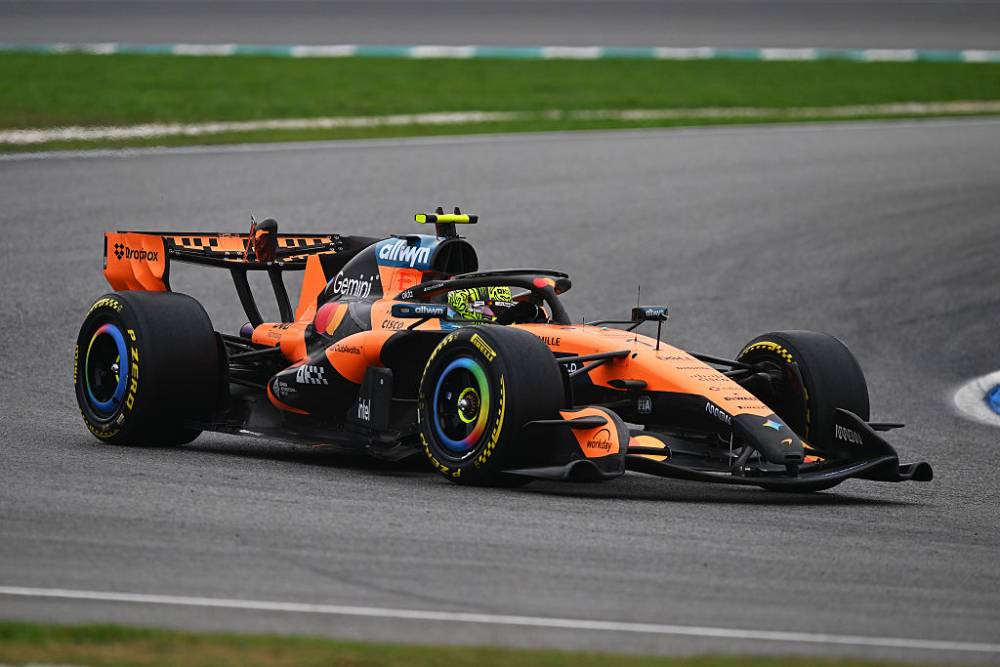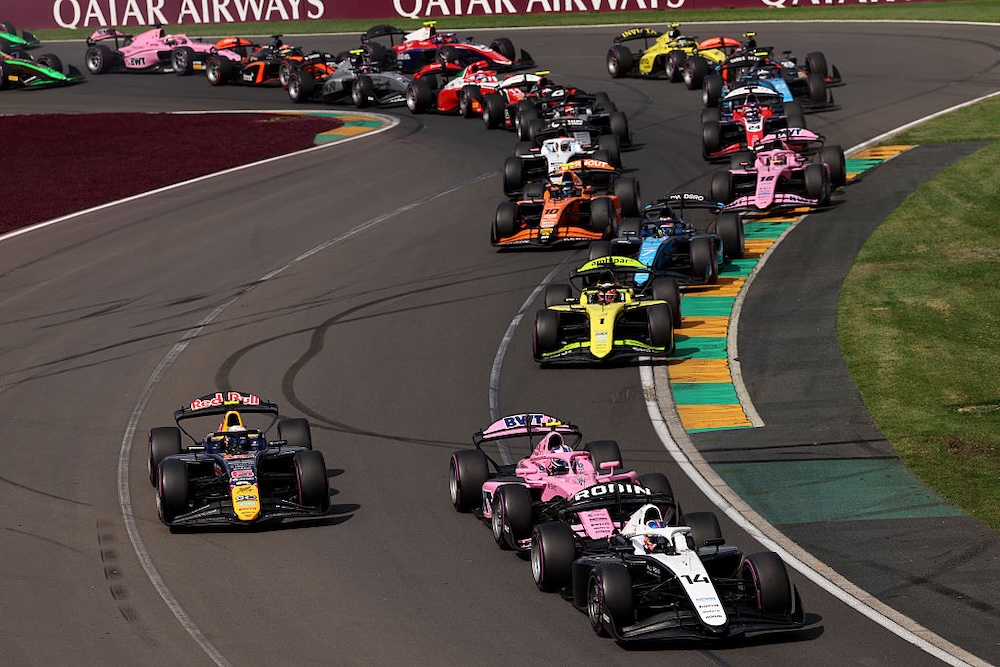
Dom Gibbons/Getty Images
How F2 finally found its way to North America
It’s quite remarkable, in many ways. Formula 2 has seen a number of American talents come through its ranks, and is part of the Liberty Media group that has overseen Formula 1’s huge focus on the United States and North America in recent years. And yet, even in its previous guise of GP2 that dates back to 2005, the feeder series has never held a race on U.S. or Canadian soil.
Until now.
Last week it was confirmed that the postponed races in Bahrain and Saudi Arabia will be replaced by spots on the support card of the upcoming grands prix in Miami and Montreal, and fans in North America will get a chance to watch the likes of Colton Herta race in F2 on a friendly timezone at the very least, if not in the flesh for themselves.
Organizing two multi-race rounds on a different continent with just a few week’s notice is no mean feat, though, and needed the collaboration of multiple stakeholders, as well as an already willing and able race promoter in Canada.
“Almost immediately when we were in Melbourne, we felt that there might have been an issue with the races in the Middle East because the whole war started a week before,” F2 CEO Bruno Michel tells RACER. “And even going to Melbourne was not an easy thing because there were quite a lot of logistics involved going through the Middle East, which made things a bit complicated for the freight, the ticket, everything.
“Not only for us, for Formula 1 as well. It was quite complicated. But it went OK and we started to look at what were the other possibilities, if – because we were not in a situation at that time where we knew that the two races in the Middle East were not going to happen in April – but we started to look at it and had a few meetings when I was in Melbourne, mainly with Stefano [Domenicali] and people from Race Promotion in Formula 1 to see what was feasible.
“Obviously, going to China and Japan was not an option, it was too close and it was difficult, but we really thought that we had to find an alternative in case Bahrain and Jeddah could not happen at that time in the calendar.
“We already had some discussions in the past [with Canada], to be honest. That’s the way it happened with Montreal, who said, ‘We would like to have you guys at some point’. And it was quite an ironic thing because I told them at that time, ‘2026, the calendar is already done, so we're not going to be able to come, but we can see for the future if it comes one day’.
“So I called them and had a meeting with them and I said, maybe there's a possibility. And they said, ‘Yeah, we're interested for sure’.”
Even before any of the logistics of the races were explored, however, Michel had to ensure such a trip made financial sense for the teams, which are largely funded by their drivers and partners.
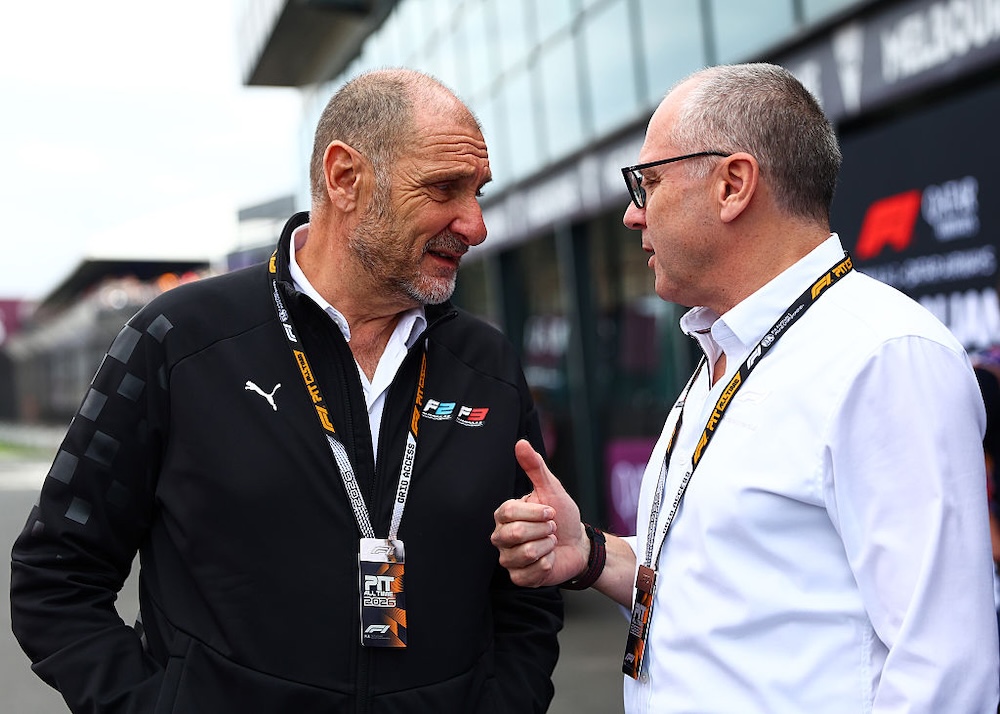
Bruno (above left) said it took cooperation across the entire sport to make the F2 events in Montreal and Miami a reality, including F1 CEO Stefano Domenicali (above right). Joe Portlock/Getty Images
Previously, Miami and Montreal were not paired together, and multiple European rounds – most recently Imola, Monaco and Barcelona - made individual trips across the Atlantic too cost-prohibitive for the series.
“What I thought at that time was, number one, I had to find two races if possible, and not only one. And number two, for logistical reasons and cost reasons, flying to North America made more sense if I had two races than if I had only one. So that's how we started to discuss with Miami as well.
“It was quite [a while], I would say, before we knew for sure that the other two races in the Middle East were not going to happen. And the answer was positive on Miami’s side as well.
“When I say it was positive, then we go into details of how complicated it's been to put together! But it was a good way to start discussions, let's put it that way.
“So we started that quite early. And knowing that, I passed the message at that time to the teams in Melbourne. We had a team principal meeting in Melbourne, and I explained to the teams that I was going to do everything I could to replace those two races.”
Aside from the fact that losing two events from a 14-round F2 calendar would have had a greater impact on the championship itself compared to F1’s reduction from 24 races to 22, Michel was also keen to avoid teams being faced with complicated legal situations with their drivers had there been fewer rounds.
Freight had been due to go straight from Melbourne to Bahrain, but was instead re-routed to Frankfurt in order to get it back to Europe for any potential next steps. Teams then sent their trucks to Germany to collect it.
Confidence within F2 was high that a Montreal round could happen, but it needed Miami to come together as well, and finding space to race on the venue centered around Hard Rock Stadium proved more complex for multiple reasons.
“For the two races, the situation was not exactly the same because Montreal, they had some space for us – there was already F1 Academy and they had a space for a support race. They also had room on the timetable to quite easily fit in another category. So with them, it was more a question of, how do we deal with the cost and other things like that? But it was not such a difficult situation in terms of logistics.
“Miami was completely different, because Miami had already signed two support races – Porsche is going to be there, and there's a McLaren trophy as well. They had no space, they were not waiting for us, and we, together with them, had to create a paddock out of nowhere, not in a place that was planned.
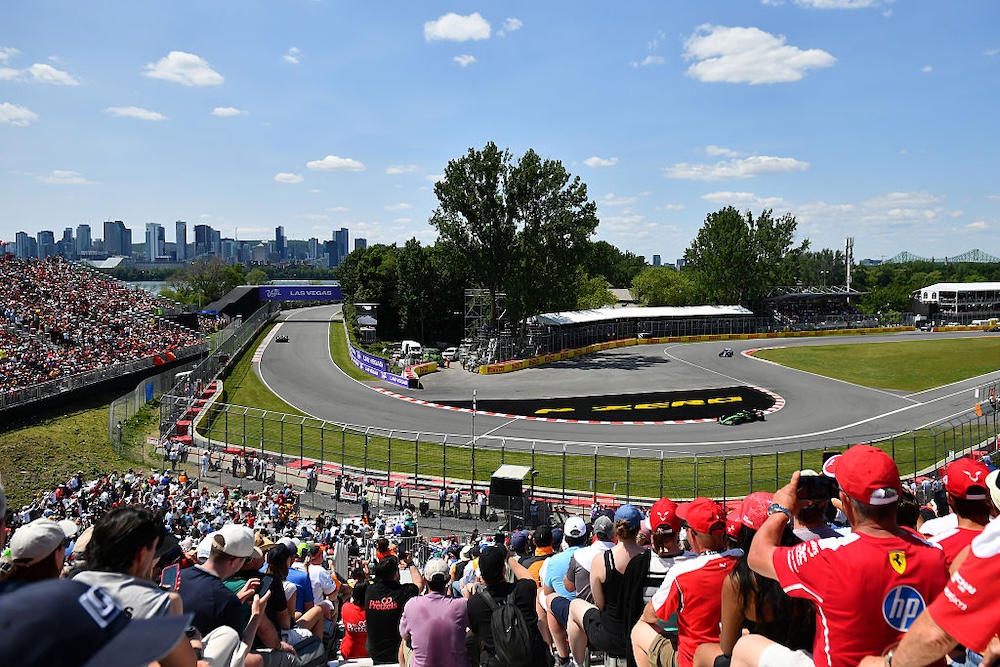
Montreal (above) was able to accommodate the late addition of F2 to its weekend schedule without too many problems. Miami was a bit more complicated... James Sutton/Getty Images
“I tell you, the logistics – because we're not there yet – are not going to be easy in Miami! But they've been extremely helpful. They found the solution quite rapidly.
“And after that, the question is always to try to minimize the cost. I'm not talking about the freight and stuff like that, but also the local cost, because creating a paddock out of nowhere… it’s not going to be very close to the F1 paddock. So that was really a quite complex thing to do.
“We had to put a lot of effort with them to make sure that it was feasible and to make sure that we could operate. Because it's not only having a paddock, it's also knowing what we need in terms of logistics, it's having access to the track for the cars, it's having access to the track for the teams – because they're coming with trolleys, with tires, with spare parts, with everything that they need during free practice, qualifying and races – and also fitting ourselves into the timetable where there were already two support races.
“So it was a very complex thing that took a lot of effort from my team, from the F1 team as well, and from the promoters. And I cannot be thankful enough for all these people that have been working on something that is extremely complicated for everybody.”
The level of complexity mean the clock was ticking, and while some of the details were still being worked out, Michel had to keep the teams informed of the likely outcome, even without final confirmation that the replacements would go ahead.
“We put something together that seemed to be good enough for me to be able to tell the teams, ‘OK, this is not official yet, because we still need to finalize a few things, but the way it is looking is that we will go to Miami and Montreal,'" he said.
“It took a little bit of time before we finalized everything, and then we could announce it last week. But it's been very complicated, I must say. It's been very complicated in terms of logistics; it's been very complicated in terms of communication; it's been very complicated in terms of agreement; and everybody played a great part.
“Starting with Stefano Domenicali, who's been incredibly helpful and incredibly supportive, because without him we could not have done that.
“The FIA as well, as you can imagine, when you do something like this, you have to involve the FIA very, very early in the system, because they were not planning to have technical delegates [for F2 at those races], they were not planning to have their platform there – there was all these things that they needed to work with as well.
“Plus, we needed to have the agreement of the World Motor Sport Council to change the calendar… You have no idea of the number of things that we have to deal with. The FIA president has been extremely helpful, too.
“So in the end, it all came together as a plan. Let's see how it goes when we get there!”
How it goes is usually judged on the on-track action and racing product on show, and that’s exactly how F2, Miami and Montreal hope it will be. But after such a significant undertaking just to put the races on, perhaps be the biggest success would be making it impossible to tell they were not part of this year's original calendar in the first place.
Chris Medland
While studying Sports Journalism at the University of Central Lancashire, Chris managed to talk his way into working at the British Grand Prix in 2008 and was retained for three years before joining ESPN F1 as Assistant Editor. After three further years at ESPN, a spell as F1 Editor at Crash Media Group was followed by the major task of launching F1i.com’s English-language website and running it as Editor. Present at every race since the start of 2014, he has continued building his freelance portfolio, working with international titles. As well as writing for RACER, his broadcast work includes television appearances on F1 TV and as a presenter and reporter on North America's live radio coverage on SiriusXM.
Read Chris Medland's articles
Latest News
Comments
Comments are disabled until you accept Social Networking Cookies. Update cookie preferences
If the dialog doesn't appear, ad-blockers are often the cause; try disabling yours or see our Social Features Support.